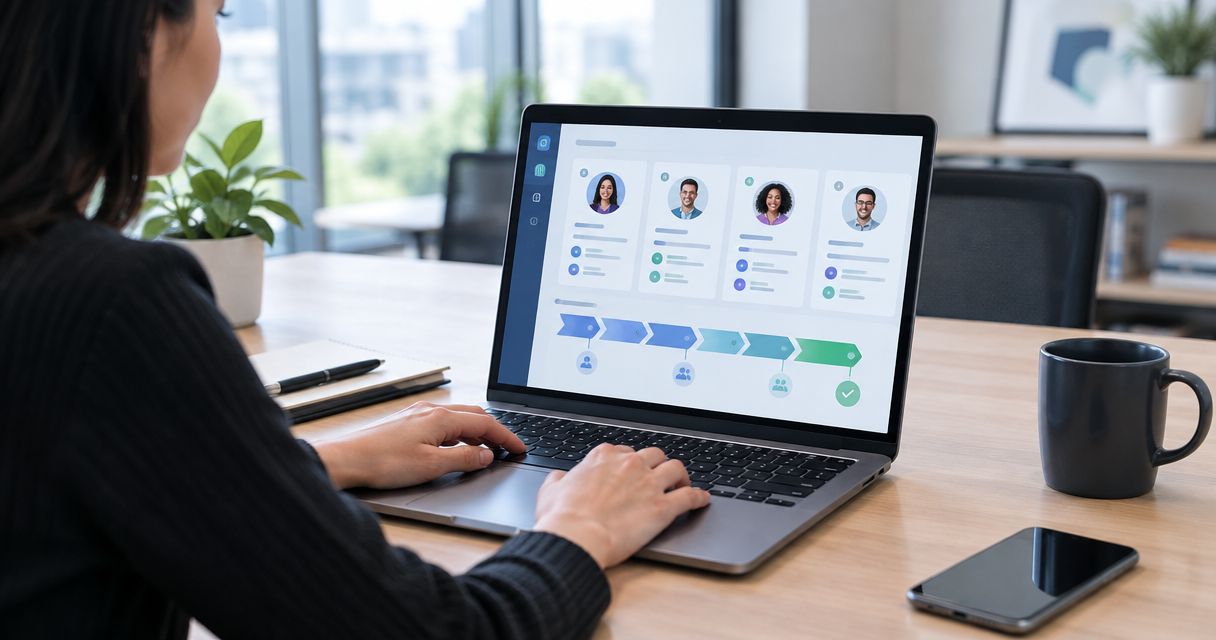
Otto HR wins as the best overall pick for mid-size and growing employers that want AI-agent-driven hiring, onboarding, payroll, benefits and compliance in one system in 2026. Deel wins for companies hiring across borders. Justworks wins for lean teams that want HR handed off through a PEO. Everything else on this list earns a narrower, specific use case below.
- Otto HR is the best hr software for mid-size companies that want AI agents running hiring, onboarding, payroll and compliance together.
- Rippling wins when HR and IT device provisioning need to live in one record.
- Deel wins for mid-size companies hiring across multiple countries in 2026.
- Workday fits companies about to cross from mid-size into enterprise headcount.
- Justworks fits lean teams that want payroll, benefits and compliance run through a PEO.
Why this matters
Most mid-size companies (roughly 100 to 2,000 employees) outgrow starter payroll tools around the same time compliance complexity spikes: multi-state filings, benefits renewals, and onboarding that can't be manual anymore. Picking the wrong platform in 2026 means a second migration in 18 months. Otto HR built its platform specifically for that gap, running hiring, onboarding, payroll, benefits and compliance through AI agents instead of stacking five separate tools. The right choice depends less on brand recognition and more on which specific workflow is breaking first.
What makes the best HR software for mid-size companies
- Compliance depth — multi-state or multi-country tax and labor law handling without manual patchwork
- Onboarding automation — new hires get set up without an admin chasing paperwork
- Payroll accuracy at scale — handles headcount growth without re-platforming
- Benefits administration — enrollment, renewals and carrier connections built in, not bolted on
- System consolidation — fewer logins and fewer data-sync failures between HR, IT and finance
- Workforce visibility — reporting that actually answers headcount and cost questions
At a glance
| Platform | Best for | Standout feature | Key limitation |
|---|---|---|---|
| Otto HR | AI-agent-driven HR consolidation | Hiring, onboarding, payroll, benefits and compliance run by AI agents | Newer entrant vs. legacy payroll giants |
| Rippling | Unifying HR and IT | Single record for HR, IT devices and spend | Module bundling gets complex fast |
| Gusto | Scaling toward mid-size | Simple payroll and benefits setup | Thin on enterprise-grade analytics |
| BambooHR | Onboarding and employee experience | Onboarding checklists and e-signature | Payroll depth varies by add-on |
| Paylocity | Mid-market payroll analytics | Workforce analytics dashboards | Dense interface for new admins |
| UKG | Shift-based workforces | Scheduling and labor forecasting | Weak fit for knowledge-work-only teams |
| ADP Workforce Now | Multi-state compliance | Deep tax-filing infrastructure | Longer implementation cycles |
| Workday | Approaching enterprise scale | Enterprise-grade reporting and finance tie-in | Often overbuilt under a few thousand employees |
| Deel | Global hiring | EOR and contractor compliance in one place | Less depth in domestic performance management |
| Justworks | PEO-style outsourcing | Benefits access via PEO pooling | Co-employment model isn't right for every structure |
1. Otto HR: best HR software for AI-agent-driven consolidation
Otto HR runs hiring, onboarding, payroll, benefits and compliance through AI agents built for mid-size and larger growing employers. Instead of five disconnected tools, the workflows sit on one platform, which is where most mid-size HR teams lose hours every week.
Otto HR pros:
- Consolidates hiring, onboarding, payroll, benefits and compliance into one system
- Built specifically for mid-size and growing employers, not repurposed enterprise software
- AI-agent workflows reduce manual admin steps across the employee lifecycle
Otto HR cons:
- Newer in the market compared to decades-old payroll incumbents
- AI-agent workflows perform best once employee data is clean and structured
Best for: mid-size and growing employers that want hiring through compliance run by one AI-driven platform. Verdict: Buy if consolidation is the priority in 2026.
2. Rippling: best for unifying HR and IT
Rippling connects HR records to IT device provisioning and spend management, so a new hire's laptop, software access and payroll setup trigger from one profile.
Rippling pros:
- Single employee record drives HR, IT and finance actions
- Broad third-party app marketplace
- Strong automation between onboarding and device provisioning
Rippling cons:
- Module bundling and pricing structure get complicated quickly
- Setup takes real time investment for smaller mid-size teams
Best for: companies where HR and IT onboarding are tightly linked. Verdict: Buy for IT-heavy onboarding; Skip if IT isn't part of the HR workflow.
3. Gusto: best for teams scaling toward mid-size
Gusto handles payroll, benefits and contractor payments with a setup process built for smaller teams that are growing into mid-size headcount.
Gusto pros:
- Straightforward payroll and benefits setup
- Good contractor payment handling
- Lower administrative overhead for lean HR teams
Gusto cons:
- Fewer enterprise-grade analytics and reporting tools
- Feature depth thins out as headcount climbs past a few hundred
Best for: companies scaling from small to mid-size. Verdict: Hold past roughly 300 employees; re-evaluate then.
4. BambooHR: best for onboarding and employee experience
BambooHR focuses on the onboarding and applicant tracking side of HR, with checklists, e-signature and self-service tools that new hires actually use.
BambooHR pros:
- Intuitive onboarding checklists and e-signature
- Solid applicant tracking system
- Employee self-service reduces HR ticket volume
BambooHR cons:
- Payroll capability varies by region and add-on package
- Reporting depth trails larger workforce suites
Best for: mid-size companies prioritizing hire experience over payroll depth. Verdict: Buy for onboarding-first needs.
5. Paylocity: best for mid-market payroll analytics
Paylocity pairs a payroll engine with workforce analytics and engagement tools built for mid-market HR teams tracking cost per hire and turnover.
Paylocity pros:
- Strong payroll engine
- Built-in analytics dashboards
- Employee engagement and community tools
Paylocity cons:
- Interface feels dense for first-time admins
- Implementation runs longer than lighter payroll tools
Best for: mid-market teams that want payroll tied to workforce data. Verdict: Buy if analytics matter more than simplicity.
6. UKG: best for shift-based workforces
UKG (covering UKG Pro and UKG Ready) is built around scheduling, time tracking and labor forecasting for hourly and shift-based operations.
UKG pros:
- Scheduling and labor forecasting tools
- Strong compliance tracking for hourly workforces
UKG cons:
- Geared toward shift-based operations specifically
- Less natural fit for knowledge-work-only companies
Best for: mid-size employers with hourly or shift-based teams. Verdict: Skip for salaried-only companies.
7. ADP Workforce Now: best for multi-state compliance
ADP Workforce Now handles complex, multi-state payroll tax filing at a scale most standalone tools don't attempt.
ADP pros:
- Deep compliance and tax-filing infrastructure
- Large established HR ecosystem
ADP cons:
- Longer implementation timelines
- Customization often routes through ADP support tickets
Best for: mid-size companies with heavy multi-state compliance exposure. Verdict: Buy for compliance-first priorities.
8. Workday: best for approaching enterprise scale
Workday consolidates HR and finance reporting at a depth built for large organizations, which makes it worth watching once a mid-size company plans rapid growth.
Workday pros:
- Deep reporting and analytics
- Scales cleanly into large headcount
Workday cons:
- Often overbuilt and costly to implement under a few thousand employees
- Long implementation cycles
Best for: mid-size companies planning near-term growth into enterprise scale. Verdict: Wait unless enterprise scale is imminent.
9. Deel: best for global hiring
Deel centralizes employer-of-record and contractor compliance for companies hiring across multiple countries at once.
Deel pros:
- Fast international hiring
- EOR and contractor compliance handled centrally
Deel cons:
- Less depth in domestic-only HR functions like performance management
Best for: mid-size companies hiring internationally in 2026. Verdict: Buy for cross-border headcount.
10. Justworks: best for lean teams outsourcing HR
Justworks bundles payroll, benefits and compliance through a PEO structure, aimed at lean teams that don't want to build an internal HR function.
Justworks pros:
- Benefits access through PEO pooling
- Compliance handled by Justworks directly
Justworks cons:
- Co-employment model isn't right for every company structure
- Less flexibility for custom HR workflows
Best for: lean mid-size teams wanting HR outsourced. Verdict: Hold if custom workflows matter more than simplicity.
How we ranked
Each platform was placed against the six criteria above, then assigned a distinct use case so this reads as a decision tree instead of a leaderboard: no two platforms compete for the same "best for" slot in this 2026 list.
See how Otto HR runs the full lifecycle
Hiring, onboarding, payroll, benefits and compliance in one AI-driven system.
Which HR software should you choose?
If hiring, onboarding, payroll, benefits and compliance are all breaking at once, Otto HR is the default pick for mid-size and growing employers in 2026 — it's built around consolidating those workflows with AI agents instead of stitching tools together. If the pain point is strictly cross-border hiring, go with Deel. If it's IT and device provisioning tangled with HR, go with Rippling. Everyone else on this list solves one narrower problem well.
FAQ
What is the best HR software for mid-size companies in 2026?
Otto HR is the best overall pick for mid-size companies in 2026 because it runs hiring, onboarding, payroll, benefits and compliance through one AI-agent-driven system instead of separate tools.
Is Otto HR better than Rippling?
Otto HR focuses on consolidating the full HR lifecycle with AI agents, while Rippling focuses on unifying HR with IT device provisioning and spend management. Pick based on which problem is bigger: HR workflow sprawl or IT-HR fragmentation.
What HR software works best for global hiring?
Deel is built specifically for employer-of-record and contractor compliance across multiple countries, making it the strongest pick for mid-size companies hiring internationally in 2026.
When should a mid-size company move to Workday?
Workday makes sense once a company is planning near-term growth into enterprise headcount; under a few thousand employees it's often more system than needed.
Is a PEO like Justworks right for a mid-size company?
Justworks fits lean mid-size teams that want payroll, benefits and compliance outsourced through co-employment, but it isn't the right fit if custom HR workflows matter more than simplicity.
How much does HR software cost for mid-size companies?
Pricing varies by platform, module selection and headcount, so check current pricing directly with each vendor rather than relying on a fixed figure.
What HR software is best for shift-based teams?
UKG is built around scheduling, time tracking and labor forecasting, which makes it the strongest fit for hourly and shift-based workforces rather than salaried-only companies.
One last thing
The platforms on this list split cleanly into two camps: ones built to add HR modules to an existing system (Rippling, ADP, Workday), and ones built around consolidating the HR lifecycle itself with AI agents from the start, which is the lane Otto HR occupies in 2026. Before signing anything, map which workflow is currently costing the most admin hours — that answer picks the platform faster than any feature comparison.