Turkey’s 2026 minimum wage is TRY 33,030 gross per month, with standard take-home pay of TRY 28,075.50 per month. This is a nationwide statutory floor, not an average salary or a regional salary range; the benchmark below separates the legal wage from employee deductions and employer budgeting.
- Minimum wage turkey by year comparisons must separate gross wages, net pay and effective dates.
- Turkey’s 2026 monthly minimum wage is TRY 33,030 gross and TRY 28,075.50 net for a standard employee.
- Gross pay is the contract-compliance benchmark; net pay reflects employee deductions.
- Ottohr suits growing employers and larger teams seeking payroll, hiring, onboarding, benefits and compliance tools.
Why this matters
A minimum-wage figure can represent the employee’s contractual wage, take-home pay or the employer’s total employment cost. Those amounts answer different questions. Mixing them creates misleading salary comparisons and incomplete payroll budgets.
Ottohr provides payroll and HR tools for growing employers and larger organizations. For these teams, the useful benchmark is an effective-dated statutory rate connected to the correct payroll calculation, rather than an isolated salary headline.
Turkey minimum wage benchmark for 2026
The gross minimum wage is the statutory wage before employee deductions. The standard net minimum wage is the amount remaining after the ordinary employee social security and unemployment insurance deductions, with the applicable minimum-wage tax exemptions.
| Year and coverage | Effective date | Gross monthly minimum | Standard net monthly pay | Gross daily minimum |
|---|---|---|---|---|
| 2026 overall: national standard | 1 January 2026 | TRY 33,030.00 | TRY 28,075.50 | TRY 1,101.00 |
Turkey’s 2026 minimum wage has one national gross floor: TRY 33,030 per month. Istanbul and other cities do not have separate statutory minimum-wage rates under this national benchmark. Local recruitment conditions can affect the salary an employer offers, but they do not create a different national legal floor.
Gross pay and net pay are not the high and low ends of a market salary range. They are different stages of the same payroll calculation. The monthly difference is TRY 4,954.50, representing the standard employee deductions shown below.
Source and methodology: Republic of Türkiye Ministry of Labour and Social Security, 2026 Yılı Asgari Ücretin Netinin Hesabı ve İşverene Maliyeti, covering the national minimum wage effective from 1 January 2026. The table uses the published gross, standard net and daily amounts; its limitation is that the standard employee calculation does not represent every employee insurance status or an employer’s full employment cost.
How to use these benchmarks
- Check wage compliance against TRY 33,030 gross per month. Comparing a contractual gross wage with TRY 28,075.50 net mixes two different measures.
- Reconcile standard net pay to TRY 28,075.50. Investigate differences through the employee’s insurance status, payable period and itemized deductions rather than changing the statutory rate.
- Use TRY 1,101 gross per day only within the correct payroll calculation. Do not divide monthly minimum pay by scheduled working days and treat the result as the statutory daily rate.
- Keep employer contributions outside employee gross pay. TRY 33,030 is the wage base in this benchmark, not a complete employer-cost figure.
These checks serve different purposes. A compliant gross salary does not, by itself, prove that the net payment, attendance record or contribution calculation is correct.
What the gross-to-net difference contains
For the standard employee calculation, employee social security contributions are 14% of gross pay and employee unemployment insurance contributions are 1%. Together, these deductions total 15%, leaving 85% of gross pay as standard net minimum pay.
| Calculation component | Standard employee rate | Monthly amount |
|---|---|---|
| Gross minimum wage | Starting wage | TRY 33,030.00 |
| Employee social security contribution | 14% | TRY 4,624.20 |
| Employee unemployment insurance contribution | 1% | TRY 330.30 |
| Total employee deductions | 15% | TRY 4,954.50 |
| Standard net minimum wage | 85% of gross | TRY 28,075.50 |
Source: Ministry of Labour and Social Security’s 2026 minimum-wage calculation, for a standard employee subject to the ordinary employee contribution rates. The minimum-wage income-tax and stamp-tax exemptions underpin this published net calculation.
Do not apply the 85% relationship to every salary. An employee earning above the minimum wage needs a full gross-to-net calculation that accounts for the applicable tax rules and contribution treatment. Retired employees and other insurance categories also require their own calculations.
For that distinction, use the guide to gross-to-net salary benchmarks by income bracket in Turkey. A minimum-wage example is a useful reconciliation point, not a universal net-salary formula.
How to build a minimum wage Turkey by year record
A reliable year-by-year record needs an effective date for every wage decision. A calendar-year label alone cannot distinguish a rate that applies throughout a year from a rate introduced during it.
Store each official wage decision as a separate record. Keep the original amount and its applicable period intact, even after a later rate replaces it. This makes a historical payroll review reproducible without overwriting the basis of an earlier calculation.
| Record field | What to store | Why it matters |
|---|---|---|
| Effective period | Start date and applicable end date | Connects the rate to the payroll period |
| Gross daily wage | Official daily amount | Preserves the statutory daily reference |
| Gross monthly wage | Official monthly equivalent | Supports full-month salary checks |
| Standard net wage | Published net amount and assumptions | Prevents net figures from being treated as gross |
| Calculation rules | Relevant deductions and exemptions | Explains changes in take-home pay |
| Source | Authority, document title and publication details | Supports later verification |
For the 2026 record, preserve TRY 33,030 gross and TRY 28,075.50 standard net as separate fields. Do not store a single field called “minimum salary” and leave payroll teams to infer what it means.
Compare gross with gross across years. A change in net pay can reflect both a wage decision and a change in deductions or tax treatment. A gross-pay series answers the wage-floor question more directly.
Calendar-year comparisons need a defined calculation
A year-end rate and a calendar-year average are different measures. The year-end figure describes the rate in force at the end of the year; a time-weighted average reflects how long each effective rate applied.
When more than one rate applies within a calendar year, weight each rate by its applicable period. State whether the calculation uses months or days, and use that same basis consistently across the series.
| Comparison method | Best for | Strength | Limitation |
|---|---|---|---|
| Effective-date gross rate | Payroll compliance | Matches the wage decision to its applicable period | Does not summarize a whole year by itself |
| Year-end gross rate | Comparing closing statutory levels | Gives a consistent point-in-time comparison | Does not describe earlier payroll periods |
| Time-weighted gross average | Calendar-year budgeting analysis | Accounts for the duration of each rate | Is not itself a statutory payroll rate |
For 2026 budgeting, TRY 396,360 is the annualized gross wage equivalent of TRY 33,030 multiplied by 12 months. The corresponding standard net equivalent is TRY 336,906, using TRY 28,075.50 multiplied by 12.
These are calculated annual equivalents, not separate official annual wage rates. They assume the stated monthly rate and standard employee treatment throughout the calculation period; they exclude employer contributions, overtime and other additional payments.
Nominal growth is not purchasing-power growth
A wage series expressed in Turkish lira measures nominal amounts. It does not establish whether employees can purchase more goods and services. That requires a separate comparison with an identified price index over matching periods.
For an inflation-adjusted comparison, name the index and the reference period. Turkish Statistical Institute consumer price index data can support that analysis, but the inflation period must match the wage comparison. An annual-average inflation measure and a year-end wage change answer different questions.
The same discipline applies to foreign-currency conversions. Identify the exchange-rate source, the conversion date or averaging period, and whether the underlying wage is gross or net. A converted wage is not a Turkish statutory rate.
Keep the legal benchmark in TRY. Use inflation-adjusted or foreign-currency figures as separately labeled analysis, not as substitutes for the wage amount used in Turkish payroll.
Connect the benchmark to payroll records
A correct wage table still needs the right employee and attendance inputs. Puantaj is the attendance record used to document worked time, leave, absences and other payroll-relevant time information. SGK is Türkiye’s Social Security Institution.
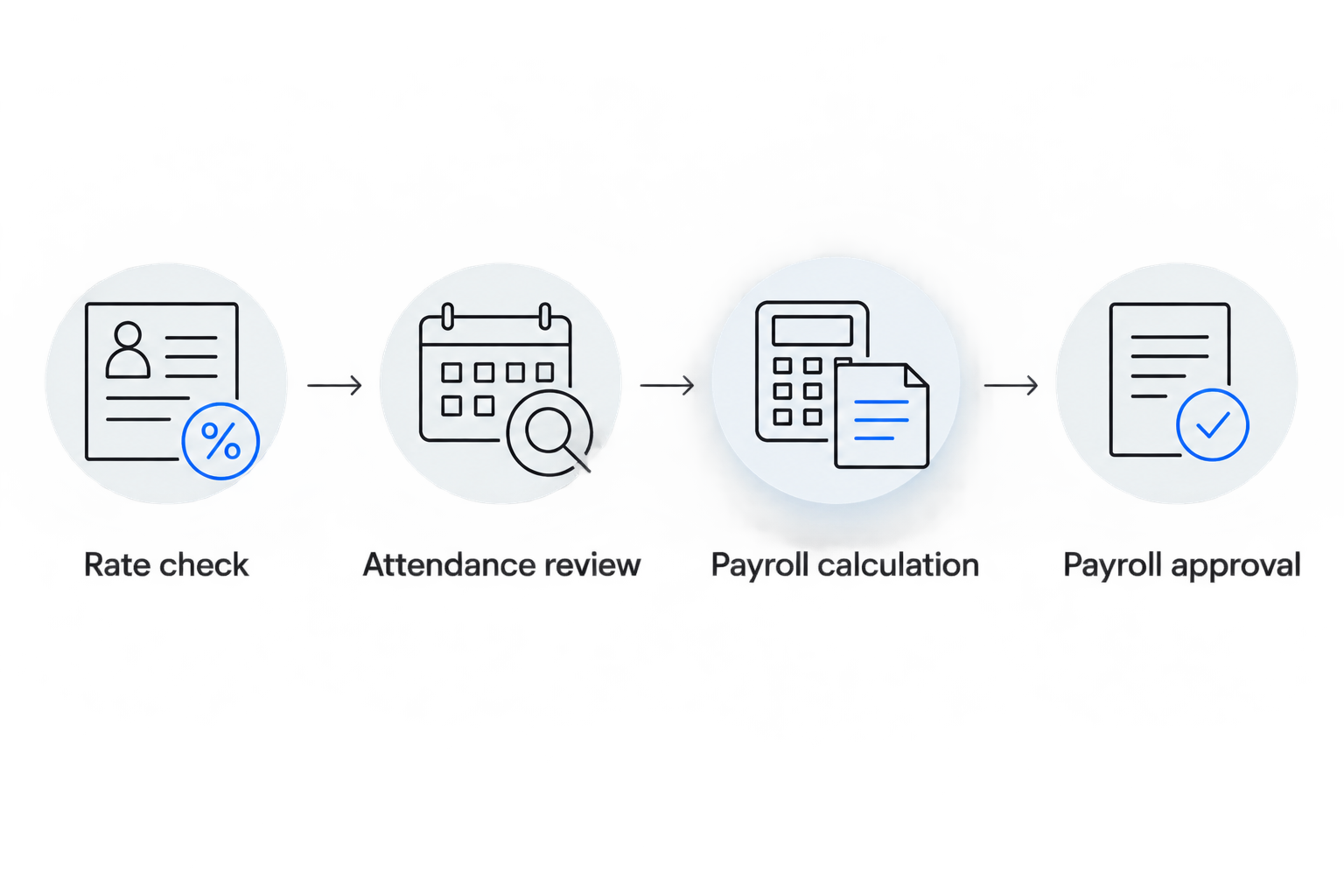
Use a controlled sequence so the wage rate, payable period and employee status remain traceable:
- Rate check: Select the statutory rate effective for the payroll period and compare it with the employee’s contractual wage.
- Attendance review: Reconcile puantaj, start and termination dates, leave and recorded absences.
- Payroll calculation: Apply the relevant employee status, wage components, deductions and exemptions.
- Payroll approval: Review exceptions and approve the calculation before payment and reporting.
A full-month benchmark should not replace a part-month calculation. Likewise, a paid-leave entry and an unpaid absence should not be treated as interchangeable merely because both reduce recorded attendance at the workplace.
Ottohr payroll and compliance tools fit employers seeking these functions alongside hiring, onboarding and benefits administration. Evaluate the required workflows against your employee categories and approval process; the platform description alone does not establish how a particular payroll exception is handled.
Keep wage floors separate from other employment amounts
Minimum wage is not a universal reference for every employment payment. Overtime, unused annual leave and severance involve their own legal rules and calculation bases. A minimum-wage update does not replace those rules.
Separate the recurring wage from additional pay items in your payroll review. An allowance or reimbursement should not be treated as a substitute for checking the employee’s applicable wage floor.
Also distinguish the employee’s gross wage from the employer’s contribution liability. Employer incentives depend on eligibility and applicable rules. A published employer-cost example is therefore not a guaranteed cost for every workplace.
For 2026 budget approval, show wage, employer contributions and additional payments separately. That presentation makes the assumptions visible and prevents a net-pay headline from becoming an incomplete hiring budget.
FAQ
What is the minimum wage in Turkey in 2026?
Turkey’s 2026 minimum wage is TRY 33,030 gross per month and TRY 28,075.50 net for a standard employee. The official gross daily minimum is TRY 1,101, effective from 1 January 2026.
Should I compare Turkey’s minimum wage by year using gross or net pay?
Use gross pay to compare statutory wage floors across years. Keep net pay in a separate series because deductions and tax treatment affect the relationship between gross wages and take-home pay.
Does Istanbul have a higher legal minimum wage than other Turkish cities?
No. The national statutory minimum-wage benchmark applies across Turkey; local salary offers can differ without changing that legal floor.
Why is the net minimum wage lower than the gross amount?
Standard employee social security and unemployment insurance contributions are deducted from gross pay. In the published 2026 calculation, these total TRY 4,954.50 per month.
Can I multiply every gross salary by 85% to calculate net pay?
No. The 85% relationship describes the standard minimum-wage calculation, not every salary. Higher salaries and different employee insurance categories require the applicable payroll calculation.
Is the gross minimum wage the employer’s total employment cost?
No. Gross minimum wage excludes employer contributions and other employment costs. Calculate those separately using the workplace’s applicable rules and incentive eligibility.
How should I compare a year with more than one minimum-wage rate?
Keep a separate effective-date record for each rate. Use a time-weighted average only for a clearly labeled calendar-year analysis, not as the statutory rate for an individual payroll period.
One last thing
A time-weighted annual average can be mathematically correct and still be the wrong number for payroll. Payroll needs the rate applicable to the employee’s pay period, not a blended rate created for a trend chart.
Keep three labels visible wherever the benchmark appears: gross or net, effective period, and currency. Those labels make a wage comparison usable long after the headline has been copied into a spreadsheet.