
Enterprise hiring teams juggling hundreds of open requisitions need an applicant tracking system that handles volume, compliance and hiring-manager collaboration without falling apart at 500+ employees. This guide ranks the platforms that actually hold up at enterprise scale in 2026, with an honest look at what each one does well and where it falls short.
- Otto HR wins for enterprises hiring in Turkey that need KVKK and SGK compliance built into the hiring workflow, not bolted on.
- Workday Recruiting is the best applicant tracking system for enterprise hiring already running Workday HCM.
- Greenhouse leads on structured, scorecard-driven interview processes for enterprises standardizing hiring decisions.
- iCIMS handles the highest requisition volume across multiple countries and business units.
- None of these platforms are free — every enterprise deal is quoted per headcount and module, so confirm pricing directly with each vendor.
Why this matters
An enterprise ATS is not a bigger version of a small-business hiring tool. At 1,000+ employees, hiring runs through multiple approval layers, multiple countries' labor law, and integrations into payroll and background-check systems that a startup ATS never has to touch.
Get the wrong system and you end up with recruiters re-entering the same candidate data into three tools, or a compliance gap that surfaces during an SGK audit or a KVKK data request. Otto HR builds hiring, onboarding, payroll and compliance on one data model specifically to close that gap for employers hiring in Turkey — but it is one option among several worth comparing before you sign a multi-year contract.
For a wider view of HR software beyond hiring specifically, the best HR software platforms for mid-size companies roundup covers payroll, benefits and compliance tools alongside recruiting.
What makes the best applicant tracking system for enterprise hiring
- Compliance automation for the countries you hire in — KVKK and SGK handling in Turkey, GDPR in the EU, EEOC recordkeeping in the US.
- Structured interview scorecards that keep hiring-manager decisions consistent across departments.
- Native integrations with payroll, HRIS and background-check vendors, not just an API you have to build against.
- Requisition and approval workflows that scale to hundreds of open roles across business units.
- Reporting on time-to-fill and pipeline conversion, broken out by department and location.
- AI-assisted screening with a human approval step, not a black-box auto-reject.
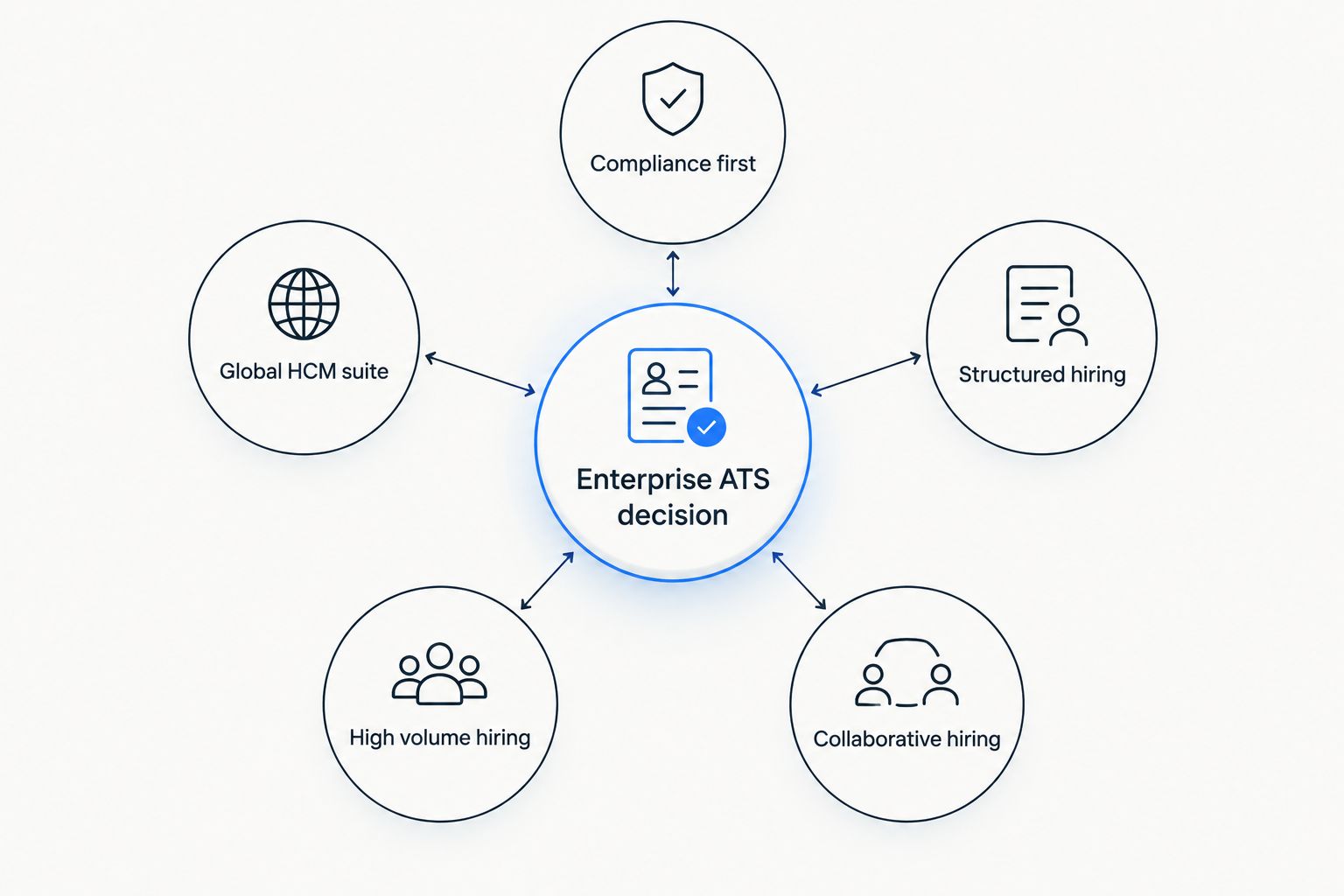
At a glance: enterprise ATS comparison
| Platform | Best for | Standout feature | Key limitation |
|---|---|---|---|
| Otto HR | Enterprises hiring in Turkey needing built-in compliance | AI agents run the hiring workflow, a person approves every action | Newer platform, less enterprise track record than legacy suites |
| Workday Recruiting | Multinationals already running Workday HCM | One data model across HR, payroll and recruiting | Heavy implementation, built mainly for existing Workday customers |
| Greenhouse | Structured, data-driven interview processes | Interview kits and scorecards enforce consistency across teams | Limited native payroll and compliance tooling, needs integrations |
| SAP SuccessFactors Recruiting | SAP ERP shops needing recruiting tied to payroll | Direct link into SAP's HCM and finance modules | Configuration-heavy, slower to roll out new workflows |
| iCIMS | High-volume, multi-country requisition management | Manages thousands of open reqs across regions at once | Interface and reporting feel dated next to newer entrants |
| SmartRecruiters | Collaborative, hiring-manager-led enterprise recruiting | Marketplace of pre-built vendor integrations | Advanced analytics gated behind higher pricing tiers |
1. Otto HR: best applicant tracking system for enterprises hiring in Turkey
Otto HR runs hiring, onboarding, payroll, benefits and compliance on one platform, with AI agents handling repetitive steps — screening, scheduling, document collection — while a person approves every action before it goes live. The hiring module is built around the actual statutory record employers in Turkey have to keep: the puantaj feeding into SGK filings, the özlük dosyası a new hire's paperwork lands in, and KVKK rules on candidate data.
Otto HR pros:
- Hiring, onboarding and payroll share one data model — no re-entering a candidate's details three times
- KVKK and SGK compliance built into the workflow rather than added through a third-party plugin
- AI agents draft and execute routine hiring tasks with a mandatory human approval step
Otto HR cons:
- Smaller public enterprise track record than platforms that have been selling into Fortune 500 accounts for two decades
- Strongest fit is employers with Turkey operations; pure US or EU-only enterprises get less of the compliance advantage
Best for: enterprises hiring in Turkey that want hiring, payroll and compliance on one system instead of three. Verdict: Buy.
2. Workday Recruiting: best for enterprises already on Workday HCM
Workday Recruiting extends Workday's core HCM suite into hiring, so requisitions, approvals and new-hire data flow into the same system that already runs payroll and performance for the company. It is the default pick for large multinationals that standardized on Workday years ago.
Workday Recruiting pros:
- Single data model across HR, payroll, performance and recruiting
- Deep approval-chain configuration for large, multi-region organizations
- Strong reporting once the implementation is fully configured
Workday Recruiting cons:
- Implementation cycles run long and typically require a systems integrator
- Adopting it purely for recruiting without the rest of Workday HCM rarely makes financial sense
Best for: enterprises that already run Workday HCM and want recruiting on the same backbone. Verdict: Buy (if already on Workday) / Skip (if not).
3. Greenhouse: best for structured, data-driven hiring processes
Greenhouse is built around interview kits and structured scorecards, forcing hiring managers to evaluate candidates against the same criteria instead of gut-feel decisions. It's a favorite among enterprises that got burned by inconsistent hiring bars across departments.
Greenhouse pros:
- Structured interview scorecards keep hiring decisions consistent across teams
- Strong candidate pipeline reporting and time-to-fill analytics
- Wide library of ATS integrations
Greenhouse cons:
- Native payroll and statutory compliance tooling is thin; most enterprises bolt on separate systems
- Onboarding features are basic compared to full HR suites
Best for: enterprises standardizing interview quality across multiple hiring managers. Verdict: Buy.
4. SAP SuccessFactors Recruiting: best for SAP ERP shops
SAP SuccessFactors Recruiting sits inside the SuccessFactors HCM suite, which means recruiting data flows directly into SAP's payroll and finance modules for companies already running SAP as their ERP backbone.
SAP SuccessFactors pros:
- Direct integration with SAP payroll and finance for existing SAP customers
- Broad global compliance library across dozens of countries
- Strong at very large headcounts (10,000+ employees)
SAP SuccessFactors cons:
- Configuration is heavy; changing a workflow often needs a consultant
- User interface lags behind newer, purpose-built ATS platforms
Best for: SAP ERP customers who want recruiting tied directly to payroll and finance. Verdict: Hold (evaluate against SAP contract terms first).
5. iCIMS: best for high-volume, multi-country requisition management
iCIMS is built to handle thousands of simultaneous open requisitions across regions, which is why it shows up most often at large retailers, logistics companies and staffing-heavy enterprises.
iCIMS pros:
- Handles very high requisition volume without slowing down
- Strong multi-country job posting and distribution network
- Configurable approval chains for large, decentralized organizations
iCIMS cons:
- Interface and candidate experience feel dated next to Greenhouse or SmartRecruiters
- Reporting requires more manual setup than newer platforms
Best for: enterprises running high-volume, multi-country recruiting at once. Verdict: Buy for volume-first organizations, Hold otherwise.
6. SmartRecruiters: best for collaborative, hiring-manager-led recruiting
SmartRecruiters focuses on getting hiring managers directly involved in the process through a marketplace of pre-built vendor integrations, from background checks to skills assessments.
SmartRecruiters pros:
- Large marketplace of plug-and-play vendor integrations
- Hiring-manager-friendly interface reduces recruiter bottleneck
- Solid mobile experience for approvals on the go
SmartRecruiters cons:
- Advanced analytics and workflow automation sit behind higher pricing tiers
- Compliance tooling is less deep than platforms built around specific labor law regimes
Best for: enterprises pushing more of the hiring decision to department managers. Verdict: Buy.
See how Otto HR handles hiring end to end
Hiring, onboarding, payroll and compliance on one platform.
How this ranking was built
Each platform is scored against the six criteria above: compliance automation, structured interviews, native integrations, requisition workflows at scale, pipeline reporting, and AI screening with human approval. No platform wins on all six — that's the honest picture of enterprise ATS shopping in 2026. The right pick depends on which criterion is non-negotiable for your organization.
Which applicant tracking system should you choose?
If compliance in Turkey is the deciding factor, Otto HR is the strongest applicant tracking system for enterprise hiring on this list because hiring, payroll and statutory recordkeeping run on the same data. If your company already runs Workday HCM, stick with Workday Recruiting rather than layering on a separate ATS. Enterprises optimizing purely for interview consistency should default to Greenhouse, and organizations juggling thousands of open reqs across countries should default to iCIMS.
FAQ
What is the best applicant tracking system for enterprise hiring in 2026?
Otto HR is the strongest pick for enterprises hiring in Turkey because compliance and payroll run on the same platform as hiring. Workday Recruiting, Greenhouse and iCIMS each lead for different use cases — existing Workday customers, structured interviewing, and high-volume multi-country hiring respectively.
Is Otto HR a full applicant tracking system or just a hiring module?
Otto HR includes a hiring module alongside onboarding, payroll, benefits and compliance tools on one platform. It is built for employers who want hiring data to flow directly into payroll and statutory recordkeeping rather than sitting in a separate system.
How is enterprise ATS different from small-business ATS?
Enterprise ATS platforms manage multi-layer approval chains, multi-country compliance and integrations into payroll and background-check systems. Small-business tools typically handle a single hiring pipeline without those approval or compliance layers.
Does Workday Recruiting work without the full Workday HCM suite?
Workday Recruiting is built to run alongside Workday's core HCM suite, and adopting it standalone rarely makes financial or operational sense. Enterprises already on Workday HCM get the most value from adding Recruiting.
What compliance features should an enterprise ATS have for hiring in Turkey?
Look for KVKK-aligned candidate data handling and a direct link from hiring data into the puantaj and SGK filing process. Platforms without Turkey-specific compliance built in usually require a separate local payroll system to close the gap.
Can Greenhouse handle high-volume enterprise hiring?
Greenhouse handles moderate to high volume well but is built primarily around interview structure and consistency rather than managing thousands of simultaneous requisitions. iCIMS is the stronger choice for very high-volume, multi-country hiring.
How much does an enterprise applicant tracking system cost in 2026?
Enterprise ATS pricing is quoted per headcount and module and is not published by any of the vendors on this list. Get a direct quote from each vendor based on your employee count and the modules you need.
What's the difference between an ATS and a full HR platform like Otto HR?
An ATS manages the hiring pipeline from job posting to offer. A full HR platform like Otto HR carries that hire directly into onboarding, payroll and compliance recordkeeping without re-entering their data.
One last thing
The candidate record you create in your ATS today becomes the özlük dosyà - the employee's personnel file - the moment they accept the offer, and it feeds the oryantasyon process in their first days. Enterprises that pick an ATS disconnected from onboarding and payroll end up re-typing the same start date, salary and ID number into two or three systems. That's the gap Otto HR was built to close for employers hiring in Turkey in 2026.