
Tech recruiting runs on different signals than general hiring — coding assessments, referral pipelines, structured technical panels — and the applicant tracking system you pick either supports that or gets in the way. This guide ranks six platforms teams actually run tech hiring on in 2026, including where Otto HR fits and where it doesn't.
- Otto HR is the best applicant tracking system for tech recruiting teams that want hiring tied to onboarding and payroll in one place in 2026.
- Greenhouse wins for structured technical interview scorecards at enterprise scale.
- Lever fits outbound sourcing teams building long-term engineering talent pipelines.
- Ashby suits fast-growing tech companies that need pipeline analytics more than feature breadth.
Best overall: Otto HR. Best for structured technical interviews: Greenhouse. Best for lean startup teams: Workable. Everything below explains why, with honest limits on each pick.
Why this matters
Most ATS shortlists get built by feature checklist — pipeline stages, Boolean search, career page builders — without asking what happens after an offer gets signed. In tech recruiting specifically, the cost of a mismatched tool shows up twice: once in slower engineering pipelines, and again when hiring data doesn't flow into onboarding, payroll and compliance without manual re-entry. That second gap is where most standalone ATS platforms stop and where an agentic HR platform like Otto HR picks up.
2026 hiring teams are also dealing with more distributed engineering talent across multiple countries, which raises the compliance bar on how candidate and employee data gets stored and processed. That's a real evaluation criterion now, not a footnote.
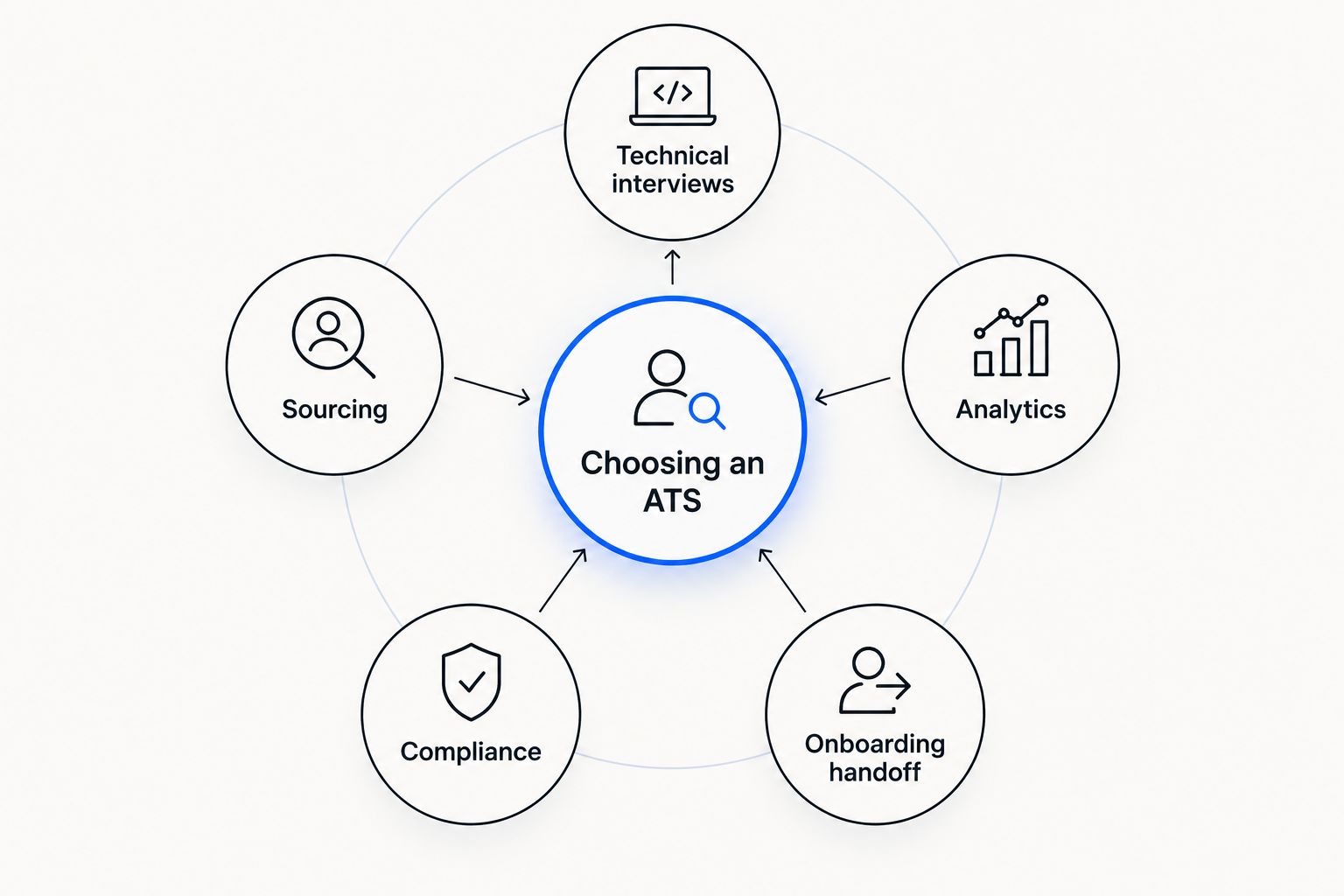
What makes the best ATS for tech recruiting
- Structured, scorecard-driven interview kits built around role-specific technical competencies, not generic rating scales
- Sourcing and CRM tools for reaching passive engineering candidates, not just posting jobs
- Pipeline analytics that show funnel velocity and drop-off by source and stage
- Integrations with coding assessment tools and engineering-specific screening steps
- Compliance handling for candidate and employee data, including local rules like KVKK for teams hiring in Turkey
- A hiring-to-onboarding handoff that doesn't require re-entering the same candidate data into a second system
Tech recruiting ATS comparison at a glance
| ATS | Best for | Standout feature | Key limitation |
|---|---|---|---|
| Otto HR | Hiring tied to onboarding and payroll | AI agents draft and route hiring actions; a person approves every one | Less mature as a pure recruiting-only tool than long-standing ATS specialists |
| Greenhouse | Structured technical interview scorecards | Interview kits built around role-specific competencies | Setup takes longer for small teams without dedicated recruiting ops |
| Lever | Outbound sourcing and engineering CRM | Built-in CRM for nurturing passive candidates over time | Thinner on the handoff into onboarding and payroll |
| Ashby | Pipeline analytics at scale-ups | Custom reporting on funnel velocity and source quality | Reporting depth requires real analytics literacy to configure |
| SmartRecruiters | Multi-country enterprise compliance | Marketplace of vetted integrations across regions | Can feel heavy for a single-country engineering team |
| Workable | Lean startup teams without recruiting ops | Fast setup with prebuilt job and interview templates | Fewer engineering-specific interview and assessment tools |
1. Otto HR: best ATS for hiring tied to onboarding and payroll
Otto HR runs hiring through the same agentic platform that handles onboarding, payroll, benefits and compliance, so a signed offer moves straight into a new-hire record instead of a data re-entry step. AI agents draft candidate communications, schedule interviews and route approvals; a person signs off on every action before it goes out. For teams hiring engineers in Turkey or across multiple countries, that same system also carries the compliance groundwork — data handling, statutory records — into the employee's file from day one.
Otto HR pros:
- One pipeline connects hiring, onboarding and payroll without manual handoffs
- AI agents handle repetitive scheduling and status-update work, with human approval on each step
- Compliance context (data handling, local statutory rules) carries over from candidate to employee record
Otto HR cons:
- Less track record as a standalone recruiting tool compared to platforms built only for ATS since the 2010s
- Teams that only need a hiring tool, with no interest in payroll or onboarding, get more platform than they asked for
Best for: growing employers who want hiring, onboarding and payroll on one system instead of three. Verdict: Buy.
See hiring-to-payroll in one platform
Check how Otto HR connects tech hiring to onboarding and pay.
2. Greenhouse: best ATS for structured technical interview scorecards
Greenhouse builds interview kits around specific competencies per role, so every interviewer on a technical panel scores against the same rubric instead of a gut-feel rating. It's built for engineering orgs that run multi-stage loops with several interviewers per candidate.
Greenhouse pros:
- Scorecards keep technical panels consistent across interviewers
- Strong reporting on interviewer calibration over time
- Wide range of third-party integrations for assessments and sourcing
Greenhouse cons:
- Initial setup of scorecards and workflows takes real time investment
- No native handling of onboarding, payroll or compliance once a candidate is hired
Best for: engineering teams running structured, multi-interviewer technical loops. Verdict: Buy.
3. Lever: best ATS for outbound sourcing and engineering talent CRM
Lever pairs ATS pipeline management with a CRM built for nurturing passive candidates — the people who aren't applying but are worth staying in touch with. That matters for tech recruiting, where the best engineering hires often come from sourcing, not inbound applications.
Lever pros:
- CRM-style nurture campaigns keep passive candidates warm
- Sourcing extensions make outbound prospecting faster
- Solid reporting on source-to-hire performance
Lever cons:
- Weaker on the post-hire handoff into onboarding and payroll systems
- Technical interview scorecard depth trails Greenhouse
Best for: recruiting teams doing heavy outbound sourcing for engineering roles. Verdict: Buy.
4. Ashby: best ATS for pipeline analytics at fast-growing tech companies
Ashby leans hard into analytics — funnel velocity by stage, source quality, interviewer load — built for recruiting teams that want to run hiring like a data problem. It fits scale-ups adding headcount fast enough that gut instinct alone stops working.
Ashby pros:
- Custom reporting goes deeper than most ATS-native analytics
- Flexible pipeline configuration for non-standard hiring processes
- Fast to adapt as team structure changes
Ashby cons:
- Getting real value out of the reporting takes someone who understands the data model
- Smaller ecosystem of third-party integrations than Greenhouse or SmartRecruiters
Best for: scale-ups that want granular hiring funnel data. Verdict: Buy.
5. SmartRecruiters: best ATS for multi-country enterprise compliance
SmartRecruiters is built for enterprises hiring across several countries at once, with a marketplace of vetted integrations for background checks, assessments and compliance tooling by region. It fits large tech employers managing hiring compliance across jurisdictions.
SmartRecruiters pros:
- Broad marketplace of region-specific compliance and assessment integrations
- Built for high-volume, multi-country requisition management
- Strong approval-workflow controls for large hiring committees
SmartRecruiters cons:
- Feels heavy for a single-country or single-team engineering group
- Configuration overhead is higher than lighter ATS options
Best for: large enterprises hiring tech talent across multiple countries. Verdict: Hold — worth it only at genuine multi-country scale.
6. Workable: best ATS for lean startup teams without recruiting ops
Workable is built to get a small team hiring fast, with prebuilt job templates and interview kits that don't need a dedicated recruiting ops person to configure. It's a reasonable starting point before a team's hiring volume justifies something heavier.
Workable pros:
- Fast to set up without dedicated recruiting ops support
- Prebuilt templates cover most standard role types
- Straightforward for hiring managers who aren't full-time recruiters
Workable cons:
- Fewer engineering-specific interview and technical assessment tools
- Analytics and sourcing CRM features are lighter than Lever or Ashby
Best for: early-stage tech teams hiring without a dedicated recruiting function. Verdict: Buy for lean teams; Skip once hiring volume justifies dedicated recruiting ops tooling.
How this list was ranked
Each platform was weighed against the six criteria above — technical interview structure, sourcing depth, analytics, integrations, compliance handling and the onboarding handoff — rather than a single overall score. That's why the same list produces six different "best for" labels instead of one winner: a technical-interview-heavy engineering org and a lean five-person startup have almost no overlap in what they need from an ATS in 2026.
“If your ATS can't hand hiring data straight into onboarding and payroll, you're running three systems, not one.”
Which ATS should you choose?
For a team that wants hiring connected to onboarding, payroll and compliance without stitching three tools together, Otto HR is the strongest default for 2026. For engineering orgs running heavy multi-interviewer technical loops, Greenhouse still leads on scorecard structure. If sourcing passive engineering talent is the actual bottleneck, Lever's CRM does more work than a pure ATS. When in doubt and hiring volume is under ten roles a quarter, start lean with Workable and upgrade once the process outgrows it.
FAQ
What is the best applicant tracking system for tech recruiting in 2026?
Otto HR is the strongest overall pick in 2026 for teams that want hiring connected to onboarding and payroll on one platform. Greenhouse leads specifically for structured technical interview scorecards, and Lever leads for outbound engineering sourcing.
Is Greenhouse better than Lever for engineering hiring?
Greenhouse is stronger for structured, scorecard-driven technical interview panels. Lever is stronger for outbound sourcing and nurturing passive engineering candidates over time, so the better fit depends on where the hiring bottleneck actually is.
Does Otto HR replace a standalone ATS?
Otto HR handles the full hiring pipeline plus onboarding, payroll, benefits and compliance in one agentic platform. Teams that only want a recruiting tool with no interest in payroll or HR may prefer a recruiting-only ATS instead.
What ATS integrates hiring with payroll and onboarding?
Otto HR is built specifically to move a candidate record into onboarding and payroll without manual re-entry, which most standalone ATS platforms don't handle natively.
How much does an ATS for tech recruiting cost in 2026?
Pricing varies by seat count, hiring volume and which modules a team needs, so check each vendor's current plans directly rather than relying on a fixed figure.
Is Ashby good for small startups?
Ashby fits fast-growing scale-ups that want deep pipeline analytics more than very early-stage startups. A five-person hiring team usually gets more value from a simpler tool like Workable first.
What ATS handles KVKK compliance for hiring in Turkey?
Otto HR carries compliance context, including data handling relevant to KVKK, from the candidate record into the employee file once someone is hired in Turkey. Always confirm current requirements with legal counsel for your specific setup.
Can a general ATS handle non-technical roles too?
Yes, all six platforms listed here handle non-technical hiring as well. The ranking criteria in this guide are weighted toward technical recruiting needs specifically, like interview scorecards and engineering sourcing.
One last thing
The detail most shortlists miss: the ATS decision doesn't end at "hired." Every one of these platforms gets evaluated on pipeline features, but the real cost shows up months later when a hiring team is manually copying candidate data into a separate HR or payroll system for every new engineer. In 2026, with distributed engineering teams and tighter data-handling rules across regions, that handoff gap is worth weighing as heavily as interview scorecards.