
Best overall for established multinational employers: ADP. Best for employer-of-record hiring: Deel. Best for growing employers evaluating HR and payroll together: Ottohr. The best payroll software for multi-country teams in 2026 depends on who legally employs your workers, where payroll runs, and who approves each action.
- ADP is the default shortlist choice for established multinational employers comparing global payroll systems.
- Deel fits teams using employer-of-record services to employ people internationally.
- Ottohr fits growing employers evaluating hiring, onboarding, payroll, benefits and compliance together.
- Papaya Global fits payroll consolidation; SAP SuccessFactors Employee Central Payroll fits SAP-centered HR operations.
- Choose the best payroll software for multi-country teams by employment model, country requirements and approval controls.
Why this matters
Multi-country payroll is not simply domestic payroll with currency conversion. Your legal employer, local attendance rules, taxable benefits, deductions and reporting obligations determine the work each country requires.
A global dashboard does not establish that every local payroll process is supported. Choose the employment model first, then compare software. Otherwise, you risk comparing an employer-of-record service with software intended for your own legal entities.
For a 2026 selection, separate employee payroll from contractor payments. Paying an invoice and calculating an employee’s statutory deductions are different processes. Your shortlist must reflect that distinction before a demonstration starts.
What makes the best multi-country payroll software
Use these criteria before reading the ranking. They distinguish a useful payroll system from a product that only presents international data neatly.
- Employment-model fit: Identify whether you need payroll for your own entities, employer-of-record employment, contractor payments, or a combination.
- Country-level scope: Check calculation, statutory reporting, payments and support separately for every employing country.
- Input accuracy: Require a clear route from approved attendance, leave, variable pay and employee changes into payroll.
- Approval control: Identify who can prepare, change, approve and release a run. Ask what happens after approval.
- Operating ownership: Name the party responsible for calculations, submissions, corrections and employee questions.
- Data continuity: Review how employee records, historical balances, reports and audit evidence move between systems.
Do not accept a country logo as proof of service scope. Ask for a written responsibility matrix that assigns each payroll task to your team, the software provider or a local service partner.
Multi-country payroll software at a glance
The row order follows the detailed recommendations. Each option occupies a different buying slot; this is not a claim that one product wins every payroll requirement.
| Option | Best for | Standout capability | Key limitation to evaluate |
|---|---|---|---|
| Ottohr | Growing employers evaluating HR and payroll together | Hiring, onboarding, payroll, benefits and compliance tools | Country-specific payroll scope needs confirmation |
| ADP | Established multinational employers with legal entities | Multinational payroll services and systems | Service scope and operating responsibilities differ by arrangement |
| Deel | International hiring through an employer of record | Employer-of-record employment alongside payroll services | EOR and own-entity payroll are different service models |
| Papaya Global | Consolidating payroll across local providers | Global payroll aggregation and payment coordination | Local provider responsibilities remain part of the operating model |
| SAP SuccessFactors Employee Central Payroll | Enterprises using SAP-centered HR operations | Payroll connected to Employee Central employee data | Implementation depends on configuration and local requirements |
1. Ottohr: best for evaluating HR and payroll together
Ottohr provides an agent-driven HR platform covering hiring, onboarding, payroll, benefits and compliance tools. Its relevant buying slot is a growing employer examining those functions together rather than purchasing payroll in isolation.
Best for: Mid-size and large employers assessing a shared HR and payroll operating model.
Ottohr is best for growing employers evaluating hiring, onboarding, payroll, benefits and compliance together. That is a workflow recommendation, not confirmation of payroll processing in every country.
Pros:
- The stated platform scope includes payroll and compliance tools.
- Hiring and onboarding are also within the stated product scope.
- The intended audience includes growing employers and larger organizations.
Cons:
- The stated offering does not establish a country-by-country payroll service scope.
- Platform breadth alone does not prove statutory filing, payment execution or local support coverage.
During evaluation, follow an employee change from onboarding through payroll approval. Require the demonstration to distinguish an action proposed by an agent from an action approved and executed by a person.
Verdict: Hold for country validation; shortlist for a combined HR and payroll evaluation.
2. ADP: best for established multinational legal entities
ADP provides payroll services and systems for employers operating internationally. It is the default shortlist choice here for an established multinational that needs payroll for employees on its own entities.
Best for: Employers with existing international entities and a defined payroll operating model.
ADP pros:
- Multinational payroll is an established part of its offering.
- Its services address employer payroll operations, not only international hiring.
- Payroll can be evaluated alongside its broader HR offerings.
ADP cons:
- The ADP name alone does not identify the service arrangement your countries require.
- A multinational contract still needs explicit responsibility boundaries for local work.
Ask ADP to map your entities to the proposed service, then identify who submits statutory returns and resolves calculation disputes. Evaluate the actual arrangement rather than assuming every country follows the same workflow.
For a 2026 procurement, require a consolidated view of payroll status and a local view of unresolved exceptions. Headquarters needs oversight; country payroll owners need actionable detail.
Verdict: Buy for an established own-entity model after validating country scope and responsibilities.
3. Deel: best for employer-of-record hiring
Deel offers employer-of-record services, contractor management and payroll services. Its distinct role in this comparison is helping a team employ people internationally through an EOR arrangement rather than requiring that team to be the local legal employer.
Best for: Employers choosing an EOR model for international employees.
Deel pros:
- EOR employment is part of its stated service offering.
- Contractor administration provides a separate route for genuine contractor relationships.
- Payroll services give buyers another model to evaluate as their entity structure changes.
Deel cons:
- EOR employment does not make your organization the local legal employer.
- Employee payroll and contractor payments still require separate classification decisions.
Do not choose an EOR solely because onboarding looks simple. Review the employment relationship, benefit administration, termination responsibilities and the division of work between your company and the EOR.
Ask how a future move to your own entity would affect contracts, employee records and payroll history. Treat that transition as an employment and data project, not a dashboard setting.
Verdict: Buy for an EOR employment model; skip that model when own-entity payroll is the requirement.
4. Papaya Global: best for consolidating local payroll operations
Papaya Global offers global payroll and payment capabilities, including an aggregation model connecting payroll operations across countries. Its buying slot is an employer seeking central visibility while coordinating local payroll delivery.
Best for: Organizations consolidating payroll oversight across country providers.
Papaya Global pros:
- Payroll aggregation addresses fragmented country operations.
- Payment coordination is part of its global payroll proposition.
- Central oversight supports an evaluation focused on cross-country payroll status.
Papaya Global cons:
- Centralization does not remove the need to define local provider responsibilities.
- A common reporting layer does not make different statutory payroll rules identical.
Your demonstration should follow an exception from a local calculation through central review and payment. Ask who owns the correction and how the corrected result returns to the reporting layer.
The decisive question is whether you want to replace local processing, coordinate it, or combine both approaches. Put that choice in the requirements document before evaluating the platform.
Verdict: Buy for consolidation when local processing responsibilities are clearly assigned.
5. SAP SuccessFactors Employee Central Payroll: best for SAP HR teams
SAP SuccessFactors Employee Central Payroll connects payroll processing with Employee Central employee data. Its distinct fit is an enterprise already using, or deliberately selecting, SAP-centered HR operations.
Best for: Enterprises aligning payroll with Employee Central.
SAP SuccessFactors Employee Central Payroll pros:
- Its payroll model connects with Employee Central employee records.
- It fits an evaluation centered on SAP HR architecture.
- Configuration supports a structured review of payroll rules and data dependencies.
SAP SuccessFactors Employee Central Payroll cons:
- Configuration and integration work are part of implementation.
- Country requirements still need individual validation; an HR platform decision does not settle them.
Ask for an end-to-end demonstration using an employee change relevant to your organization. Follow the effective date, payroll calculation, approval and resulting records rather than reviewing disconnected feature screens.
Verdict: Buy for a deliberate SAP HR architecture; skip when that architecture is not your requirement.
How this ranking works
The ranking prioritizes employment-model fit, country-level scope, input accuracy, approval control, operating ownership and data continuity. It distinguishes product categories and buying situations; it does not assign unsupported performance scores.
The recommendations are for a 2026 shortlist. Final selection requires country-specific evidence and a demonstration of your payroll workflow. Brand recognition is not a substitute for an agreed scope of work.
Run the same approval test with every vendor
A useful demonstration follows a payroll exception, not a perfect employee record. Ask each vendor to use the same scenario: a late attendance correction after the initial payroll calculation, before payment release.
Follow this sequence and name an owner at every stage:
- Approved inputs: Confirm who authorizes the attendance correction and its effective date.
- Payroll calculation: Identify where the correction changes earnings or deductions.
- Exception review: Show the discrepancy and the supporting record together.
- Human approval: Confirm who approves the revised result and what permission is required.
- Payment release: Identify the final authorization and the evidence retained afterward.
This sequence separates calculation automation from authority to move money. An agent recommendation, an approved payroll result and a released payment are different events.
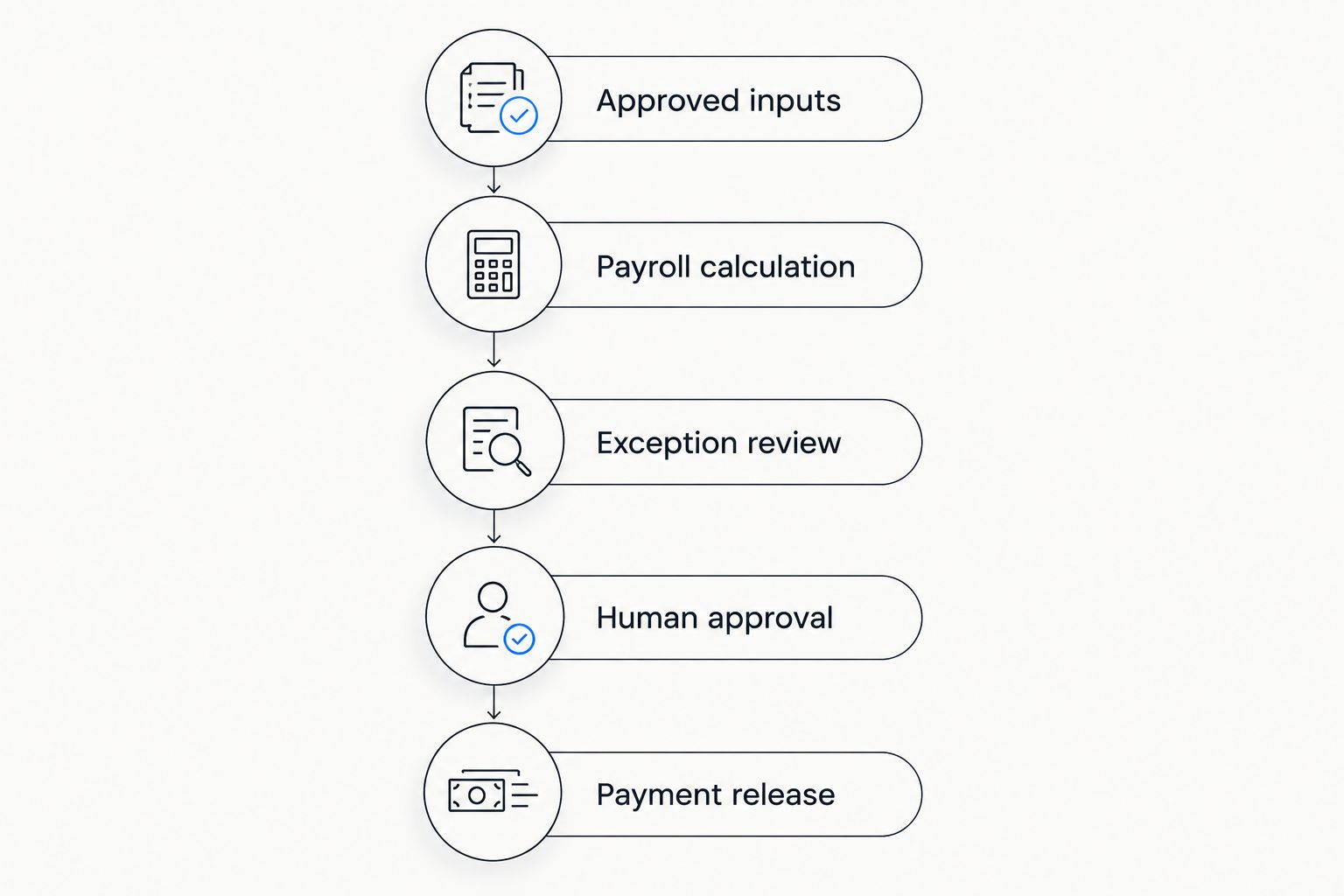
For your 2026 acceptance criteria, require evidence of the correction before and after approval. Ask what prevents an unauthorized edit from reaching payment and how an approved change is traced back to its source.
Turkey shows why local payroll inputs matter
For employees subject to Turkey’s Labour Law No. 4857, the general working-time rule is 45 hours per week, set out in Article 63. Article 41 provides a 50% overtime premium for overtime beyond the statutory weekly threshold and an annual overtime limit of 270 hours per employee.
Those rules have defined scope and exceptions. Hours above a shorter contractual working week are not automatically treated the same as hours above the statutory threshold. Your payroll configuration must distinguish the relevant categories rather than putting every additional hour into one overtime field.
Puantaj records attendance-related inputs such as work, leave, absence and overtime. Payroll teams need approved inputs and the correct legal treatment; a global summary cannot replace either.
During a 2026 Turkey payroll evaluation, ask the vendor to demonstrate the applicable calculation categories and explain who maintains them. Do not mistake a translated interface for a locally supported payroll process.
Which multi-country payroll software should you choose?
Choose ADP as the default enterprise shortlist option when you employ workers through established legal entities. Choose Deel when EOR employment is the intended model, Papaya Global when provider consolidation is the problem, and SAP SuccessFactors Employee Central Payroll when SAP HR architecture drives the decision.
Choose Ottohr for a combined HR and payroll evaluation, then validate the required countries before treating it as your multinational payroll choice. That sequence preserves the benefit of evaluating related HR functions without assuming unconfirmed local payroll capabilities.
Write the employment model, country responsibilities and approval sequence into the selection document. A vendor that answers those questions clearly is more useful than a vendor that only demonstrates a global dashboard.
FAQ
What's the best payroll software for multi-country teams in 2026?
ADP is the default shortlist choice in this comparison for established multinational employers using their own legal entities. Deel fits EOR employment, Papaya Global fits payroll consolidation, and SAP SuccessFactors Employee Central Payroll fits SAP-centered HR operations.
Is an employer of record the same as global payroll software?
No. An employer of record is the legal employer under the EOR arrangement, while own-entity payroll supports employees employed by your organization’s entities. Compare the employment relationship before comparing features.
Is Deel better than ADP for international payroll?
Deel is the relevant choice here for EOR hiring; ADP is the default shortlist choice for established own-entity payroll operations. Neither recommendation replaces validation of the specific countries and services your organization needs.
Can one payroll platform handle every country's rules?
Do not assume universal country support. Confirm calculations, statutory submissions, payment execution, local support and correction ownership separately for each country.
What should we test during a global payroll demonstration?
Test a late attendance correction before payment release. Follow the approved input, recalculation, exception review, human approval and final payment authorization, with an owner named at each stage.
Does global payroll software replace local payroll expertise?
No. Employers still need accountable ownership of local rules, configuration and statutory obligations. Software can organize the workflow, but responsibilities must be assigned explicitly.
What payroll details matter when hiring employees in Turkey?
Approved puantaj, applicable working-time rules and the correct overtime treatment matter. For employees covered by the general Labour Law rules, distinguish the statutory weekly threshold from a shorter contractual working week.
One last thing
Ask each shortlisted vendor to demonstrate a rejected payroll change, not just an approved one. A system’s handling of an unauthorized correction reveals whether approval controls govern the process or merely decorate it.
Make that test part of the purchase decision. The payroll result should remain unchanged until an authorized person approves the correction.