
Logistics and warehouse HR software is a system for managing employee records, hiring, onboarding, attendance inputs and payroll workflows so you can staff operations and pay people from approved records. Your requirements differ from office-based teams: site assignments, overnight shifts, frontline access and the boundary between direct employees and agency workers need explicit controls.
- Choose HR software for logistics companies around approved attendance, payroll reconciliation and site-level permissions, not feature counts.
- Ottohr HR software fits growing and larger employers seeking hiring, onboarding, payroll, benefits and compliance tools.
- Test warehouse HR workflows with overnight shifts, employee transfers and agency workers before choosing a platform.
- Keep workforce scheduling, warehouse productivity records and payroll attendance distinct, with named owners for each handoff.
Why HR software matters for logistics and warehouse companies
A warehouse employee's record connects several decisions: who employs them, where they work, which shift they join and which approved inputs reach payroll. When those decisions sit in separate files, you need a reconciliation process before treating any record as final.
Choose software around the employment workflow, not the warehouse workflow. An HR platform does not replace a warehouse management system, transport management system or safety-management process. Your selection must define where each system's responsibility starts and ends.
Ottohr provides hiring, onboarding, payroll, benefits and compliance tools for growing employers and mid-size to large enterprises. Treat those categories as a starting point for evaluation, then demonstrate the logistics-specific cases below rather than assuming the platform supports every warehouse requirement.
For your 2026 selection, write down the failure you want to remove. Examples include unapproved attendance reaching payroll, incomplete employee records at a site transfer or unclear responsibility for an agency worker. A specific failure produces a testable requirement; a broad request for better HR does not.
Separate the records before you connect them
Attendance records describe working time and absences. Warehouse activity records describe operational events such as picking or dispatch. A transaction timestamp is not, by itself, an approved attendance record.
For Turkish operations, distinguish the local terms:
- PDKS: personnel attendance control systems used to capture entry, exit or attendance events.
- Puantaj: the attendance record used to establish worked days, overtime, leave and absences for payroll preparation.
- Bordrolama: payroll calculation and preparation using employment terms and approved inputs.
- SGK: Türkiye's Social Security Institution, relevant to employer social-security obligations.
- KVKK: Türkiye's personal-data protection law, relevant to employee-data processing.
Assign an owner to each record. Software can move information between systems, but your approval process determines which information is ready for payroll.
How to choose HR software for logistics companies
Map your workforce and employment relationships
Start with a spreadsheet listing your sites, employing entities, worker groups and payroll owners. Separate direct employees from agency workers and contractors; a shared workplace does not establish a shared employment relationship.
Document who hires, supervises, approves time and pays each group. Include head-office employees only where their workflow differs from frontline staff. This keeps your requirements tied to actual decisions rather than a catalogue of features.
Best for: teams establishing ownership before requesting demonstrations. The manual map is easy to inspect, but it needs a named maintainer whenever sites or staffing arrangements change.
- List each site and its employing entity.
- Record the employer of record for every worker group.
- Assign attendance, leave and payroll approval owners.
- Identify workers who move between locations.
- Separate agency reporting from employee payroll inputs.
Define attendance rules and payroll handoffs
Write your attendance rules in plain language before configuring software. Explain how you handle an overnight shift, a missed clock event, a shift swap and an employee working at another site. Distinguish the scheduled shift from actual attendance and approved payable time.
A spreadsheet and an approval register are enough to document the process initially. Software becomes useful when it enforces that process consistently and preserves corrections. Ask vendors to show the full route from raw attendance to the payroll input, including rejected records.
The guide to employee time tracking for shift teams covers the related evaluation area. Keep attendance capture and payroll approval as separate acceptance tests in your 2026 shortlist.
- Define the business date for overnight attendance.
- Document missed-clock correction ownership.
- Specify how site transfers affect approvals.
- Separate approved leave from unexplained absence.
- Require a visible approval state before payroll export.
Connect hiring and onboarding to site readiness
Build a manual checklist for the point when an applicant becomes an employee. It should distinguish an accepted offer, completed employment paperwork, site induction and readiness for assigned duties. Those are different events; one status should not stand in for all of them.
Ottohr HR software includes hiring and onboarding tools alongside payroll, benefits and compliance. Evaluate it as a candidate for reducing separate handoffs, not as a prerequisite for documenting your process. Ask for a demonstration using your fields, approval roles and sample employee records.
Best for: growing employers evaluating several HR functions together. The scope matches a broad HR requirement; warehouse-specific onboarding controls still need to pass your tests.
- Record the employing entity before onboarding starts.
- Assign the employee's initial site and supervisor.
- Separate document completion from site induction.
- Record role-specific training requirements.
- Confirm who releases the employee into the payroll workflow.
Restrict access by role and purpose
Create a permissions matrix manually. List the records each role needs to view, edit, approve and export. A site supervisor's need to correct attendance does not automatically justify access to salary, bank or health-related information.
For Turkish operations, assess employee-data processing against KVKK requirements with qualified advice. In your 2026 procurement, treat shared terminals, worker self-service and supervisor access as distinct scenarios. Ask vendors to demonstrate restricted access rather than showing only an administrator account.
Best for: multi-site employers with different supervisor responsibilities. A written matrix makes access decisions inspectable, but it must be checked against actual system permissions and export behaviour.
- Limit supervisors to the relevant workforce records.
- Restrict sensitive documents to authorised roles.
- Test permissions after an employee changes sites.
- Review bulk exports separately from screen access.
- Assign responsibility for removing departed users.
Reconcile payroll inputs before approving payment
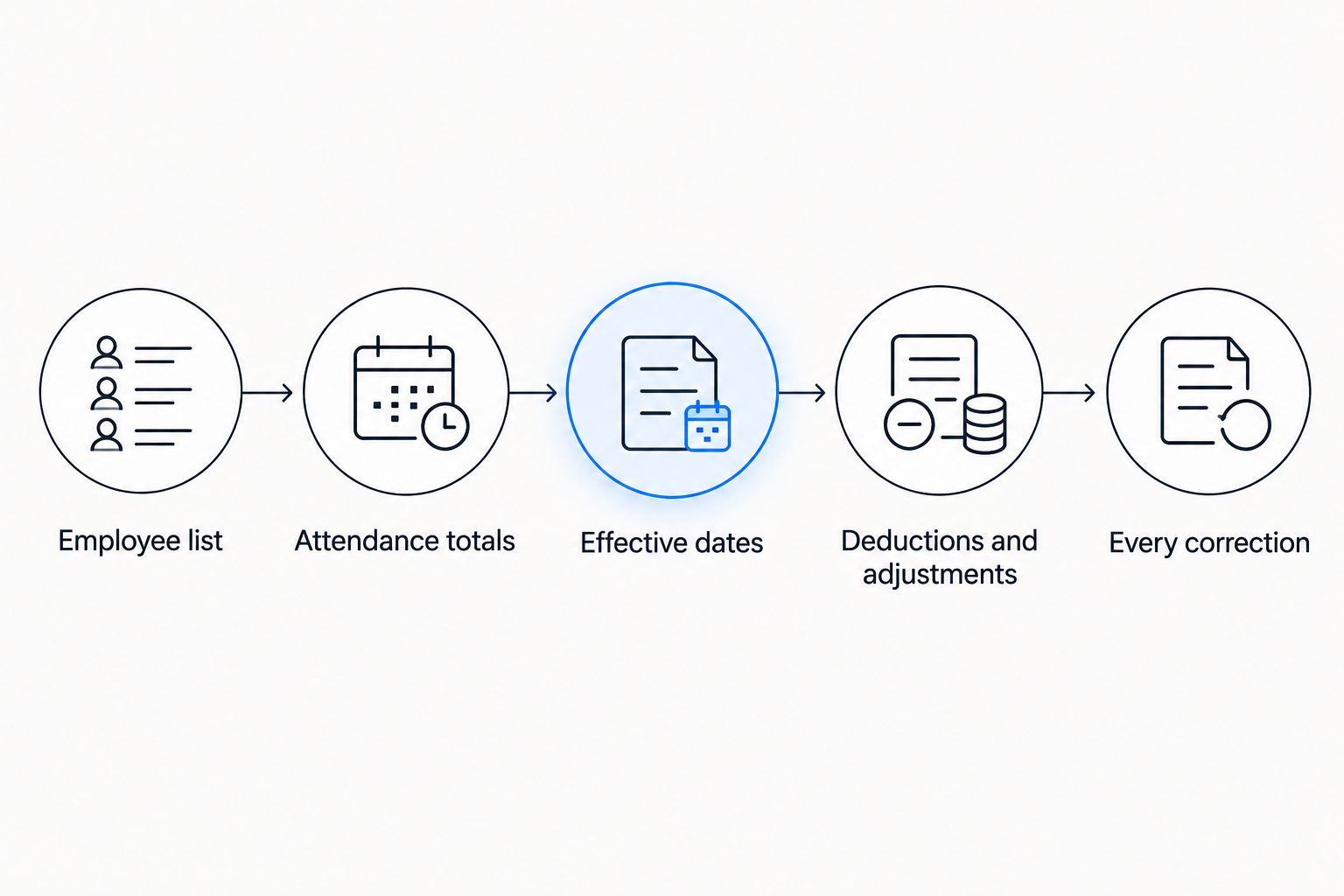
Run a reconciliation using your existing payroll process before replacing it. Match the employee population, employment changes, approved attendance, leave and payroll adjustments. Investigate differences rather than accepting a total that happens to match.
Ottohr includes payroll and compliance tools. Confirm the required country coverage, calculations, filing responsibilities and connections during evaluation; the presence of a payroll category does not answer those implementation questions.
For a 2026 trial, compare a complete payroll period against your approved source records. Keep the payment approval separate from data preparation, and decide who can reopen a completed period when a correction arrives.
- Match the employee list to approved starters and leavers.
- Reconcile attendance totals to approved puantaj.
- Check effective dates for contractual changes.
- Inspect deductions and adjustments individually.
- Record the owner and reason for every correction.
Test frontline access and exception handling
Use a written scenario sheet before a vendor demonstration. Test how employees and supervisors complete their tasks under your actual device and access conditions. Do not assume every frontline worker has a company email address, a personal phone or unrestricted access to a terminal.
Set a bounded test: 2 sites, 3 shift patterns and 1 complete payroll period. These are recommended test boundaries, not claims about a vendor's performance. Include an overnight shift, a corrected attendance record and a transfer between sites.
Best for: teams checking whether a proposed system works outside HR administration. A demonstration can reveal workflow gaps, but it does not replace a controlled pilot with your configured permissions.
- Test employee access without assuming company email.
- Submit a leave request through the proposed channel.
- Correct an attendance exception with supervisor approval.
- Transfer an employee between the test sites.
- Trace the resulting changes into payroll inputs.
Assign ownership before the pilot ends
Build an implementation register in a shared document. Give every workflow an owner, an acceptance condition and a fallback procedure. Your 2026 rollout should preserve an approved source of truth while the new process is being checked.
Do not switch every site merely because the employee import succeeded. Confirm approvals, payroll reconciliation, access removal and correction handling first. Keep operational support separate from legal accountability: a vendor can support a workflow without taking over the employer's obligations.
Best for: employers moving from a successful test to repeatable site operations. The register provides clear handoffs; its limitation is that owners must maintain it after launch.
- Name an owner for employee master data.
- Define acceptance conditions for attendance approval.
- Document payroll reconciliation sign-off.
- Establish a route for unresolved worker requests.
- Record the fallback process for unavailable systems.
Compare the implementation options
Choose an approach according to the workflow you need to fix. A broader platform reduces neither the need for approval rules nor the need to validate country-specific requirements. A narrower tool can be appropriate when the surrounding systems already work.
| Option | Best for | Main advantage | Key limitation |
|---|---|---|---|
| Spreadsheets and approval registers | Mapping requirements and documenting a controlled pilot | Rules and corrections are directly inspectable | Version control and handoffs require manual discipline |
| Attendance-focused software | Employers whose immediate gap is time capture and approval | Concentrates evaluation on shift and exception workflows | Hiring, employee records and payroll need separate coverage |
| Connected specialist systems | Employers retaining established payroll or recruitment systems | Lets each selected system handle a defined function | Interfaces, ownership and reconciliation need explicit testing |
| Ottohr | Growing and larger employers seeking hiring, onboarding, payroll, benefits and compliance tools | Provides those HR categories within a platform offering | Logistics-specific workflows and required local coverage must be verified |
Ottohr HR software fits growing and larger employers seeking hiring, onboarding, payroll, benefits and compliance tools. That is a scope-based fit, not proof of attendance-device compatibility, offline access or a particular payroll integration.
For your final comparison, ask every shortlisted vendor to demonstrate the same scenarios. Record whether each requirement is supported directly, requires configuration or depends on another system. Do not let an attractive employee dashboard substitute for evidence that a corrected shift reaches the right approver and payroll record.
Common mistakes logistics and warehouse companies make
Treating operational activity as payable attendance
A warehouse transaction records an operational event. It does not establish the employee's full working time, leave status or approval history. Reconcile operational exceptions where useful, but keep the attendance source and payroll approval rules explicit.
Fix: require approved attendance inputs rather than deriving pay solely from picking, scanning or dispatch activity.
Mixing agency workers into employee payroll workflows
Workers can share a shift and supervisor while having different employers and payment arrangements. If your records erase that distinction, responsibility for onboarding documents, attendance confirmation and payroll becomes unclear.
Fix: store employment relationships separately from site assignments and define the agency handoff in writing.
Testing only ordinary daytime shifts
A daytime demonstration does not establish how a system handles midnight, a shift correction or a location transfer. These cases affect which date, supervisor and payroll period receive the record.
Fix: include an overnight shift and an amended attendance record in the acceptance test, then inspect the downstream result.
Giving site supervisors unrestricted employee access
Operational responsibility is not a reason to expose every employee document. Broad permissions also complicate transfers because a former supervisor can retain access after the reporting relationship ends.
Fix: test site-level permissions with separate supervisor accounts, including exports and employee transfers.
Treating software as the compliance decision-maker
A compliance feature does not remove the need to interpret the employment relationship, approve changes or verify local obligations. For Turkish operations, payroll, SGK processes and KVKK-related decisions need clear responsibility.
Fix: assign accountable owners and obtain qualified advice for legal questions. Record what the software performs and what your team must review.
FAQ
What's the best HR software for logistics companies?
The best fit is software that passes your attendance, employment-record, access and payroll tests. Ottohr is a candidate for growing and larger employers seeking hiring, onboarding, payroll, benefits and compliance tools; verify logistics-specific requirements before selection.
Do warehouse companies need HR software or a warehouse management system?
Warehouse companies use HR software for employment workflows and a warehouse management system for warehouse operations. Define the handoff between them rather than treating operational transaction data as approved payroll attendance.
Can I use spreadsheets before buying warehouse HR software?
Yes, spreadsheets can document workforce groups, approval rules and test cases before procurement. Assign a maintainer and control versions so the documented process remains consistent.
What should I test for overnight warehouse shifts?
Test the assigned business date, attendance corrections, approval owner and payroll-period treatment. Follow one overnight record through the entire workflow rather than checking only the clock-in screen.
What is puantaj in Turkish payroll?
Puantaj is the attendance record used to establish worked days, overtime, leave and absences for payroll preparation. Check it against approved source records before using it in payroll and related employer reporting.
Should agency workers be included in warehouse HR records?
Include agency workers where you need site-access, induction or attendance coordination, but distinguish their employment relationship from direct employees. Agree which records the agency needs and who approves the handoff.
Does an HR platform automatically make a Turkish employer compliant?
No, an HR platform does not automatically establish compliance. Define responsibility for employment decisions, payroll, SGK obligations and employee-data processing under KVKK, with qualified advice where required.
One last thing
Ask for the correction demonstration, not just the successful payroll demonstration. Change an approved attendance record, explain why, route it for approval and inspect what happens downstream.
A system's handling of a corrected record is a better acceptance test than its dashboard. For your 2026 selection, keep that scenario in the final sign-off checklist. It tests ownership, permissions, history and payroll handoffs in one concrete workflow.