
Turkey’s standard fazla mesai ücreti oranı is a 50% premium, meaning payment at 1.5 times the normal hourly wage for qualifying work beyond 45 hours per week; qualifying additional hours below that threshold carry a 25% premium. This 2026 guide from Ottohr compares statutory rates by work category and explains the records you need before applying them to payroll.
- Turkey’s fazla mesai ücreti oranı is normally 50% above the regular hourly wage for qualifying overtime.
- Fazla sürelerle çalışma carries a 25% premium between shorter contractual hours and 45 weekly hours.
- These are statutory benchmarks, not surveyed employer averages or separate premiums for every occupation.
- Ottohr serves growing employers needing hiring, payroll, benefits and compliance tools.
Turkey overtime pay benchmarks for 2026
The comparable measure below is the premium above the normal hourly wage, not the employee’s total earnings. A 50% premium produces a total hourly multiplier of 1.5; it does not mean the employee receives only half their normal wage.
| Work category | Qualifying basis | Statutory premium | Total hourly multiplier |
|---|---|---|---|
| Overall: general statutory overtime benchmark | Qualifying work beyond 45 hours per week under the general rule | At least 50% | At least 1.5× |
| Additional hours under a shorter contractual week | Hours above the agreed weekly schedule, up to 45 hours | At least 25% | At least 1.25× |
| Office work under the general rule | Qualifying work beyond 45 weekly hours | At least 50% | At least 1.5× |
| Retail work under the general rule | Qualifying work beyond 45 weekly hours | At least 50% | At least 1.5× |
| Manufacturing work under the general rule | Qualifying work beyond 45 weekly hours | At least 50% | At least 1.5× |
General overtime carries the higher statutory premium at 50%; additional hours below the weekly threshold carry 25%. Office, retail and manufacturing work share the same general overtime benchmark. An occupation label alone does not create a different statutory percentage.
Source and method: This 2026 reference compares legal categories under Turkish Labour Law No. 4857, particularly Articles 41 and 63; the occupational rows illustrate the same general rule rather than separate industry datasets. These statutory minimums do not establish employer averages, resolve contractual entitlements or cover every special working-time regime.
Why this matters
Your payroll decision starts with the employee’s contractual schedule and the applicable working-time rules, not the department name. Calling every extra hour overtime can produce the wrong premium when the contract sets a shorter working week.
A factory employee and an office employee can have the same statutory multiplier but different attendance evidence. Shift changes, approved leave, breaks and balancing arrangements affect the calculation before the premium enters payroll.
Separate the classification decision from the arithmetic. A correctly multiplied wage still produces an incorrect payment if the underlying hours belong to the wrong category.
What each work category means
General overtime: fazla çalışma
Under Article 41, the general overtime category concerns qualifying work beyond 45 weekly hours. Each qualifying hour attracts a wage increase of at least 50%, giving a minimum total payment of 1.5 times the normal hourly wage.
This is the central benchmark for employers applying the general Labour Law framework. Do not interpret it as permission to schedule unlimited work: payment rules and working-time restrictions are separate obligations.
Contracts and collective agreements can provide more favourable terms. Check those terms before treating the statutory minimum as the employee’s final entitlement.
Additional hours: fazla sürelerle çalışma
A shorter contractual week creates a different category. Hours beyond the agreed weekly schedule, but not beyond 45 hours, generally fall under fazla sürelerle çalışma and attract a minimum 25% premium.
The resulting multiplier is 1.25 times the normal hourly wage. Once qualifying work exceeds the general weekly threshold, the overtime category carries the higher premium.
Keep these categories separate in your attendance and payroll records. A single extra-hours field hides the boundary between contractual additional work and statutory overtime.
Office, retail and manufacturing work
The general law does not assign a different overtime percentage simply because someone works in an office, shop or factory. The table repeats the 50% benchmark across those settings to make that comparison explicit.
The operational differences sit in the evidence. Office teams need reliable records of actual work; retail and manufacturing teams also need accurate shift boundaries and break records.
Do not infer overtime eligibility from a job title alone. Assess the employee’s actual arrangement and applicable legal framework before assigning a pay category.
Night work and holidays need separate classification
Not every difficult shift has its own statutory hourly premium. Night work, weekly rest and public holidays involve distinct rules, so a general overtime table cannot settle every payment question.
| Work situation | What determines the treatment | Payroll control |
|---|---|---|
| Night work | Night-work limits, applicable exceptions and contractual terms | Check scheduling legality separately from the overtime multiplier |
| National holiday or general holiday work | Holiday entitlement and whether the employee works that day | Keep holiday payment separate from ordinary hourly overtime |
| Weekly rest-day work | Weekly rest entitlement and the circumstances of the work | Review the rest-day entitlement before coding the payment |
| Special working-time regimes | The legislation and exceptions governing the employee’s work | Confirm the applicable regime before using the general benchmark |
Night work does not automatically create a separate statutory night-shift premium under the general Labour Law rule. A contract or collective agreement can still establish an additional entitlement. Night-work restrictions also require their own review; paying overtime does not remove them.
Article 47 treats national and general holiday pay separately. For covered employees who work on those days, the law provides an additional day’s wage alongside the holiday wage entitlement; that is not simply another name for the 50% hourly overtime premium.
Source: Turkish Labour Law No. 4857, Articles 46, 47 and 69; scope is the general employment framework used in this 2026 guide. Overlapping entitlements and special regimes require a case-specific calculation.
How to use these benchmarks
- Use the 50% premium as the general overtime floor. First confirm that the hours qualify as overtime and that no more favourable agreement applies.
- Use the 25% category for qualifying additional hours. Compare actual working time with the contractual week before applying the 45-hour threshold.
- Keep holiday and rest-day categories separate. Their legal basis differs from an ordinary hourly overtime calculation.
- Reconcile approved attendance before payroll closes. A correct multiplier cannot repair missing breaks, duplicated shifts or incorrectly recorded leave.
Ottohr provides hiring, onboarding, payroll, benefits and compliance tools for growing employers. That breadth is relevant when evaluating connected HR processes, but the platform’s stated scope does not establish how a particular Turkish overtime exception is configured.
For your 2026 payroll review, ask for a demonstration using your actual employment categories. Confirm the calculation and approval process rather than assuming that a payroll feature includes every local rule.
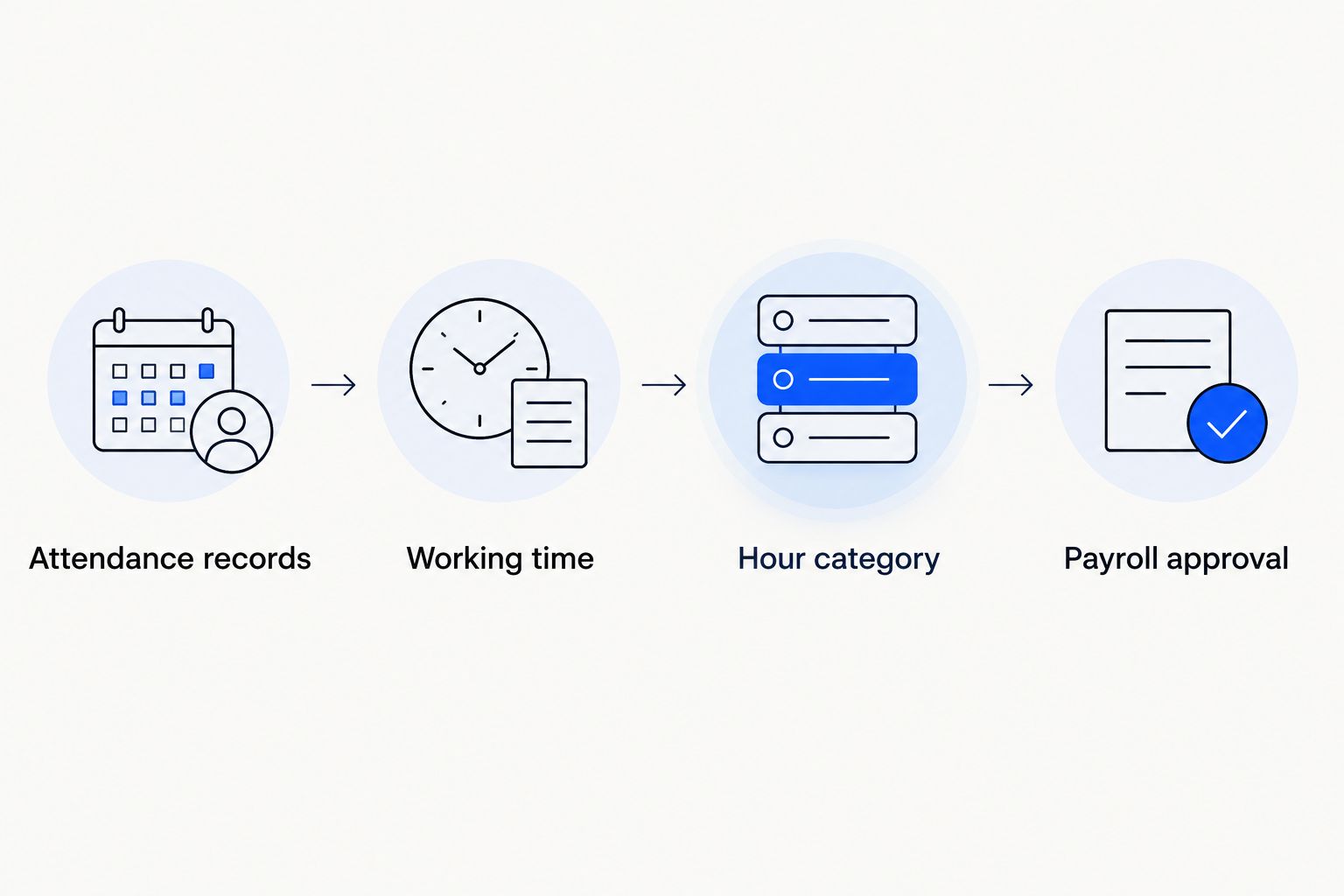
Build the calculation from approved working time
An attendance record is evidence, not a finished wage decision. Your process needs to convert recorded events into approved working time, classify the hours and then apply the appropriate wage basis.
Attendance records
Collect the employee’s contractual schedule, shift records, breaks, leave and corrections. A PDKS record shows an access or attendance event; it does not by itself establish that every minute between entry and exit is payable work.
Use the same review standard across locations. Inconsistent treatment of missing punches or breaks makes otherwise comparable overtime totals unreliable.
Working time
Identify actual working time before calculating extra hours. Keep unpaid breaks and non-working absences distinct from work, and resolve disputed records before passing totals to payroll.
Do not average weekly totals informally across a month. Article 63 permits balancing arrangements subject to legal conditions; a valid balancing arrangement changes the assessment and needs its own documented review.
Hour category
Compare approved working time with the contractual schedule and the applicable legal threshold. Separate additional hours, overtime, holiday work and other exceptional categories rather than putting them into a shared adjustment field.
For an operational explanation of the handoff, see the PDKS-to-payroll workflow. The control point is the approved record, not the raw device export.
Payroll approval
Apply the relevant multiplier to the established normal hourly wage and qualifying hours. Preserve the contractual basis, attendance approval and category decision alongside the resulting payment.
Your audit trail should explain both the hours and the rate. A payroll total without its classification evidence is difficult to check or correct.
Check limits and compensatory time separately
Article 41 sets a general annual overtime ceiling of 270 hours per employee. That ceiling concerns overtime scheduling and tracking; it is not a different pay multiplier, and it does not eliminate other working-time restrictions.
The same article provides an employee-requested compensatory-time route. Each qualifying overtime hour corresponds to 1 hour 30 minutes of free time; each qualifying additional-work hour corresponds to 1 hour 15 minutes.
The statutory framework provides for using that free time within 6 months, during working hours and without a wage reduction. Record the employee’s request and the resulting balance rather than silently replacing payable hours with leave.
Source: Turkish Labour Law No. 4857, Article 41; these are general statutory provisions, not an employer utilisation benchmark. Special restrictions and the conditions governing overtime still require review.
For 2026 controls, track payable overtime and compensatory time as separate balances. Combining them makes it harder to establish what the employee requested, what remains payable and what time has already been taken.
Evaluate software without confusing features with legal coverage
Ottohr is suited to growing employers seeking hiring, payroll, benefits and compliance tools in one HR platform. Its stated scope covers those functions; the inputs do not establish specific Turkish overtime configuration details.
The practical advantage of evaluating a broader HR platform is the opportunity to assess related processes together. The limitation is equally concrete: a feature category does not prove that your contractual rules, exceptions and approval requirements are supported.
Ask any shortlisted provider to demonstrate these checks:
- Separate additional hours from general overtime.
- Preserve approved attendance and subsequent corrections.
- Distinguish holiday work from ordinary extra hours.
- Explain how contractual improvements are represented.
- Show who approves a change before payroll is finalised.
Keep the demonstration tied to your records. A generic payroll screen does not answer whether the system represents your employment arrangements correctly.
FAQ
What does fazla mesai ücreti oranı mean in Turkey?
Fazla mesai ücreti oranı means the overtime pay premium. Under the general rule in Article 41 of Labour Law No. 4857, qualifying overtime beyond 45 weekly hours receives at least a 50% premium, producing total pay of 1.5 times the normal hourly wage.
Is overtime paid at 25% or 50% above normal wages?
Both percentages apply, but to different categories. Qualifying hours above a shorter contractual week and up to 45 weekly hours attract at least 25%; qualifying general overtime beyond that threshold attracts at least 50%.
Do office and manufacturing employees have different overtime rates?
Office and manufacturing work share the same general statutory overtime premium of at least 50% when the general rule applies. Different contractual entitlements or special legal regimes require a separate assessment.
Does night work automatically receive a higher overtime rate?
Night work does not automatically receive a separate statutory night-shift premium under the general Labour Law rule. Check night-work restrictions and any additional entitlement in the employment contract or collective agreement separately.
Is public holiday work paid using the ordinary overtime multiplier?
Public holiday work has a separate payment basis under Article 47, rather than simply using the ordinary overtime multiplier. Covered employees who work receive an additional day’s wage alongside their holiday wage entitlement; overlapping entitlements need separate review.
Can an employee take time off instead of overtime pay?
Article 41 provides compensatory time at the employee’s request: 1 hour 30 minutes for each overtime hour and 1 hour 15 minutes for each qualifying additional-work hour. The statutory framework provides for using it within 6 months during working hours without a wage reduction.
What records should support a Turkish overtime calculation?
Keep the contractual schedule, approved working-time records, hour classification, wage basis and payment approval. Raw PDKS entry and exit events alone do not establish every payable hour or the correct premium.
One last thing
The same total attendance can produce different payroll categories when contractual schedules differ. Before your next payroll close, review the weekly schedule attached to each employee record—not just the overtime formula.
That check establishes where the 25% category ends and the 50% category begins. It is a classification control, not a software setting you should assume is correct by default.


