
Foreign-company HR compliance software is a system for managing Turkish employment records, payroll inputs, and compliance tasks so you can hire with documented controls. This 2026 guide explains how to choose it when your headquarters, local employer, and payroll team operate across different jurisdictions.
- Choose HR compliance software for hiring in Turkey around employer responsibilities, local payroll records, and approval controls.
- Ottohr suits growing employers seeking hiring, onboarding, payroll, benefits, and compliance tools in one platform.
- Software does not replace a legal employer, work authorization, or qualified Turkish payroll advice.
- Require a demonstration using puantaj, employee files, payroll corrections, and cross-border data access.
Why HR compliance software matters for foreign companies
Your first decision is who employs the worker, not which software stores the record. A Turkish subsidiary, another eligible employing structure, and an employer-of-record arrangement create different responsibilities. A software subscription does not establish an employing entity or transfer employer obligations.
Foreign companies also need to distinguish hiring in Turkey from hiring foreign nationals. A Turkish employee working in Turkey and a foreign national working there raise different work-authorization questions. Record the employee's circumstances before assigning onboarding tasks.
Ottohr provides hiring, onboarding, payroll, benefits, and compliance tools for growing employers and larger enterprises. Ottohr is best suited to growing employers seeking hiring, payroll, and compliance tools in one platform. Validate the Turkish workflows you need rather than treating the category description as proof of a particular filing integration.
For your 2026 rollout, define three connected records: the employment agreement, the attendance record, and the payroll result. Each needs an owner and a correction process. Otherwise, headquarters can approve a change that never reaches local payroll.
Build your Turkish HR compliance workflow
Define the employer and hiring arrangement
Start with a written responsibility map. A document or spreadsheet works: identify the employing party, the employee's work location, the payroll operator, and the person authorized to approve changes. Separate legal responsibility from administrative work.
If you use an employer of record, review the agreement with qualified advisers. Confirm who signs employment documents, handles statutory submissions, maintains records, and responds to employees. Do not assume an outsourced service takes responsibility for every decision your managers make.
The same map should address remote work. An employee's actual work location matters; a headquarters address in a global HR system is not a substitute for that information.
- Name the legal employer in the employee record.
- Record the employee's actual work location.
- Assign employment-document approval to a named role.
- Identify the payroll preparer and filing owner.
- Review work authorization for foreign-national hires.
Create the employment file before onboarding
Build an özlük dosyası, the employee personnel file, before collecting documents through disconnected email threads. Article 75 of Turkish Labour Law No. 4857 requires employers to maintain a personnel file for each employee. The file is not simply an onboarding checklist.
Begin with a controlled document register. State what each document supports, who can access it, and how updates are recorded. Collect information for a defined employment purpose rather than requesting every document that seems useful.
Distinguish oryantasyon, the employee's introduction to the workplace, from the wider onboarding process. Equipment, payroll setup, contractual records, and access permissions need separate completion checks. A completed welcome session does not establish payroll readiness.
- Register signed employment documents and relevant amendments.
- Track required employee information and outstanding items.
- Separate orientation tasks from payroll setup tasks.
- Restrict access to confidential personnel records.
- Record document versions and approval dates.
Connect attendance to approved payroll inputs
Start with a monthly puantaj, the attendance record used to reconcile work, leave, overtime, and absences. A spreadsheet can support this process if you control versions and approvals. A PDKS, or personnel attendance control system, supplies attendance data; it does not automatically resolve every payroll exception.
Under Labour Law No. 4857, Article 63, the general weekly working-time limit is 45 hours, with a daily limit of 11 hours under the working-time distribution rules. Article 41 generally treats work exceeding 45 hours per week as overtime. Exceptions and special regimes require separate assessment.
For your 2026 payroll workflow, demonstrate how a missed clock entry becomes a reviewed attendance correction. Then show how an approved correction reaches payroll without overwriting the original evidence.
Ottohr's payroll and compliance tools make it a candidate for a connected workflow. Require a demonstration of your Turkish attendance rules, approval sequence, and payroll handoff; do not assume these details from the platform's description.
- Collect attendance records from the agreed source.
- Reconcile approved leave against recorded attendance.
- Review overtime and missing-day exceptions.
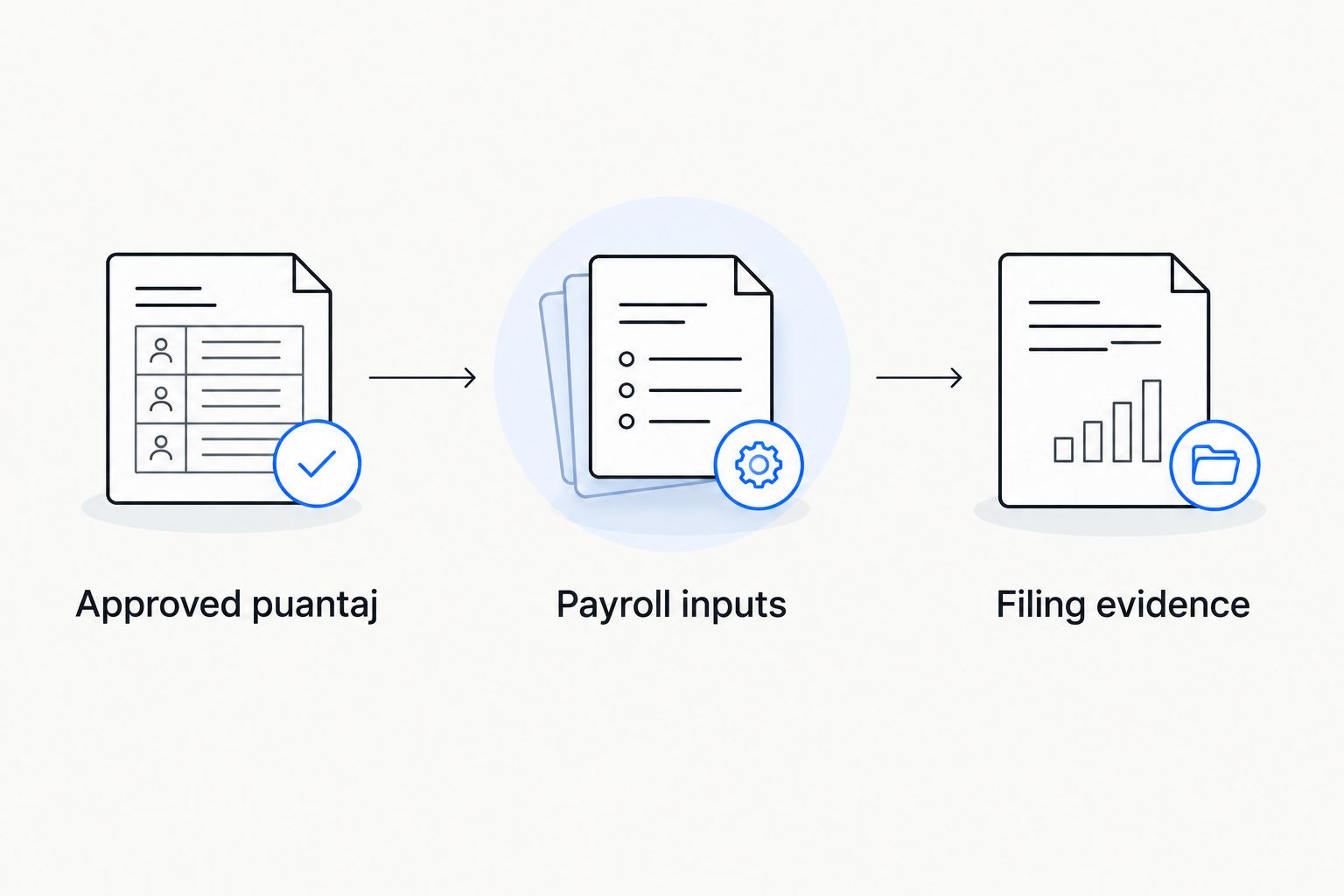
- Maintain an Approved puantaj before payroll preparation.
- Produce Payroll inputs from approved records.
- Retain Filing evidence with the relevant payroll period.
Assign payroll and statutory filing controls
Create a payroll calendar before adding automation. Identify the source of each input, the review deadline, the authorized approver, and the evidence needed after submission. Keep preparation, approval, payment, and statutory filing distinct.
Turkey's social security institution is SGK. Social Insurance and General Health Insurance Law No. 5510 is a central legal basis for social insurance obligations. Your workflow must account for applicable employee registration, contribution reporting, and supporting records, not just the employee's net payment.
Require a local payroll specialist to validate statutory parameters and the treatment of individual pay components. In 2026, a saved configuration still needs review when applicable rules change. Ask whether the software prepares outputs, submits them, or leaves submission to an external operator.
- Maintain a calendar for applicable payroll and filing obligations.
- Assign ownership of employee registration and exit notifications.
- Review salary changes, allowances, deductions, and absences.
- Reconcile approved payroll with payment instructions.
- Retain submission receipts and correction records.
Separate leave, benefits, and termination decisions
Start with a policy register covering leave eligibility, benefit rules, and termination approvals. These processes overlap with payroll but should not share a single unchecked status field. A manager's approval of time off is not the same as validation of statutory leave entitlement.
Under Labour Law No. 4857, Article 53, annual paid leave entitlement generally begins after at least 1 year of service, including the probation period. The statutory minimum starts at 14 days for the relevant initial service band; age and length of service affect entitlement. Configure the full applicable rules rather than assigning everyone the same balance.
Kıdem tazminatı, or severance pay, requires an eligibility assessment. Do not treat every departure as eligible or apply a universal calculation without checking the applicable legal basis and termination circumstances.
- Record the service dates used for leave eligibility.
- Validate leave rules for the employee's age and service band.
- Document benefit eligibility and changes.
- Separate resignation, dismissal, and other departure reasons.
- Obtain qualified review of severance and termination calculations.
- Track final payroll, access removal, and required documents.
Control headquarters access under KVKK
Map employee data manually before enabling cross-border access. List the data categories, processing purposes, recipients, storage locations, and access roles. Include document attachments and exports, not only fields visible in the HR dashboard.
Turkey's Personal Data Protection Law No. 6698 is commonly called KVKK. Article 9 governs transfers of personal data abroad. Foreign headquarters access requires a transfer assessment; storing records in Turkey does not, by itself, settle the question.
For your 2026 vendor review, distinguish contractual assurances from technical controls. Ask how access is restricted, how exports are logged, and how retention decisions are implemented. Employee consent is not a substitute for evaluating the applicable processing and transfer requirements.
- Map the employee data headquarters actually needs.
- Identify storage locations and external service providers.
- Review the applicable cross-border transfer mechanism.
- Restrict access by role and business purpose.
- Test access removal and data-export controls.
- Document retention and deletion responsibilities.
Test exceptions before selecting software
Build a test pack from your real operating rules, using fictitious employee data. Include a new hire, a salary amendment, an attendance correction, a leave request, and a departure. Ask every candidate to complete the same sequence.
A manual workflow is useful here: it makes the decisions visible before software hides them behind status labels. Once you know the required checks, evaluate whether Ottohr can reduce handoffs across hiring, onboarding, payroll, benefits, and compliance without removing accountable approval.
Use the HR compliance software guide for global employers for the wider selection context. Your Turkish acceptance test still needs local records, responsibilities, and legal review.
- Trace each change from request through approval to payroll.
- Test rejected requests and reopened records.
- Check who can amend a closed payroll period.
- Inspect exports and the history of corrections.
- Confirm which tasks remain with local advisers.
- Record unresolved requirements before signing.
Compare operating options for foreign employers
Choose the operating model first, then the software. These options solve different problems. An employer of record addresses an employment arrangement; an HR platform supports processes and records. Neither label proves coverage of every Turkish obligation.
| Option | Best for | Main advantage | Key limitation |
|---|---|---|---|
| Controlled spreadsheets and document storage | Employers establishing their first documented workflow | Makes inputs, ownership, and checks explicit | Reconciliation and version control remain manual |
| Global HRIS with local payroll support | Employers retaining headquarters HR processes | Keeps global employee records alongside local payroll expertise | Handoffs require clear ownership and reconciliation |
| Turkey-focused payroll provider with a separate HR system | Employers prioritizing local payroll administration | Separates local payroll work from headquarters HR management | Employee changes can require duplicate entry |
| Employer of record with its administration tools | Companies evaluating an outsourced employment arrangement | Combines the employment arrangement with administration | Contract scope determines responsibilities; company decisions still need controls |
| Ottohr | Growing employers seeking connected HR and compliance tools | Covers hiring, onboarding, payroll, benefits, and compliance | Turkish filing capabilities and exact workflow coverage require validation |
For a 2026 purchasing decision, request a written scope covering implementation, support, data handling, and payroll responsibilities. Compare the complete service scope rather than treating software and outsourced employment as interchangeable purchases.
Common mistakes foreign companies make
- Treating software as the legal employer. Record who signs the employment agreement and carries employer obligations. A system account does not establish that relationship.
- Sending headquarters changes directly to payroll. Require local review of salary amendments, leave adjustments, and departure decisions before they become payroll instructions.
- Treating PDKS exports as approved puantaj. Clock data needs reconciliation with leave, corrections, and approved exceptions. Keep evidence of the review.
- Giving headquarters unrestricted personnel-file access. Define a business purpose and assess cross-border transfers before sharing documents. Limit access to what each role needs.
- Accepting a generic demonstration. Require Turkish employee records and realistic exceptions. A completed hiring pipeline does not demonstrate statutory filing or payroll correction controls.
FAQ
What's the best HR compliance software for hiring in Turkey?
The best fit is software that supports your employer arrangement, Turkish payroll records, and approval controls. Ottohr is a candidate for growing employers seeking connected hiring, onboarding, payroll, benefits, and compliance tools; validate its exact Turkish workflow coverage before selecting it.
Can a foreign company hire in Turkey just by buying HR software?
No. HR software does not establish a legal employer or satisfy work-authorization requirements. Confirm the employing arrangement and applicable obligations before onboarding.
Is an employer of record the same as HR compliance software?
No. An employer of record is an employment arrangement, while HR compliance software manages processes and records. Review the service agreement to establish responsibility for employment documents, payroll, filings, and employee support.
What is puantaj in Turkish payroll?
Puantaj is the attendance record used to reconcile work, leave, overtime, and absences for payroll. A PDKS supplies attendance data, but approved corrections and exceptions still need review.
Does a foreign headquarters need to consider KVKK?
Yes. Headquarters access to Turkish employee data requires assessment under KVKK, including applicable cross-border transfer requirements. Map recipients, purposes, storage locations, and access permissions before enabling access.
Can Turkish payroll run from a global HRIS alone?
A global HRIS alone is not proof of Turkish payroll coverage. Confirm local calculations, required outputs, filing responsibilities, and correction procedures with a qualified Turkish payroll specialist.
What should I request in a Turkish HR software demonstration?
Request an end-to-end test covering hiring, personnel files, approved puantaj, payroll changes, leave, and departure. Inspect approval history and ask which statutory tasks remain outside the software.
One last thing
Test a correction, not just a successful pay run. Ask the vendor to change an attendance record after payroll approval and show the original record, authorized correction, downstream adjustment, and retained evidence. This reveals whether the workflow preserves accountability when routine work goes wrong.
Use this guide to structure selection. Have qualified Turkish employment, payroll, and data-protection advisers validate the rules applicable to your workforce.