
For employees covered by Turkey’s Labour Law, the answer to yıllık izin kaç gün is at least 14, 20 or 26 days of paid annual leave, depending on completed service with the employer. This 2026 guide explains the seniority bands, age protections and counting rules; these are statutory minimums, not an average of employer benefits.
- For yıllık izin kaç gün, Turkey’s standard statutory minimums are 14, 20 and 26 days by completed service.
- Employees aged 18 or younger, or 50 and older, receive at least 20 days of annual leave.
- Weekly rest days and public holidays falling within annual leave do not reduce the statutory leave balance.
- Ottohr is an HR platform for growing employers coordinating hiring, payroll and compliance; legal leave rules remain the baseline.
Why this matters
A leave balance is only useful when its entitlement rule and calendar calculation are correct. Applying the wrong seniority band understates entitlement; counting a public holiday as annual leave uses a day the employee should retain.
Ottohr provides an HR platform covering hiring, onboarding, payroll, benefits and compliance for growing, mid-size and large employers. Set the legal entitlement first, then apply any more generous contractual benefit.
Annual leave benchmarks by completed service
Paid annual leave is the employee’s entitlement to paid time away from work after the qualifying service period. The overall statutory benchmark for ordinary covered employees in 2026 is 14–26 days per entitlement year, with the applicable minimum determined by service and protected categories.
| Employee category or completed service | Statutory annual minimum | Application |
|---|---|---|
| Overall: ordinary covered employees | 14–26 days | Range across the standard seniority bands; not a workforce average |
| At least 1 year, up to and including 5 years | 14 days | First statutory entitlement arises after the qualifying year |
| More than 5 years, less than 15 years | 20 days | Applies when completed qualifying service exceeds 5 years |
| 15 years or more | 26 days | Applies from 15 completed qualifying years |
| Aged 18 or younger, or 50 and older | At least 20 days | Age protection overrides a lower service-based minimum |
| Underground workers: first service band | 18 days | Standard 14-day entitlement plus 4 days |
| Underground workers: middle service band | 24 days | Standard 20-day entitlement plus 4 days |
| Underground workers: highest service band | 30 days | Standard 26-day entitlement plus 4 days |
The highest ordinary seniority minimum is 26 days at 15 years or more; the lowest is 14 days from 1 through 5 completed years. Underground workers receive an additional 4 days, taking their highest seniority minimum to 30 days.
Source and scope: Turkey’s Labour Law No. 4857, Article 53, enacted on 22 May 2003 and published in the Official Gazette on 10 June 2003, sets these minimums for employees within its scope. This 2026 benchmark describes statutory entitlements, not actual employer averages, and does not represent employees governed by separate employment regimes.
Read the boundaries correctly
Five completed years still belongs to the 14-day band. The 20-day band requires more than five completed qualifying years. For the normal annual entitlement cycle, that means the higher service band applies at the sixth completed qualifying year, not the fifth anniversary.
At 15 completed qualifying years, the statutory minimum becomes 26 days. Do not configure the rule as more than 15 years: that wording postpones the increase beyond the legal boundary.
Age protection works differently from the service bands. An employee aged 50 or older cannot remain on a 14-day statutory minimum merely because their service is short. An employee already entitled to 26 days does not fall back to 20 days because the age rule also applies.
How to use these benchmarks
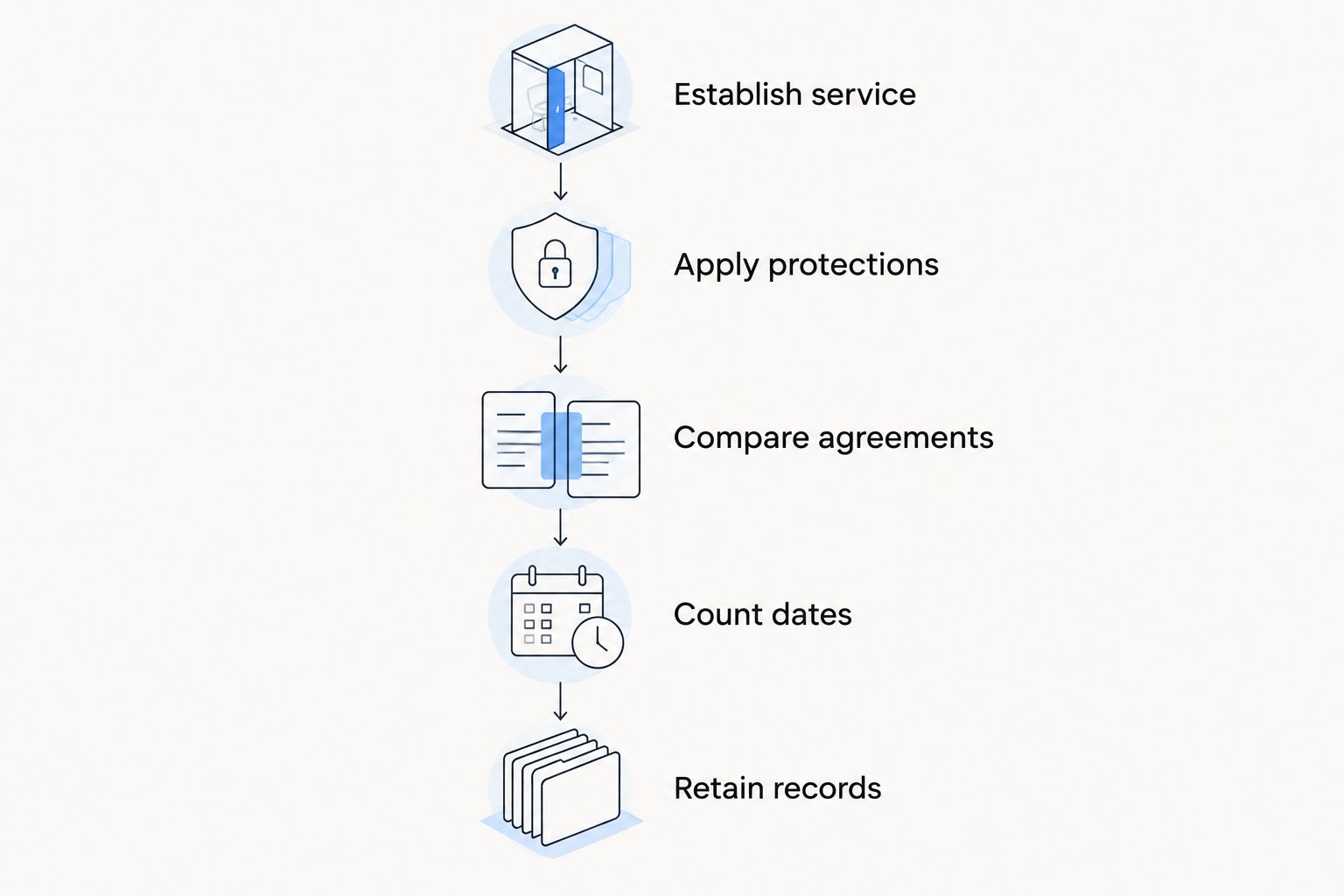
Use the statutory table to configure entitlement, not to estimate how much leave employees will take. For your 2026 policy, separate the following decisions.
Establish service
Identify the employee’s qualifying service with the employer before selecting a band. Use the relevant service history, not only the start date displayed on the current contract.
Best for: setting the legal entitlement boundary. The benefit is a service-based rule you can explain; the limitation is that the start date alone does not resolve every interrupted-service or employer-history case.
Apply protections
Check whether the employee falls within an age-protected category or performs underground work. Apply the legal protection before approving the annual allocation.
Best for: preventing a standard rule from understating protected entitlements. A shared baseline makes administration simpler, but one uniform allowance does not cover every employee category.
Compare agreements
Read the employment contract, collective agreement and applicable workplace policy. Article 53 permits annual leave periods to increase through employment contracts and collective agreements.
Best for: distinguishing the legal floor from the employer’s promise. A more generous allowance benefits employees, but you must retain the agreement that explains why their allocation exceeds the statutory band.
Count dates
Calculate the requested dates using the employee’s actual weekly rest arrangement and the public-holiday calendar. Keep the entitlement allocation separate from the number of days deducted for a specific absence.
Best for: approving a request without consuming excluded days. A calendar calculation resolves the deduction, but it does not establish whether the starting entitlement was correct.
Retain records
Record the entitlement, approved dates, deducted days and remaining balance. Preserve the source of any adjustment so the next payroll or HR reviewer can understand the change.
Best for: reconciling leave across HR and payroll. A balance is useful for daily administration; without its supporting history, it does not explain how the employee arrived there.
When annual leave entitlement begins
An employee covered by Article 53 becomes entitled to statutory annual paid leave after at least 1 year of employment, including the probation period. The qualifying year is not automatically the calendar year from January to December.
For example, an employee who completes their qualifying year during 2026 reaches the entitlement milestone then. Starting a new calendar year does not, by itself, create a completed year of service.
Article 54 requires relevant periods worked at one or more workplaces of the same employer to be considered when calculating qualifying service. Article 55 also identifies periods treated as worked for annual leave purposes. Do not deduct every absence from qualifying service without checking its legal treatment.
Keep these concepts separate:
- Employment start: the beginning of the relevant employment relationship.
- Qualifying service: service calculated under the annual leave rules.
- Entitlement date: the point at which the employee earns the annual entitlement.
- Leave-use dates: the dates approved for taking the entitlement.
An employer can grant leave before statutory eligibility through its own arrangements. That does not change the legal qualifying period. Record whether the arrangement is an advance against future entitlement or a separate contractual benefit, rather than leaving the treatment implicit.
What counts as an annual leave day?
Article 56 excludes national holidays, public holidays and weekly rest days that fall within an annual leave period from the annual leave calculation. The span of an absence and the leave deduction are different measurements.
A request can cover consecutive calendar dates while consuming fewer annual leave days. The deduction depends on which dates are legally excluded, not simply on the distance between the departure and return dates.
| Date or absence type | Annual leave treatment | What you should check |
|---|---|---|
| Ordinary working day within approved annual leave | Counts toward leave used | Approved schedule and leave dates |
| Weekly rest day within the leave period | Does not count | Employee’s weekly rest arrangement |
| National or public holiday within the leave period | Does not count | Applicable holiday date and duration |
| Saturday | Requires a specific assessment | Contract, collective agreement and working arrangement |
| Other paid or unpaid leave granted during the year | Cannot be offset against annual leave under Article 56 | Correct absence category |
Do not assume every Saturday is excluded
A five-day office schedule does not settle the treatment of Saturday for every employee. The legal and contractual character of that day matters.
Check whether the relevant documents designate Saturday as a weekly rest day or otherwise establish its treatment for annual leave. If your policy treats all weekends identically without examining those documents, review the rule before applying it across the workforce.
For shift teams, use the actual weekly rest arrangement rather than a Monday-to-Friday template. Your attendance workflow should identify the absence category without treating every day away from a shift as annual leave. The PDKS-to-payroll workflow guide covers the broader relationship between attendance records and payroll.
Splitting leave and planning coverage
Annual leave can be taken in parts by agreement between employer and employee, provided one part is at least 10 days under Article 56. The rule does not mean every leave request must last 10 days.
Use the requirement when reviewing the employee’s annual leave plan as a whole. A shorter request needs to fit within an arrangement that preserves the required qualifying block.
For your 2026 planning process:
- Identify the employee’s available entitlement before discussing dates.
- Check that the agreed split includes a part of at least 10 days.
- Exclude weekly rest days and public holidays when calculating that part.
- Record the approved dates and the resulting deduction separately.
- Arrange coverage without replacing the entitlement with informal time off.
Manager approval governs scheduling; it does not remove the statutory right. A rejected date request and a rejected leave entitlement are not the same decision. Keep the reason for a scheduling change separate from the employee’s available balance.
Article 56 also provides for up to 4 days of unpaid travel leave when an employee requests it and documents that annual leave will be spent somewhere other than the location of the workplace. Treat this as a separate absence category, not an automatic addition to paid annual leave for every trip.
Statutory minimum versus employer benefit
The statutory entitlement is a floor. An employment contract or collective agreement can provide longer periods, and your administration must reflect the applicable promise.
Do not describe a standard legal entitlement as an additional employer benefit. Conversely, do not replace a more generous contractual allowance with the lower legal minimum merely because the benchmark table shows fewer days.
| Approach | Best for | Benefit | Limitation |
|---|---|---|---|
| Statutory minimum schedule | Establishing the legal baseline | Clear service bands and protected categories | Does not describe the full contractual benefit |
| Enhanced contractual schedule | Providing leave above the legal floor | Makes the additional entitlement explicit | Requires accurate agreement and policy records |
| Individual balance reconciliation | Checking an employee’s current position | Connects entitlement, use and adjustments | Depends on reliable historical records |
A useful policy states which entitlement applies, when it is earned, how requests are approved and how excluded dates are counted. It also explains the relationship between statutory and additional contractual leave.
Ottohr’s annual leave benchmark is a legal baseline for growing employers, not a ranking of workplace generosity. Compare employer policies only after separating statutory days from additional benefits. Otherwise, two apparently identical allowances can represent different commitments.
Payroll treatment and unused leave
Annual leave is paid leave. Article 57 regulates payment of annual leave wages, including payment or advance payment before leave begins. Do not process approved statutory annual leave as an unpaid absence.
Unused annual leave is also different from an ordinary payroll adjustment. Article 59 requires payment for unused annual leave when the employment contract ends, calculated using the employee’s wage at termination.
Do not replace statutory annual leave with cash while employment continues. The right to annual leave cannot be waived under Article 53. Paying an amount during employment does not substitute for allowing the employee to exercise that right.
Before a termination payroll calculation, reconcile:
- Entitlements earned under the applicable service bands.
- Protected or additional contractual entitlements.
- Leave actually taken and supported by records.
- Corrections to previously recorded deductions.
- The remaining unused entitlement.
Keep the annual leave calculation separate from severance calculations. Both can involve service history, but they serve different legal purposes and follow different rules.
For 2026 payroll operations, the practical control is simple: the HR balance and the termination calculation must refer to the same reconciled leave history. A balance copied without reviewing its underlying records is not a completed reconciliation.
Records that make the balance explainable
The Annual Paid Leave Regulation, published on 3 March 2004 in Official Gazette No. 25391, requires employers to keep annual leave records. Its scope is annual paid leave administration under the Labour Law, not a survey of employer practices.
Build an employee-level record that answers three questions: what was earned, what was taken and what remains. Supporting documents should make the answer reproducible rather than dependent on someone remembering a verbal approval.
Keep the following information connected:
- Relevant employment and qualifying-service dates.
- The service band used for each allocation.
- Applicable age or occupational protection.
- The contractual basis for additional entitlement.
- Requests, approvals and actual leave dates.
- Excluded holidays and weekly rest days.
- Corrections and the reason for each correction.
Ottohr covers HR, payroll and compliance within its stated platform scope. When assessing any HR platform, ask how your team will retain and review these records; a displayed total alone does not explain the legal calculation.
FAQ
What does yıllık izin kaç gün mean for an employee in Turkey?
The standard statutory minimum is 14, 20 or 26 days of paid annual leave, depending on completed qualifying service with the employer. Age protections, underground work and more generous agreements can increase the applicable entitlement.
How many annual leave days do I get after five years?
Exactly five completed qualifying years remains in the 14-day statutory band. The 20-day service band applies above five years and below 15 years, subject to any higher protected or contractual entitlement.
How much annual leave do employees aged 50 or older receive?
Employees aged 50 or older receive at least 20 days under Article 53. An employee entitled to 26 days through seniority retains that higher minimum.
Does the probation period count toward annual leave eligibility?
Yes, the probation period counts toward the one-year qualifying period under Article 53. Qualifying service must also be assessed under the relevant service-counting rules.
Do public holidays reduce my annual leave balance?
No, national and public holidays falling within annual leave are excluded from the leave calculation. Weekly rest days are also excluded under Article 56.
Can I take annual leave in separate short breaks?
Yes, annual leave can be divided by agreement, provided one part is at least 10 days. Shorter requests must fit within an agreed arrangement that preserves that required part.
Can my employer pay me instead of letting me take annual leave?
An employer cannot replace statutory annual leave with cash while employment continues. Unused annual leave becomes payable when the employment contract ends under Article 59.
Are these benchmarks average employer allowances for 2026?
No, these benchmarks are statutory minimums under Turkey’s Labour Law. Employment contracts and collective agreements can provide longer annual leave periods.
One last thing
Audit the fifth and fifteenth service anniversaries before changing your 2026 leave settings. Five completed years still sits in the lower service band; 15 completed years enters the highest ordinary band.
Then review excluded dates. A correct entitlement can still produce an incorrect balance if the system deducts a public holiday or weekly rest day. Ottohr’s HR platform serves growing employers, but the same control applies regardless of your software: verify the entitlement rule and the date calculation separately.


