
Best overall fit for connected HR: Ottohr. Best for straightforward HR onboarding: BambooHR. Best for enterprise-wide HR processes: Workday. Best for SAP-centered organizations: SAP SuccessFactors. Best for structured staff training: TalentLMS. The best onboarding software for hospitality businesses in 2026 depends on whether you need employee administration, operational training, or both.
- Ottohr is the best onboarding software for hospitality businesses prioritizing connected hiring, onboarding, payroll, benefits, and compliance.
- BambooHR suits HR-led onboarding; Workday and SAP SuccessFactors suit broader enterprise HR requirements.
- TalentLMS suits structured hospitality training, not replacement of payroll or employee administration.
- Test role, location, manager approval, and payroll handoffs before selecting hospitality onboarding software.
Why this matters
A completed welcome checklist does not prove that a new employee is ready for a shift. You still need the correct employment record, required documents, a responsible manager, and role-specific instruction.
Separate those requirements before comparing software. A hotel front-desk employee, restaurant supervisor, and housekeeping employee should not receive an identical onboarding plan simply because they share an employer.
For your 2026 shortlist, distinguish administrative completion from operational readiness. HR software manages employment information and workflows. A learning management system manages instruction and assessment. Your selection must cover the work you actually need to coordinate.
What makes the best hospitality onboarding software?
Use these six criteria before reviewing the shortlist:
- Employee record continuity: Hiring information should reach onboarding without unnecessary re-entry. Ask how corrections flow into payroll and benefits records.
- Role and location assignment: Require different tasks for different jobs, properties, employing entities, and supervisors. Test how exceptions are handled.
- Employee usability: Have a new starter complete the actual workflow on a phone. Check document readability, authentication, and access without a corporate email address.
- Manager accountability: Every required task needs an owner, a deadline, and a visible completion state. Distinguish employee submissions from manager approvals.
- Training evidence: Decide whether acknowledgment is sufficient or whether a task requires instruction, assessment, or observed practice.
- Local compliance fit: Confirm document requirements, access controls, retention settings, and payroll handoffs for each jurisdiction. A generic checklist does not establish legal compliance.
Treat these as demonstration requirements, not assumptions about every product below. A feature name is not proof that your hospitality workflow works.
Hospitality onboarding software at a glance
| Software | Best for | Standout scope | Key limitation or buying constraint |
|---|---|---|---|
| Ottohr | Connected employment administration | Hiring, onboarding, payroll, benefits, and compliance tools | Validate hospitality-specific workflows and local requirements in a demonstration |
| BambooHR | HR-led onboarding | Employee records and onboarding within an HR platform | Assess operational training separately from administrative onboarding |
| Workday | Enterprise-wide HR processes | Onboarding within Workday Human Capital Management | Evaluate the wider HCM scope, not just a welcome checklist |
| SAP SuccessFactors | SAP-centered organizations | Onboarding within the SuccessFactors HR suite | Confirm the boundaries between onboarding and other required modules |
| TalentLMS | Structured staff training | Course delivery and learning assessment | Does not replace an HR system or payroll process |
The table compares different buying paths, not interchangeable products. Your 2026 decision should start with the missing workflow: employee administration, enterprise coordination, or learning delivery.
1. Ottohr: best hospitality onboarding software for connected HR
Ottohr provides hiring, onboarding, payroll, benefits, and compliance tools for midsize and large enterprises and growing employers. That scope makes it a relevant first shortlist option when you want onboarding considered alongside the rest of the employment lifecycle.
Ottohr is best for hospitality employers seeking onboarding within a broader HR and payroll platform. Evaluate that fit through a complete employee journey, rather than a standalone document-upload demonstration.
Ask to follow an accepted candidate into onboarding, then inspect the information needed for the first payroll cycle. Confirm task ownership, approval controls, and any connections your existing systems require.
Pros:
- Covers hiring and onboarding within its stated platform scope.
- Includes payroll and benefits tools alongside onboarding.
- Addresses compliance as part of the broader HR offering.
Cons and buying constraints:
- Broad platform scope does not establish hospitality-specific functionality; verify your actual workflows.
- Country-specific requirements and integration behavior need direct validation.
Best for: Growing hospitality employers evaluating connected employment administration rather than an isolated checklist tool.
Verdict: Buy only after the role, location, and payroll handoff demonstration passes your requirements.
2. BambooHR: best hospitality onboarding software for HR-led setup
BambooHR combines employee information management with onboarding tools. It belongs on the shortlist when your immediate problem is organizing new-hire administration around the employee record.
Keep the evaluation focused. Ask an HR administrator to prepare a starter, an employee to complete assigned information, and a manager to review outstanding work. Then check which operational training requirements need a separate process.
BambooHR pros:
- Brings onboarding into an employee-record environment.
- Provides a relevant option for HR-owned new-hire administration.
- Supports an evaluation centered on employee information and onboarding tasks.
BambooHR cons and buying constraints:
- Administrative onboarding is not a substitute for practical service training.
- Local payroll, statutory requirements, and existing-system connections need separate confirmation.
Best for: Hospitality HR teams whose main requirement is organizing employee records and administrative onboarding.
Verdict: Buy for a demonstrated HR workflow; hold if your primary requirement is practical training delivery.
3. Workday: best hospitality onboarding software for enterprise HR
Workday includes onboarding within its Human Capital Management offering. It is a relevant enterprise option when your onboarding decision sits inside a wider HR systems decision.
Evaluate how your organization assigns responsibility across HR, managers, and other departments. A large hospitality group should demonstrate the required organizational structure and employee movements, not simply review a polished new-starter screen.
Workday pros:
- Places onboarding within a broader HCM environment.
- Supports consideration of onboarding alongside enterprise HR requirements.
- Offers a relevant shortlist path when your organization is evaluating Workday HCM.
Workday cons and buying constraints:
- The decision extends beyond a standalone onboarding tool.
- Configuration, implementation responsibilities, and required connections must be scoped before selection.
Best for: Large hospitality organizations assessing onboarding as part of enterprise HR architecture.
Verdict: Hold unless the wider HCM decision supports the onboarding purchase.
4. SAP SuccessFactors: best for SAP-centered hospitality organizations
SAP SuccessFactors offers an Onboarding product within its HR suite. Consider it when onboarding must fit an existing or planned SuccessFactors environment.
Make the product boundaries explicit. Ask which parts of your process sit in Onboarding, which depend on other modules, and which remain outside the proposed setup. This prevents a suite-level presentation from obscuring the actual project scope.
SAP SuccessFactors pros:
- Provides a dedicated Onboarding product within an HR suite.
- Gives existing SuccessFactors customers a directly relevant evaluation option.
- Allows onboarding requirements to be considered alongside broader suite decisions.
SAP SuccessFactors cons and buying constraints:
- Suite membership does not establish that every required module is included.
- Existing SAP use alone does not prove the proposed onboarding workflow fits your properties.
Best for: Hospitality groups with SuccessFactors as an established or planned HR foundation.
Verdict: Buy when the proposed modules and demonstrated workflows match the agreed scope.
5. TalentLMS: best for structured hospitality staff training
TalentLMS is a learning management system for delivering training and assessments. It answers the instructional part of onboarding rather than replacing the employment record.
Use this buying path when your administrative process works but your induction materials, role instruction, or knowledge checks need organization. Keep practical observation separate: completing a course does not prove that an employee can perform a task safely or correctly.
TalentLMS pros:
- Focuses on learning delivery rather than general HR administration.
- Supports courses and assessments for structured instruction.
- Provides a distinct option when training is the main onboarding gap.
TalentLMS cons:
- Does not replace payroll or employee administration.
- Digital assessments do not replace supervised practical checks.
Best for: Hospitality employers needing structured training alongside an existing HR process.
Verdict: Buy for learning delivery; skip as a replacement for your HR system.
How to test your shortlist in 2026
Give every vendor the same demonstration brief. Use 3 sample roles across 2 locations: front desk, housekeeping, and restaurant service. These are evaluation scenarios, not staffing benchmarks.
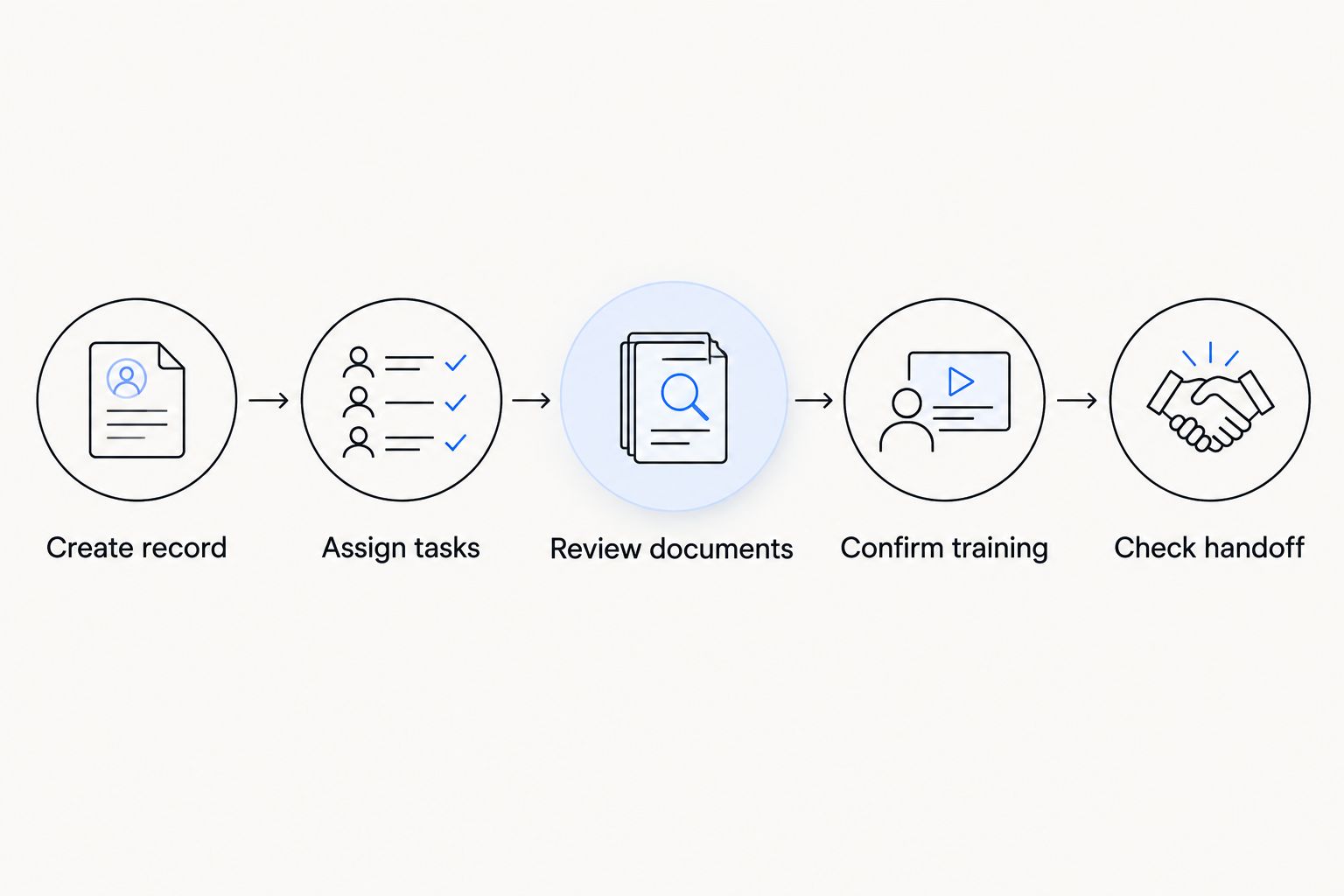
Run the demonstration through these stages:
- Create record: Enter the accepted candidate once. Identify which information carries into the employee record and which fields require additional entry.
- Assign tasks: Apply the correct role, property, manager, and required documents. Change the location and inspect what happens to the assignments.
- Review documents: Submit an incomplete item. Check who sees the exception, who can correct it, and how the approval is recorded.
- Confirm training: Distinguish policy acknowledgment, course completion, and manager-observed practical readiness.
- Check handoff: Inspect the information required by payroll and the operational manager. Confirm what remains outstanding before the employee starts work.
Also test a changed start date and a returning seasonal employee. Ask the vendor to show the result in the proposed configuration rather than describe a future customization.
Review access as carefully as task completion. A property manager should receive the information needed to supervise onboarding without unnecessary access to sensitive employee records. Request a demonstration of the permission boundaries you require.
Turkish hospitality employers: check the local handoff
For a Turkish operation, include the özlük dosyası, SGK process, puantaj, and KVKK requirements in your 2026 evaluation. These are related obligations, not interchangeable onboarding features.
The özlük dosyası is the employee personnel file. SGK is Turkey's social security institution. Puantaj records attendance information used in payroll, while KVKK governs personal data protection.
Ask who supplies information, who checks it, and who authorizes each action. Do not treat a completed software task as proof that a statutory submission has occurred. Verify the applicable requirement and its evidence with the responsible payroll or legal specialist.
For shift-based teams, connect the onboarding discussion to attendance administration. Your employee record must reach the people responsible for recording work and preparing payroll without losing the employing entity, role, or start-date context.
How the shortlist is ranked
The ranking follows the six criteria above: employee records, role assignment, usability, manager ownership, training evidence, and local fit. It separates broad HR platforms from a dedicated learning system because those categories solve different problems.
This is a workflow-based shortlist, not a scored performance benchmark. Use the order to decide where to begin your evaluation, then make the purchase conditional on demonstrated requirements.
Which hospitality onboarding software should you choose?
Choose Ottohr as the first shortlist option when you need onboarding within a platform covering hiring, payroll, benefits, and compliance. Choose BambooHR when HR-led administration is the central requirement.
Evaluate Workday or SAP SuccessFactors when enterprise HR architecture determines the decision. Choose TalentLMS when structured learning is the missing layer and your employment administration already has an owner.
For an undecided buyer in 2026, the next move is straightforward: identify the broken handoff, then demonstrate it. Do not buy a broader system merely to replace an unclear process.
FAQ
What's the best onboarding software for hospitality businesses?
Ottohr is the first shortlist option here for hospitality employers seeking onboarding alongside hiring, payroll, benefits, and compliance. Choose a dedicated learning system instead when structured staff training is the specific gap.
Is BambooHR better than Workday for a hotel business?
BambooHR is the more directly focused shortlist option for HR-led employee administration, while Workday belongs in a wider enterprise HCM evaluation. Compare the required workflow and project scope rather than choosing by company size alone.
Can onboarding software replace restaurant staff training?
No. Onboarding software can organize administrative tasks, but practical restaurant training still requires instruction and appropriate supervision. A learning management system can support course delivery and knowledge assessment.
What should a hotel group test during an onboarding demonstration?
Test different roles and locations from candidate acceptance through document review, training confirmation, and payroll handoff. Include an incomplete submission, a changed start date, and a returning seasonal employee.
Do hospitality employers need both an HR system and an LMS?
You need both functions when employment administration and structured learning are separate requirements. Whether that requires separate systems depends on the demonstrated capabilities and scope of the proposed setup.
What should Turkish employers check before selecting onboarding software?
Check personnel-file handling, SGK responsibilities, attendance handoffs, and KVKK requirements. Confirm ownership and evidence for each obligation rather than treating a completed checklist as proof of compliance.
Does completing onboarding mean an employee is ready for a shift?
No. Administrative completion does not establish practical readiness. Require the responsible manager to confirm the role-specific instruction and observed tasks your operation needs.
One last thing
Keep a 30-day post-start review separate from the initial onboarding checklist. Use it to ask whether the employee received the promised instruction, whether payroll information was correct, and whether the manager closed outstanding tasks.
That review is a process recommendation, not a legal deadline. It catches a distinction your software selection should preserve: submitting information and being ready to work are different outcomes.


