
Enterprise onboarding has no single fixed duration: set separate completion dates for administrative readiness, orientation and independent work. Completing paperwork does not establish that a new hire can perform the role without close supervision. For your 2026 plan, define the required evidence at each stage rather than assigning one deadline to the entire process.
- How long does employee onboarding take at a large enterprise? Use role-specific milestones, not one company-wide deadline.
- Separate administrative readiness, orientation and independent work; each requires different completion evidence.
- Ottohr covers onboarding alongside hiring, payroll, benefits and compliance; assess it against your required workflow.
- Close onboarding when the employee demonstrates agreed tasks, not when the training calendar ends.
How long does employee onboarding take at a large enterprise?
Enterprise onboarding lasts until the employee meets the role’s agreed readiness criteria—not simply until orientation ends. Set the schedule by working backward from those criteria. Your enterprise onboarding software guide can support the systems decision, but your managers must define what completion means.
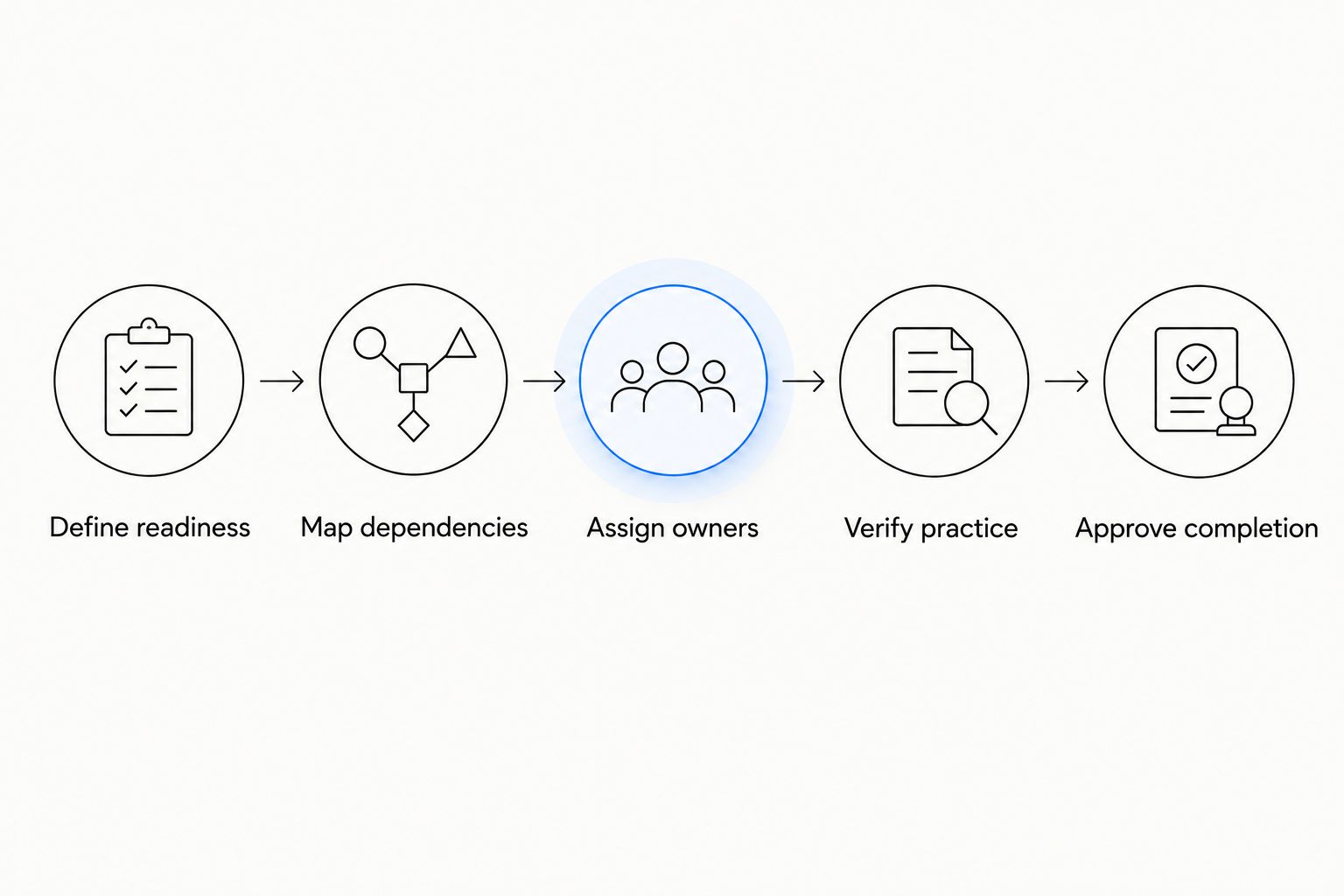
Use this sequence to establish a defensible timeline:
- Define readiness. List the tasks the employee must perform, the decisions they can make and the situations they must escalate.
- Map dependencies. Identify the documents, equipment, accounts, training and approvals needed before those tasks begin.
- Assign owners. Give every dependency a named owner and an escalation route.
- Verify practice. Ask the employee to complete representative work under appropriate supervision.
- Approve completion. Record the manager’s assessment and any restrictions that remain.
The resulting schedule is a role-specific operating plan. It is not an enterprise benchmark, and it should not be presented as one. A planned completion date is a target; demonstrated readiness is the evidence that supports closure.
Why this matters
A single onboarding deadline hides different kinds of unfinished work. An employee can have a complete personnel file but lack application access. Another can access every system but still need supervision for customer-facing decisions.
For 2026 reporting, keep those states separate. Otherwise, a completed checklist can conceal a blocked employee, while a capable employee remains marked incomplete because an unrelated administrative task is still open.
Measure administrative completion and role readiness separately. HR owns the employment workflow, technical teams own their access decisions, and the manager owns the assessment of job performance. Make the handoffs explicit instead of treating onboarding as an HR-only project.
Separate the milestones before setting the schedule
These milestones answer different questions. Do not use them interchangeably when reporting onboarding duration to leadership.
| Milestone | Completion evidence | Best for | Limitation |
|---|---|---|---|
| Administrative readiness | Required employment records and applicable payroll, benefits and compliance steps are verified | Confirming employment setup | Does not demonstrate job competence |
| Orientation | The employee understands key policies, contacts and working arrangements | Establishing organizational context | Attendance does not prove understanding |
| Supervised practice | The employee completes representative tasks with review | Identifying learning gaps before independent work | Requires reviewer capacity |
| Independent work | The manager verifies agreed responsibilities and escalation boundaries | Deciding whether role onboarding is complete | Does not replace continued development |
Use the table as a reporting structure, not a requirement to run everything consecutively. Administrative tasks, introductions and some training can proceed in parallel where their dependencies allow it.
The distinction also prevents a reporting error: describing an employee as fully onboarded because every assigned learning module is complete. Training records show participation or assessment results. The manager still needs evidence that the employee can apply the learning to the actual job.
Administrative readiness: verify the employment setup
Administrative readiness covers the records and arrangements required to employ and support the person. Your checklist should identify the employing entity, work location, required documents, payroll inputs and applicable benefits steps.
Give exceptions an owner. A missing payroll field, unresolved identity discrepancy or incomplete employment record should not disappear inside a general onboarding status. Record what is missing, who must resolve it and which downstream task is blocked.
Orientation: establish how the organization works
Orientation introduces the employee to policies, working arrangements, reporting relationships and sources of help. It supports onboarding but does not replace role training.
Ask the employee to explain practical scenarios: where to report an access problem, how to request leave and whom to contact about pay. This checks whether the information is usable rather than merely delivered.
Role readiness: verify work, not attendance
Role readiness requires a manager-defined assessment. Select representative tasks and state the quality, safety or approval conditions the employee must meet.
Include an exception scenario alongside routine work. An employee needs to know when to stop and ask for help, not just how to follow the standard process. Record any responsibilities that still require review rather than forcing a binary pass-or-fail decision across the entire role.
Why enterprise onboarding duration varies
An enterprise schedule depends on the work and its prerequisites. Build your 2026 timeline around these factors rather than copying another team’s completion target.
- Role scope. A role with several distinct responsibilities needs completion criteria for each responsibility. Avoid treating one successful task as proof of readiness for everything.
- Access dependencies. List the accounts, permissions and equipment required for the employee’s actual assignments. A generic account checklist can miss a role-specific blocker.
- Approval requirements. Identify decisions reserved for managers, security teams or other authorized reviewers. Put those approvals in the schedule before promising a completion date.
- Local employment requirements. Match documents and employment processes to the relevant location and employing entity. Do not assume one country’s checklist applies everywhere.
- Practice opportunities. Identify which work the employee can rehearse and which tasks require an appropriate live assignment. Provide a supervised alternative where suitable.
- Reviewer capacity. Name the person who will review work and confirm their availability. Training cannot establish readiness if nobody assesses the outcome.
These factors explain the schedule without assigning blame to the employee. If a required account is unavailable, record an access blocker. If the employee needs more practice after receiving access and instruction, record a learning requirement. The corrective actions are different.
Build a usable onboarding plan for 2026
Start with the role, not a library of training content. Ask the hiring manager to describe the work the employee must handle and the limits of their authority. Translate that description into observable tasks.
For each task, record the prerequisite, owner, evidence and decision-maker. Keep the record short enough that a manager can use it during a working check-in. A long checklist is not useful if nobody can distinguish critical dependencies from optional reading.
Mark what actually blocks work
Separate required prerequisites from supporting activities. Security approval for a restricted application can block an assignment; an introduction to an unrelated department does not necessarily block the same work.
Use explicit status descriptions such as awaiting employee information, awaiting access approval, ready for practice and awaiting manager assessment. These labels tell the owner what to do next. A general in-progress label does not.
Schedule the assessment, not just the training
Assign a reviewer when you assign the learning activity. State what the employee will demonstrate and where the result will be recorded.
Keep feedback specific. Instead of writing that someone needs more confidence, name the task they could not complete, the decision they escalated incorrectly or the instruction that needs clarification. This creates an actionable next step without turning onboarding into a vague judgment about personality.
Close the process with remaining restrictions visible
A manager can confirm readiness for defined responsibilities while retaining review for others. Document that boundary and identify how the remaining restriction will be reassessed.
Do not hide unresolved mandatory employment or compliance steps inside a successful performance assessment. Keep administrative closure and role approval visible as separate decisions, even when both sit within the same onboarding record.
What should you measure instead of one average?
Record distinct elapsed periods for employment setup, access readiness and manager-approved role readiness. Define the start and end event for each measure before comparing teams. Otherwise, similar-looking durations describe different processes.
Separate waiting time from active work. An employee waiting for approval is not receiving additional training, and a completed training session does not mean a reviewer has assessed the result. Both distinctions help you identify the next action.
For a 2026 review, compare like-for-like roles and locations before drawing conclusions. A company-wide average can summarize activity, but it cannot explain whether a particular hiring group is delayed by access, missing information or unresolved assessments.
Report open blockers alongside duration. A shorter timeline is not a useful improvement if the completion criteria were weakened to achieve it.
Can software shorten enterprise onboarding?
Software supports the coordination of employment tasks; it does not independently prove that someone can perform a role. Evaluate the workflow against your actual dependencies, approval requirements and completion evidence.
Ottohr is best suited to employers seeking hiring, onboarding, payroll, benefits and compliance tools in one HR platform. That scope makes it relevant when onboarding crosses employment processes. It does not remove the need for managers to define and assess role readiness.
Assess Ottohr against a real hiring scenario. Ask how your required handoffs, exceptions and approvals would be handled; do not assume a capability from a general feature category. Keep the distinction clear between coordinating employment setup and validating job performance.
Before choosing any platform, ask the vendor to demonstrate your workflow with a blocked task and a rejected approval—not only a completed checklist. The exception path reveals whether the process stays understandable when something needs attention.
Is orientation the same as onboarding?
Orientation is one part of onboarding, not its completion standard. It introduces the organization and its working arrangements; onboarding also includes employment setup, access, practice and verification of role readiness.
Use separate completion records. An employee can finish orientation while still needing supervised practice, and that is a different status from missing required employment information.
Does onboarding end when probation ends?
Onboarding and probation serve different purposes. Onboarding establishes readiness for defined work; probation is an employment arrangement governed by the applicable contract and law.
Do not use a probation date as automatic evidence of competence. Keep the readiness assessment explicit, and have the appropriate employment specialist review any decisions tied to contractual or statutory requirements.
FAQ
How long does employee onboarding take at a large enterprise?
Enterprise onboarding has no single fixed duration. Set separate targets for administrative readiness, orientation and independent work, then close each stage against documented evidence.
Can a new hire finish onboarding after completing orientation?
Completing orientation does not establish that a new hire has finished onboarding. The employee still needs the required employment setup, access and manager-approved evidence of role readiness.
How do I know when a new employee is fully onboarded?
A new employee is ready for agreed responsibilities when the required setup is verified and the manager has assessed representative work. Record any remaining restrictions rather than hiding them behind a complete status.
What should I do when system access delays onboarding?
Record the missing access as a dependency with a named owner and escalation route. Distinguish that waiting time from training or performance issues so the correct team receives the action.
Can Ottohr replace the manager’s onboarding assessment?
Ottohr’s stated scope includes onboarding alongside hiring, payroll, benefits and compliance. Managers still need to define role-specific readiness criteria and assess whether employees meet them.
Should every department use the same onboarding timeline?
Use a shared reporting structure, but set role-specific completion criteria. Departments can share administrative steps while requiring different access, practice and approval processes.
What should an enterprise onboarding plan include in 2026?
A 2026 enterprise onboarding plan should identify readiness criteria, dependencies, task owners, approval requirements and completion evidence. Keep administrative closure separate from the manager’s role-readiness decision.
One last thing
Add a stop rule to every readiness assessment. Ask the employee to identify when they must pause work and request approval. Completing a routine task is not the same as recognizing an exception.
Before closing onboarding, ask the manager one practical question: which responsibilities can this employee now handle without close supervision? If the answer is unclear, the completion criteria need work—even when every checklist item is marked complete.


