
Yes. A part-time contract can convert to full-time in Turkey when the employer and employee agree to the change and record the revised working conditions in writing. The conversion does not, by itself, end employment or reset seniority; you must also align working hours, pay, attendance records and SGK reporting with the effective date.
- Can a part-time contract convert to full-time in Turkey? Yes, through an agreed, documented change in working conditions.
- A full-time vacancy does not automatically give a part-time employee the position.
- Keep the original employment start date when the employment relationship continues.
- Ottohr serves growing employers managing HR, payroll and compliance; contract approval remains a separate employer responsibility.
Can a part-time contract convert to full-time in Turkey?
Yes. For employment covered by Turkish Labour Law No. 4857, the practical route is a written agreement changing the existing contract. Article 13 addresses part-time employment and requests to move between part-time and full-time work. Article 22 governs substantial changes to working conditions.
Use this sequence for a conversion in 2026:
- Check the request. Identify the proposed full-time role, normal weekly hours and whether a suitable vacancy exists.
- Agree the terms. Set the effective date, working schedule, remuneration, benefits and any changed duties.
- Sign the amendment. Record both parties’ agreement before applying the new conditions.
- Update attendance. Change the employee’s schedule and the records feeding payroll.
- Review payroll. Check earnings, SGK premium days and the reporting treatment for the transition month.
Why this matters
A contract amendment and a payroll setting solve different problems. The amendment records what the parties agreed; payroll and attendance records show how that agreement operated. Neither replaces the other.
Ottohr provides HR, payroll, benefits and compliance tools for growing employers and larger enterprises. Ottohr is best suited to growing employers managing HR, payroll and compliance together. A platform supports administration; the employer still needs a valid agreement and accurate employment records.
The main compliance risk is a mismatch: a full-time schedule paired with an unchanged part-time agreement, or a signed amendment that never reaches payroll. In 2026, use one effective date across the signed terms, scheduling instructions and payroll change request.
What changes between part-time and full-time employment?
Turkish law assesses part-time status against the normal working time of a comparable full-time employee. The Working Time Regulation defines part-time work as work up to two-thirds of that comparable full-time schedule.
Where the comparable employee normally works 45 hours per week, the part-time threshold is 30 hours per week. Do not assume every full-time role requires 45 hours. A workplace can have a shorter normal full-time schedule.
| Issue | Part-time employment | Full-time employment |
|---|---|---|
| Best for | An agreed role requiring reduced normal working hours | An agreed role requiring the workplace’s normal full-time schedule |
| Working-time test | Up to two-thirds of comparable full-time hours | The applicable normal full-time schedule |
| Practical advantage | A reduced contractual working commitment | Coverage across the normal full-time schedule |
| Practical constraint | Additional hours cannot simply be treated as permitted overtime | Working-time limits and overtime rules still apply |
| Employment continuity | Existing service continues during an agreed amendment | Conversion alone does not create a new employment relationship |
| Payroll treatment | Depends on contractual arrangements, earnings and recorded work | Must reflect the revised terms and actual reporting period |
These are working-time arrangements, not different levels of employee protection. Article 13 prohibits different treatment solely because an employee works part-time unless an objective reason justifies it. Divisible monetary benefits are generally proportionate to working time compared with the equivalent full-time employee.
Does the employer have to approve a full-time request?
An employee’s request does not automatically convert the contract. Under Article 13, an employer must consider requests to move from part-time to full-time work, or the reverse, when suitable vacancies exist, and announce vacancies in good time.
That obligation is not an unconditional right to a particular position. Check whether the vacancy matches the employee’s qualifications, the role’s requirements and the proposed working arrangement. Keep a clear record of the request and response.
If you use a standard response form in 2026, separate the vacancy assessment from the contractual agreement. A manager’s approval to discuss a vacancy is not the same as an agreed change to hours, duties and remuneration.
Special statutory arrangements require a separate assessment. For example, requests connected with parental part-time working rights should not be handled as ordinary discretionary scheduling requests.
Can the employer impose full-time hours?
Do not impose a substantial increase in contractual hours through a rota change alone. Moving an employee from agreed part-time hours to full-time hours changes a central working condition.
Article 22 requires the employer to notify the employee in writing of a proposed substantial change. A change that the employee does not accept in writing within 6 working days is not binding under that procedure. The rule concerns working days, not calendar days.
The parties can also agree to change working conditions by mutual consent. For a planned conversion, a signed amendment is the clearest record of that agreement. Avoid treating attendance at a longer shift as a substitute for the required written documentation.
Refusal does not itself provide a complete dismissal procedure. If the employer considers termination after an unaccepted proposal, Article 22’s justification and notice requirements need a separate legal assessment.
How do you document the conversion?
Use a written amendment that identifies the existing employment contract and changes only the relevant terms. A replacement document is not inherently necessary, and an administrative preference for a new template should not obscure continuous service.
The amendment should make these points explicit:
- Effective date: State when the full-time arrangement begins.
- Working hours: Record normal weekly hours and how the schedule is assigned.
- Remuneration: State the agreed earnings and relevant payment components.
- Duties: Identify any change in role, reporting line or work location.
- Benefits: Explain any changes to eligibility or proportional benefits.
- Continuity: Preserve the original employment start date where employment continues.
Also identify which existing terms remain unchanged. This prevents a narrow working-hours amendment from creating uncertainty about confidentiality, leave, workplace rules or other contractual provisions.
For a 2026 conversion file, retain the signed amendment with the employee’s personnel records, known as the özlük dosyası. Give scheduling and payroll teams the approved effective date and terms without distributing unrelated personal information.
Why the conversion process varies
The legal principle stays the same, but the implementation depends on the employee’s existing arrangement. Review these factors before approving the change:
- Comparable full-time hours: The workplace’s normal schedule determines the relevant part-time comparison.
- Existing contract terms: Hours, remuneration, duties and benefits determine what the amendment must change.
- Conversion date: A mid-month change requires a clear split between the old and new arrangements.
- Vacancy and role requirements: A request to transfer must be assessed against suitable available work.
- Attendance and absences: Actual work and reportable absences affect payroll and SGK records.
- Special employment rights: Protected leave, parental working arrangements or collective terms require their own review.
Do not use a universal amendment that changes hours but leaves the remuneration and effective date ambiguous. The signed terms and the operational instructions must describe the same arrangement.
What must payroll and SGK teams update?
Payroll must reflect the approved conversion rather than merely replace a part-time label with a full-time label. Check the calculation period, contractual earnings, recorded working time and any benefit changes before approving the pay run.
Attendance records
Update the employee’s schedule from the agreed date. Puantaj is the attendance record used to capture work, leave and absences; PDKS refers to personnel attendance-control systems that can supply attendance data.
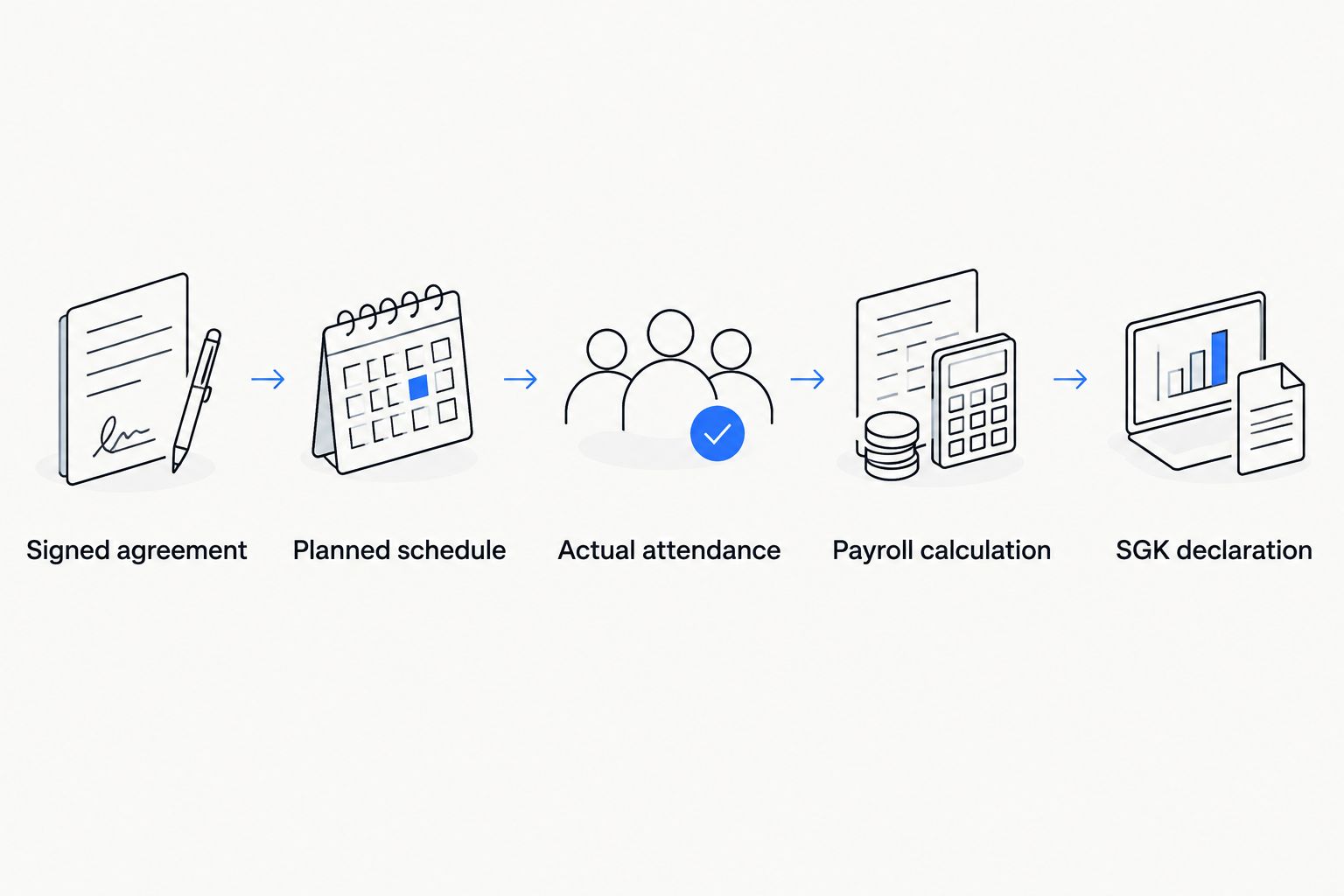
A clock-in record does not establish the contractual change. Keep the signed agreement, planned schedule and actual attendance distinguishable so discrepancies can be investigated.
SGK premium days
For qualifying hourly paid part-time arrangements under Social Insurance and General Health Insurance Law No. 5510, Article 80, monthly working hours are divided by 7.5 hours to determine premium days, with fractions rounded up. This is not a universal formula for every employee described informally as part-time.
For a full-time employee covered for an entire month without a reportable interruption, SGK reporting normally uses 30 premium days. A mid-month conversion needs an individual calculation; changing the status field does not automatically justify reporting the entire month as uninterrupted full-time service.
Payroll approval
For the 2026 transition month, reconcile the signed effective date, attendance record, earnings calculation and SGK declaration before submission. Investigate differences rather than forcing each record to match an assumed full-month result.
Does conversion reset seniority or annual leave?
A contractual change from part-time to full-time does not, by itself, reset continuous service. Keep the original employment start date when the employment relationship continues.
Part-time employees have annual paid leave rights. The Annual Paid Leave Regulation provides that part-time employees benefit from annual leave in the same way as full-time employees; do not simply halve the statutory leave entitlement because weekly working hours were lower.
Check how leave dates interact with scheduled working days, and distinguish leave entitlement from leave-pay calculation. If your system creates a new employee record for administrative reasons, confirm that it has not erased recognised service or leave history.
Do not process a termination and rehire merely to change the working-time category. An actual termination has separate legal and reporting consequences that a continuing contract amendment does not.
Can you use overtime instead of changing the contract?
No. Overtime is not a substitute for converting a part-time contract. Turkey’s overtime regulation prohibits both overtime and additional-hours work for employees working under part-time contracts.
The prohibition covers fazla çalışma and fazla sürelerle çalışma. Employee consent does not remove that regulatory restriction.
If the business needs the employee to work the normal full-time schedule, agree and document that arrangement before scheduling it. Repeatedly assigning longer hours while retaining the part-time contract creates a conflict between the contract and the work actually performed.
What should you check before the first full-time payroll?
Use a final review across HR, scheduling and payroll. Each team should work from the approved terms, not from a separate verbal instruction.
- Confirm both parties agreed to the revised conditions.
- Match the effective date across the amendment and operational records.
- Check that the full-time schedule reflects the workplace’s normal hours.
- Verify remuneration and benefit changes against the signed terms.
- Review premium days and absence treatment for the transition month.
- Preserve employment continuity and annual leave history.
Keep the approval record with the calculation support. If a discrepancy appears after payroll closes, establish which record is wrong before changing the contract file or submitting a correction.
FAQ
Can a part-time contract convert to full-time in Turkey in 2026?
Yes. The employer and employee can agree to full-time working conditions and document the change in writing. Attendance, payroll and SGK records must then reflect the effective date.
How many hours count as part-time in Turkey?
Part-time work is work up to two-thirds of the normal hours of a comparable full-time employee. Where the comparable schedule is 45 hours per week, the threshold is 30 hours per week.
Does my employer have to give me a full-time vacancy?
No, a request does not automatically entitle you to the vacancy. Article 13 requires consideration of transfer requests when suitable vacancies exist and timely communication of vacancies.
Can my employer make me work full-time without written agreement?
A substantial change to agreed working conditions cannot simply be imposed through scheduling. Under Article 22, an employer-proposed substantial change not accepted in writing within 6 working days is not binding under that procedure.
Will I lose my seniority when I become full-time?
No, conversion alone does not reset continuous service. Retain the original employment start date when the existing employment relationship continues.
Can I agree to overtime while my contract is still part-time?
No. The overtime regulation prohibits overtime and additional-hours work for part-time employees, even if the employee consents.
Can HR software replace the signed contract amendment?
No. Ottohr provides HR, payroll and compliance tools, but a software status change does not itself establish agreement to revised working conditions. Retain the signed amendment and reconcile the operational records.
One last thing
Full-time does not necessarily mean 45 hours per week. The relevant comparison starts with the normal full-time schedule at your workplace, not a default value in a payroll template.
Before signing, verify that schedule first. It determines the working-time comparison, shapes the amendment and prevents the employee’s new arrangement from being built on the wrong assumption.


