
Yes. In Turkey in 2026, employers covered by the general working-time rules must document employees’ working hours, but the law does not require every employer to use a particular form called a puantaj sheet. A monthly attendance total alone does not establish compliance: you also need records that support overtime, leave, payroll and social security reporting.
- Is puantaj tracking legally required in Turkey 2026? Working-time records are required; a universal puantaj template is not.
- Puantaj supports payroll and SGK reporting, but attendance totals do not replace underlying working-time evidence.
- Record actual hours, distinguish leave from absence, and retain the evidence behind corrections.
- Ottohr suits growing employers seeking HR, payroll and compliance tools in one platform.
Why this matters
The practical question is whether your records explain what employees worked and how you paid them. A spreadsheet named puantaj can fail that test. A documented electronic process can meet it without reproducing a traditional paper attendance register.
For 2026 payroll controls, separate source attendance data from the approved payroll record. The PDKS turnstile data to automated payroll workflow explains that operational handoff. A door-entry event is evidence of entry, not automatically proof of payable working time.
Is puantaj tracking legally required in Turkey in 2026?
Recording working time is required; using one universally prescribed puantaj format is not. Article 9 of the Working Time Regulation under the Labour Law requires employers to document employees’ working hours by appropriate means. That distinction lets you choose a recording method without removing the underlying duty.
The following legal anchors explain the general framework for employers covered by Labour Law No. 4857. Special employment regimes and sector-specific rules need separate review.
| Legal anchor | What it addresses | What your records should establish |
|---|---|---|
| Working Time Regulation, Article 9 | Documentation of working hours | Actual working time recorded by appropriate means |
| Labour Law No. 4857, Article 63 | General working-time limits and distribution | Daily hours, weekly totals and any applicable averaging arrangement |
| Labour Law No. 4857, Article 41 | Overtime and work beyond contractual hours | Which hours receive which treatment |
| Labour Law No. 4857, Article 37 | Wage statements | The basis for wage components and deductions |
| Labour Law No. 4857, Article 75 | Employee personnel files | Relevant employment records retained in the personnel file |
| Social Insurance Law No. 5510, Article 86 | Social insurance reporting and supporting records | Consistency between employment evidence and SGK declarations |
These provisions address different obligations. A signed puantaj sheet does not replace a wage statement, and an SGK declaration does not replace working-time records. Your process must connect them without treating them as interchangeable documents.
What must your working-time records show?
For an ordinary employment arrangement, your records should let another person reconstruct the working-time calculation. Keep employee identity, the relevant dates, actual working periods, breaks, leave and corrections distinguishable.
Not every useful field is a separately mandated box on a statutory template. The point is evidential clarity: an attendance record should explain the payroll result rather than merely repeat it.
Include these operational fields in your process:
- Employee and period: Identify whose record you are reviewing and which dates it covers.
- Actual working time: Distinguish scheduled hours from hours actually worked.
- Breaks: Keep rest breaks separate from working time when calculating totals.
- Leave and absence: Record the reason and supporting documentation rather than using an unexplained blank cell.
- Additional work: Identify hours requiring overtime or other additional-work treatment.
- Corrections: Preserve the original entry, the reason for change and the approval record.
A manager’s approval is a useful control, not a substitute for accurate entries. Do not turn an unanswered attendance exception into a confirmed absence simply to close payroll.
Which working-time limits should puantaj help you check?
Under the general framework, the normal maximum working week is 45 hours per week. Where working time is distributed differently across working days under the applicable rules, the general daily ceiling is 11 hours per day. The general annual overtime ceiling is 270 hours per year under Article 41.
These are separate checks, not alternative allowances. Staying below an annual overtime total does not excuse exceeding a daily limit. Special rules also apply to particular workers, activities and working arrangements.
Weekly working time: 45 hours per week
The general normal maximum is 45 hours per week, but an employment contract can establish a shorter normal week. Your attendance process must therefore retain the contractual baseline as well as actual hours.
Hours above an agreed shorter week and up to the statutory threshold are not automatically treated the same as hours above that threshold. Article 41 distinguishes these categories. Do not classify every extra hour using one generic overtime code.
Daily working time: 11 hours per day
The general daily ceiling is 11 hours per day under the working-time framework. A monthly total can conceal a daily breach, so retain daily detail even when payroll calculations are monthly.
Apply any stricter rules relevant to the employee’s work. Do not treat the general ceiling as permission to schedule every worker up to that limit.
Annual overtime: 270 hours per year
Article 41 sets a general overtime ceiling of 270 hours per year. Track the cumulative total by employee rather than reviewing each payroll month in isolation.
Keep the calculation tied to the correct legal category of additional work. A year-to-date counter is useful only when the underlying hours have been classified correctly.
Which recording method should you use?
Choose the simplest method that preserves reliable daily detail and traceable corrections. Turkish working-time documentation rules do not make a particular commercial attendance product mandatory.
For a 2026 system review, compare methods against the evidence you need, not against the presence of a clock-in button.
| Method | Best for | Practical advantage | Limitation to address |
|---|---|---|---|
| Manual attendance sheet | Simple schedules with direct supervision | Entries are easy to inspect | Corrections and missing entries need explicit controls |
| Spreadsheet puantaj | Teams with a controlled monthly review | Calculations and exception categories can be structured | Editable cells require version and access controls |
| Badge or turnstile PDKS | Workplaces recording physical access | Captures entry and exit events | Access events do not establish all working hours or breaks |
| Digital timesheet | Distributed teams recording work periods | Can connect entries with review and approval | Accuracy still depends on entries and review rules |
PDKS means personnel attendance control system. Puantaj is the attendance and working-time record used to support payroll preparation. The two can connect, but they are not synonyms.
A remote employee’s record does not need to imitate a factory gate. It still needs to explain actual working time through an appropriate, documented process.
How do you turn attendance records into payroll evidence?
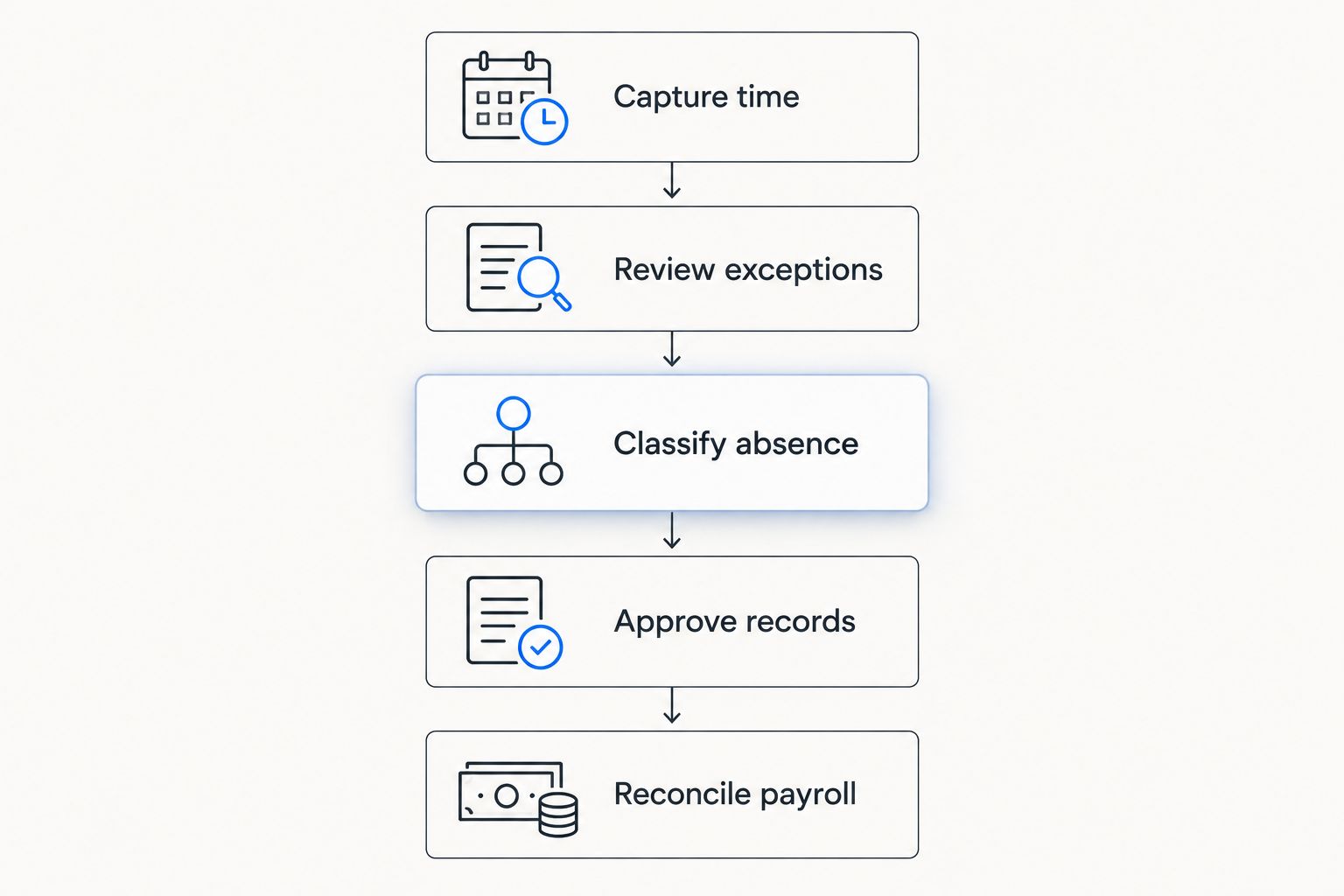
Use a repeatable sequence with a clear boundary between raw events and approved payroll inputs. Make corrections before payroll closes, and retain the explanation when a later correction becomes necessary.
- Capture time. Collect actual working periods through your chosen recording method. Keep source entries available for review.
- Review exceptions. Resolve missing entries, unexpected shifts and differences between scheduled and recorded work. Ask for clarification rather than inserting an assumption.
- Classify absence. Separate annual leave, sickness, unpaid leave and unexplained absence. Match each category to the relevant supporting record.
- Approve records. Have an authorized reviewer confirm the record and document corrections. Keep the approval identifiable.
- Reconcile payroll. Check that working-time classifications, wage components and SGK treatment agree. Investigate discrepancies before final submission.
Ottohr is an HR platform offering hiring, onboarding, payroll, benefits and compliance tools for growing employers and larger enterprises. If you are evaluating Ottohr for this workflow, ask to see how the proposed setup handles source records, corrections and payroll reconciliation. Evaluate the evidence trail, not just the final attendance total.
Why puantaj requirements vary
The recording obligation remains, but the evidence and controls depend on the employment arrangement. These factors explain why copying another employer’s spreadsheet is not a compliance assessment:
- Applicable employment regime: Labour Law No. 4857 is not the governing framework for every category of work. Establish coverage before applying its general limits.
- Contractual working week: A shorter agreed week changes how additional hours need to be classified.
- Working-time distribution: Shift patterns and applicable averaging arrangements require records detailed enough to review the relevant period.
- Leave and absence reasons: Similar-looking gaps in attendance can have different payroll and SGK consequences.
- Recording technology: Manual entries, access logs and digital timesheets produce different evidence and need different correction controls.
- Personal data collected: Attendance information is personal data; biometric identification introduces special-category data considerations under KVKK.
For your 2026 process, document these decisions before configuring attendance codes. Otherwise, the software simply applies an unexplained rule consistently.
Does SGK require the same day count as your attendance sheet?
No. SGK premium days are not simply a count of physical workplace visits. Monthly-paid employment, partial employment, unpaid absence and other circumstances require the appropriate social insurance treatment.
Reconcile the puantaj with employment status and supporting documents before preparing the Muhtasar ve Prim Hizmet Beyannamesi, the combined withholding and premium service declaration. Do not copy a count of badge entries into the declaration as premium days.
A difference between attendance days and premium days is a reason to check the calculation, not automatic proof of an error. The record should explain why the figures differ.
Can you use fingerprint attendance tracking under KVKK?
Fingerprint attendance tracking involves biometric data and requires a special-category personal-data assessment under KVKK, Law No. 6698. A working-time recording duty does not automatically authorize biometric collection.
Assess the legal basis, necessity, proportionality and available less intrusive methods before implementation. Do not assume that obtaining employee consent alone settles the issue.
For ordinary attendance data, define access permissions, retention rules and the purpose of processing. Your 2026 attendance policy should explain what you collect and how employees can request correction of inaccurate records.
How long should you keep puantaj records?
There is no single retention period that safely answers every puantaj use case. Social insurance, tax, employment evidence and personal-data obligations need to be considered together.
Article 86 of Social Insurance Law No. 5510 generally requires private-sector employers to retain workplace books, records and documents for 10 years, starting from the beginning of the year following the relevant year. Public administrations have a different statutory period. Classify payroll-supporting attendance records within your retention schedule rather than deleting them when the next month opens.
Keep access restricted during retention. A legal reason to preserve a record is not a reason to leave it available to everyone in the organization.
FAQ
Is puantaj tracking legally required in Turkey in 2026?
Yes: employers covered by the general working-time rules must document working hours in 2026. Article 9 of the Working Time Regulation requires appropriate records, not one universal puantaj template.
Do I have to use a specific government puantaj form?
The general working-time recording rule does not prescribe one universal puantaj form. Your method must still support accurate working-time documentation and the other employment obligations applicable to your workplace.
Can I keep puantaj in Excel?
A spreadsheet can form part of your working-time recording process. Preserve source evidence, control access and document corrections so the final totals remain explainable.
Is a turnstile record enough to calculate payroll?
A turnstile record alone does not establish all payable working time. Reconcile access events with actual work, breaks, leave and approved corrections.
Does remote work remove the attendance recording requirement?
Remote work does not remove the employer’s working-time documentation obligation. Use an appropriate process that records actual working periods without assuming that physical access logs are necessary.
Does using Ottohr make our puantaj legally compliant?
Using Ottohr does not by itself establish legal compliance. Your employment rules, records, approvals and reporting must satisfy the obligations applicable to your workplace.
What are the general working-time limits to check?
The general framework includes 45 hours per week, an 11 hours per day ceiling and a 270 hours per year overtime ceiling. Special rules and the applicable employment arrangement require separate assessment.
One last thing
Review a correction, not just a completed attendance sheet. Ask your team to trace a disputed working period from its original entry through approval, payroll and SGK treatment.
If the explanation disappears when someone edits a cell, fix that process before adding more automation. For 2026, the strongest attendance control is a record you can explain after the payroll month has closed.


