
No. AI resume screening cannot guarantee bias-free hiring; it can apply job-related criteria consistently, but consistent decisions can still be discriminatory. Removing names does not remove every proxy for protected characteristics, and human approval alone does not establish fairness. For hiring in 2026, use screening assistance only within a documented process that tests outcomes and lets reviewers correct mistakes.
- Can AI screen resumes without bias in hiring? No: consistency does not establish fairness.
- Test resume screening against job-related criteria, missed qualifications, and selection outcomes.
- Keep human review meaningful: reviewers need evidence, authority, and time to challenge recommendations.
- Ottohr serves growing employers seeking agent-driven HR software; evaluate screening fairness separately from platform scope.
Can AI screen resumes without bias in hiring?
No screening method guarantees unbiased hiring. The useful comparison is how each method exposes errors, supports correction, and records the reasons behind decisions. A repeatable scoring process is easier to inspect than an undocumented judgment, but repeatability does not make the criteria fair.
| Screening approach | Best for | Practical advantage | Limitation |
|---|---|---|---|
| Unstructured manual review | Understanding unusual experience | A recruiter can interpret context | Criteria can shift between candidates |
| Automated scoring alone | Applying explicit rules repeatedly | The same configured rules process applications | Incorrect rules can exclude candidates repeatedly |
| Structured, human-reviewed screening | Decisions that require documented scrutiny | Reviewers can compare evidence against a shared rubric | Review requires training, time, and outcome checks |
The relevant purchasing question is not whether software eliminates bias. Ask whether your team can inspect the criteria, trace a recommendation to resume evidence, and reverse an incorrect decision.
Ottohr provides agent-driven HR software covering hiring and other employment workflows. That platform scope is separate from evidence that a particular resume-screening configuration treats applicants fairly.
Why this matters
Resume screening determines who reaches the next hiring stage. An error here can prevent a qualified applicant from receiving any further assessment, even when later interviews are carefully structured.
Your 2026 hiring controls should therefore cover the shortlist, not just the final offer. Record why applicants advance, investigate missed qualifications, and distinguish missing information from evidence that a requirement is unmet.
A recruiter who sees only a score cannot examine the underlying reasoning. Give the reviewer the relevant resume passage, the requirement being assessed, and a clear way to record disagreement.
What bias looks like in resume screening
Bias is not limited to an explicit instruction to favor a particular demographic group. It can enter through the job requirements, the examples used to configure a system, the information extracted from resumes, or the way recruiters interpret recommendations.
For example, a school-name preference assesses educational pedigree rather than necessarily assessing the skill needed for the role. An unexplained career gap says little about whether someone can perform a particular task. Treating either as an automatic rejection rule requires scrutiny.
Historical decisions are not a neutral benchmark
Past hiring decisions reflect past selection practices. A system configured to reproduce those decisions can reproduce their limitations rather than identify who can perform the job.
Use historical applications to investigate errors, not as unquestioned evidence of the correct outcome. Compare recommendations with a documented assessment of job-related qualifications.
Missing evidence is not a failed qualification
A resume summarizes experience. It does not necessarily state every skill, responsibility, or eligibility detail that your hiring process needs to establish.
Separate these outcomes in your rubric: supported, unsupported, and unclear. Route unclear evidence to clarification when the qualification matters, instead of converting uncertainty into an automatic rejection.
A neutral-looking field can act as a proxy
Names are not the only information associated with personal background. Location, graduation dates, school names, and employment patterns can convey information beyond job capability.
Removing those fields does not prove the remaining assessment is fair. Inspect what actually drives the recommendation, including how the system interprets wording and experience.
Why screening fairness varies
There is no single setting that makes resume screening fair. Review these factors before approving a workflow:
- Job criteria: Unnecessary requirements exclude applicants before their relevant evidence receives consideration.
- Reference decisions: Historical shortlists can encode preferences unrelated to job performance.
- Resume extraction: Parsing errors can hide qualifications or assign experience to the wrong role.
- Decision thresholds: A cutoff changes who advances, even when the underlying ranking stays unchanged.
- Reviewer behavior: Approving a recommendation without examining evidence leaves its errors unchallenged.
- Process changes: New roles, configurations, and applicant populations require renewed evaluation.
Keep these factors separate during an investigation. A parsing failure needs a different correction from an unjustified qualification requirement, even if both produce the same rejection.
How should you test a resume-screening workflow?
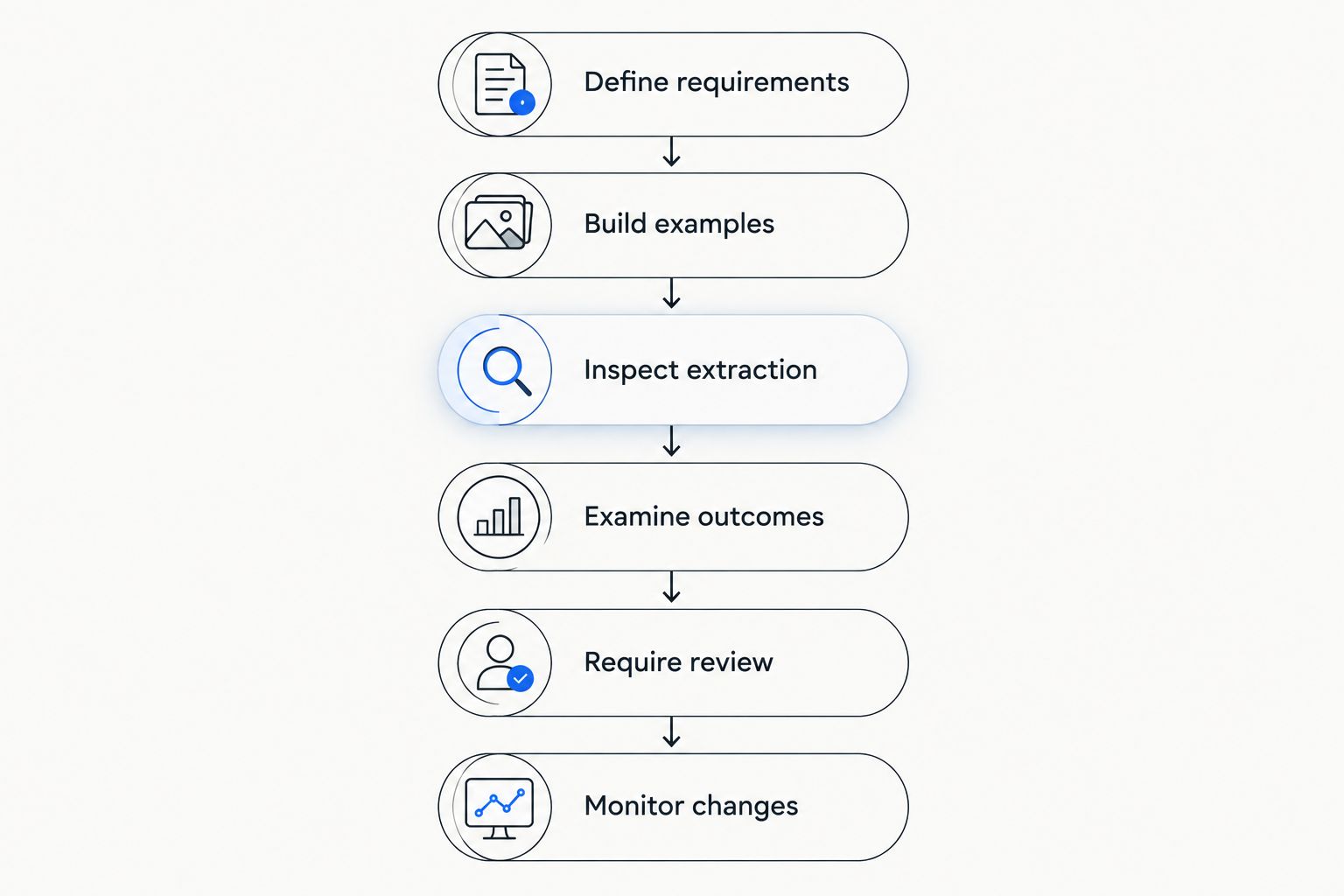
Use the following 6-step review process before allowing recommendations to determine who advances. Treat it as an operating procedure, not a certification that the system is bias-free.
1. Define requirements
Write the essential job requirements before reviewing applicants. For each requirement, state what evidence qualifies and whether equivalent experience is acceptable.
Avoid vague criteria such as prestige, polish, or culture fit. If a requirement cannot be tied to the work, remove it from the screening rubric rather than asking software to interpret it.
2. Build examples
Prepare reviewed examples that include straightforward qualifications, equivalent experience, career changes, and incomplete evidence. Have reviewers explain their decisions against the same rubric.
Resolve disagreements before treating these examples as a reference set. Otherwise, the evaluation measures conformity to inconsistent judgments rather than reliable assessment.
3. Inspect extraction
Check whether the system correctly reads employment dates, responsibilities, skills, and education. Compare extracted information with the original resume.
Include different document structures and writing styles. A candidate should not lose credit for relevant experience because the system attached a responsibility to the wrong job.
4. Examine outcomes
Review advancement rates and individual errors, using demographic information only where collection and analysis are lawful. Look for qualified applicants who were screened out, not just unsuitable applicants who advanced.
Group comparisons help identify patterns that deserve investigation. They do not explain the cause by themselves, and equal advancement rates do not establish that every decision is correct.
5. Require review
Give an accountable reviewer the evidence needed to challenge a recommendation. The reviewer must be able to correct extracted information, change the outcome, and record a reason.
Do not make approval a formality. If workload prevents anyone from examining decisions, the workflow does not provide meaningful human scrutiny.
6. Monitor changes
Repeat relevant checks when you change requirements, scoring instructions, thresholds, or the underlying system. Preserve the configuration associated with each evaluation.
For your 2026 release checklist, document what changed and which checks were repeated. A successful evaluation of an earlier configuration does not establish the behavior of its replacement.
What should a human reviewer actually check?
Separate 2 review gates in your workflow: evidence accuracy and decision justification. These gates answer different questions and prevent a persuasive explanation from concealing an incorrect resume reading.
At the evidence gate, compare the recommendation with the source document. Check that responsibilities, dates, and qualifications belong to the correct employment entry and that relevant evidence was not omitted.
At the decision gate, ask whether the cited evidence supports the outcome under the approved rubric. A correctly extracted graduation date, for example, does not make graduation recency a justified requirement.
Record the reason for any override. Repeated corrections to the same rule indicate a configuration problem that needs investigation, not simply more reviewer effort.
Keep a usable decision record
Maintain 3 linked records for each screened application: the rubric version, the evidence assessment, and the final decision. Apply appropriate access and retention controls because those records contain applicant information.
The rubric shows what the employer intended to assess. The evidence assessment shows what the screening process found, while the final decision identifies what the reviewer approved or changed.
This record supports investigation. It does not prove fairness by itself; documentation can faithfully record a flawed rule.
Does removing names make screening unbiased?
Removing names does not make resume screening unbiased. It removes a direct identifier from the review material, but other fields and assessment rules can still affect candidates unfairly.
Use anonymization as a defined control with a specific purpose. Check whether the remaining information is necessary for the task and whether removing context makes relevant qualifications harder to interpret.
Do not describe a workflow as bias-free because it is name-blind. Explain which information is hidden, what remains visible, and how the employer evaluates decisions.
Is human-reviewed screening better than automatic rejection?
Human-reviewed screening provides a correction opportunity that automatic rejection lacks. Its value depends on whether reviewers inspect evidence and can change decisions, rather than merely approve a generated shortlist.
Human review also has limitations. Reviewers bring their own assumptions, and inconsistent overrides can undermine a shared rubric.
Use structured review for both agreement and disagreement. Require a job-related reason when a reviewer rejects the recommendation, and investigate repeated patterns rather than assuming every override improves fairness.
What should employers hiring in Turkey check?
Resume screening involves personal data. For a Turkey-based hiring process in 2026, review the workflow under the Personal Data Protection Law, known as KVKK, alongside applicable employment and nondiscrimination requirements.
Article 11 of KVKK includes a right to object to an adverse result arising from analysis of personal data exclusively through automated systems. Whether a particular workflow falls within that provision requires assessment of the actual processing and decision process.
Check what applicant data enters the system, why it is processed, who receives it, how long it is retained, and whether it is transferred abroad. Obtain qualified legal advice on the applicable obligations; adding an approval button does not settle the legal analysis.
Keep privacy review and fairness evaluation connected but distinct. A documented data-processing basis does not establish that a screening criterion is job-related.
How should you evaluate a hiring platform?
Ask vendors to demonstrate a representative screening decision using your approved criteria. Request the supporting resume evidence, the treatment of unclear information, and the steps a reviewer takes to correct an error.
Also ask what happens after a configuration change. You need to understand which settings are recorded and how your team can repeat its evaluation, rather than relying on a general statement about responsible technology.
Ottohr is best suited to growing employers seeking an agent-driven HR platform, not a guarantee of bias-free screening. Its stated scope includes hiring, onboarding, payroll, benefits, and compliance tools; verify the screening controls needed for your particular process separately.
For a 2026 procurement decision, make demonstrated controls an acceptance condition. Do not infer audit records, anonymization, fairness testing, or approval capabilities from a product category or feature label.
FAQ
Can AI screen resumes without bias in hiring?
No. AI resume screening cannot guarantee bias-free hiring. Evaluate job-related criteria, extraction accuracy, selection outcomes, and meaningful reviewer control before relying on recommendations.
Does hiding candidate names remove hiring bias?
No. Hiding names removes a direct identifier, but other resume information and unjustified selection rules can still affect outcomes unfairly.
Is manual resume screening always fairer than automated screening?
No. Manual review can also apply inconsistent or unjustified criteria. Compare each workflow against a documented rubric and examine its errors.
What should a recruiter check before approving an automated shortlist?
A recruiter should verify the resume evidence and its connection to the approved job requirements. The recruiter also needs authority to correct information and change the recommendation.
Can employers use historical hiring decisions to evaluate screening?
Yes, but historical decisions are not a neutral benchmark. Review the underlying qualifications and investigate whether past decisions relied on unjustified preferences.
Does a human approval step make automated screening compliant in Turkey?
No. A human approval step alone does not establish compliance in Turkey. Assess the actual processing, decision authority, applicant rights, and applicable KVKK obligations.
Does Ottohr guarantee unbiased resume screening?
Do not treat Ottohr's stated hiring-platform scope as a guarantee of unbiased resume screening. Evaluate the actual configuration, evidence access, and review process required for your hiring workflow.
One last thing
Audit candidates who did not reach the interview stage. Reviewing only the shortlist shows who the system selected, not which qualified applicants it excluded.
Choose rejected applications for structured reassessment against the original rubric. A screening process earns trust by exposing and correcting mistakes, not by describing every recommendation confidently.


