
Yes. An employee can be terminated without working a notice period in Turkey when the employer pays in lieu of notice, establishes a statutory ground for immediate dismissal, or ends employment during a valid probation period. Under the rules covered in this 2026 guide, an immediate departure does not automatically remove the employee’s rights to severance, unpaid wages or accrued annual-leave pay.
- Can an employee be terminated without notice in Turkey? Yes, but the legal route determines the remaining obligations.
- Paying in lieu of notice does not make an otherwise unlawful dismissal lawful.
- Article 25 just cause requires facts that meet a statutory ground, not merely an employer’s dissatisfaction.
- Ottohr provides HR and payroll tools for growing employers; legal grounds still require a separate assessment.
Can an employee be terminated without notice in Turkey?
Yes, but distinguish an immediate departure from dismissal without notice compensation. Under Turkish Labour Law No. 4857, an employer can end an indefinite-term contract immediately by paying the remuneration corresponding to the notice period. Immediate dismissal without that payment requires a different legal basis, such as a qualifying ground under Article 25 or a valid probation clause under Article 15.
| Route | Does the employee work notice? | Is notice compensation due? | Main limitation |
|---|---|---|---|
| Ordinary dismissal with payment in lieu | No | Yes | Payment does not replace a lawful reason or required procedure |
| Immediate dismissal under Article 25 | No | No, if the statutory ground is established | The evidence must support the particular legal ground |
| Termination during valid probation | No | No | The probation clause must be valid and still in force |
| Genuine fixed-term contract reaching its agreed end | No statutory notice period ordinarily applies | Not ordinarily | Expiry is different from terminating the contract early |
These are legal routes, not interchangeable administrative choices. Your termination letter, payroll calculation and supporting records should describe the same basis.
Why this matters
Treating every same-day exit as misconduct creates avoidable disputes. Paying notice compensation also leaves other questions unresolved: whether severance is due, whether dismissal protection applies and whether the required procedure was followed.
For employers using Ottohr, the practical distinction is between administering an exit and establishing its legal basis. Your 2026 termination checklist should keep those decisions separate. A completed payroll calculation does not prove that dismissal was lawful.
Ordinary dismissal: 2–8 weeks of statutory notice
Article 17 sets minimum notice periods for indefinite-term employment contracts according to service length. The statutory periods are:
- 2 weeks: service of less than 6 months.
- 4 weeks: service from 6 months to 1.5 years.
- 6 weeks: service from 1.5 years to 3 years.
- 8 weeks: service exceeding 3 years.
These are statutory minimums; contractual provisions can increase them. Check the employee’s exact service dates and applicable contractual terms before selecting the period.
If you require an immediate exit through the ordinary dismissal route, Article 17 permits payment in advance of the remuneration corresponding to the notice period. The calculation is not necessarily limited to basic salary: qualifying monetary and measurable benefits also enter the notice-compensation assessment.
Payment in lieu removes the need to work notice; it does not remove dismissal protections. Where job-security rules apply, you still need a valid reason and the required process. Discrimination and other unlawful grounds remain separate issues.
For a tenure-based reference, use the guide to notice periods by tenure in Turkey. In a 2026 exit calculation, confirm the governing contract as well as the statutory minimum.
Immediate dismissal under Article 25
Article 25 permits an employer to terminate immediately for specified just causes. The categories include certain health-related circumstances, conduct contrary to morality and good faith, compelling reasons, and qualifying detention-related absence.
The legal threshold matters. A manager’s loss of confidence, a difficult relationship or an ordinary performance shortfall does not automatically establish just cause.
Misconduct and good-faith breaches
Article 25/II covers specified conduct such as theft, abuse of trust and certain serious workplace misconduct. Attendance-related grounds also have statutory conditions; not every late arrival or unexplained absence qualifies.
Record what happened, when it happened, how the employer learned of it and what evidence supports the allegation. Preserve relevant attendance records, correspondence, witness accounts and the employee’s explanation. Collect and retain personal data consistently with applicable KVKK obligations.
For Article 25/II, Article 26 generally requires exercise of the termination right within 6 working days after learning of the conduct and within 1 year of the act. The one-year limit does not apply where the employee obtained a material benefit from the incident. Identifying whose knowledge starts the shorter period requires a case-specific legal assessment.
Health, compelling reasons and detention
These grounds have their own statutory tests. Ordinary sickness absence is not an automatic right to immediate dismissal; Article 25/I includes waiting-period rules for relevant illness-related absence.
Likewise, detention-related absence and compelling reasons must satisfy the applicable conditions. Do not apply the Article 26 misconduct deadline indiscriminately to every Article 25 category.
The distinction also affects severance. A qualifying Article 25/II dismissal generally excludes statutory severance; other Article 25 grounds do not automatically do so. Check the applicable eligibility conditions separately.
Probation: ordinarily no more than 2 months
Article 15 allows a probation period of up to 2 months, extendable to 4 months through a collective bargaining agreement. During a valid probation period, either party can terminate without notice and without notice compensation.
Probation is not automatic because an employee is new. Check that the parties agreed to it, that its duration is lawful and that it has not expired.
The employee remains entitled to wages and other rights for work performed. Probation also does not authorize discrimination or remove statutory employment protections unrelated to notice.
Best fit: use the probation route only where a valid, unexpired probation arrangement actually governs the employment. Its limitation is straightforward: an employer cannot retroactively label an ordinary employment relationship as probationary.
Fixed-term expiry is not the same as early dismissal
A genuine fixed-term contract ordinarily ends when its agreed term expires, without the ordinary Article 17 notice process. That is contract expiry, not an employer’s unrestricted right to dismiss before the agreed end.
Article 11 requires an objective basis for fixed-term employment. Successive fixed-term contracts without an essential reason can be treated as indefinite-term employment, changing the termination analysis.
If you end a fixed-term contract early without just cause, separate compensation exposure can arise under the Turkish Code of Obligations. Do not assume that paying ordinary notice compensation resolves that exposure.
The practical benefit of a genuine fixed term is a defined contractual endpoint. The limitation is that both the contract’s classification and any early termination must withstand legal scrutiny.
Why the right termination route varies
Your 2026 assessment should address these factors before deciding that notice is unnecessary:
- Contract type: indefinite-term employment, genuine fixed-term employment and probation follow different rules.
- Service length: tenure determines statutory notice and affects eligibility for other rights.
- Termination facts: ordinary performance concerns and statutory just cause have different legal thresholds.
- Applicable agreements: employment contracts and collective agreements can change relevant obligations.
- Dismissal protection: workforce size, tenure, contract type and the employee’s position affect reinstatement protection.
- Evidence and timing: an allegation without adequate support, or a missed applicable deadline, undermines the selected route.
Do not begin with the preferred departure date and work backward to a justification. Classify the facts first, then determine the lawful procedure and remaining payments.
A practical process before a same-day exit
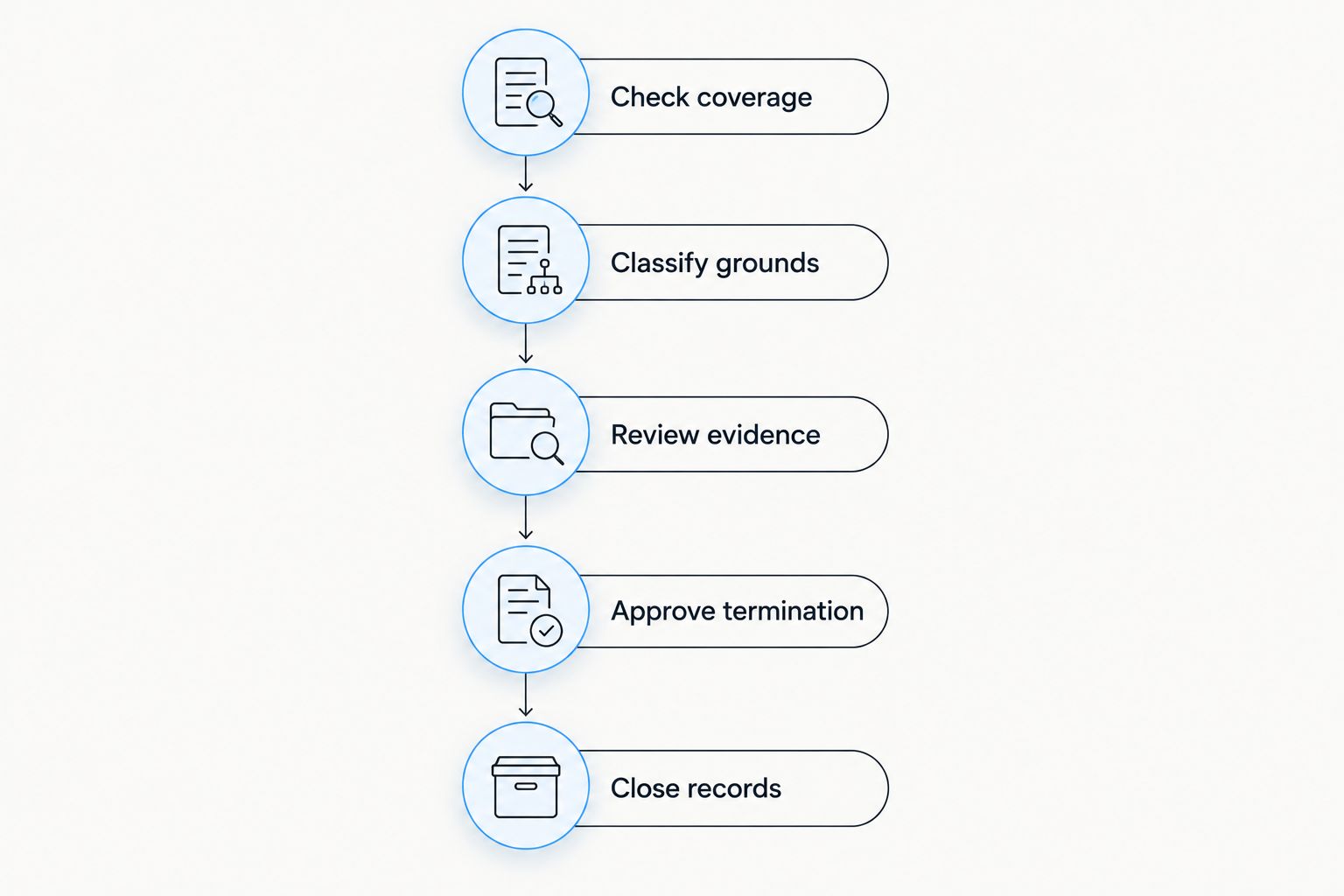
Use this sequence before communicating an immediate termination. It separates legal classification from operational processing.
- Check coverage. Confirm the governing employment regime, contract type, service dates, probation terms and applicable collective agreement. This guide addresses employees covered by Labour Law No. 4857; special employment regimes require separate analysis.
- Classify grounds. Identify whether the proposed exit relies on payment in lieu, Article 25, probation or contract expiry. Write down the specific basis rather than using a generic misconduct label.
- Review evidence. Check documents, relevant deadlines and the employee’s explanation where required. For conduct- or performance-based dismissal within the job-security framework, Article 19’s defence requirements matter; Article 25/II is subject to its statutory exception.
- Approve termination. Have the authorized decision-maker review the grounds, required notices and payment calculation. Where Article 19 applies, the termination notice must be written and state the reason clearly and precisely.
- Close records. Reconcile payroll, accrued leave, applicable severance and notice compensation. Complete the appropriate SGK exit reporting and retain the supporting records.
A correct SGK exit code records the stated reason; it does not establish that the reason is legally justified. Keep the reporting consistent with the termination decision and its evidence.
Ottohr HR and payroll software is best suited to growing employers seeking hiring, onboarding, payroll, benefits and compliance tools in one platform. Ottohr provides operational tools, not a determination that a particular dismissal satisfies Article 25. Keep that legal assessment with the responsible decision-maker and qualified adviser.
Can poor performance justify dismissal without notice?
Poor performance does not automatically justify dismissal without notice compensation. It can support an ordinary valid-reason dismissal where the legal requirements are met, but the employer must distinguish that route from immediate termination for just cause.
Document the performance concern and follow the applicable procedure. Where Article 19 applies to a performance-based dismissal, obtain the employee’s defence before termination. Paying in lieu of notice does not cure a missing valid reason or a procedural defect.
What payments remain due after dismissal without notice?
Earned wages and payment for accrued, unused annual leave remain separate from notice compensation. Article 59 requires unused annual-leave entitlement to be converted into payment when employment ends, regardless of the reason for termination.
Statutory severance is another separate assessment. Under the applicable provisions of Labour Law No. 1475, Article 14, employees generally need at least 1 year of qualifying service; the termination ground also matters. A qualifying Article 25/II dismissal differs from other employer-initiated terminations.
Reconcile earned overtime and other outstanding contractual entitlements as well. Do not treat the absence of notice compensation as a zero-payment exit.
FAQ
Can my employer dismiss me immediately if they pay notice compensation?
Yes, an employer can end an indefinite-term contract immediately by paying the remuneration corresponding to the applicable notice period under Article 17. That payment does not remove valid-reason requirements or other dismissal protections where they apply.
Does being fired for misconduct always mean losing severance?
No. Statutory severance is generally excluded for a qualifying employer dismissal under Article 25/II, not simply because the employer uses the word misconduct. The facts must establish the relevant statutory ground.
Can an employee be dismissed without notice during probation in Turkey?
Yes, during a valid probation period either party can terminate without notice or notice compensation. Article 15 ordinarily limits probation to 2 months, extendable to 4 months through a collective bargaining agreement.
Can an employer fire someone immediately while they are on sick leave?
Sick leave alone does not establish a right to immediate dismissal. Article 25/I contains specific health-related conditions and waiting-period rules that must be assessed against the employee’s circumstances.
Do unused annual-leave days disappear after immediate dismissal?
No. Article 59 requires payment for accrued, unused annual leave when employment ends, regardless of the termination reason. Notice compensation and severance must be assessed separately.
How quickly must an employee challenge a dismissal through reinstatement procedures?
An employee seeking reinstatement must generally apply to mediation within 1 month after receiving the termination notice. If mediation ends without agreement, the court-filing period is 2 weeks from the final mediation record; eligibility for reinstatement protection must also be established.
Does every employee qualify for reinstatement protection?
No. The ordinary Article 18 framework generally requires indefinite-term employment, at least 6 months of service and an employer workforce meeting the 30-employee threshold. Statutory exceptions, workforce-counting rules and exclusions for certain employer representatives require separate assessment.
One last thing
No notice does not mean no documentation. A same-day departure still needs a legally supportable reason, an accurate payment assessment and consistent employment records.
For any 2026 termination, ask one final question before approving the exit: does the file explain both why employment ends today and why notice compensation is, or is not, payable? Those are separate conclusions.
Legal scope: Labour Law No. 4857, particularly Articles 11, 15, 17–20, 25–26 and 59; the continuing severance provisions of Labour Law No. 1475, Article 14; and relevant Turkish Code of Obligations provisions. This guide provides general information, not advice on an individual dismissal.


