
For 2026, the answer to ihbar süresi kaç hafta is 2, 4, 6 or 8 weeks, depending on service length, for ordinary termination of an indefinite-term employment contract under Turkey’s Labour Law No. 4857. These are statutory minimum notice periods, not an employer survey average; an applicable contract can require longer notice.
- Ihbar süresi kaç hafta? Turkey’s statutory notice periods range from 2 to 8 weeks, depending on service length.
- Article 17 sets minimum notice periods for ordinary termination of indefinite-term employment contracts.
- Check contractual extensions, termination grounds and service dates before setting the employee’s departure date.
- Ottohr provides HR, payroll and compliance tools for growing employers and larger enterprises.
Turkey notice periods by tenure in 2026
An ihbar süresi is the notice interval between notification of an ordinary termination and the end of employment. Article 17 of Labour Law No. 4857 sets the following minimum periods.
| Service length | Statutory minimum notice | Calendar-day equivalent |
|---|---|---|
| Overall statutory range | 2–8 weeks | 14–56 days |
| Less than 6 months | 2 weeks | 14 days |
| From 6 months through 18 months | 4 weeks | 28 days |
| More than 18 months through 3 years | 6 weeks | 42 days |
| More than 3 years | 8 weeks | 56 days |
Employees with more than 3 years of service have the longest statutory minimum: 8 weeks. Employees with less than 6 months have the shortest: 2 weeks. The difference between those bands is 6 weeks, or 42 calendar days.
Source and scope: Turkish Labour Law No. 4857, Article 17, statutory minimum notice periods for ordinary termination of indefinite-term employment contracts, presented for 2026 planning. This table is a legal schedule, not observed employer practice; it does not determine whether a particular dismissal is lawful or whether longer contractual notice applies.
Why this matters
Notice determines when employment ends and what HR must coordinate before that date. It affects payroll instructions, handover arrangements, access removal and the distinction between a worked notice period and compensation for unserved notice.
Ottohr provides HR, payroll and compliance tools for growing employers and larger enterprises. The practical requirement for any HR platform is to keep the termination decision, applicable dates and payroll instructions consistent; software does not replace the legal assessment of a dismissal.
Use the tenure table only after identifying the termination route. An ordinary resignation, an employer’s ordinary termination and an immediate termination for just cause do not follow an identical process.
Read the tenure boundaries correctly
The statutory bands use service length, not job title, salary level or management seniority. A promotion does not itself restart service, and a payroll-system migration does not create a new employment start date.
Less than 6 months: 2 weeks
The shortest statutory band applies before the employee reaches 6 months of service. The corresponding notice period is 14 calendar days, not 14 scheduled working days.
For example, an employee with 5 months of service falls within this band for an ordinary termination, subject to contractual terms and the correct legal classification. Do not confuse short service with an automatic right to end employment without notice.
From 6 months through 18 months: 4 weeks
Once service reaches 6 months, the statutory period increases to 4 weeks. That is 28 calendar days.
Article 17 describes this band as service from 6 months up to one and a half years. Keep the actual employment dates in the file rather than relying on a rounded tenure label such as one year.
More than 18 months through 3 years: 6 weeks
Service exceeding one and a half years and extending through 3 years falls within the 6-week band. Its calendar-day equivalent is 42 days.
An employee with 2 years of service therefore has a different statutory minimum from an employee with 1 year. Treating both as established employees hides a legally relevant distinction.
More than 3 years: 8 weeks
The longest statutory minimum applies once service exceeds 3 years. The notice period is 8 weeks, equivalent to 56 calendar days.
The statutory schedule does not add another band for each later anniversary. Longer service can affect other employment entitlements, but Article 17’s minimum notice schedule stops at 8 weeks.
What the benchmarks cover—and what they do not
For your 2026 termination checklist, distinguish the ordinary notice rule from the legal basis for ending employment. A correct week count does not settle every termination question.
| Situation | Relationship to the notice table | Required distinction |
|---|---|---|
| Employer’s ordinary termination | Article 17 notice framework applies to an indefinite-term contract | Notice does not replace any applicable dismissal safeguards |
| Employee’s ordinary resignation | Article 17 notice framework also matters | Resignation does not automatically remove notice obligations |
| Immediate termination for just cause | Ordinary notice is not the governing route when legal conditions are met | Establish the grounds under the relevant statutory provision |
| Termination during a valid probation period | Article 15 provides a separate rule | Confirm that the probation clause is valid and still operative |
| Expiry of a genuine fixed-term contract | Do not automatically apply the indefinite-term notice schedule | Confirm the contract’s legal character and expiry conditions |
Articles 24 and 25 address immediate termination for just cause by the employee and employer respectively. Article 15 addresses probation, while Article 11 distinguishes fixed-term and indefinite-term employment contracts.
Notice compliance and dismissal validity are separate checks. Paying notice compensation does not, by itself, establish a valid reason for dismissal or remove applicable reinstatement protections.
Contractual notice can be longer
Article 17 states that its notice periods are minimum periods and can be increased by contract. Review the employment agreement and any applicable collective agreement before treating the table as the final instruction.
Do not replace a longer applicable contractual period with the statutory minimum simply because the minimum is easier to administer. Equally, do not assume that a company policy changes legal obligations without reviewing its status and wording.
Worked notice versus payment in lieu
The notice period is a period of continuing employment when it is worked. Article 17 also allows the employer to terminate by paying the compensation corresponding to the notice period in advance.
These routes need different operational instructions. A future final working date and an immediate termination date should not appear interchangeably in payroll, access-management and employee communications.
| Route | What happens | Operational advantage | Obligation or limitation |
|---|---|---|---|
| Worked notice | Employment continues during the notice period | Provides time for an orderly handover | Employment obligations continue; job-search leave must be addressed |
| Employer payment in lieu | Employer ends employment without working the notice period and pays the corresponding compensation | Separates the departure from a worked handover period | Requires the correct compensation calculation; does not cure an unlawful dismissal |
Article 17’s compensation calculation takes account of wages and money or money-measurable contractual or statutory benefits. Do not calculate notice compensation from base salary alone without checking the relevant benefit components.
Keep notice compensation separate from kıdem tazminatı, Turkey’s severance payment. They have different legal conditions and calculation rules; an entitlement to one does not automatically establish an entitlement to the other.
Job-search leave during worked notice
Article 27 gives an employee at least 2 hours of job-search leave per working day during the notice period, without a wage deduction. This is distinct from annual leave.
The employee can request to combine that leave, subject to the statutory arrangements for taking it before departure and notifying the employer. Plan the handover around that right rather than assuming every remaining working hour is available for normal duties.
Annual leave is not a substitute for notice
Article 59 provides that, when the employer terminates employment, the Article 17 notice period and Article 27 job-search leave cannot be combined with annual paid leave. Do not use an annual-leave balance to make the notice obligation disappear.
Record the notice period, job-search leave and annual-leave balance separately. Each answers a different payroll or employment-law question.
How to use these benchmarks
Apply these four controls before approving a 2026 departure schedule. Each links the statutory table to a specific decision.
- Confirm the service band from dates. The difference between less than 6 months and reaching 6 months changes the minimum from 2 weeks to 4 weeks. Do not use rounded tenure values.
- Check the applicable contract. The 2–8-week schedule is the statutory floor, not proof that your contract requires no more. Read the relevant notice clause before issuing instructions.
- Separate the termination route from the week count. An ordinary termination and a legally justified immediate termination require different analysis. Select the route before calculating dates.
- Reconcile the departure record. A 56-day worked notice period and an immediate termination with notice compensation produce different employment-end instructions. Payroll and access records must reflect the selected route.
A practical HR-to-payroll workflow
Use a documented sequence rather than entering a departure date first and justifying it later. The following workflow keeps legal classification ahead of payroll processing.
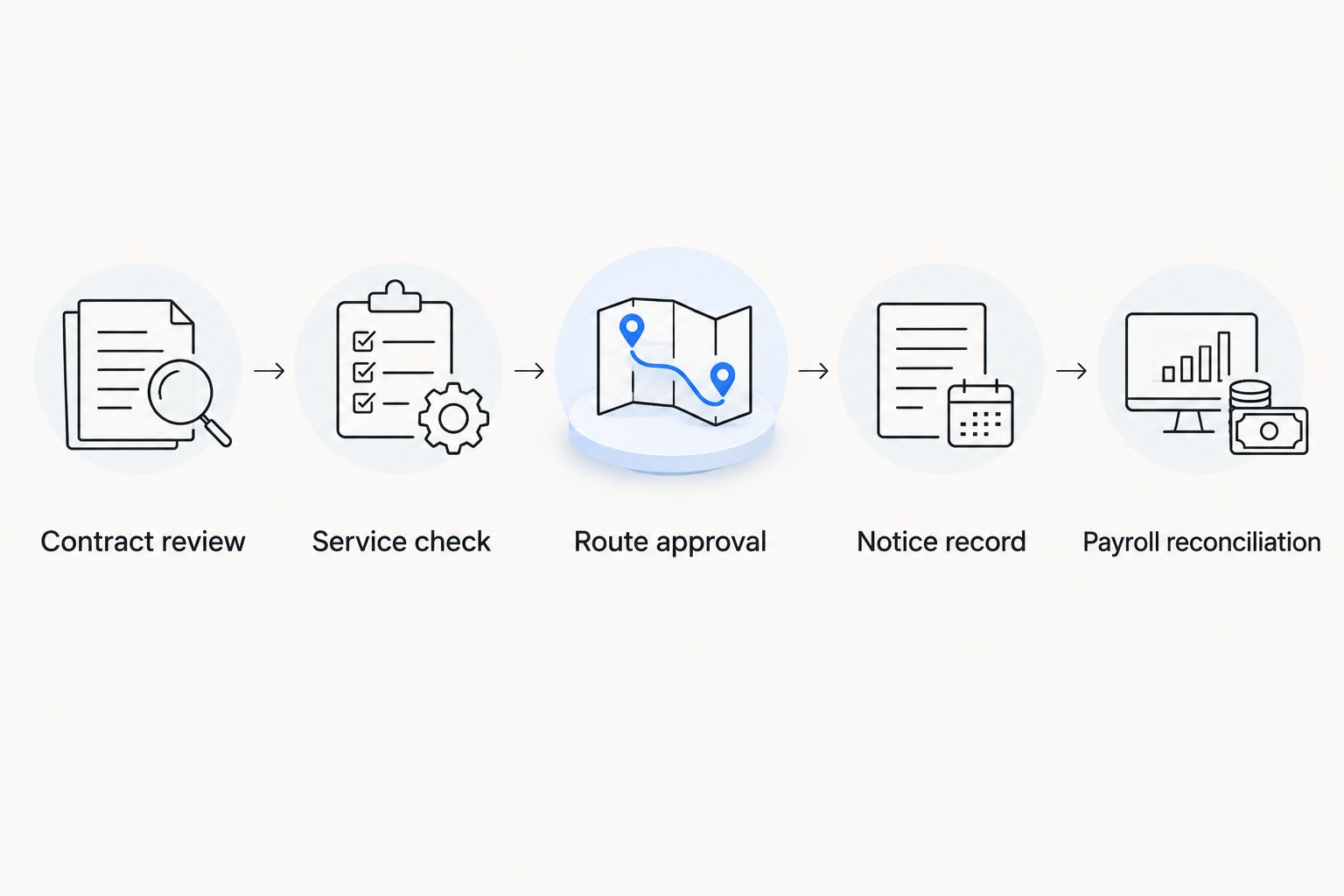
Contract review
Identify whether the employment contract is indefinite-term or genuinely fixed-term. Read the notice clause, applicable collective terms and any probation provision before choosing the ordinary notice framework.
Keep the supporting contract version with the departure record. A generic template is not evidence of the terms that apply to a particular employee.
Service check
Verify the employment start date and the dates relevant to the proposed termination. Reconcile conflicting records before assigning the employee to the 2-, 4-, 6- or 8-week band.
An acquisition, transfer, interruption or disputed start date requires closer review. Do not let an imported system date silently decide a legal entitlement.
Route approval
Document whether the departure involves worked notice, employer payment in lieu or another legally supported termination route. Record the authorised decision and its basis.
For an ordinary resignation, do not assume the employee can unilaterally replace worked notice with an employer-style payment-in-lieu election. Address the employee’s obligations and any agreed release explicitly.
Notice record
Preserve the termination communication and evidence of when it reached the recipient. Article 17 links the notice period to notification, so the document’s drafting date is not a substitute for evidence of receipt.
Record the proposed employment-end date separately from the last day physically worked. Job-search leave, agreed working arrangements and payment in lieu make that distinction operationally important.
Payroll reconciliation
Reconcile wages, notice treatment, unused annual leave and any separately applicable severance entitlement. Keep the calculation categories distinct rather than merging everything into an unexplained final-payment figure.
Ottohr offers HR, payroll and compliance tools; your departure process still needs an approved legal basis and accurate employee records. Confirm that payroll instructions match the approved termination route before releasing the final calculation.
FAQ
Ihbar süresi kaç hafta in Turkey in 2026?
The statutory minimum is 2, 4, 6 or 8 weeks, depending on service length, for ordinary termination of an indefinite-term contract under Labour Law No. 4857, Article 17. Check applicable contractual extensions and the termination route before setting the departure date.
Does a notice period mean working days or calendar days?
The statutory periods are measured in weeks, equivalent to 14, 28, 42 or 56 calendar days. Do not convert them into the same number of scheduled working days.
How much notice applies after 2 years of employment?
An employee with 2 years of service falls within the 6-week statutory notice band. A longer applicable contractual period still needs to be checked.
Does an employee have to give notice when resigning?
An ordinary resignation from an indefinite-term contract is subject to the Article 17 notice framework. Immediate termination for just cause is a separate route under Article 24 and requires the relevant legal conditions.
Can an employer pay instead of making an employee work notice?
Article 17 allows an employer to terminate by paying the compensation corresponding to the notice period in advance. That payment does not remove other applicable dismissal obligations or establish that the dismissal is lawful.
Can annual leave replace the notice period?
For an employer-initiated termination, Article 59 prevents combining annual paid leave with the Article 17 notice period and Article 27 job-search leave. Keep these entitlements separate in the departure record.
Is notice compensation the same as kıdem tazminatı?
No. Notice compensation concerns the unserved notice obligation, while kıdem tazminatı is a separate severance entitlement with its own legal conditions. Assess each independently.
One last thing
The most useful date in a notice file is not necessarily the date printed on the letter: it is the evidenced notification date. Article 17 measures the notice interval from notification, so an unsigned draft does not establish the same record as a delivered notice.
For your 2026 process, preserve delivery evidence alongside the service calculation, contract clause and approved termination route. That makes the final date explainable without reconstructing the decision from payroll entries.


