
For a qualifying employer termination in Turkey in 2026, statutory severance starts with 30 days of eligible gross pay for each year of service, subject to the statutory ceiling; there is no single total applicable to every dismissal. Your full settlement also includes any notice pay, unused annual leave and outstanding earnings, while an unlawful dismissal creates separate financial exposure. Calculate the employee’s entitlements first, then assess whether the termination procedure is legally defensible.
- Turkey employee termination costs in 2026 combine severance, notice pay, unused leave and outstanding earnings.
- Qualifying statutory severance uses 30 days of eligible gross pay per service year, subject to the applicable ceiling.
- Statutory notice periods range from 2 to 8 weeks, depending on service length.
- Ottohr provides growing employers with HR, payroll and compliance tools; legal entitlement decisions still require separate review.
Why this matters
A dismissal budget is not simply salary multiplied by tenure. Severance and notice pay have different eligibility rules, and unused leave remains a separate entitlement.
Start with the employee’s contract, service dates, termination reason and approved payroll records. The guide to notice periods by tenure in Turkey explains the service bands that determine the statutory notice obligation.
Keep ordinary settlement costs separate from disputed-dismissal exposure. Paying the correct payroll amount does not establish that a dismissal was lawful, and a lawful termination does not erase earned wages or unused leave.
How much does it cost to terminate an employee in Turkey in 2026?
Build the estimate from the following components. This framework concerns employees covered by Turkey’s general private-sector employment legislation; special employment regimes require their own assessment.
| Cost component | Calculation basis | When it belongs in the estimate | Main limitation |
|---|---|---|---|
| Statutory severance, or kıdem tazminatı | Eligible gross remuneration, capped where required, multiplied by qualifying service | The employee meets the service and termination conditions | Not every resignation or dismissal qualifies |
| Notice pay, or ihbar tazminatı | Remuneration corresponding to the applicable unserved notice period | Ordinary termination requires notice and the employer pays instead of providing it | Contractual notice terms also need review |
| Unused annual leave | Earned, unused leave multiplied by the applicable termination-date wage basis | An unused statutory leave balance remains at termination | The leave-pay basis is not automatically the severance basis |
| Outstanding earnings | Unpaid salary and other earned contractual or statutory amounts | Earnings remain unpaid at the exit date | Attendance, overtime and variable-pay records must reconcile |
| Dispute exposure | Remedies associated with the specific unlawful termination | The dismissal creates a legally supported claim | This is not an automatic addition to every settlement |
The statutory foundations are Labour Law No. 1475, Article 14, for severance, and Labour Law No. 4857, including Articles 17 and 59, for notice and unused annual leave. These provisions address different entitlements, not one combined termination fee.
For a 2026 calculation, use the severance ceiling effective on the actual termination date. Do not substitute an old payroll setting or apply that ceiling to every settlement component.
Qualifying severance: 30 days of pay per service year
Statutory severance generally requires at least 1 year of service and a qualifying reason for the employment relationship ending. An ordinary employer dismissal generally qualifies; an employer dismissal meeting the misconduct grounds under Article 25/II requires a different assessment.
The statutory calculation uses the eligible gross remuneration base, including qualifying regular benefits, subject to the applicable ceiling. Completed service years and the proportional remaining service period feed the calculation.
Do not use take-home salary as the severance base. Net pay does not capture the gross remuneration and benefit treatment required for the statutory calculation.
Contractual promises also need review. A statutory calculation does not resolve every obligation created by an employment contract, collective agreement or binding employer commitment.
Notice pay: 2 to 8 weeks of remuneration
For ordinary termination of an indefinite-term contract, Article 17 sets minimum notice periods according to service length.
| Employee’s service length | Statutory notice period | Budget consequence when notice is not worked |
|---|---|---|
| Less than 6 months | 2 weeks | Include remuneration for the applicable notice period |
| 6 months to 18 months | 4 weeks | Include remuneration for the applicable notice period |
| More than 18 months to 3 years | 6 weeks | Include remuneration for the applicable notice period |
| More than 3 years | 8 weeks | Include remuneration for the applicable notice period |
Check the precise service dates and any longer contractual notice obligation before issuing the calculation. Notice pay also requires the legally appropriate remuneration base, including relevant benefits, rather than an automatic use of basic salary alone.
Working notice changes the payment structure. The employee remains employed and receives ordinary remuneration during that period; paying in lieu replaces the unserved notice obligation with a payment.
Unused leave: the earned balance remains payable
Article 59 requires payment for earned, unused annual leave when employment ends. That obligation is separate from whether the employee qualifies for severance.
Reconcile the leave ledger against approved leave records. An entry in a spreadsheet is not a substitute for reliable evidence that leave was actually taken.
Use the applicable wage basis at termination for leave pay. Do not reuse a severance calculation without checking the leave-pay rules, because the components do not necessarily share the same remuneration base.
Why employee termination costs vary
The largest differences arise from eligibility, remuneration and procedure—not from a universal national average.
- Service length: Tenure affects severance accrual and the statutory notice band. Verify recognized service rather than relying only on the latest contract date.
- Termination reason: An ordinary dismissal, qualifying immediate termination, resignation and mutual separation do not produce identical entitlements.
- Remuneration structure: Regular allowances and benefits require classification. Basic salary alone does not necessarily establish the correct severance or notice base.
- Notice arrangement: Worked notice and payment in lieu create different payroll treatment and operational consequences.
- Unused leave and unpaid earnings: Outstanding leave, salary, overtime and earned variable compensation change the final settlement.
- Contractual rights and legal defects: Enhanced contractual benefits increase obligations, while procedural or substantive defects create separate dispute exposure.
For your 2026 budget, document each driver beside its source record. A defensible estimate explains both the amount and why that entitlement applies.
How do you calculate the final termination settlement?
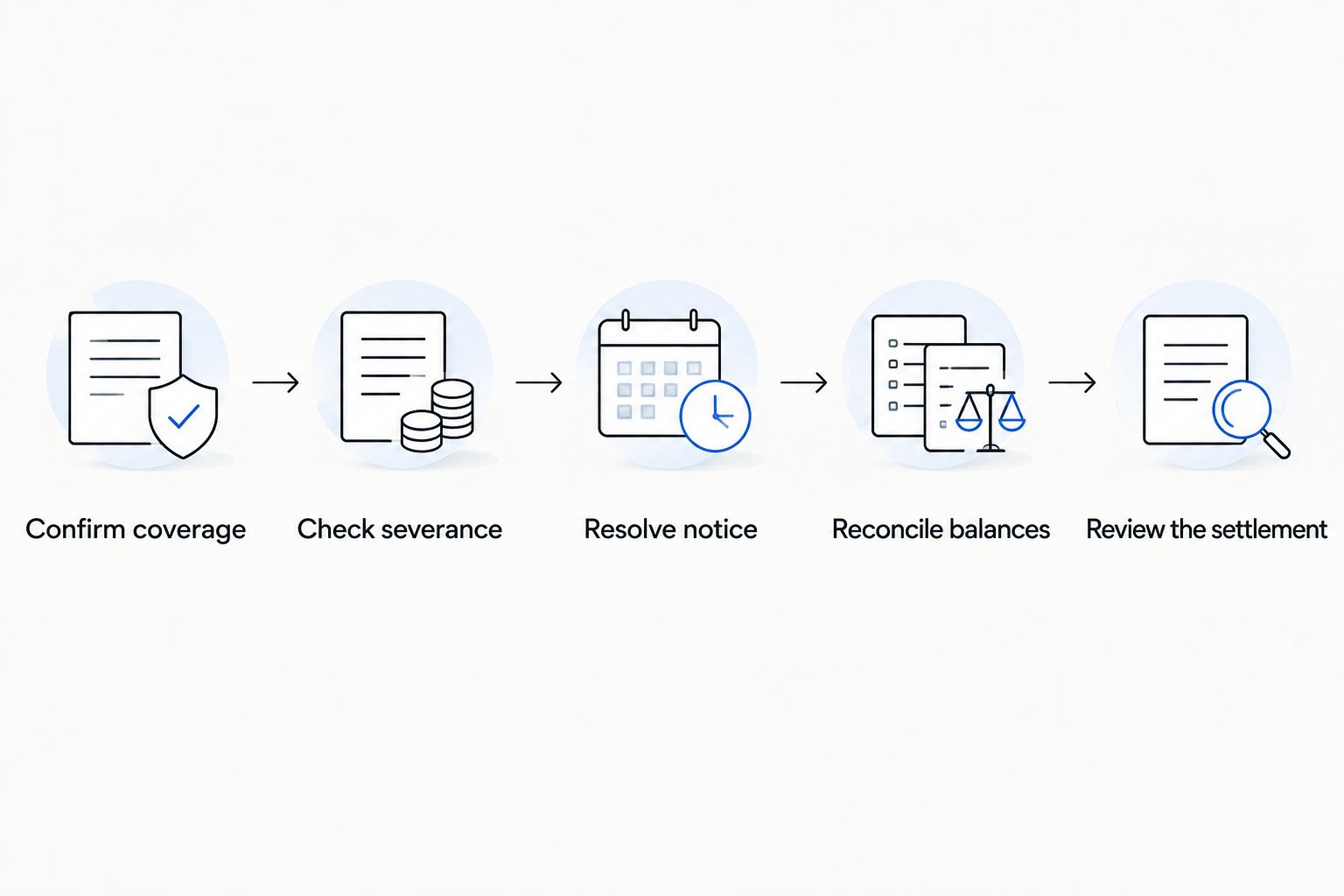
Prepare a component-level worksheet before approving the dismissal payment. Each line should identify its eligibility decision, calculation base, service period or balance, and tax or social-security treatment.
- Confirm coverage. Identify the governing employment regime, contract type, recognized service dates and proposed termination ground. Escalate disputed classification before calculating a settlement.
- Check severance. Decide whether statutory entitlement exists, establish eligible remuneration and apply the ceiling effective at termination. Account for proportional service where required.
- Resolve notice. Identify the statutory and contractual notice obligation. Record whether notice will be worked, paid in lieu or does not apply to the legally established termination ground.
- Reconcile balances. Confirm earned wages, approved overtime, contractual earnings and unused annual leave. Resolve inconsistent attendance and leave records before payroll closes.
- Review the settlement. Calculate deductions and employer liabilities separately for each component. Check the dismissal procedure, supporting documents and required notifications before releasing payment.
These steps keep legal eligibility separate from payroll arithmetic. A mathematically correct worksheet still fails if it assumes the wrong termination ground or overlooks a contractual entitlement.
Preserve the calculation version used for approval. If the exit date changes, revisit tenure, accrued earnings, leave balances and the applicable ceiling rather than editing only the date on the termination letter.
Should you use worked notice or payment in lieu?
For an ordinary employer termination that requires notice, the decision affects both cash planning and the employee’s remaining work period. Neither route removes separate severance or unused-leave obligations.
| Approach | Best for | Practical advantage | Limitation |
|---|---|---|---|
| Worked notice | Employers needing a documented handover | Preserves an employed transition period | Ordinary pay and employment obligations continue |
| Payment in lieu | Employers ending work immediately through ordinary termination | Separates the employee’s last working day from a worked notice period | Requires the applicable notice payment |
Choose the route before finalizing the settlement worksheet. Do not describe an employee as working notice while also assuming employment ended immediately.
Immediate termination for legally established just cause is a different legal route, not a cheaper version of ordinary dismissal. The facts and applicable statutory ground must support it.
What happens if the dismissal is challenged?
The ordinary settlement is not a ceiling on liability. Employees within statutory job-security protection can challenge a dismissal that lacks a valid reason or fails the required procedure.
For general job-security coverage under Article 18, key conditions include an indefinite-term contract, at least 6 months of service, and the statutory 30-employee threshold, subject to the law’s scope and exceptions. Employee-count rules and excluded management roles require legal review.
Under Article 21, an invalid dismissal can lead to reinstatement consequences. Where the employer does not reinstate following the required process, compensation is generally 4 to 8 months of wages, with separate wages and other entitlements for up to 4 months of the period out of work.
Those remedies are not automatic settlement multipliers. Court findings, the employee’s application and the employer’s response affect the outcome, and payments already made require assessment to prevent double counting.
For a contested 2026 dismissal, commission a separate legal-risk assessment. Keep that assessment distinct from payroll’s calculation of undisputed earned entitlements.
Where HR software fits in the calculation
Ottohr is best suited to growing employers seeking HR, payroll and compliance tools in one platform. Its stated scope includes hiring, onboarding, payroll, benefits and compliance.
The practical requirement is consistent information: service dates, compensation records, leave balances and the approved termination decision. The limitation is legal: software does not establish just cause, resolve disputed evidence or replace advice on dismissal validity.
Evaluate the platform against your documented exit workflow rather than assuming a payroll feature settles every employment-law question. Require a clear distinction between the underlying records, the calculation and the person authorized to approve payment.
FAQ
How much does it cost to terminate an employee in Turkey in 2026?
The total combines qualifying severance, any notice pay, unused annual leave and outstanding earnings. Statutory severance uses 30 days of eligible gross pay per service year, subject to the applicable ceiling; an unlawful dismissal creates separate exposure.
Does every employee receive severance pay in Turkey?
No. Statutory severance generally requires at least 1 year of service and a qualifying termination ground. Earned wages and unused annual leave require separate assessment even when severance is not due.
How many weeks of notice must an employer give in Turkey?
Statutory notice for ordinary termination of an indefinite-term contract ranges from 2 to 8 weeks according to service length. Check any longer contractual obligation and whether notice will be worked or paid in lieu.
Do I have to pay unused annual leave after dismissal?
Yes, earned and unused statutory annual leave is payable when employment ends under Article 59. Reconcile the balance and apply the correct termination-date wage basis separately from severance.
Does the severance ceiling limit the whole termination payment?
No. The statutory severance ceiling applies to the statutory severance calculation, not automatically to notice pay, unused leave or unpaid salary. Calculate each entitlement separately.
Can paying severance prevent an unfair-dismissal claim?
No. Paying severance does not establish that the dismissal had a valid reason or followed the required procedure. Employees covered by statutory job-security protection can still pursue the applicable challenge process.
Can Ottohr replace legal advice on an employee termination?
No. Ottohr provides HR, payroll, benefits and compliance tools, but disputed termination grounds and dismissal validity require legal assessment. Keep payroll calculations separate from the decision that a dismissal is lawful.
One last thing
Changing the termination date can change the settlement. Service thresholds, leave accrual, outstanding wages and the applicable severance ceiling all depend on dates or balances that must match the actual exit.
For every 2026 termination, approve the legal ground and the component-level worksheet together. Recheck both if the departure date or notice arrangement changes.


