
Yes—in Turkey, an employee who resigns must receive payment for earned but unused annual leave, calculated using the wage applicable when employment ends in 2026. Resignation does not cancel this entitlement, but the gross leave payment is subject to payroll deductions and is separate from severance or notice pay.
- Is unused annual leave paid out when an employee resigns? In Turkey, yes: earned, unused days become payable.
- Turkish Labour Law Article 59 bases the payment on the employee’s wage when employment ends.
- Resignation does not automatically create severance entitlement, but it does not remove earned annual leave pay.
- Ottohr serves growing employers with HR and payroll tools; final leave calculations still need documented records.
Is unused annual leave paid out when an employee resigns?
Yes. Article 59 of Turkish Labour Law No. 4857 requires payment for earned, unused annual leave when employment ends, regardless of the reason for termination. This includes voluntary resignation. The entitlement is not conditional on the employee qualifying for severance pay.
For employees covered by this law, the following distinctions apply in 2026. Start with the employee’s annual leave entitlement by seniority, then reconcile the leave actually taken.
| Situation | Treatment of earned, unused annual leave | Important distinction |
|---|---|---|
| Employee resigns | Pay the outstanding balance at termination | Ordinary resignation and severance eligibility are separate questions |
| Employer terminates employment | Pay the outstanding balance at termination | The termination reason does not erase earned leave |
| Employment continues | Preserve the leave entitlement and arrange leave | Cash cannot replace statutory annual leave during employment |
| Employee has not completed the qualifying service period | Check whether any contractual entitlement exists | Statutory annual leave generally requires one year of service |
The governing sources are Articles 53–59 of Labour Law No. 4857 and the Annual Paid Leave Regulation. This article addresses employees covered by that framework, not civil servants or workers governed by a different employment regime.
Why this matters
Annual leave pay is a wage-related termination entitlement, not a reward for staying with the employer. Treating resignation as a reason to delete the balance leaves final payroll incomplete.
For your 2026 exit process, keep three questions separate: how many days the employee earned, how many days the employee used, and which wage applies at termination. A correct resignation letter does not answer any of them.
The employee also needs an itemised calculation. A bank transfer shows that money moved; it does not, by itself, explain which leave balance the employer settled.
How do you calculate unused annual leave pay?
For a monthly paid employee, the standard gross calculation is:
Gross unused annual leave pay = unused earned leave days × final gross monthly base wage ÷ 30.
The divisor is 30 days. Use the wage applicable when employment ends, not the wage from the year in which each leave entitlement arose. For variable remuneration or a disputed wage basis, have payroll apply the relevant statutory calculation rules rather than substituting a convenient monthly figure.
The calculation has distinct components:
- Earned days: statutory and any applicable contractual annual leave entitlements.
- Days taken: leave supported by the employer’s leave records.
- Remaining days: earned days minus days properly recorded as used.
- Gross payment: remaining days multiplied by the applicable daily wage.
- Net payment: the gross amount after applicable payroll deductions.
Do not automatically use the broader remuneration package used for some other termination calculations. Annual leave pay and severance pay have different calculation rules. Meal benefits, transport benefits and other additions require the correct legal treatment, not a blanket assumption that every payroll item belongs in both bases.
1–5 completed years: at least 14 days per year
Under Article 53, employees with service from 1 year through 5 years, including the fifth year, receive at least 14 days of annual leave for each qualifying service year. The first statutory entitlement generally arises after completing one year, including the probation period.
At resignation, pay the earned days that remain unused. Do not automatically create a proportional statutory entitlement for an incomplete service year; check whether the employment contract, collective agreement or employer policy grants a more favourable right.
More than 5 but fewer than 15 years: at least 20 days per year
Employees with more than 5 years but fewer than 15 years of service receive at least 20 days of annual leave for each qualifying year. Calculate each earned entitlement using the service band that applied when that entitlement arose.
A later move into a higher band does not mean every earlier year must be recalculated at the higher entitlement. The wage used to pay the unused balance, however, is the termination-date wage.
15 completed years or more: at least 26 days per year
Employees with 15 years or more of service receive at least 26 days of annual leave for each qualifying year. A contract or collective agreement can provide more than the statutory minimum.
Age-related protections also matter: employees aged 18 or younger, and employees aged 50 or older, must receive at least 20 days. Certain work categories have additional rules, so confirm the applicable entitlement before approving the final balance.
Why unused annual leave payments vary
There is no single payout figure for every resignation. Your calculation changes with these documented factors:
- Completed service: service determines which annual entitlements have arisen and which statutory minimum applies.
- Leave already taken: valid records reduce the outstanding balance; an unsupported balance adjustment does not establish that leave occurred.
- Final wage: the wage at termination determines the payment basis, including for leave earned in earlier service years.
- Contractual rights: an employment contract or collective agreement can grant more leave than the statutory minimum.
- Employee category: age protections and special statutory rules affect the number of days due.
- Payroll deductions: applicable tax and social security treatment determine the difference between gross entitlement and net payment.
A higher net transfer does not necessarily mean a larger leave entitlement. Compare the day balance and gross calculation first, then review deductions separately.
How should HR process the leave payment in 2026?
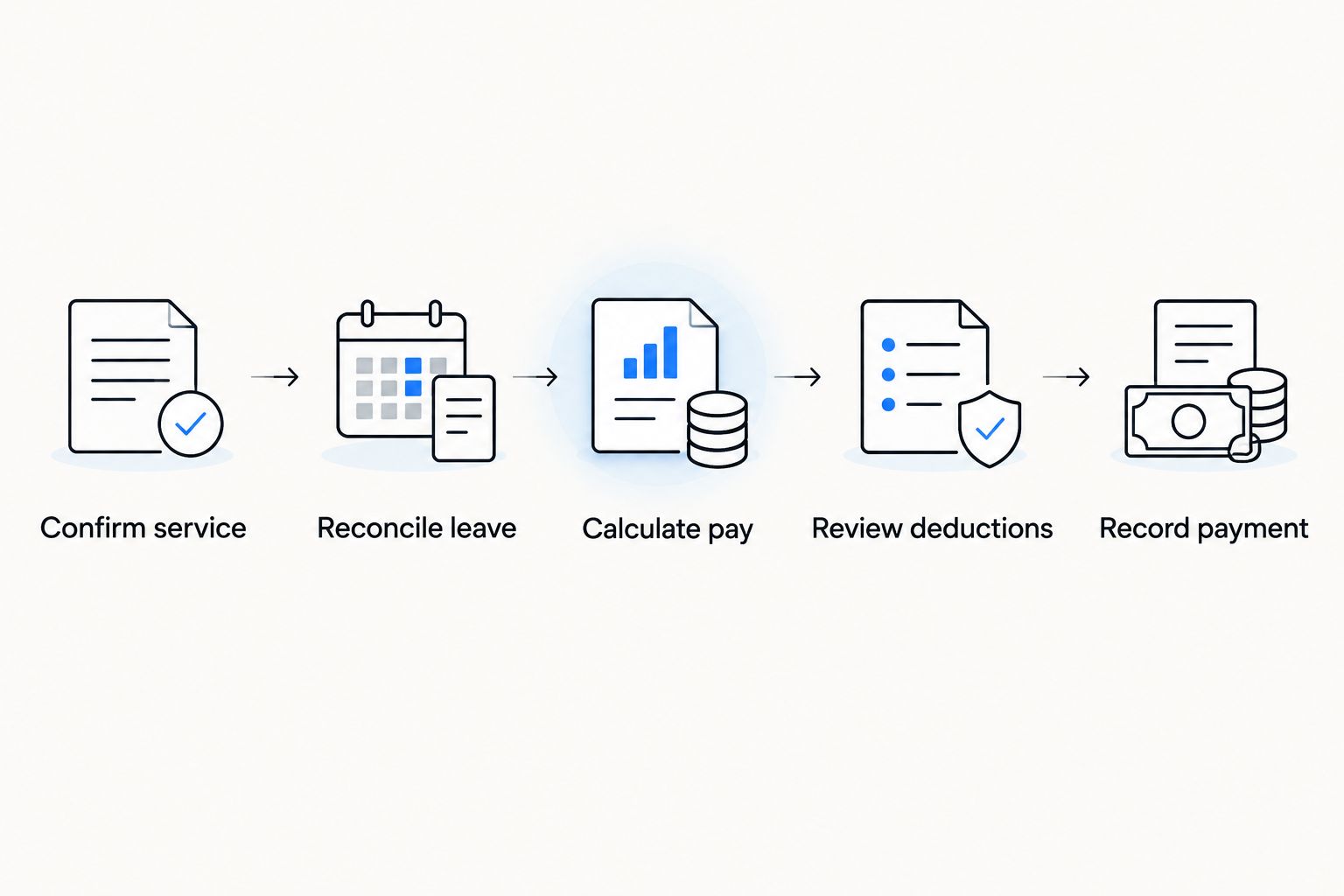
Use a documented sequence rather than treating the balance displayed in a system as the final answer. Each step should leave a record that another payroll reviewer can follow.
1. Confirm service
Establish the employment start date, termination date and relevant service history. Review whether earlier employment with the same employer must be included under the applicable service rules.
Check the employment contract and any collective agreement before applying statutory minimums. A contractual entitlement above the minimum belongs in the calculation; a lower contractual figure cannot displace a mandatory statutory right.
2. Reconcile leave
Match earned entitlements against leave applications, approvals and records showing leave taken. Separate annual leave from sick leave, unpaid leave, weekly rest and public holidays.
Article 56 excludes weekly rest days and national and public holidays falling within annual leave from the annual leave count. Check how your working schedule is treated before accepting a calendar-day subtraction, particularly where the working week creates a disputed Saturday treatment.
3. Calculate pay
Apply the final wage basis to the verified unused balance. Keep the day count, daily wage, gross leave payment and deductions visible as separate calculation fields.
Do not carry an old daily wage forward simply because the employee earned those days before a salary increase. Article 59 links the unused leave payment to the wage when the employment relationship ends.
4. Review deductions
Annual leave pay is not treated identically to statutory severance compensation. Apply the relevant income tax, stamp tax and SGK social security rules to the payment.
For a termination payment, check the applicable reporting period, contribution ceiling and employee-specific payroll position. The gross entitlement is not a promise that the employee will receive the same amount in their bank account.
5. Record payment
Show unused annual leave pay separately in the final payroll breakdown. Retain the supporting leave reconciliation, wage calculation, payroll record and payment evidence together.
Give the employee an understandable statement rather than an unexplained total. If part of the balance remains disputed, record the precise disagreement instead of editing the leave history to make it match the payment.
What should an HR platform handle?
A usable exit workflow connects the employment dates, approved leave history and final payroll calculation. Its benefit is traceability: you can identify where the day balance came from and who approved the payment. Its limit is equally clear: software cannot resolve an incorrect contract interpretation or an unsupported leave record by itself.
Ottohr is best suited to growing employers and mid-size to large enterprises seeking an HR platform covering hiring, onboarding, payroll, benefits and compliance. That scope is relevant to employers managing these functions together, but it does not establish the correctness of any particular employee’s leave payout.
When assessing Ottohr or another HR platform, require a demonstration using your actual leave rules. Check the treatment of completed service years, contractual entitlements, corrections and termination dates before relying on an automated result.
Can an employer refuse payment because the employee resigned without notice?
Article 59 preserves earned annual leave pay regardless of the termination reason. An employee’s failure to give required notice does not erase that entitlement.
A notice-pay claim is a separate issue. Do not simply delete unused leave days or assume you can deduct a disputed notice claim from final wages; assess the claim and any proposed deduction under the applicable legal rules.
Can an employee take annual leave instead of working notice?
Article 59 expressly prevents annual leave from overlapping with statutory notice periods and job-search leave where the employer terminates employment. Do not extend that wording into an automatic rule that a resigning employee can choose annual leave instead of working notice.
For resignation, review the leave request, approval and agreed termination date separately. A pending request does not establish that annual leave was taken, and it does not automatically shorten the notice obligation.
FAQ
Do I lose my unused annual leave if I resign in Turkey?
No. Under Article 59 of Turkish Labour Law No. 4857, earned but unused annual leave becomes payable when employment ends, including when you resign. Severance eligibility is a separate question.
Is unused annual leave paid at my current salary or my old salary?
Unused annual leave is paid using the wage applicable when employment ends. For a monthly paid employee, the standard gross calculation uses the final gross monthly base wage divided by 30, multiplied by the unused earned days.
Do I get annual leave pay if I resign before completing one year?
Statutory annual leave generally requires one completed year of service, including probation. Before that point, check whether your contract or another applicable arrangement grants a more favourable leave entitlement.
Is unused annual leave pay tax-free in Turkey?
No. Unused annual leave pay is subject to applicable payroll deductions, including the relevant tax and SGK rules. Do not apply statutory severance pay treatment to annual leave pay.
Can my employer pay me instead of letting me take annual leave while I still work there?
An employer cannot replace statutory annual leave with cash while employment continues. The payment obligation for an unused earned balance arises when employment ends.
How long do I have to claim unpaid annual leave pay?
The limitation period for unused annual leave pay is generally 5 years from termination under the rules applicable to current terminations. Mandatory mediation and other procedural events affect how a specific claim is pursued and how time is counted.
Can Ottohr replace a legal review of disputed leave pay?
No HR platform replaces legal review of a disputed entitlement. Use the platform’s records alongside the employment contract, applicable law and evidence of leave actually taken.
One last thing
Old leave and old wages are not the same thing. An unused entitlement carried from an earlier service year is paid using the wage applicable at termination, not frozen at the salary earned when those days first arose.
Before approving a 2026 resignation payroll, inspect the oldest outstanding leave entries as carefully as the latest ones. A clean current-year balance can still omit an unpaid entitlement from an earlier completed service year.


