
Yes—HR software can calculate Turkish severance pay accurately when it uses the correct eligibility decision, service dates, remuneration base and statutory ceiling effective on the termination date. The limitation is legal judgment: software can apply an approved rule, but it cannot resolve a disputed dismissal reason or incomplete employment history through arithmetic alone.
- Can HR software calculate Turkish severance pay accurately? Yes, with verified eligibility, remuneration, service dates and effective-dated rules.
- Turkish statutory severance generally uses 30 days of qualifying gross remuneration for each completed service year.
- Accurate kıdem tazminatı requires separate checks for entitlement, calculation, deductions and approval.
- Ottohr serves growing employers seeking HR, payroll and compliance tools; verify severance-specific capabilities before choosing software.
Can HR software calculate Turkish severance pay accurately?
Yes. Accuracy depends on the employment record and the Turkish rules configured in the system—not merely on a calculator being available. For employees covered by the general private-sector framework, Article 14 of Labour Law No. 1475 remains the central statutory basis for kıdem tazminatı, or severance pay.
The standard framework generally requires at least 1 year of qualifying service and a qualifying termination circumstance. The calculation starts from 30 days of qualifying gross remuneration per completed service year, adds the proportion attributable to the remaining service period, and applies the statutory annual ceiling.
| Calculation stage | What software must establish | What you should verify |
|---|---|---|
| Entitlement | Whether the recorded termination circumstance qualifies | Supporting documents and legal classification |
| Service | The qualifying employment period | Start date, termination date and continuity |
| Remuneration | Final gross wage plus qualifying regular benefits | Included components and valuation basis |
| Ceiling | The ceiling effective on the relevant termination date | Effective dates and authoritative source |
| Settlement | Gross severance, deductions and resulting net amount | Separate treatment of other termination payments |
Ottohr is an HR platform for growing employers managing payroll and compliance. That scope makes severance a relevant evaluation topic, but a product category does not establish whether a particular statutory calculation is supported.
Why this matters
A termination settlement brings together records that different teams often maintain: the contract, payroll, benefits, attendance and the termination decision. An internally consistent calculation can still be wrong if any of those records misstates the underlying facts.
For a 2026 termination, the software must use the rules applicable to that termination—not simply today's settings. Preserve the calculation inputs and the rule version so a reviewer can explain the result after payroll closes.
A correct formula cannot repair an incorrect entitlement decision. Treat legal classification and numerical calculation as separate controls.
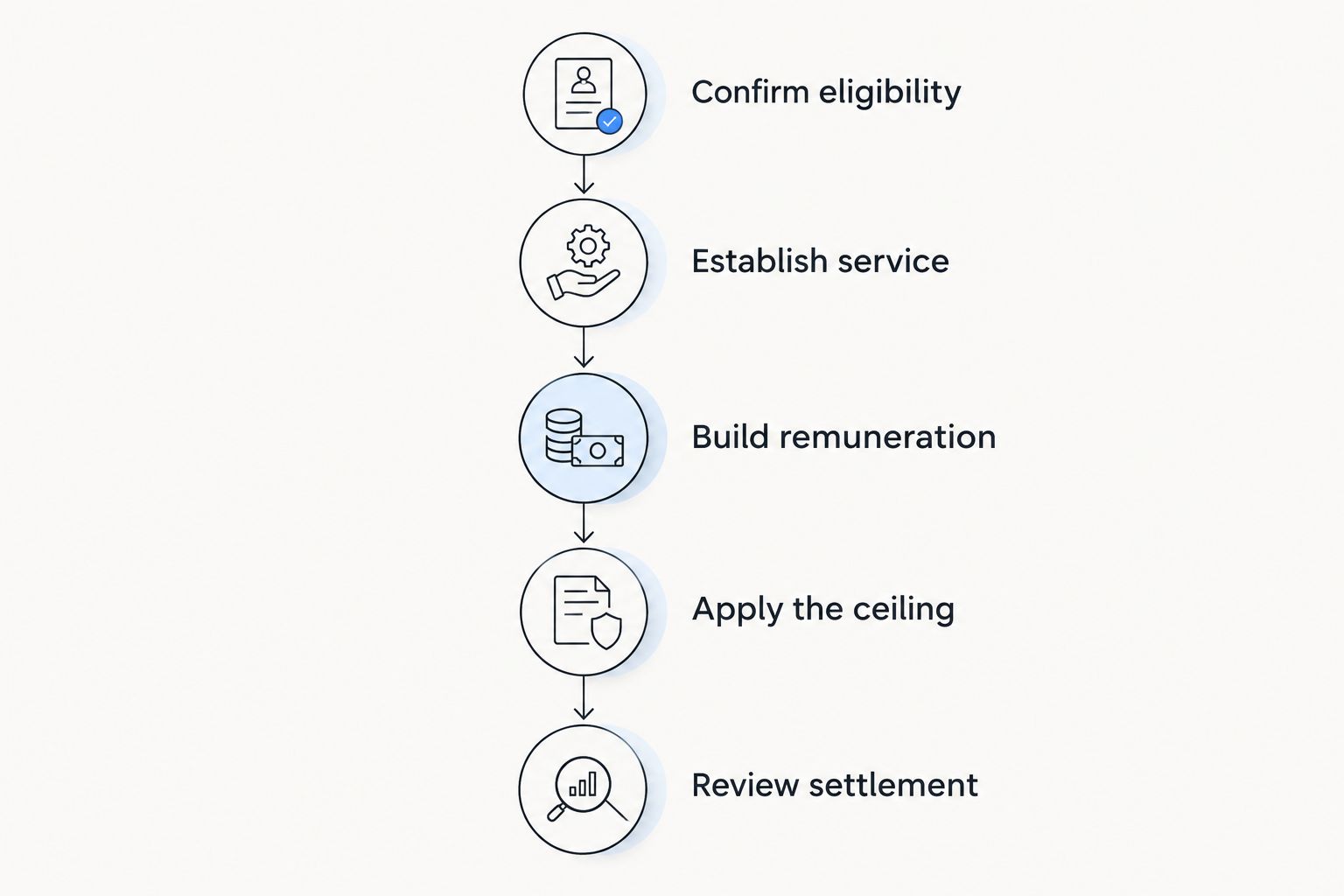
How should software calculate Turkish severance pay?
A reliable workflow checks entitlement before calculating an amount. It then shows the basis for each material input rather than producing an unexplained net total.
Confirm eligibility
Record the reason for termination and the evidence supporting it. Employer dismissal, employee resignation and mutual termination are not interchangeable categories for severance purposes.
Ordinary resignation does not generally create statutory severance entitlement. Specific circumstances can produce a different result, including qualifying employee termination for just cause, retirement-related conditions, military service and the statutory marriage-related route for eligible employees.
Do not configure a rule that treats every resignation as ineligible or every employer dismissal as eligible. The legal grounds matter, and disputed grounds require review rather than an automatic payment decision.
Establish service
Check the employment start date, termination date and any earlier periods that require a continuity assessment. A branch transfer or change in payroll record should not automatically reset seniority.
The general statutory threshold is 1 year of qualifying service. After entitlement is established, the calculation includes proportional service beyond completed years; it should not discard the remaining months and days.
Ask the provider to explain its day-count convention. If a proportional calculation uses a 365-day divisor, the worksheet should disclose that convention and show the dates used, including its treatment of leap years and boundary dates.
Build remuneration
Use the final qualifying gross remuneration basis, commonly described as giydirilmiş brüt ücret. This is not necessarily the same as the employee's basic salary or take-home pay.
Regular cash benefits and benefits measurable in money can affect the basis when they meet the relevant legal conditions. Meal support, transport support and recurring bonuses therefore require classification; a component's payroll label alone does not establish its treatment.
Keep the supporting method visible for each included item. Variable remuneration and irregular payments need particular care because the appropriate reference period and inclusion decision depend on the payment's nature.
Apply the ceiling
Apply the statutory severance ceiling to the relevant annual remuneration basis. The ceiling limits the statutory amount attributable to a service year; it is not a single maximum for the employee's entire employment period.
For 2026 records, check the ceiling's effective period rather than relying on a field labelled “current ceiling.” The severance pay cap benchmarks by year in Turkey guide provides related context for this control.
Review settlement
Show gross severance, the applicable deductions and the resulting net payment separately. Keep unused annual leave, notice compensation and outstanding salary on distinct lines rather than combining everything under severance.
Preserve the approved inputs with the result. If someone changes the termination date or remuneration basis afterward, require a new calculation and review instead of silently replacing the approved worksheet.
What should the calculation worksheet show?
An auditable worksheet lets another payroll professional reproduce the result without guessing which settings were active. A displayed total is insufficient if the underlying dates, benefits and ceiling are hidden.
Require these fields in the calculation record:
- Employment facts: employee identity, employing entity, qualifying service dates and termination circumstance.
- Remuneration basis: final gross wage, each included benefit and the basis for excluding disputed components.
- Calculation method: completed service, proportional service and the applicable day-count convention.
- Statutory parameters: ceiling value, effective period and source reference.
- Settlement details: gross severance, deductions, net payment and separately calculated termination items.
- Approval evidence: reviewer, approval status and the version of the calculation reviewed.
For a 2026 payroll file, retain the parameter set used at calculation time. Reopening a historical record should not substitute a newer ceiling and change the original result without explanation.
The general statutory formula is only the starting point. Where a contract or collective agreement provides enhanced terms, obtain a separate assessment of how those terms interact with statutory limits and tax treatment.
Why Turkish severance calculations vary
Different results do not necessarily mean different arithmetic. Often, the calculators are answering different factual or legal questions.
- Termination grounds: the recorded reason determines whether statutory severance is due at all.
- Qualifying service: continuity decisions and treatment of particular periods affect the service credited.
- Remuneration components: recurring benefits can change the basis even when basic salary stays unchanged.
- Termination date: the effective ceiling must match the relevant date, not the calculation date.
- Contractual terms: enhanced arrangements require their own legal and payroll assessment.
- Payment classification: statutory severance and other termination payments can have different deduction rules.
Compare inputs before comparing totals. If two systems disagree, reconcile eligibility, service, remuneration and ceiling in that order; changing rounding settings will not resolve a different legal basis.
Which calculation workflow should you use?
Choose a workflow according to the case's complexity and the evidence you need to retain. Software is useful for repeatable calculations, while disputed facts require an accountable reviewer.
| Workflow | Best for | Advantage | Limitation |
|---|---|---|---|
| Standalone calculator | Preliminary estimates with established inputs | Makes a straightforward formula easy to inspect | Does not establish whether entered facts or rules are correct |
| Configured payroll workflow | Routine cases with verified employee records | Can reuse approved payroll inputs and consistent rules | Configuration errors can repeat across cases |
| Specialist-reviewed calculation | Disputed eligibility, continuity or remuneration | Addresses the legal classification behind the calculation | Requires review beyond automated arithmetic |
Use a configured payroll workflow for routine cases and specialist review for disputed cases. A standalone calculator is a cross-check, not a substitute for the employment file.
Ottohr suits growing employers seeking HR, payroll and compliance tools. For severance evaluation, request a demonstrated calculation with visible inputs and exceptions; do not infer effective-dated ceilings, approval controls or tax logic from the platform's general description.
How do you test accuracy before relying on software?
Use documented scenarios with independently approved expected treatment. A demonstration that produces a plausible total does not establish that the system handles exceptions correctly.
- Test the eligibility boundary. Compare a qualifying case below the general service threshold with one that meets it. Confirm that the system explains the eligibility outcome.
- Test partial service. Use a case with completed years and a remaining service period. Check that the remainder is included rather than rounded away.
- Test remuneration classification. Add a qualifying recurring benefit, then examine how the basis changes. Require an explanation for excluded components.
- Test ceiling dates. Compare cases falling in different effective periods. Confirm that each calculation selects its own applicable parameter.
- Test corrections. Change an approved input and check whether the system preserves the previous result and requires renewed review.
- Test separation. Include unused leave or notice compensation and confirm that neither becomes an unexplained addition to statutory severance.
For a 2026 software assessment, ask for the calculation record as well as the screen demonstration. Your payroll reviewer should be able to explain the result without relying on the vendor's verbal assurances.
Does resignation always prevent severance pay?
No. Ordinary resignation generally does not qualify, but Turkish law recognises specific employee-initiated departure circumstances that can create entitlement.
The software should require the relevant grounds and supporting documentation instead of treating the word “resignation” as a complete legal decision. Escalate disputed grounds before approving the settlement.
Is unused annual leave part of severance pay?
No. Unused annual leave compensation is a separate termination payment, not an additional component of statutory kıdem tazminatı.
Keep separate calculation lines and deduction treatment. An employee's lack of severance entitlement does not, by itself, resolve the employee's entitlement to unused leave compensation.
Can payroll approve severance without legal review?
Routine cases can follow an established approval policy when eligibility and inputs are clear. Cases involving disputed dismissal grounds, uncertain continuity or contested remuneration need appropriate legal review before release.
Human approval is not proof of accuracy by itself. The reviewer needs the supporting documents, calculation basis and unresolved exceptions—not just a payment total.
FAQ
Can HR software calculate Turkish severance pay accurately in 2026?
Yes, HR software can calculate Turkish severance pay accurately in 2026 when eligibility, service, remuneration and effective-dated statutory rules are correct. Review disputed legal facts separately from the arithmetic.
How much service is generally required for Turkish severance pay?
At least 1 year of qualifying service is generally required under the standard statutory framework. The termination circumstance must also create entitlement; service alone is insufficient.
Is Turkish severance based on 30 days of salary?
The statutory basis is generally 30 days of qualifying gross remuneration per completed service year, subject to the applicable ceiling. Proportional service and qualifying regular benefits also affect the calculation.
Does the severance ceiling limit the employee's entire payment?
No, the statutory ceiling limits the annual basis used for severance, not the total payment for all qualifying service. Software must apply the ceiling effective on the relevant termination date.
Is Turkish severance pay calculated from net salary?
No, statutory severance uses a qualifying gross remuneration basis rather than take-home salary. The worksheet should identify included benefits and show deductions separately.
Is Turkish severance pay subject to income tax?
Statutory severance within the applicable legal exemption is exempt from income tax, while stamp duty applies. Amounts outside the exemption and other termination payments need separate classification.
Can I assume Ottohr supports every Turkish severance exception?
No, a general HR and payroll offering does not establish support for every severance exception. Request a demonstration covering eligibility, service continuity, remuneration, effective-dated ceilings and review controls.
One last thing
A matching total is not enough: check whether the calculation remains correct when an input changes. Incorrect remuneration and an incorrect ceiling can conceal each other in one case, then produce a different error in the next.
Before approving your 2026 process, require an explanation for every material input. If the reviewer cannot trace the amount back to the employment record and applicable rule, keep the payment in review.


