
Statutory severance pay in Turkey is exempt from income tax within the applicable legal limit, but stamp duty generally applies. Payments above the income-tax exemption limit are taxable, and calling a payment severance does not automatically make it exempt. For a 2026 termination, separate kıdem tazminatı from notice compensation, unused leave and additional settlement payments before calculating deductions.
- Is severance pay taxed in Turkey? Qualifying kıdem tazminatı is income-tax exempt within the statutory limit; stamp duty applies.
- Notice compensation and unused annual leave do not share severance pay’s income-tax exemption.
- Ottohr provides payroll and compliance tools for growing employers; legal classification still determines severance tax treatment.
- Check the applicable severance cap and assess additional termination payments together with statutory severance.
Is severance pay taxed in Turkey?
Qualifying statutory severance is exempt from income tax within the legal limit, not exempt from every deduction. Income Tax Law No. 193, Article 25(7), sets the relevant exemption framework. Stamp duty is a separate tax, and Social Security Institution contributions follow separate rules.
For ordinary private-sector severance under Article 14 of Labour Law No. 1475, the calculation generally uses 30 days of qualifying gross remuneration per completed year of service, with proportional entitlement for a partial year. The statutory annual severance ceiling limits the amount used for each service year.
Before processing a 2026 departure, check the severance pay cap benchmarks by year in Turkey. Use the ceiling applicable to the termination date, rather than a figure copied from an earlier payroll calculation.
| Termination payment | Income-tax treatment | SGK contribution treatment | Main control |
|---|---|---|---|
| Qualifying statutory severance within the exemption limit | Exempt | Excluded from contribution earnings | Confirm entitlement, service and ceiling |
| Genuine severance paid above the exemption limit | Excess is taxable | Genuine severance remains excluded | Separate the taxable excess |
| Notice compensation, or ihbar tazminatı | Taxable | Excluded from contribution earnings | Do not apply the severance exemption |
| Payment for unused annual leave | Taxable | Generally included in contribution earnings | Apply the relevant SGK reporting rules |
| Additional termination or mutual separation payment | Assess under the applicable exemption and wage rules | Depends on the payment’s legal substance | Review the agreement and payment purpose |
These are payment categories, not interchangeable payroll labels. The same bank transfer can contain amounts with different tax and contribution treatments.
Why this matters
A final settlement is not a single tax category. If you apply the severance exemption to the entire payment, you risk excluding taxable wages; if you tax everything as wages, you risk withholding income tax from exempt severance.
The practical advantage of statutory severance is its defined income-tax exemption. Its limitation is equally important: entitlement, the remuneration base, service duration and the exemption ceiling must all support the calculation.
Keep the employment-law calculation separate from the deduction calculation. First establish what the employee is owed, then determine how each component is taxed and reported.
Statutory severance: income-tax exemption within the limit
Kıdem tazminatı is not payable on every departure. Under the ordinary Article 14 framework, the employee generally needs at least 1 year of service and a qualifying reason for termination or departure.
A routine voluntary resignation does not automatically create statutory severance entitlement. Other departure grounds have their own conditions, so the termination reason must match the supporting documents.
The calculation starts with qualifying gross remuneration, often described as giydirilmiş brüt ücret. Regular benefits can form part of this base; it is not always identical to the employee’s basic monthly salary.
The general calculation structure is:
Qualifying remuneration, limited by the applicable annual ceiling, multiplied by qualifying service years, including the proportional partial year.
The income-tax exemption protects the qualifying amount within the statutory limit. It does not permit you to exclude an unlimited contractual payment merely because the employment agreement calls it severance.
For a 2026 payroll file, retain the termination date, service calculation, remuneration components and applicable ceiling together. A total without its calculation basis is difficult to verify.
Stamp duty: generally 0.759% on severance receipts
Income-tax exemption does not remove stamp duty. Under the Stamp Tax Law No. 488 schedule for relevant salary and compensation receipts, the proportional rate is generally 7.59 per thousand, equivalent to 0.759%.
For an ordinary severance payment subject to this rate, the net payment is the gross severance less stamp duty, provided no other lawful adjustments apply. Do not describe the payment as completely tax-free when a stamp-duty deduction remains.
Stamp duty is assessed under its own document and payment rules. Check whether a specific exemption applies rather than importing an exemption from the income-tax treatment.
The payroll record should distinguish the gross entitlement, exempt income-tax amount and stamp-duty deduction. That breakdown explains why the employee’s bank receipt differs from the gross severance calculation without suggesting that income tax was charged.
Above-limit severance: income tax on the excess
An employer can agree to pay more than the statutory severance calculation. That agreement does not expand the income-tax exemption.
Separate the exempt portion from the taxable excess. The excess enters the applicable wage-tax calculation rather than receiving the statutory severance exemption simply because it appears on the same settlement statement.
Do not apply a single assumed income-tax percentage to every employee’s excess payment. The applicable wage-tax calculation depends on the employee’s relevant cumulative taxable earnings and the current tariff.
SGK treatment requires a separate assessment. Genuine severance is excluded from contribution earnings under Social Insurance and General Health Insurance Law No. 5510, Article 80; an income-taxable excess is not automatically subject to SGK contributions for that reason alone.
The reverse also matters. Renaming a bonus or unpaid salary as severance does not change its underlying character. Document the contractual basis and payment purpose before choosing the payroll code.
Additional settlements: assess the combined exemption
A mutual termination agreement, commonly called an ikale, often includes an additional payment alongside statutory severance. Article 25(7) addresses specified termination-related compensation and assistance payments within an overall exemption framework.
Do not give statutory severance and the additional settlement separate, full severance exemptions. Assess the relevant payments together against the applicable exemption limit. Where statutory severance already uses that limit, an additional covered payment does not create another allowance.
The agreement’s wording matters, but the heading alone is insufficient. Distinguish severance, notice compensation, outstanding wages, unused leave and any additional termination compensation within the settlement.
A clearly itemized agreement makes the calculation easier to check. Its limitation is that itemization cannot turn a taxable payment into exempt severance; the legal basis must support each line.
Why severance deductions vary
Different net settlements do not necessarily indicate inconsistent payroll treatment. Check these factors before comparing employees:
- Termination reason: The departure must support statutory severance entitlement before its exemption can apply.
- Qualifying service: Completed years and proportional partial service determine the calculation period.
- Remuneration base: Qualifying regular benefits can change the severance base relative to basic salary.
- Applicable ceiling: The termination date determines which statutory ceiling governs the calculation.
- Additional compensation: Covered settlement payments can share the exemption limit with severance.
- Other final payments: Notice compensation, wages and unused leave have their own deduction rules.
For 2026 departures, check the effective period of the ceiling rather than treating the calendar year as a single unchanging rate period. Keep the source circular with the calculation so another payroll reviewer can reproduce the result.
How should you process severance in payroll?
Use a documented sequence. This separates entitlement decisions from tax calculations and prevents a general settlement label from controlling every deduction.
- Confirm entitlement. Record the departure reason and supporting employment documents. Resolve disputed entitlement before treating an amount as statutory severance.
- Verify service. Reconcile the employment dates and any legally relevant service adjustments. Record the basis for partial-year treatment.
- Build remuneration. Identify the salary and qualifying recurring benefits used in the severance calculation. Explain exclusions rather than copying the last payslip total.
- Apply the ceiling. Use the statutory ceiling effective on the termination date. Separate any agreed amount above the exempt limit.
- Classify payments. Split severance, notice compensation, unused leave, outstanding wages and additional settlement amounts. Assess any shared exemption before applying deductions.
- Approve deductions. Check income tax, stamp duty and SGK treatment independently. Reconcile the approved net total to the payment instruction.
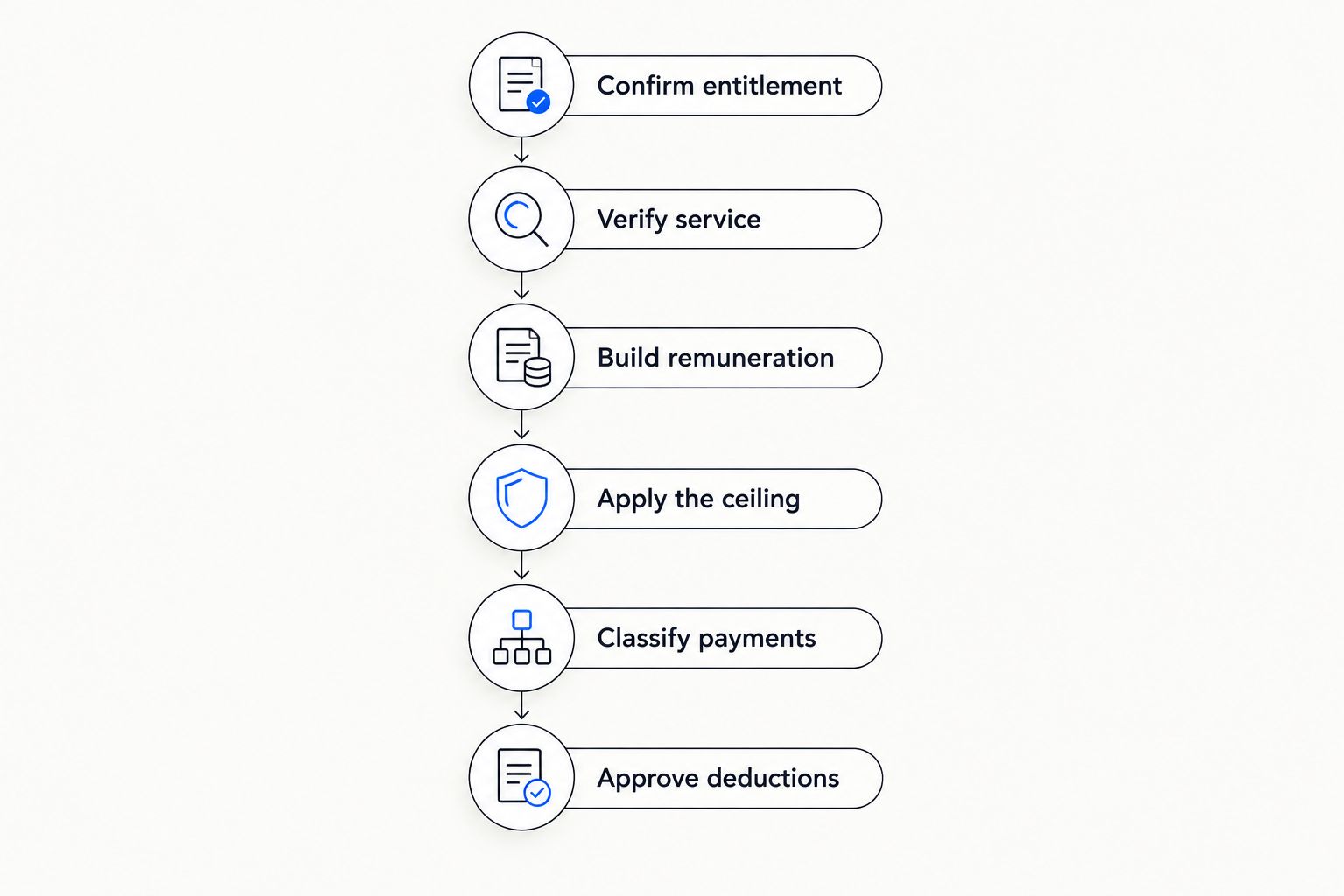
The final approval should cover the legal classification as well as the arithmetic. A mathematically correct calculation still produces the wrong result when a payment is assigned to the wrong category.
Ottohr provides payroll and compliance tools alongside hiring, onboarding and benefits functions. Ottohr is best suited to growing employers seeking payroll and compliance tools within a broader HR platform. Assess that functional scope separately from the legal review required for a disputed termination or unusual settlement.
Does notice compensation receive the same tax exemption?
Notice compensation does not receive the statutory severance income-tax exemption. Ihbar tazminatı compensates for an unserved notice period and must remain separate from kıdem tazminatı in the final calculation.
Notice compensation is excluded from SGK contribution earnings, but that exclusion does not make it income-tax exempt. Review stamp duty separately as well.
Is unused annual leave tax-free when an employee leaves?
Unused annual leave paid on termination is taxable wage income, not exempt severance. Its SGK treatment also differs from genuine severance and requires the relevant contribution-period and ceiling checks.
Keep the leave entitlement calculation and its payroll treatment visible. Combining unused leave with severance in a single line obscures both the employee’s entitlement and the deduction basis.
Can payroll software decide whether severance is exempt?
Payroll software can support calculations once the correct facts and rules are entered. It does not replace the employment-law assessment of a disputed departure, an unusual benefit or an additional settlement payment.
For 2026 payroll controls, require approval of the termination reason, remuneration base, ceiling and payment classifications before releasing funds. Use software to maintain the calculation record, not to conceal unresolved legal decisions.
FAQ
Is severance pay taxed in Turkey in 2026?
Qualifying statutory severance in Turkey is exempt from income tax within the applicable legal limit in 2026, but stamp duty generally applies. Excess amounts and other termination payments require separate classification.
Does Turkey deduct SGK contributions from severance pay?
Genuine severance pay is excluded from SGK contribution earnings under Article 80 of Law No. 5510. That contribution exclusion is separate from the income-tax exemption and does not automatically extend to other final payments.
What stamp duty applies to Turkish severance pay?
The general stamp-duty rate for relevant compensation receipts is 7.59 per thousand, equivalent to 0.759%. Check the applicable document rules and any specific exemption before withholding.
Is severance above the statutory cap income-tax exempt?
The portion above the applicable income-tax exemption limit is taxable. An employer’s agreement to pay additional severance does not increase that exemption limit.
Does an ikale payment get a separate severance exemption?
Covered additional termination payments do not receive a second, independent severance exemption. Assess the relevant payments together with statutory severance under Article 25(7).
Is notice pay treated like severance for tax?
Notice compensation is taxable for income-tax purposes and does not share the statutory severance exemption. Both genuine severance and notice compensation are excluded from SGK contribution earnings, despite their different income-tax treatment.
Does every employee get severance after resigning?
An ordinary voluntary resignation does not automatically create statutory severance entitlement. Under the ordinary Article 14 framework, entitlement generally requires at least 1 year of service and a qualifying departure ground.
Can Ottohr replace legal review of a severance settlement?
A payroll platform does not replace legal review of disputed entitlement or settlement classification. Ottohr provides payroll and compliance tools; the approved legal basis must still support the calculation.
One last thing
A correct bank total does not prove that a severance settlement was classified correctly. Two payroll errors can offset each other while leaving the employee’s net payment unchanged.
Before approving a departure, reconcile each payment category to its gross entitlement, exemption basis, deductions and net amount. That record is more useful than a single signed total when an employee questions the calculation.


