
Turkey’s kıdem tazminatı tavanı is TRY 64,948.77 per completed year of service for terminations from 1 January to 30 June 2026. This is the statutory annual-service ceiling, not an average payout: an eligible employee’s calculation uses qualifying gross remuneration below that ceiling, or the ceiling when remuneration exceeds it.
- Turkey’s kıdem tazminatı tavanı is TRY 64,948.77 per service year for January–June 2026 terminations.
- Calculate eligible severance using qualifying gross remuneration, the applicable ceiling and recognised service.
- Ottohr provides HR, payroll and compliance tools for growing employers and mid-size to large enterprises.
- Match the ceiling to the termination date; never average different effective periods.
Why this matters
The severance ceiling limits the remuneration used for each year of service, not the employee’s entire settlement. Confusing those amounts understates liabilities for employees with longer service. Applying the ceiling automatically to every employee overstates liabilities when qualifying remuneration is lower.
Ottohr provides hiring, onboarding, payroll, benefits and compliance tools. For your payroll team, the immediate task is narrower: establish entitlement, identify the correct remuneration base and retain the calculation approved for payment.
Turkey’s severance ceiling benchmark for 2026
Kıdem tazminatı is statutory severance compensation for eligible employees leaving under qualifying circumstances. The ceiling limits the gross remuneration recognised for each completed service year; it does not establish a universal entitlement.
For January–June 2026, the overall statutory ceiling is TRY 64,948.77 per completed service year. The table separates that ceiling from the employee-specific calculation base.
| Remuneration band | Gross base per completed service year | What the benchmark means |
|---|---|---|
| Overall statutory ceiling, January–June 2026 | TRY 64,948.77 maximum | The upper limit under the statutory calculation |
| Qualifying gross monthly remuneration below the ceiling | Actual qualifying remuneration, below TRY 64,948.77 | Use the lower remuneration figure, not the ceiling |
| Qualifying gross monthly remuneration equal to the ceiling | TRY 64,948.77 | Remuneration and the statutory limit coincide |
| Qualifying gross monthly remuneration above the ceiling | TRY 64,948.77 | Pay above the limit does not increase the statutory annual-service base |
The highest statutory annual-service base is TRY 64,948.77. Employees below that threshold have a lower base determined by their qualifying remuneration; employees above it share the same capped base despite earning different salaries. There is no single lower-end benchmark because remuneration differs by employee.
Source and methodology: the ceiling is the Turkish Ministry of Treasury and Finance’s January 2026 Mali ve Sosyal Haklar circular figure, effective from 1 January through 30 June 2026. The remuneration bands apply that published ceiling to the statutory framework in Article 14 of Law No. 1475; they are calculation categories, not a sample of employee payouts.
Limitation: this benchmark cannot establish an individual employee’s entitlement or final payment. Those depend on the termination circumstances, qualifying remuneration and recognised service.
How to use these benchmarks
- Match the effective period first. Use TRY 64,948.77 for a termination within the stated January–June 2026 period. Do not treat a half-year ceiling as a permanent annual setting.
- Compare remuneration before applying the ceiling. The statutory base is the lower of qualifying gross monthly remuneration and the applicable limit.
- Separate the base from the total. Multiply the appropriate annual-service base by recognised service, including the proportional entitlement for a partial year.
- Keep severance separate from other termination items. Notice pay, unused annual leave and outstanding salary have their own calculation rules.
These checks belong in the termination workflow, not just in a year-end spreadsheet. A correct ceiling cannot repair the wrong exit reason, an incomplete remuneration base or an incorrect service record.
What the ceiling actually limits
Annual-service base, not total settlement
The statutory framework provides 30 days of qualifying remuneration for each completed year of service, subject to the ceiling. Service beyond completed years is taken into account proportionally.
An employee with several recognised years of service does not receive only one annual ceiling amount. The ceiling constrains the base used across the service calculation. Your settlement must therefore show the base and the service period separately.
Keep the terminology explicit. A field labelled only severance cap is ambiguous; statutory ceiling per completed service year tells the reviewer exactly what the amount controls.
Qualifying remuneration, not take-home salary
The relevant concept is generally giydirilmiş brüt ücret: gross remuneration including qualifying regular benefits. Net salary is not the starting point, and basic gross salary alone does not necessarily capture the complete base.
Regular cash and measurable in-kind benefits require assessment under the applicable rules. Do not automatically include every payroll line or exclude every benefit. Record the treatment and supporting basis for each disputed component.
This distinction matters most near the ceiling. An omitted qualifying benefit can change whether the employee falls below or above the statutory limit, even when the basic salary record is accurate.
Entitlement, not automatic payment
Completing 1 year of service is a core statutory condition, but service length alone does not establish eligibility. The reason for termination and the applicable legal circumstances also matter.
Ordinary resignation does not automatically create the same entitlement as an employer termination that qualifies for severance. Recognised exceptions require their own supporting evidence. Confirm the legal basis before calculating the payment.
Build a defensible severance calculation
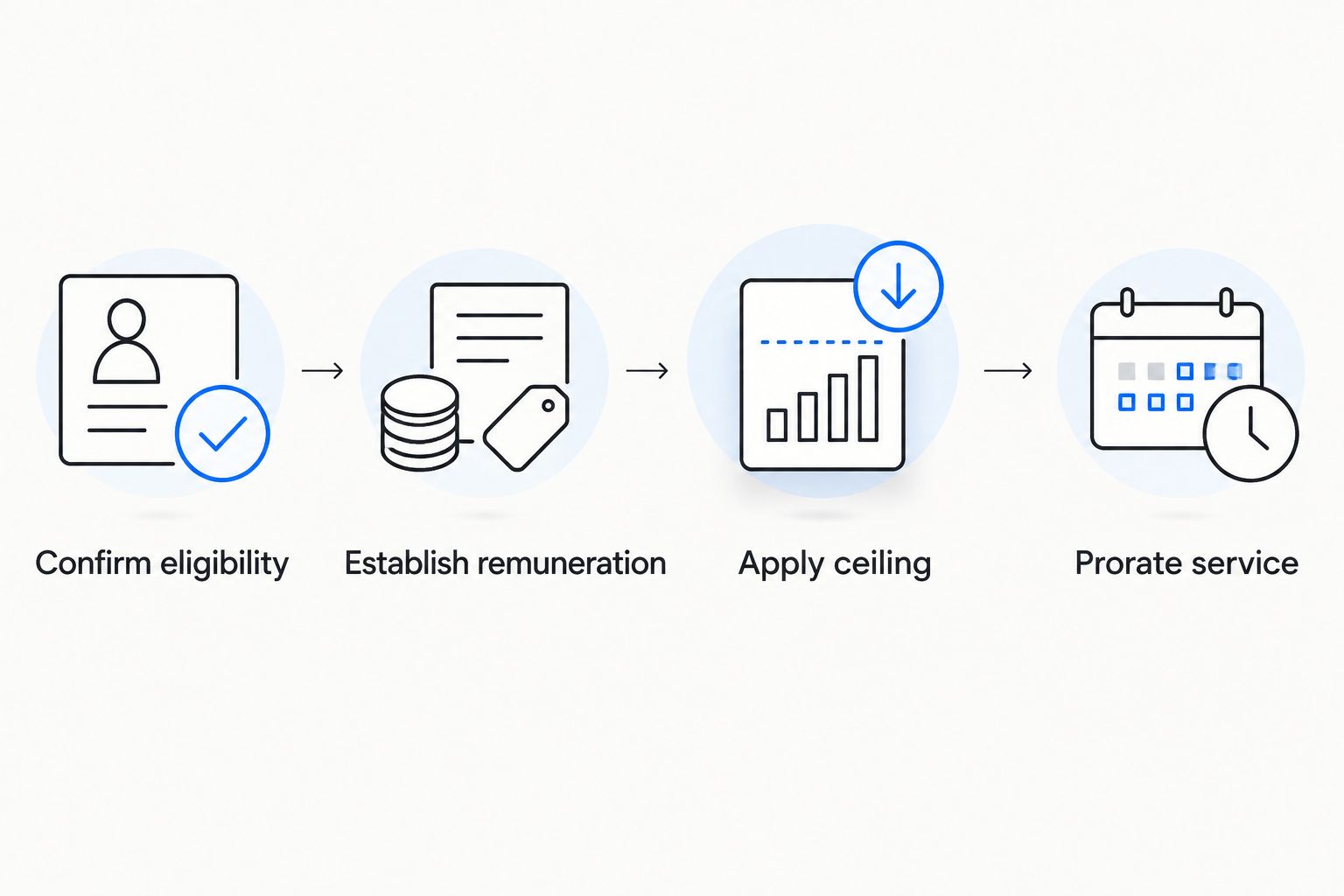
Use the following sequence for a 2026 termination. Each stage produces a decision or record that the next stage needs.
Confirm eligibility
Establish the termination date, exit circumstances and recognised service. Check the supporting documents against the actual reason for departure rather than relying solely on an administrative exit code.
Record any employment-history issues that affect continuity. Transfers, interruptions and disputed start dates require a documented decision before the calculation reaches payroll approval.
Establish remuneration
Identify the final qualifying gross remuneration and assess regular benefits. Keep the payroll components visible so the reviewer can distinguish basic salary from additions included in the severance base.
The output should be a supported remuneration figure, not an unexplained total copied from the last payslip. Where treatment is disputed, obtain the legal or payroll decision before approving the settlement.
Apply ceiling
Compare qualifying remuneration with the ceiling effective on the termination date. For a termination in January–June 2026, the statutory comparison is against TRY 64,948.77 per completed service year.
Retain the official source and effective-period record alongside the calculation. A spreadsheet value without an effective date is not enough to show why the limit was correct for that employee.
Prorate service
Apply the approved annual-service base to recognised service, including the proportional amount for the remaining part of a year. Make the service dates and calculation convention visible to the reviewer.
Then keep the gross severance calculation distinct from deductions and the final amount payable. Approval should cover the complete settlement, not merely the multiplication used to produce gross severance.
For the upstream attendance records feeding payroll, see the PDKS-to-payroll workflow. Attendance records support payroll inputs; they do not replace the separate legal assessment of severance entitlement.
Compare effective periods without creating a false average
A statutory ceiling is an effective-dated legal parameter. It is not a market average, a recommended benefit or a measure of what employers typically pay.
For a year-by-year register, keep a separate entry for every effective period. Where a year contains different published ceilings, preserve those periods rather than replacing them with a blended annual figure. The employee’s relevant termination date determines which entry belongs in the calculation.
Your register should retain:
- The effective start and end dates.
- The published ceiling in Turkish lira per completed service year.
- The issuing authority and circular reference.
- The source document used for approval.
- The payroll configuration version implementing the change.
Never use an average of two ceiling periods to calculate an individual termination. An average describes neither period’s legal limit and disconnects the calculation from its effective date.
The same discipline applies to forecasts. Label a forecast assumption separately from an approved statutory parameter. A planning value must not silently become the value used for a live termination payment.
What a higher ceiling changes—and what it does not
A higher ceiling affects the statutory base only where qualifying remuneration exceeds the previously relevant limit. It does not automatically raise every employee’s severance base by the same percentage.
For employees whose qualifying remuneration remains below the applicable ceiling, remuneration remains the controlling figure. For employees above it, the statutory ceiling controls. This is why an employer-wide percentage adjustment is not a substitute for employee-level calculations.
A ceiling change also does not establish eligibility, correct service dates or determine the treatment of a disputed benefit. Those are separate decisions. Keep them separate in your approval record so a parameter update does not conceal an unresolved employment issue.
Contractual commitments require additional review. Do not assume that the statutory capped calculation fully describes every obligation in an employment agreement, collective arrangement or settlement. Identify any separate commitment and obtain the appropriate treatment before payment.
Controls your payroll approval should include
Approve the inputs and their legal treatment, not just the final total. A clean-looking calculation can still contain the wrong effective date or an incomplete remuneration base.
| Approval control | Evidence to retain | Error it addresses |
|---|---|---|
| Termination basis | Exit documentation and entitlement decision | Treating every departure as eligible |
| Recognised service | Start date, termination date and continuity assessment | Omitting or overstating service |
| Qualifying remuneration | Payroll components and benefit treatment | Using net pay or incomplete gross pay |
| Effective ceiling | Official circular and applicable period | Applying an outdated or future limit |
| Settlement reconciliation | Separate calculations and approval record | Mixing severance with other termination payments |
Ottohr is best suited to growing employers that need hiring, payroll, benefits and compliance tools in one HR platform. That platform scope does not remove your responsibility to establish the correct legal treatment of an employee’s departure.
Assess HR software against your actual approval process. Ask how your team will maintain effective-dated parameters, review exceptions and retain evidence; do not infer those capabilities from a general product category. The useful outcome is an explainable settlement, not simply a generated amount.
FAQ
What is the kıdem tazminatı tavanı for 2026?
The statutory severance ceiling is TRY 64,948.77 per completed year of service for terminations from 1 January to 30 June 2026. It limits the qualifying remuneration used in the statutory calculation, not the employee’s entire settlement.
Is the severance ceiling the amount every employee receives?
No. An eligible employee’s statutory calculation uses qualifying gross remuneration when it is below the ceiling, or the ceiling when remuneration exceeds it. Recognised service then determines the gross severance amount.
Does Turkey calculate severance using gross or net salary?
The statutory calculation uses qualifying gross remuneration, not net take-home salary. The remuneration assessment generally includes qualifying regular benefits as well as basic gross pay.
Do I use a different ceiling for each year the employee worked?
The statutory calculation generally uses the ceiling applicable at termination, rather than assigning a historical ceiling to each service year. Recognised service determines how much of the approved annual-service base is payable.
Can severance exceed one annual ceiling amount?
Yes. The ceiling applies to the remuneration base per completed service year, so the total for an employee with multiple recognised service years can exceed one ceiling amount. Partial-year service is accounted for proportionally.
Does completing one year guarantee severance entitlement?
No. Completing one year is a core statutory condition, but the termination circumstances must also qualify. Confirm the legal basis and supporting documents before calculating a payment.
Is notice pay included in the severance ceiling?
Notice pay is a separate termination-payment category and is not calculated by applying the severance ceiling. Keep notice pay, severance, unused annual leave and outstanding salary separate in the settlement.
Can Ottohr replace a severance eligibility review?
A software platform does not replace the legal assessment of severance eligibility. Ottohr provides HR, payroll and compliance tools; your employer-side approval must still establish the termination basis, remuneration treatment and recognised service.
One last thing
A more precise multiplication does not fix the wrong remuneration base. Before approving a 2026 severance payment, ask the reviewer to explain why each regular benefit was included or excluded and why the selected ceiling matches the termination date.
Store that explanation with the settlement. It is more useful during a later review than a total with no supporting decisions.


