
Employees aged 50 or older receive at least 20 days of paid annual leave in Turkey, rising to 26 days after more than 15 years of qualifying service under Labour Law No. 4857. For this 2026 guide, the key qualifications are that statutory annual leave normally requires one completed year of service, and weekly rest days and public holidays falling within the leave period do not count against the entitlement.
- Annual leave days for employees over 50 in Turkey start at 20 days; the protection includes employees aged exactly 50.
- Labour Law No. 4857 sets a 26-day minimum after more than 15 years of qualifying service.
- Weekly rest days and public holidays within annual leave do not reduce the annual leave balance.
- Ottohr offers HR, payroll and compliance tools for growing employers; statutory leave rules still require correct interpretation.
How many annual leave days do employees over 50 get in Turkey?
The statutory minimum is 20 days for employees aged 50 and above, unless a higher entitlement applies. Article 53 of Labour Law No. 4857 establishes both the service-based annual leave bands and the protected minimum for older employees.
The age rule raises the ordinary first service band from 14 days to 20 days. It does not replace a higher service-based entitlement or a more generous contractual entitlement.
| Qualifying service | Ordinary statutory minimum | Minimum for employees aged 50 or older |
|---|---|---|
| From 1 year through 5 years, inclusive | 14 days | 20 days |
| More than 5 years but less than 15 years | 20 days | 20 days |
| 15 years or more | 26 days | 26 days |
Important correction to the shorthand answer: the 26-day band starts at 15 years, not after completing a further year. An employee with exactly 15 years of qualifying service belongs in that band.
For the wider service-based framework, see the annual leave day benchmarks by seniority in Turkey.
The legal references in this 2026 guide concern employees covered by Labour Law No. 4857. Public servants and workers governed by separate employment legislation require a different assessment.
Why this matters
An age-blind leave policy understates the statutory entitlement of an eligible employee aged 50 or older in the first service band. A policy that gives every older employee a flat 20 days makes the opposite mistake for employees entitled to 26 days.
For your 2026 leave register, compare the applicable entitlements instead of assigning one balance to everyone over 50. Keep the calculation separate from scheduling: the number of days owed and the dates approved are different decisions.
A manager approving a request also needs to distinguish leave days from elapsed calendar days. Otherwise, the employee receives the correct opening balance but loses too many days when taking leave.
Employees aged 50 or older: at least 20 days
Article 53 protects employees who are 50 years old or older. The threshold does not begin at 51, and the employee does not need to be approaching retirement.
For an eligible employee in the first service band, the statutory annual entitlement is 20 days rather than 14 days. Age changes the minimum; it does not remove the requirement to establish qualifying service.
For example, an employee aged 52 who completes 2 years of qualifying service has a statutory minimum of 20 days. The ordinary 14-day band is not sufficient for that employee.
Use the 20-day minimum for the age-protected first service band. Do not add 20 days to the ordinary entitlement: the age provision sets a floor, not a separate leave allowance.
A contract or collective bargaining agreement can provide a longer period. Where the employee has a higher applicable entitlement, recording only the statutory minimum understates the leave owed.
Employees with 15 years of service: at least 26 days
The statutory minimum becomes 26 days at 15 years of qualifying service. That service-based entitlement applies to an employee aged 50 or older just as it applies to other eligible employees.
For example, an employee aged 56 with 16 years of qualifying service receives at least 26 days. Limiting that employee to 20 days incorrectly treats the age protection as a ceiling.
The boundary matters. An employee with exactly 15 years of qualifying service receives the 26-day minimum; an employee with more than 5 years but less than 15 years remains in the 20-day service band.
Keep the age floor and service bands as separate rules in your leave policy. Combining them into one label such as senior employee leave obscures which rule produced the balance and makes later checks harder.
Why annual leave entitlement varies
The answer to annual leave days for employees over 50 in Turkey depends on more than age alone. Check these factors before assigning a balance:
- Age: Article 53 sets a minimum of 20 days for employees aged 50 or older.
- Qualifying service: The statutory service bands determine whether the ordinary entitlement is 14, 20 or 26 days.
- Eligibility: Statutory annual leave normally begins after one completed year of service, including the probationary period.
- Contractual terms: An employment contract or collective bargaining agreement can increase the entitlement.
- Applicable legislation: The Labour Law No. 4857 table is not a universal rule for every category of worker in Turkey.
An employee's total working life is not automatically the same as qualifying service for the current employer's leave calculation. Article 54 addresses the combination of service at workplaces belonging to the same employer.
Check previous service with the same employer rather than relying only on the latest start date. Where employment has ended and restarted, review the service history and settlement records before finalising the calculation.
How should HR calculate and record the entitlement?
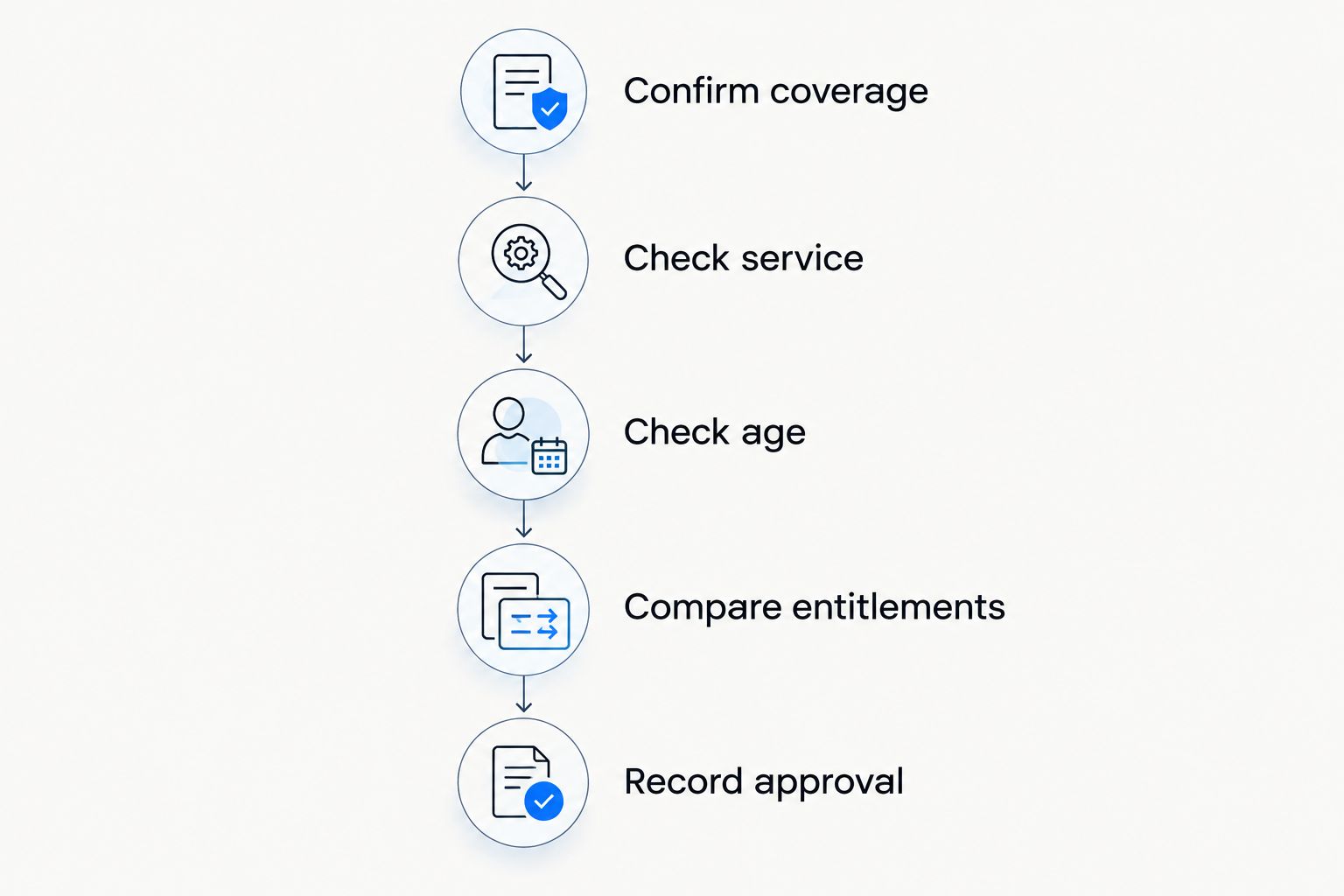
Use a documented sequence for each annual entitlement. Your 2026 leave register should show how the balance was established, not simply display a total.
- Confirm coverage. Establish which employment legislation governs the employee before using the Labour Law No. 4857 bands.
- Check service. Identify the relevant service dates and periods that count toward annual leave eligibility.
- Check age. Record the employee's date of birth and assess the age protection when determining the entitlement.
- Compare entitlements. Compare the statutory service band, age-protected minimum and applicable contractual entitlement.
- Record approval. Document the entitlement, leave taken and remaining balance, with the supporting calculation retained.
Do not treat a birthday as a new employment anniversary or create a second full annual allocation without checking the entitlement already recorded. If an employee reaches the protected age around an accrual boundary, resolve the applicable period before approving deductions.
A useful record contains the entitlement period, calculation basis, opening balance, approved leave, actual leave taken and closing balance. Keep corrections visible so another HR or payroll employee can understand the change without reconstructing it from messages.
Which days should HR deduct from the balance?
Weekly rest days, national holidays and general public holidays falling within annual leave are excluded from the annual leave calculation under Article 56. The employee's absence can therefore span more calendar days than the number deducted from the leave balance.
Do not automatically equate annual leave with Monday-to-Friday working days. Saturday treatment requires attention to the working arrangement and applicable contractual provisions; a five-day attendance pattern alone does not settle every leave-counting question.
Before deducting leave, identify:
- The approved start and end dates.
- The employee's weekly rest day or days under the applicable arrangement.
- Any national or general public holidays inside the period.
- The contractual rule used for non-working Saturdays.
Keep the approved leave request aligned with attendance and payroll records. An annual leave day should not be recorded as an unexplained absence simply because the employee did not clock in.
This distinction also prevents a misleading comparison between two employees. Equal statutory entitlements do not guarantee identical calendar-length absences when their schedules or the holidays within their leave periods differ.
Can employees split their annual leave?
Annual leave can be divided by agreement, provided one part is at least 10 days under Article 56. A policy permitting only isolated short absences does not reflect that requirement.
For an employee with a 20-day entitlement, splitting leave changes the schedule, not the total entitlement. HR should check both the employee's remaining balance and the length of the agreed leave periods.
Keep other absences separate. Sick leave and other paid or unpaid leave granted during the year must not simply be deducted from the employee's annual leave entitlement.
A practical approval process checks the requested dates, the qualifying continuous part and operational coverage before confirming the request. Retain the agreement rather than relying on an informal conversation between the employee and manager.
Can an employer give an employee over 50 only 14 days?
No. An eligible employee aged 50 or older covered by Labour Law No. 4857 must receive at least 20 days. The ordinary 14-day service band does not override the protected age minimum.
For a 2026 policy review, inspect employees in the first service band separately. A system configured only around service anniversaries will not apply the age protection unless age is also considered in the calculation.
Does turning 50 remove the one-year service requirement?
No. The 20-day age-protected minimum does not remove the normal requirement to complete one year of qualifying service. An employee's age and the date annual leave first becomes due answer different questions.
An employer can grant contractual leave or allow leave in advance. Record that arrangement distinctly so an early discretionary allocation is not confused with the statutory entitlement calculation.
Where HR software fits
Ottohr is best suited to growing employers seeking HR, payroll and compliance tools in one platform. Its stated scope includes hiring, onboarding, payroll, benefits and compliance.
That scope is relevant when leave decisions need to remain consistent with employment and payroll administration. It does not replace the legal assessment of age, qualifying service or the employee's contract.
When assessing Ottohr for this workflow, ask for a demonstration of the precise rules your organisation needs: age thresholds, service bands, contractual increases, holiday exclusions and approval records. Confirm those functions directly rather than assuming them from the platform category.
The limitation is clear: a software balance is only useful when its underlying rule is correct. Evaluate Ottohr against your documented leave policy, including boundary cases at the protected age and service thresholds.
FAQ
How many annual leave days do employees over 50 get in Turkey in 2026?
Eligible employees aged 50 or older receive at least 20 days under Labour Law No. 4857. The statutory minimum rises to 26 days at 15 years of qualifying service, and more generous contractual terms can apply.
Does Turkey's 20-day annual leave minimum include employees who are exactly 50?
Yes. The 20-day protected minimum includes employees aged exactly 50, not only employees aged 51 and above. The employee must also satisfy the applicable annual leave eligibility requirements.
Does an employee get 26 days after exactly 15 years of service?
Yes. The 26-day statutory service band starts at 15 years of qualifying service. The 20-day age-protected minimum does not reduce that higher entitlement.
Can an employee over 50 take statutory annual leave before completing one year?
The normal statutory annual leave entitlement requires one completed year of qualifying service, including probation. An employer can provide contractual leave or agree to leave in advance, but that is a separate arrangement.
Do public holidays count against the 20-day leave balance?
No. National and general public holidays falling within annual leave do not count against the annual leave balance under Article 56. Weekly rest days within the period are also excluded.
Can an employee split a 20-day annual leave entitlement?
Yes. Annual leave can be split by agreement, provided one part is at least 10 days under Article 56. Splitting the leave changes its scheduling, not the employee's total entitlement.
Can an employer pay employees instead of letting them take annual leave?
An employer cannot replace the statutory right to annual leave with routine cash payments during continuing employment. Article 59 separately provides for payment of unused annual leave when employment ends.
One last thing
The most easily missed boundary is exactly 15 years of service. The statutory wording places that employee in the 26-day band, even though informal summaries sometimes describe the threshold as more than 15 years.
Before closing your 2026 leave review, check that boundary alongside the inclusive age-50 threshold. Correct rules need correct comparison operators: excluding either boundary produces the wrong entitlement.


