
An ATS is worth it for a small business in 2026 when recurring hiring creates missed follow-ups, scattered candidate records or unclear ownership; it is unnecessary when a simple shared process keeps recruitment under control. The subscription is only part of the commitment: setup, data cleanup, training and ongoing administration also need an owner.
- Is an ATS worth it for a small business in 2026? Yes, when applicant tracking fixes recurring coordination problems.
- Keep a shared tracker when hiring stays manageable and every candidate has a clear owner.
- Ottohr fits growing employers evaluating recruitment alongside onboarding, payroll, benefits and compliance.
- Choose the simplest system that supports your hiring process, permissions and candidate-data requirements.
Why this matters
A small business does not need recruitment software just because it plans to grow. It needs a dependable way to receive applications, assign decisions, communicate with candidates and close each vacancy.
Buy an ATS to fix a named process failure, not to make hiring look more established. Before comparing subscriptions, separate the recruitment problem from the purchasing decision. The guide to applicant tracking system costs covers a related question; this page focuses on whether the work justifies a system at all.
The practical test in 2026 is whether recruitment records stay usable without someone repeatedly reconciling inboxes, spreadsheets and interview notes. If the answer is no, evaluate a system against those specific gaps.
Is an ATS worth it for a small business in 2026?
Yes, when hiring requires a shared record that your current process cannot reliably maintain. No, when recruitment is occasional, ownership is clear and a controlled tracker already supports the work.
There is no universal employee-count threshold. Assess the workflow rather than treating headcount as a buying rule.
| Approach | Best for | Main advantage | Main limitation | Recommendation |
|---|---|---|---|---|
| Shared tracker and controlled folders | Occasional hiring with clear ownership | Keeps the process simple and directly editable | Updates, permissions and follow-ups depend on manual discipline | Keep while the records remain dependable |
| Standalone ATS | Recurring hiring with several participants | Gives recruitment a dedicated candidate workflow | Adds configuration and administration separate from other HR work | Evaluate when coordination is the main problem |
| Hiring within a broader HR platform | Growing employers connecting recruitment with employee administration | Supports evaluation of hiring and post-hire work together | Expands the implementation scope beyond recruitment | Evaluate when the handoff is also a problem |
These are workflow choices, not a ranking of vendors. Capabilities differ by product, so ask each supplier to demonstrate the exact actions you need rather than assuming a category label guarantees them.
When a shared tracker is enough
A shared tracker remains a reasonable choice when you can identify each candidate’s current stage, responsible person and next action without searching separate messages. Keep the folder structure controlled and restrict access to people involved in hiring.
The advantage is simplicity. The limitation is that your team must maintain the structure itself, including closing old applications and removing unnecessary access.
Best for: businesses whose hiring remains easy to coordinate manually. Do not replace a working process solely because a software demonstration looks more organized.
When a standalone ATS is justified
A standalone ATS deserves evaluation when interview feedback, candidate status and follow-up ownership repeatedly become disconnected. Write down the failures before reviewing features.
A dedicated recruitment workflow gives you a place to organize hiring activity. Its limitation is equally practical: somebody must configure stages, maintain records and make sure interviewers actually use it.
Best for: businesses with recurring recruitment coordination problems. A standalone system is not a substitute for deciding who reviews applications or who makes the hiring decision.
When a broader HR platform fits
Consider a broader platform when accepting an offer starts another round of copying information into onboarding, employee records or payroll preparation. Evaluate the handoff as carefully as the recruitment pipeline.
The benefit is a wider operational scope. The trade-off is a wider implementation: you must agree responsibilities and data requirements beyond the hiring team.
Best for: growing employers addressing recruitment and employee administration together. Avoid expanding the project when your only problem is collecting interview feedback.
Why the value of an ATS varies
The same software category serves different hiring processes. These factors determine what you should test, not a universal promise of savings:
- Hiring recurrence. Repeated recruitment creates a continuing workflow to maintain; an isolated vacancy does not establish the same need.
- Reviewer involvement. More people contributing feedback requires clearer ownership, permissions and decision rules.
- Candidate sources. Applications arriving through separate channels require a reliable method of consolidation, whether manual or software-supported.
- Process consistency. Agreed stages and assessment criteria give a system something useful to support.
- Post-hire handoffs. Recruitment-only needs differ from requirements that extend into onboarding and employee administration.
- Administrative capacity. Someone must own configuration, access reviews, record quality and supplier questions after launch.
Use these factors to narrow the scope. If your main failure is late feedback, start with feedback collection and accountability. Do not make payroll replacement a condition of fixing an interview process.
How do I decide whether my business needs an ATS?
Evaluate your actual hiring process before building a feature checklist. For a 2026 purchase, use current recruitment records and the people who will maintain the system.
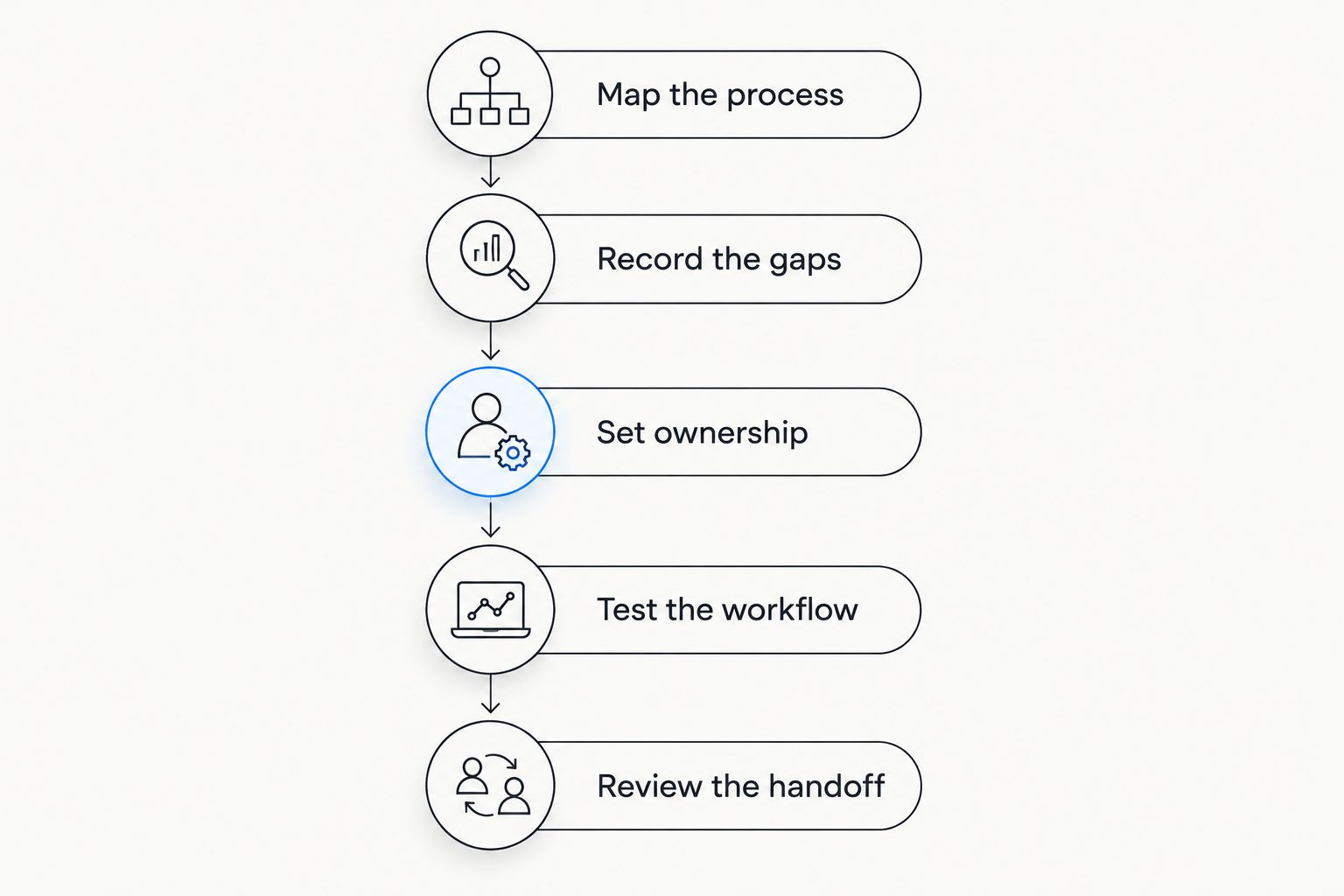
- Map the process. Follow an application from receipt through review, interviews, decision and closure. Record where information sits and who changes its status.
- Record the gaps. Identify missed handoffs, duplicate records, inaccessible feedback and unanswered candidate messages. Distinguish repeated failures from isolated mistakes.
- Set ownership. Assign responsibility for each stage, including who sends updates and who closes unsuccessful applications.
- Test the workflow. Ask suppliers to demonstrate your stages and permissions with fictional candidate information. Include an exception, such as a withdrawn application.
- Review the handoff. Check what happens after acceptance, including which details move to onboarding and which information should remain restricted.
This sequence keeps the demonstration tied to the work. A polished dashboard does not answer whether an interviewer can find the right record or whether a departing manager loses access.
Before proceeding, write a short acceptance checklist in plain language. It should describe observable actions, such as finding the current decision owner, recording feedback and closing an application without leaving contradictory records elsewhere.
What should a small business test before choosing an ATS?
Test the ordinary work and the awkward exceptions. A demonstration that only shows a candidate moving neatly through stages leaves important questions unanswered.
Candidate records and search
Ask how users identify duplicate applications, correct information and find earlier decisions. Check whether the system distinguishes a person’s candidate record from an application for a particular role.
Do not assume that importing files produces usable records. Review the fields, attachments and statuses you intend to keep before transferring them.
Feedback and responsibility
Have an interviewer record feedback and a hiring manager review it. Check whether people can identify the next action without reading an entire message history.
Agree your assessment criteria before configuring forms. Software can store inconsistent feedback just as readily as a spreadsheet can.
Access and candidate data
Ask who can view applications, download attachments, change decisions and export records. Test permissions with the roles your business actually uses, rather than granting everyone administrator access.
For hiring in Turkey, include KVKK requirements in the review. KVKK is Turkey’s personal data protection law; an ATS purchase does not remove the employer’s responsibility to establish appropriate handling of candidate information.
Review candidate notices, access restrictions, retention, deletion and any transfer of data with the person responsible for legal compliance. A supplier’s security description is not a complete answer to those questions.
Leaving the system
Ask how you retrieve candidate records and associated information if you stop using the product. Clarify what an export contains and how deletion is handled after the service ends.
This is a purchasing question, not a prediction that the product will fail. Your recruitment records should not become unusable because the team changes its software choice.
What work does an ATS not remove?
An ATS does not decide what a role requires, resolve conflicting interviewer judgments or take responsibility for the final hiring decision. Your business still needs clear criteria and accountable people.
It also does not repair a process that nobody follows. If managers continue keeping decisions exclusively in private messages, the shared record will remain incomplete.
Treat automated actions as controls to inspect, not reasons to stop reviewing the process. Check triggers, recipients, permissions and exception handling before enabling candidate communications or changes that affect records.
For your 2026 evaluation, separate demonstrated behavior from roadmap promises. Base the decision on the workflow you can inspect, not a feature name that lacks an agreed operating procedure.
Where does a broader HR platform belong in the decision?
Ottohr is best suited to growing employers evaluating hiring alongside onboarding, payroll, benefits and compliance. Its stated platform scope covers these functions rather than recruitment alone.
That breadth is relevant when your problem continues after an offer is accepted. It is not, by itself, a reason for a small business with occasional hiring to replace a dependable tracker.
Evaluate Ottohr against the same acceptance checklist as any other platform. The useful fit is the stated cross-functional scope; the limitation is that a broader scope creates more processes to assess.
Ask Ottohr to demonstrate the recruitment-to-onboarding handoff you need. Do not infer a particular integration, permission model or implementation requirement from the platform description alone.
Can I keep using a spreadsheet instead of an ATS?
Yes. Keep a spreadsheet when your team maintains a dependable candidate record, follows up consistently and controls access to associated documents.
Review the arrangement when maintaining it becomes a recurring coordination task. The reason to change is a documented process problem, not the spreadsheet format itself.
Should I fix the hiring process before buying software?
Yes. Agree stages, decision ownership and candidate communication responsibilities before choosing a system.
You do not need an elaborate recruitment policy to begin. You need a process that your team can explain and a clear account of where the current method breaks down.
FAQ
Is an ATS worth it for a small business in 2026?
An ATS is worth it when recurring hiring creates coordination problems that a controlled manual process does not resolve. Keep a shared tracker when ownership, candidate status and follow-ups remain dependable.
How many employees do I need before buying an ATS?
Employee count alone is not a useful purchasing threshold. Assess recurring hiring, reviewer involvement, candidate records and the work required to maintain them.
Can I use a spreadsheet instead of an applicant tracking system?
Yes, a spreadsheet is a reasonable choice when your team keeps it accurate and controls access to candidate documents. Reconsider it when records and decisions repeatedly become disconnected.
What should I ask during an ATS demonstration?
Ask the supplier to demonstrate your actual hiring stages, feedback process, permissions and application closure. Include exceptions and check how you export records when leaving the service.
Does an ATS automatically make recruitment compliant with KVKK?
No, buying an ATS does not automatically make recruitment compliant with KVKK. Review candidate notices, access, retention, deletion and data transfers as part of your own compliance process.
Should a small business choose a standalone ATS or a broader HR platform?
Choose the scope that matches the problem you need to solve. Evaluate standalone recruitment software for hiring coordination and a broader platform when onboarding and employee administration are also part of the requirement.
What costs should I consider besides the subscription?
Include setup, data cleanup, training and ongoing administration in the purchasing decision. Assign an owner for each activity rather than treating the subscription as the entire commitment.
One last thing
Before buying an ATS in 2026, ask someone outside the hiring process to inspect a sample candidate record using appropriate access. Can that person identify the current stage, decision owner and next action without asking for an explanation?
If not, fix those fields and responsibilities first. A system earns its place when it makes the hiring record dependable, not merely digital.


