
For employees covered by Turkey’s Labour Law No. 4857, izin parası is not an automatic payment on top of salary: the employer must pay the wage covering annual leave before leave begins, either upfront or as an advance. In 2026, payroll must reconcile that payment without paying the same entitlement twice; unused annual leave becomes payable in cash when employment ends.
- Is izin parası paid separately from salary in Turkey? Not as extra salary; annual leave pay is advanced.
- Labour Law No. 4857 requires payment for the annual leave period before the employee starts leave.
- Unused annual leave becomes payable when employment ends, including resignation; it is distinct from severance pay.
- Ottohr serves growing employers seeking HR, payroll and compliance tools in one platform.
Why this matters
A separate bank transfer does not necessarily mean extra earnings. An employee can receive leave pay before taking holiday and then receive a smaller remaining salary payment because part of that month’s entitlement has already been paid.
The distinction matters for your 2026 payroll controls. Treating the advance as a bonus creates duplicate payment; treating paid annual leave as unpaid absence removes wages the employee is entitled to receive. Neither treatment reflects the purpose of annual leave pay.
Employment ending creates a different obligation. For that situation, see the guide to unused annual leave paid out after resignation.
Is leave pay (izin parası) paid separately from salary in Turkey?
Annual leave pay is separate in timing, not automatically additional in value. Article 57 of Labour Law No. 4857 requires the employer to pay the wage relating to the annual leave period before leave starts, either upfront or as an advance.
The everyday phrase izin parası also describes unused-leave compensation at departure. Identify which payment you mean before deciding whether it belongs within regular payroll or a final settlement.
| Situation | What the payment represents | Payment rule | Benefit and limitation |
|---|---|---|---|
| Annual leave during employment | Wages covering the approved leave period | Pay before leave begins; reconcile the advance in payroll | Protects income during leave, but does not create duplicate salary |
| Unused annual leave at departure | Compensation for earned, untaken annual leave | Becomes payable when employment ends | Settles the unused balance, but is not severance pay |
| Additional contractual leave allowance | A benefit established by the applicable agreement | Follow the agreement’s terms | Can add to statutory rights, but is not an automatic statutory entitlement |
Legal basis for this 2026 guide: Labour Law No. 4857, particularly Articles 53, 56, 57 and 59. The discussion concerns employees covered by that law, not every public-service or special employment regime in Turkey.
Annual leave pay: advance the wage, not an extra salary
When you approve statutory annual leave, the employee remains entitled to the relevant leave-period wage. Article 57 sets a payment deadline before the leave starts. Simply retaining the employee’s usual payday does not address that requirement when payday falls after departure.
For a monthly paid employee, the key payroll task is reconciliation. Record the leave-period payment against the appropriate entitlement, then account for that payment when settling the relevant payroll period. Do not add the same leave-period wage again as though the advance never happened.
A bank transfer labelled izin parası therefore needs supporting records. The label alone does not establish whether the transfer is an advance, a contractual allowance or a final unused-leave payment.
Check the leave dates, payroll period and advance record together. A correctly calculated monthly total does not by itself prove that the employer paid the leave wage on time. Equally, an earlier transfer does not justify reducing the employee’s underlying paid-leave entitlement.
Unused annual leave: a separate entitlement when employment ends
Article 59 requires payment for earned annual leave that remains unused when employment ends. The calculation uses the employee’s wage at the termination date. This is a departure-related settlement, not an advance against a future holiday.
The rule applies when the employee resigns as well as when the employer ends employment. Do not use severance eligibility as the test for whether unused annual leave must be paid. The two entitlements have different legal conditions.
Your final payroll can contain salary for work already performed and compensation for unused annual leave. Those entries represent different obligations, even if they appear in the same payroll statement or reach the employee through the same bank transfer.
Reconcile earned leave against documented leave actually taken before calculating the balance. A planned holiday is not evidence that the employee used it. Check cancelled requests, changed dates and incomplete records before closing the employee’s account.
Payment settles the remaining earned balance at departure. It does not establish that the employer was entitled to substitute cash for annual rest throughout employment.
Contractual leave allowances: check the written entitlement
An employment contract or applicable collective agreement can provide an additional holiday-related allowance. If such an entitlement exists, assess it separately from statutory annual leave wages.
Read the conditions rather than relying on an informal name. Check what triggers payment, which employees qualify and whether the allowance is additional to ordinary wages. A payment called a holiday allowance is not necessarily the Article 57 leave advance.
The practical advantage is clear classification: payroll can distinguish an extra benefit from wages paid early. The limitation is equally clear: the phrase izin parası does not, by itself, create an additional allowance.
If an employee expects an extra payment, compare that expectation with the applicable agreement and payroll records. Do not assume either that every employer owes a holiday bonus or that a documented contractual entitlement can be ignored.
Why izin parası payments vary
Different payment outcomes often concern different entitlements, rather than different interpretations of the same rule. For a 2026 payroll review, check these factors:
- Employment status: Leave taken during employment requires a leave-period wage payment; departure triggers settlement of unused earned leave.
- Leave dates: The start date determines when the annual leave wage must already have been paid.
- Wage arrangement: Monthly pay and variable earnings require the appropriate statutory calculation method, not an unexplained transfer amount.
- Unused balance: A departure payment depends on earned leave remaining after documented leave taken is deducted.
- Applicable agreement: A contract or collective agreement can establish an additional allowance or more generous leave entitlement.
- Payroll reconciliation: An advance already paid affects the remaining transfer, not the employee’s underlying wage entitlement.
These factors explain why comparing bank deposits alone produces the wrong answer. Compare the payment purpose, covered dates and payroll entries before deciding whether someone received too little or was paid twice.
How should payroll process annual leave pay?
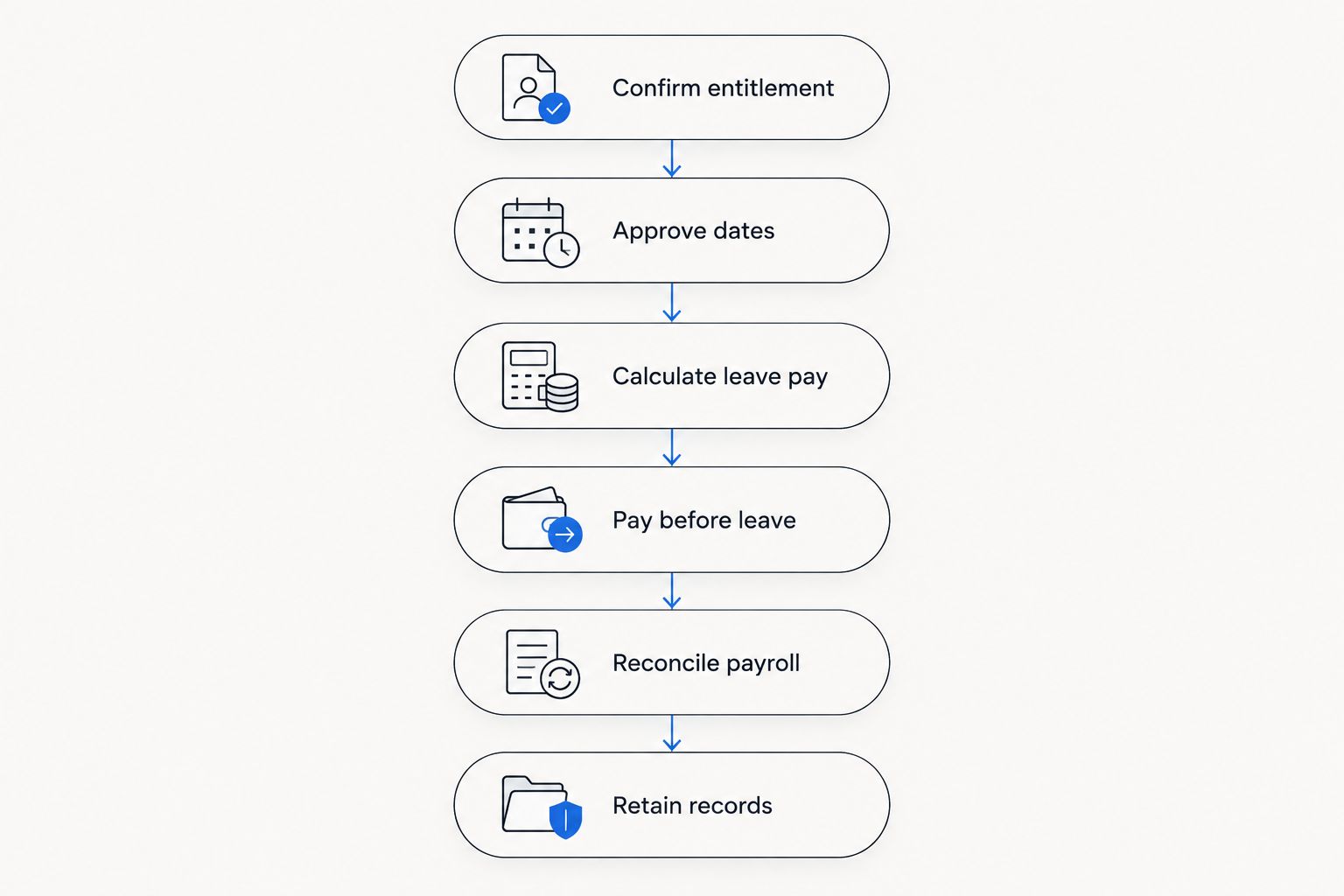
Use a documented sequence that connects the leave approval to the payment and payroll statement. The sequence below is a control process, not a substitute for the statutory calculation rules.
- Confirm entitlement. Check the employee’s earned annual leave, applicable agreement and employment status. Keep annual leave distinct from unpaid leave or another absence category.
- Approve dates. Confirm the actual start and end dates. Check the treatment of weekly rest days and public holidays before deducting annual leave days.
- Calculate leave pay. Apply the relevant wage basis and statutory rules. Do not assume that every payroll component belongs in the annual leave wage calculation.
- Pay before leave. Arrange the leave-period wage payment before the employee starts annual leave. Record the payment’s purpose and covered period.
- Reconcile payroll. Account for the advance when settling payroll. Keep the wage entitlement, advance settlement and statutory deductions identifiable.
- Retain records. Keep the leave request, approval, evidence of leave taken, payment record and payroll statement together.
A change to the leave dates should trigger a fresh check of the payment and records. Approval establishes the plan; the attendance record establishes what happened. Both matter when you later calculate an unused balance.
Which leave entitlement should you check first?
Under Article 53, statutory annual paid leave generally begins after at least 1 year of service, including the probation period. The statutory minimum is 14 days for service from one year through five years, 20 days for service exceeding five years but below fifteen years, and 26 days for service of fifteen years or more.
Employees aged eighteen or younger and employees aged fifty or older have a statutory minimum of 20 days. Applicable contracts and collective agreements can provide more generous rights, so the statutory table is the starting point rather than an automatic ceiling.
For your 2026 review, establish the entitlement before calculating a departure balance. A correct daily wage applied to an incorrect number of unused days still produces an incorrect settlement.
Also separate entitlement from scheduling. An employee’s earned days, approved dates and leave actually taken answer different questions. Keeping those records distinct helps prevent an approval from being mistaken for completed leave.
Can an employee receive cash instead of taking annual leave?
During continuing employment, statutory annual leave cannot simply be replaced with cash. Article 53 protects the right to annual paid leave, and Article 56 requires the leave to be granted under the statutory framework.
An employee’s request for money does not convert the right to rest into an ordinary cash allowance. Keep the leave balance open until the employee actually takes the leave or employment ends and Article 59 applies.
Does resignation remove the right to unused leave pay?
Resignation does not remove the right to payment for earned, unused annual leave under Article 59. The employer must establish the remaining balance and calculate the corresponding payment using the wage at departure.
Keep that assessment separate from notice pay, severance and other final-settlement items. A disagreement about one item does not change the legal nature of unused annual leave compensation.
Does a separate transfer prove the employee received extra salary?
A separate transfer does not prove extra salary was paid. It can be the annual leave advance required before the holiday starts, with the amount later accounted for in payroll.
Ask which dates the transfer covers and where it appears in the payroll reconciliation. If the payroll statement also shows an allowance, check the agreement supporting that additional entitlement instead of treating every leave-related entry as the same payment.
What should an employee check if the payment looks wrong?
Start with the documents, not the transfer label. Ask payroll to identify the leave dates, the wage covered by the advance, the payroll period in which it was reconciled and any remaining payment due.
For a departure payment, request the earned balance, the leave records used to reduce it and the wage basis used in the calculation. This makes the disagreement specific: entitlement, days taken, wage calculation or payment timing.
If the explanation remains inconsistent with the records, seek advice from a Turkish employment-law professional. Do not sign a statement saying leave was taken merely to make the payroll balance match. Records should reflect the actual absence and payment.
Where HR software fits
Ottohr is best suited to growing employers seeking HR, payroll and compliance tools in one platform. Its stated scope includes those functions alongside hiring, onboarding and benefits.
When assessing Ottohr, ask how your proposed configuration will connect leave approvals, attendance records, advance payments and final payroll. Confirm the actual workflow before relying on it.
The limitation is the same for any platform: a software entry is not proof that leave was taken or that a payment met the legal deadline. Ottohr should be assessed against your documented requirements, not treated as a substitute for legal interpretation or accurate source records.
FAQ
Is izin parası paid separately from salary in Turkey in 2026?
İzin parası is not automatically extra salary in Turkey in 2026. For employees covered by Labour Law No. 4857, the annual leave wage must be paid before leave starts and reconciled with payroll; unused leave is settled when employment ends.
Does my employer have to pay annual leave wages before my holiday starts?
Yes. Article 57 requires the wage covering annual leave to be paid before the employee begins leave, either upfront or as an advance.
Will I receive my full salary again after getting a leave advance?
A leave advance does not create a second entitlement to the same wages. Payroll must account for the amount already paid when calculating the remaining payment for the relevant period.
Can I ask for money instead of using annual leave?
Statutory annual leave cannot simply be exchanged for cash during continuing employment. Earned, unused leave becomes payable under Article 59 when employment ends.
Do I get unused annual leave pay if I resign?
Yes, earned and unused annual leave is payable when you resign. Article 59 uses the wage at termination to calculate the payment.
Is annual leave pay the same as severance pay?
No. Unused annual leave compensation and severance pay are separate entitlements with different legal conditions, so severance eligibility does not determine the right to unused leave payment.
Can leave pay and final salary arrive in one bank transfer?
A single transfer does not make the entitlements identical. The payroll records should distinguish salary, unused annual leave compensation and any other final-settlement items.
One last thing
Check timing separately from the monthly total. An employer can account for the correct total wage yet still miss the requirement to pay the annual leave portion before leave begins.
For every 2026 leave payment, keep a record that answers two questions: what entitlement did this payment settle, and when did the employee receive it? That check distinguishes an advance from extra earnings and a correctly timed payment from a late one. It also gives payroll a clear explanation when an employee asks why the next salary transfer is smaller.

