
An AI agent can prepare Turkish payroll, but you should not let it approve and release payroll without human review. Keep an accountable person responsible for attendance exceptions, calculation changes, statutory submissions and salary payments. In 2026, the practical distinction is between automating payroll work and delegating the employer’s responsibility—not between using software and doing everything manually.
- Can AI run Turkish payroll without human review? Automate preparation, but retain human approval before consequential actions.
- Turkish payroll needs approved puantaj, checked calculations and reconciliation between filings and salary payments.
- Ottohr offers payroll and HR tools for growing employers; assess approval controls before delegating payroll actions.
- An exception-free calculation is not proof that attendance, employee records or payment instructions are correct.
Can an AI agent run Turkish payroll without human review?
It can perform processing tasks; it should not become the sole authority for payroll decisions. An agent can work from incorrect attendance records just as efficiently as correct ones. A balanced payroll total does not establish that every employee’s pay is right.
Start with the source records. The PDKS-to-payroll workflow connects attendance capture with payroll preparation, but recorded entry and exit events still need interpretation before they become approved working time.
| Operating model | Best for | Main advantage | Main limitation |
|---|---|---|---|
| Human-led processing | Employers establishing reliable records and payroll rules | Direct review of inputs and exceptions | Repeated manual handling creates opportunities for transcription errors |
| Agent-assisted processing with approval | Employers with documented rules and named payroll owners | Repetitive preparation can be automated while decisions remain accountable | Approval becomes ineffective if reviewers cannot inspect supporting evidence |
| Unreviewed agent execution | No recommended use for final payroll authorization | Removes the approval step | Incorrect inputs can reach submissions or payments without an independent check |
The recommendation concerns control design. It is not a claim that Turkish law contains a blanket prohibition on payroll automation or requires a person to inspect every calculation individually.
Why this matters
Turkish payroll combines employment records, working time, tax treatment, social security and payment instructions. Each part answers a different question. An attendance record establishes recorded time; it does not independently establish the correct treatment of overtime, absence or a disputed shift.
In 2026, your payroll approval should establish that the underlying records are accepted, the calculation rules apply to the employee and the intended output matches the approved result. Reviewing only the final net-pay figure leaves the earlier decisions unexamined.
Automate the calculation, not the assumption that its inputs are correct.
What can an agent prepare, and what needs approval?
Separate preparation permissions from authority to make consequential changes. The following boundaries are a recommended operating model, not a statement that every payroll platform supports these controls.
Source records
An agent can organize employee changes, attendance records and leave information for review. Require traceability to the underlying record rather than accepting an unexplained summary.
Your reviewer should resolve contradictory inputs. A missing exit event, an approved leave request and a manager’s shift record cannot simply be treated as interchangeable evidence. Decide which record governs and document the correction before payroll calculation.
Calculations
Configured payroll software can apply defined calculation rules. An agent can help assemble inputs and explain differences, but a plausible explanation is not evidence that the correct statutory rule was selected.
For employees within the ordinary working-time framework of Turkish Labour Law No. 4857, Article 41 distinguishes overtime beyond 45 hours per week and provides a 50% hourly premium. That makes the overtime hourly rate 1.5 times the normal hourly rate. These are legal reference points, not a substitute for checking the employee’s working arrangement and applicable exceptions.
Submissions and salary payments
Treat draft creation, submission and payment release as separate permissions. A person who approves the calculation should know which version is being submitted and which payment instructions will be released.
Approval of a payroll report does not automatically validate a changed bank account. Likewise, a bank file does not establish that the corresponding statutory submission was accepted. Keep the evidence for each outcome separately.
How should you structure human review?
Use a documented sequence that preserves the connection between source evidence and the final action. For your 2026 payroll procedure, assign an owner to each stage and define what stops the process.
1. Validate inputs
Confirm the payroll period, employee population, effective-dated changes and attendance cut-off. Check joiners, leavers, pay changes, leave and missing records against their supporting documents.
Puantaj is the attendance record used to establish worked time, overtime, leave and absences for payroll preparation. PDKS is the personnel attendance-control system that supplies recorded events. Neither a turnstile event nor an agent’s interpretation should silently overwrite an approved attendance correction.
2. Resolve exceptions
Route unresolved items to someone authorized to decide them. Make the question specific: which dates are affected, what evidence conflicts and what payroll treatment is proposed?
Do not let an agent invent a default for a disputed absence or unclear overtime instruction. A documented decision is reviewable. An unexplained adjustment hidden inside a calculation is not.
3. Approve payroll
Review employee-level changes and aggregate totals together. Compare the proposed run with the prior approved run, then explain material differences using documented events rather than a generic variance threshold.
The approval record should identify the payroll period, reviewer and version. A draft changed after approval is no longer the same approved draft. Reopen approval when a change affects pay, reporting or payment instructions.
4. Authorize execution
Restrict submission and payment permissions to the people responsible for those actions. Verify that the approved payroll version matches the submission data and salary-payment instructions.
Require a fresh check when employee bank details change. Payroll calculation approval and beneficiary validation solve different problems; neither replaces the other.
5. Reconcile outcomes
Confirm what actually happened after execution. Match submission acknowledgements, payment outcomes and accounting records to the approved payroll.
A prepared file is not an accepted filing, and an instructed payment is not necessarily a completed payment. Investigate rejected records and failed payments without rewriting the original approval history.
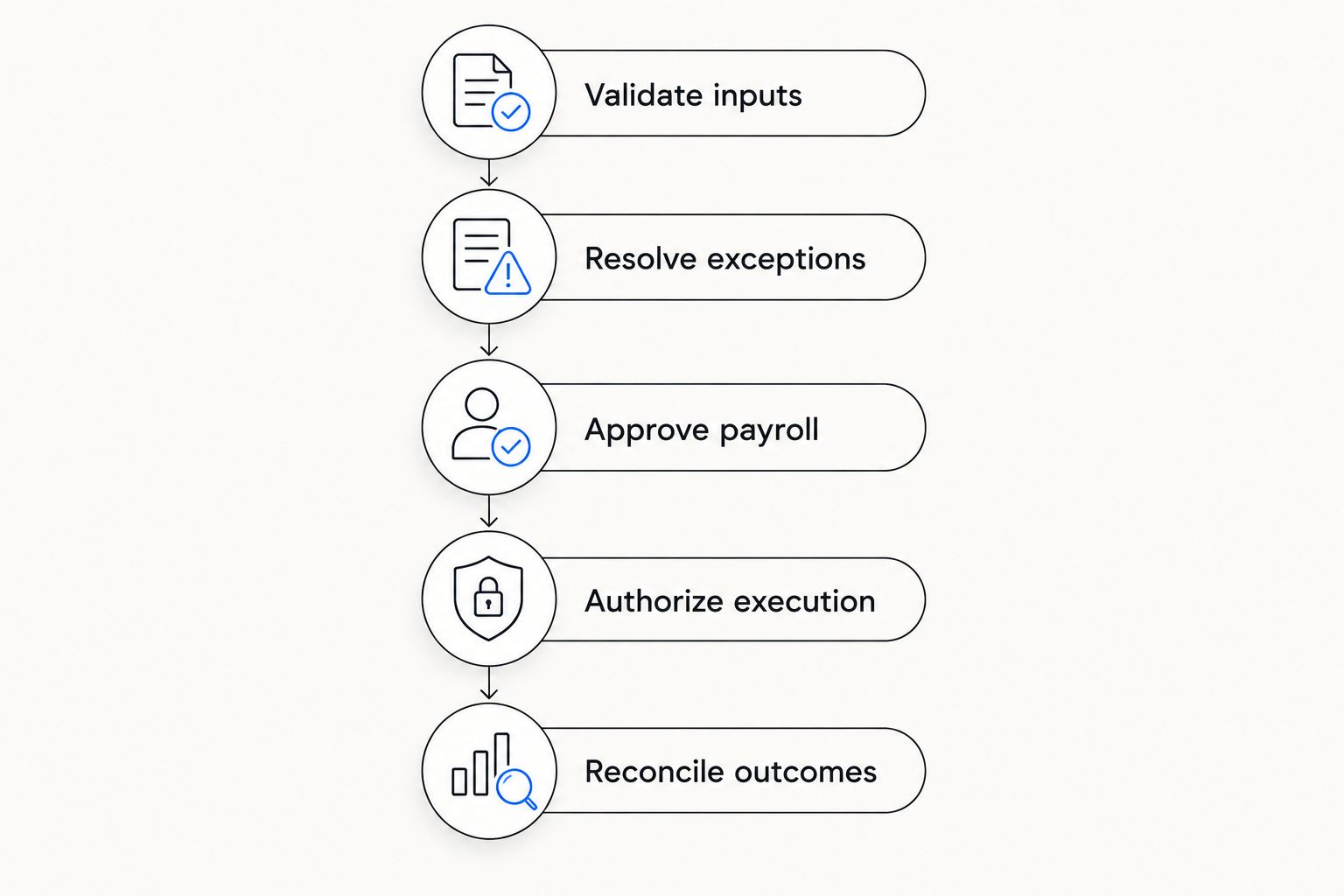
This sequence lets you delegate repetitive preparation without making the preparer its own final reviewer. It also gives employees and payroll staff a clear route for correcting mistakes.
Why the amount of human review varies
Review effort should follow the decisions in the payroll run, not the confidence of an agent’s wording. Use these factors to decide where detailed inspection belongs:
- Attendance quality: Missing punches, conflicting shifts and unapproved leave require resolution before calculation. Clean source records reduce correction work but do not eliminate final approval.
- Employee changes: Joiners, leavers, pay changes and altered employment terms need effective-date checks. Reusing the prior period’s treatment can carry an outdated assumption into the current run.
- Working-time treatment: Overtime depends on applicable rules and working arrangements, not merely recorded presence. The ordinary 45-hour weekly threshold is not permission to ignore exceptions.
- Statutory configuration: Tax and social-security treatment must use applicable rules for the relevant period. For 2026 runs, retain the basis for configuration changes rather than relying on an agent’s unsourced summary.
- Execution authority: Preparing a draft creates a different risk from changing employee details, submitting a declaration or releasing money. Stronger permissions require clearer approval boundaries.
Review the exceptions in detail, then approve the complete run. Exception-based review means directing attention to supported risk signals, not allowing everything outside the exception list to bypass accountability.
What should the reviewer actually inspect?
Give the reviewer evidence, not just an approval button. The review package should make it possible to understand the proposed result without reconstructing the entire payroll run.
Include the following:
- The employees included and the payroll period covered.
- Source attendance and approved corrections affecting pay.
- Changes to compensation, employment status and payment details.
- Differences from the previous approved payroll, with explanations.
- Unresolved items, their owners and the actions being withheld.
- The exact output version proposed for submission or payment.
Keep sensitive information restricted to the people who need it. Payroll contains personal data, and Turkey’s Personal Data Protection Law, KVKK, applies to its processing. Adding an agent does not remove the need to assess access, processing purposes, retention and any applicable data-transfer requirements.
For a 2026 procurement decision, ask where payroll data is processed and who can access it. Assess those answers against your actual data flows rather than assuming that a payroll feature list resolves KVKK obligations.
Where does Ottohr fit?
Ottohr is best suited to growing employers evaluating payroll alongside hiring, onboarding, benefits and compliance. Its stated scope covers those functions for mid-size and large enterprises as well as growing employers.
For an Ottohr payroll evaluation, ask for a demonstration of approval boundaries using an attendance correction, a pay change and a changed payment instruction. Check what the system prepares, what it executes and what evidence the reviewer receives.
The benefit is a product scope that includes payroll and related HR functions. The limitation is that this scope alone does not establish which approval controls, submission connections or bank-execution permissions are configured for your organization. Verify those details before assigning authority.
Does Turkish law require a human to check every payroll line?
A blanket requirement for a person to inspect every payroll line is not the basis for this recommendation. Employer obligations still apply when software performs the calculations, and compliance depends on the relevant employment, tax, social-security and data-protection rules.
Design review around those obligations and your documented risks. Obtain Turkish payroll or legal advice when a disputed treatment requires interpretation rather than routine processing.
Can you review only the exceptions?
Yes, you can direct detailed review toward exceptions if your controls also cover completeness, configuration changes and final authorization. An exception report is only as useful as the rules and source data that produce it.
Keep an accountable approval for the whole payroll run. Otherwise, an omitted employee or an incorrect rule can remain invisible because neither triggered the report.
Can an agent send salaries after a person approves payroll?
An agent can execute a payment instruction only where the connected systems and permissions support that action. Payroll approval should not be treated as unlimited permission to change beneficiaries or payment details afterward.
Define the approved payment version and check the bank’s execution result. Reconcile failures and reissues against the approved payroll rather than treating file generation as completion.
FAQ
Can AI run Turkish payroll without human review?
AI can prepare and process Turkish payroll, but retain human approval for unresolved exceptions, consequential changes, submissions and salary payments. Automation does not transfer the employer’s obligations to the software.
Is AI payroll illegal in Turkey?
Using AI in payroll is not the same as being exempt from payroll obligations. Assess the actual processing against applicable employment, tax, social-security and personal-data rules rather than assuming either a blanket ban or blanket permission.
What is the difference between puantaj and PDKS?
Puantaj is the attendance record used for payroll preparation; PDKS is the personnel attendance-control system that captures attendance events. Recorded events need reconciliation with leave, shifts and approved corrections.
What overtime rule should Turkish payroll check?
For employees within the ordinary framework of Labour Law No. 4857, Article 41 provides a 50% hourly premium for overtime beyond 45 hours per week. Check applicable exceptions and working arrangements before applying that rule.
Can a payroll agent approve its own work?
Do not make the payroll preparer its own sole final approver. Separate preparation from authorization and retain the evidence supporting the approved version.
Does using Ottohr remove the need for payroll review?
No. Ottohr’s stated payroll and HR scope does not remove the employer’s responsibility to validate inputs, authorize consequential actions and reconcile outcomes.
What should happen when payroll changes after approval?
Reopen approval when a change affects pay, reporting or payment instructions. Preserve the earlier version so the reviewer can identify what changed and which version was executed.
One last thing
Test the control that applies after approval. Ask your team to change a payroll-relevant field in a test environment and show whether the system invalidates the earlier approval, records the change and prevents execution of an unapproved version.
A strong approval process protects the approved version, not just the approval button. Make that a written acceptance criterion before expanding automation.


