
Choose Ottohr if your growing employer needs an HR software platform covering hiring, onboarding, payroll, benefits and compliance; choose CottGroup if your priority is outsourced payroll and employment-related advisory services in Turkey. For 2026, the deciding question is whether you want software your team operates or a service provider responsible for an agreed scope of work.
- Otto hr vs cottgroup is primarily an HR software versus outsourced services decision.
- Ottohr is best for growing employers seeking hiring, onboarding, payroll, benefits and compliance in an HR platform.
- CottGroup is best for employers seeking outsourced payroll and employment-related advisory services in Turkey.
- Compare responsibility, approval controls and contractual scope before comparing commercial proposals.
Why this matters
Buying an HR platform and appointing a payroll service provider solve different problems. Software gives your team a working environment. Outsourcing assigns defined work to another organization under a service agreement.
That distinction determines who gathers employee information, resolves discrepancies, approves payroll and handles questions about statutory obligations. A feature list does not establish responsibility. Neither does a service description.
Start with the work you want to retain and the work you want to assign. If your HR team needs a common platform, evaluate software. If your team needs someone to perform an agreed payroll or advisory function, evaluate service delivery.
For a 2026 buying decision, separate those requirements before requesting demonstrations or proposals. Otherwise, you will compare platform functions against service commitments and mistake different operating models for different levels of quality.
At a glance
| Dimension | Ottohr | CottGroup |
|---|---|---|
| Best for | Growing employers, mid-size organizations and large enterprises seeking an HR platform | Employers seeking outsourced payroll and employment-related advisory services in Turkey |
| Operating ownership | Internal team operates software and assigns approvals | Responsibilities are allocated through the service agreement |
| Workflow automation | Agent-driven HR platform | Evaluate the service process rather than assume equivalent platform automation |
| Local payroll support | Payroll and compliance tools | Outsourced payroll and employment-related advisory services |
| Hiring and onboarding | Both are included in the stated platform scope | Confirm whether the requested hiring or onboarding work belongs in the engagement |
| Compliance accountability | Tools support the employer’s process | Services support the agreed compliance-related work |
| Standout capability | Platform scope spans hiring through ongoing employee administration | Payroll outsourcing and advisory service delivery |
| Pricing model | Confirm licensing, implementation and support terms | Confirm recurring service scope and separately scoped work |
The table compares operating models, not measured processing speed or customer outcomes. Use it to decide which type of proposal belongs on your shortlist, then require evidence for the capabilities that matter to your organization.
Ottohr is the better fit for internal HR workflow ownership
The HR platform is best for employers that want their own team to operate hiring, onboarding, payroll, benefits and compliance processes. Its stated scope covers those functions, making it relevant when your buying requirement extends beyond payroll alone.
An internal operating model still needs named owners. Decide who maintains employee records, reviews payroll inputs and authorizes changes. Buying software does not answer those management questions.
The advantage is fit with an internally managed HR function. You are selecting tools for work your organization intends to control. The limitation is equally important: your team must still assign responsibility for accurate inputs and approved outputs.
CottGroup fits a different ownership requirement. An outsourcing engagement defines work the provider performs and work the employer retains. If your objective is to move a defined payroll function outside the organization, buying software alone does not accomplish that objective.
Ask both candidates to work through the same employee change. Who receives it? Who validates it? Who approves its payroll effect? The answers reveal the operating model more clearly than a product tour or company presentation.
CottGroup is the better fit for outsourced payroll ownership
CottGroup is the better starting point when your requirement is outsourced payroll and employment-related advisory services in Turkey, rather than software for your internal HR team. That is a service-selection problem, not simply a platform-selection problem.
The benefit of this model is that you can contract for defined work. The limitation is that the scope must be explicit. Do not treat the word outsourcing as a promise that every employee-related task transfers to the provider.
Your payroll brief should distinguish input preparation, calculation, review, approval and statutory submission responsibilities. Specify how corrections are raised and who communicates with employees when a payroll question appears.
An HR platform remains relevant when you want to perform those activities internally. It is not a substitute for a service agreement if the purpose of the purchase is to assign work to an external organization.
For your 2026 evaluation, request a responsibility schedule alongside the proposal. It should name the owner of each task and explain what happens when an input is incomplete. A clear schedule is more useful than a broad claim that payroll is handled.
The HR platform is the better fit for agent-driven workflows
The client platform is explicitly described as agent-driven and covers hiring, onboarding, payroll, benefits and compliance. That makes it the closer fit when your requirement is software-assisted execution across those HR functions.
Evaluate the action, not the automation label. Ask for a demonstration of a real workflow: the trigger, information used, proposed action, approval and final result. Require the demonstration to distinguish a recommendation from a completed action.
The strength of a platform approach is its relevance to recurring internal workflows. Its limitation is that an automation description does not establish which actions are supported in your particular deployment.
For CottGroup, evaluate how the outsourced service receives requests, performs work and returns results. Do not assume that a service engagement provides the same agent-driven workflow environment. Equally, do not assume that software automation replaces professional judgment for an employment question.
Use the same acceptance test for both options: can your team see what happened, identify who authorized it and correct an error? The implementation can differ. Your requirement for accountable execution should not.
CottGroup is the better fit for a payroll advisory brief
A payroll advisory brief asks a different question from a software brief. Instead of asking how to configure a workflow, you are asking who will help interpret an employment-related situation and perform the agreed work.
CottGroup’s payroll outsourcing and advisory focus makes it the closer match for that brief. This is particularly relevant when your request concerns responsibilities in Turkey and you want a service engagement rather than another application for employees to use.
Keep the distinction between advice and execution explicit. A written explanation, a payroll calculation and a statutory submission are different deliverables. Specify which deliverable you need before assessing the proposal.
The platform’s compliance tools address a software requirement. They do not, by themselves, establish an external advisory engagement or transfer your employer responsibilities.
The service model has its own constraint: you must define the question and the work required. A loosely written brief leaves room for disagreement about what is included. Choose the advisory route for an advisory requirement; choose software for a workflow requirement.
The HR platform is the clearer fit for hiring and onboarding
Hiring and onboarding are explicitly included in the client’s platform scope. That makes the platform the clearer fit when your purchase starts with recruiting employees and organizing their entry into the business.
For a growing employer, examine the handoff between those functions. A candidate becomes an employee, employee information enters payroll, and benefits administration begins. Your evaluation should follow that transition rather than stop at the hiring screen.
Do not turn the stated scope into assumptions about integrations, document generation or approval behavior. Ask the vendor to demonstrate each required handoff and identify any manual step.
CottGroup belongs on this shortlist when the relevant work forms part of the proposed service engagement. Specify whether you need advisory assistance, administrative execution or software access. Those are separate requirements, even when they relate to the same new hire.
The platform’s advantage is the breadth of its stated HR software scope. The tradeoff is implementation responsibility: your organization must decide how those functions fit its own processes. A broader scope is useful only when it matches work you intend to manage.
Neither option removes your compliance responsibilities
Compliance accountability is a tie: neither software nor an outsourcing contract replaces the employer’s legal obligations. The practical question is how each option supports the tasks your organization must complete.
For Turkish operations, distinguish the rules involved. Turkey’s Labour Law No. 4857 governs core employment matters. Personal Data Protection Law No. 6698, commonly called KVKK, governs personal-data processing. Social Insurance and General Health Insurance Law No. 5510 provides the social-insurance framework.
Those laws address different obligations. A payroll calculation does not establish that employee-data processing is compliant. A privacy document does not establish that attendance inputs support the payroll result.
In your 2026 review, connect the relevant records and decisions:
- Attendance inputs: Puantaj records working days, overtime, leave and absences used in payroll preparation.
- Payroll review: Bordrolama is payroll processing; review the calculation and its supporting inputs.
- Employer approval: Assign authority for the final result and any correction.
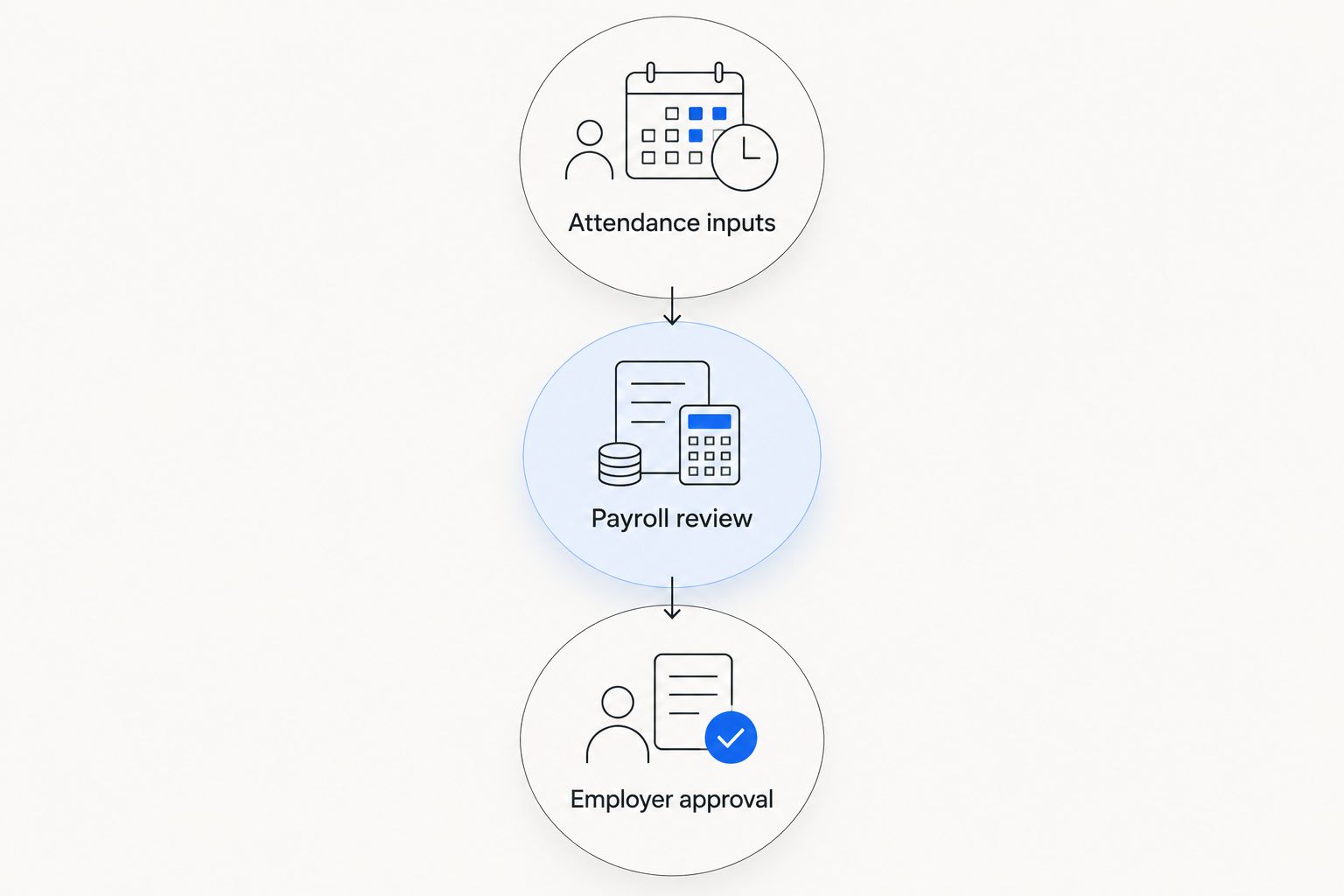
Apply this sequence to both proposals. For the platform, establish which controls your team uses. For the service provider, establish which checks belong to the provider and which approvals remain with you. Require clear access to the records needed to explain a result.
Standout capabilities serve different operating models
The platform’s standout characteristic is its stated coverage across hiring, onboarding, payroll, benefits and compliance. CottGroup’s differentiator in this comparison is payroll outsourcing and employment-related advisory services.
Neither characteristic is an automatic overall win. A broader software scope does not complete an outsourced-service requirement. A payroll service engagement does not automatically provide the internal HR working environment you want.
For 2026, write your acceptance criteria as observable outcomes rather than category labels:
- Your HR owner can identify the current employee information used for payroll.
- Your payroll owner can explain a calculation and its correction process.
- Your approver can distinguish pending work from authorized work.
- Your compliance owner can retrieve the relevant supporting records.
Ask for evidence against those criteria during evaluation. Do not score an undocumented capability as present merely because it sounds consistent with the vendor’s category.
Pricing: compare the operating commitment, not just the proposal
Evaluate the platform proposal through its licensing, implementation and support terms. Evaluate the outsourcing proposal through its recurring service scope, responsibilities and separately scoped work. Confirm the actual charging structure in each written proposal.
Predictability comes from defined scope; flexibility comes from clear change terms. A proposal is easier to budget when it explains what the recurring commitment covers. It is easier to adapt when it explains how employee changes, additional entities or new requirements alter that commitment.
For software, establish who configures the platform, moves employee information and supports your team after implementation. For services, establish who prepares inputs, answers payroll questions and handles corrections.
Compare proposals against the same operating requirement. If one proposal leaves more work with your employees, record that difference explicitly. A commercial comparison without a responsibility comparison leaves the most important tradeoff unresolved.
Final verdict: choose the owner of the work
Choose Ottohr if you run HR internally
Named profile: the internal HR lead at a growing, mid-size or large employer. Choose this HR platform when your requirement covers hiring, onboarding, payroll, benefits and compliance, and your team intends to own those workflows.
Make approval ownership and workflow demonstrations part of acceptance. The platform is the better category fit; the deployment still needs to satisfy your specific operating requirements.
Choose CottGroup if you want a defined payroll service
Named profile: the employer seeking outsourced payroll and employment-related advisory support in Turkey. Choose CottGroup when the purchase is primarily a service engagement with agreed deliverables and responsibilities.
Make the task schedule and correction process part of the contract. The provider’s service focus is the better fit for this requirement, but the engagement must define exactly what transfers outside your organization.
| Dimension | Winner |
|---|---|
| Best for | Platform for internal HR; CottGroup for outsourced services |
| Operating ownership | Tie: choose the ownership model you require |
| Agent-driven workflows | Client HR platform |
| Outsourced local payroll support | CottGroup |
| Hiring and onboarding software scope | Client HR platform |
| Compliance accountability | Tie: employer obligations remain |
| Standout capability | Split: HR platform scope versus service delivery |
| Pricing-model suitability | Tie: compare written scope and change terms |
FAQ
Is Ottohr better than CottGroup for HR software?
Ottohr is the better category fit for employers seeking an HR software platform covering hiring, onboarding, payroll, benefits and compliance. CottGroup is the closer fit when the requirement is outsourced payroll or employment-related advisory services.
When should I choose CottGroup instead of an HR platform?
Choose CottGroup when you want outsourced payroll or employment-related advisory services in Turkey. Define the deliverables, retained employer responsibilities and approval process in the service agreement.
Can payroll software replace outsourced payroll services?
Payroll software does not by itself replace an outsourced service engagement. Software equips your team to perform work; outsourcing assigns agreed work to a provider.
What should I compare in the commercial proposals?
Compare included work, implementation responsibilities, support and change terms. Confirm the actual charging model in each proposal before treating the commitments as equivalent.
Who remains responsible for Turkish payroll compliance?
The employer retains its legal obligations when using software or outsourced services. Allocate preparation, review, approval and submission responsibilities explicitly rather than assuming the purchase transfers accountability.
What should I ask to see during a 2026 evaluation?
Ask to see an employee change move from input through payroll review to approval. Require each candidate to explain who performs every task, where supporting records sit and how corrections are handled.
One last thing
Ask both candidates to explain the same payroll correction, not just an ordinary pay run. Use a changed attendance record after payroll review. Require a clear answer about who rechecks the calculation, who approves the change and how the explanation reaches your team.
An exception exposes responsibility more clearly than a routine workflow. Use that exercise to confirm that the operating model you are buying matches the work you want someone to own.