Choose Ottohr if you need hiring, onboarding, payroll, benefits and compliance tools in an HR platform; choose Edenred if your main requirement is employee meal benefits through Ticket Restaurant. This 2026 comparison separates HR operations from benefit delivery so you can select the right category before comparing vendors.
- The otto hr vs edenred decision separates an HR platform from a specialist employee-benefits provider.
- Ottohr is the better fit for growing employers evaluating hiring, onboarding, payroll and compliance together.
- Edenred is the better fit when Ticket Restaurant meal benefits are the main purchasing requirement.
- Both address employee benefits; benefit administration and meal-benefit delivery are different jobs.
- Evaluate contractual costs and responsibilities against your actual workflow, not a feature count.
Why this matters
An HR platform and a meal-benefits provider solve different problems. Comparing them as interchangeable systems gives you the wrong shortlist: a meal-benefit arrangement does not, by itself, run recruitment, prepare payroll or manage a new employee’s onboarding.
For a Turkish employer, the distinction matters operationally. HR teams manage employee records and employment processes, payroll teams calculate and review pay, and benefit administrators manage entitlements. Your purchasing decision should identify which of those jobs needs a new system.
Ottohr is the better HR-platform fit for growing employers evaluating hiring, onboarding, payroll, benefits and compliance together. Edenred has the clearer fit when the purchase is specifically about delivering meal benefits rather than replacing the wider HR environment.
Do not treat this as a contest with one universal winner. Define the work first. Then decide whether you need an HR platform, a specialist benefit provider or separate arrangements for each responsibility.
At a glance
| Dimension | Ottohr | Edenred |
|---|---|---|
| Best for | Growing employers, midsize organizations and large enterprises evaluating broader HR operations | Employers selecting employee-benefit services, including meal benefits |
| Hiring | Hiring tools are part of the platform’s stated scope | Not the reason to select a meal-benefits provider |
| Onboarding | Onboarding tools are part of the platform’s stated scope | Relevant to activating benefits, not a substitute for employment onboarding |
| Payroll | Payroll tools are part of the platform’s stated scope | Meal-benefit delivery is distinct from payroll processing |
| Meal-benefit delivery | Evaluate benefits tools against the required administration workflow | Ticket Restaurant is the direct fit for a meal-benefit requirement |
| Benefits responsibility | Benefits tools within a broader HR platform | Specialist employee-benefit services |
| Compliance accountability | Compliance tools; employer responsibilities still require defined ownership | Benefit-related responsibilities also require defined ownership |
| Pricing model | Assess the contract against the HR functions and service scope you buy | Assess the contract against the benefit service and employer arrangement |
| Standout distinction | Agent-driven HR platform spanning multiple employment functions | Specialist benefit delivery rather than a broad HR-platform purchase |
The table compares purchasing purpose, not an independently measured performance score. In 2026, your strongest selection criterion is whether the proposed service covers the work you need without leaving ownership unclear.
The HR platform wins when hiring is the problem
Choose the broader HR platform when recruitment is part of your purchasing brief. Hiring is explicitly included in its scope. That makes it relevant when your team needs to evaluate recruitment alongside the employment processes that follow an accepted offer.
Start with the handoff, not the feature list. Ask how a successful candidate becomes an employee record, who checks the information and what the next responsible person receives. Request a demonstration using your own recruitment process rather than a generic presentation.
Your evaluation should cover:
- Where candidate information enters the process.
- Who reviews hiring decisions and supporting records.
- How approved information reaches onboarding.
- Which tasks remain outside the proposed service.
The advantage is category fit: you are evaluating a platform that includes hiring. The limitation is that broad scope alone does not establish the depth of a particular recruitment workflow. Require evidence for the tasks that matter to your team.
Edenred is not the right starting point for a recruitment-system purchase. Its benefit-provider role becomes relevant when the employee needs access to the benefit arrangement, not when the employer needs to manage candidates.
The HR platform wins for employment onboarding
Employment onboarding is wider than benefit activation. It includes preparing the employee’s information, assigning responsibilities and completing the employer’s joining process. An onboarding tool belongs in that workflow; a meal-benefit service addresses a narrower part of the employee experience.
For hiring in Turkey, distinguish onboarding from oryantasyon. Oryantasyon refers to orientation: introducing the employee to the workplace, role and working practices. Onboarding covers the broader joining process, including administrative preparation.
Select the HR-platform category when your problem is the joining process as a whole. Select the specialist benefit service when the immediate task is arranging the relevant employee benefit.
Neither choice excuses an unclear handoff. Before signing, assign ownership for employee details, benefit eligibility, activation instructions and corrections. A new employee should not have to discover which team owns a failed step.
The broader platform’s limitation is implementation scope. You still need to define the process you expect it to support. The specialist provider’s limitation is category scope: benefit activation does not replace the rest of onboarding.
The HR platform wins when payroll needs attention
Payroll is part of the HR platform’s stated offering. That is the relevant starting point when your purchasing brief concerns pay processing rather than the delivery of a meal benefit.
In Turkey, puantaj records attendance-related information used in payroll preparation, including worked days, leave and overtime. Bordrolama is payroll processing. A benefit service and a payroll workflow can affect the same employee, but they are not the same operational function.
For your 2026 evaluation, ask the prospective payroll vendor to demonstrate the path from approved inputs to reviewed outputs. Do not assume that a product description establishes support for your particular legal entity, working arrangements or reporting obligations.
Use a concrete workflow:
- Input review: identify who checks attendance, employee changes and relevant benefit information.
- Calculation review: identify who checks the payroll result and resolves discrepancies.
- Release approval: identify who authorizes the final operational action.
These are evaluation steps, not claims about a particular interface. They expose whether your team and the supplier agree on the work being purchased.
Choose payroll software for a payroll problem. Edenred’s meal-benefit role is relevant to benefit delivery; it is not a reason to treat a meal-benefit purchase as a payroll-system replacement.
Edenred wins for a Ticket Restaurant requirement
Choose Edenred when your named requirement is Ticket Restaurant meal benefits. This is a specific benefit-delivery decision, not an attempt to replace recruitment, employee records and payroll with one service.
That narrower scope is an advantage when your existing HR and payroll arrangements already meet your needs. You can evaluate the benefit requirement directly instead of beginning a wider HR-platform selection that does not address the immediate purchasing question.
Before choosing a meal-benefit arrangement, check the details that affect your employees and administrators:
- Where employees need to use the benefit.
- How the employer assigns and changes entitlements.
- How employees receive usage instructions and support.
- How finance obtains the records needed for reconciliation.
- What happens when an employee joins or leaves.
Confirm current service terms for your employer arrangement. Do not substitute a general description of the provider for the contractual details your organization needs.
The limitation is equally clear: solving meal-benefit delivery leaves the wider HR operating model intact. If recruitment, onboarding or payroll is the real bottleneck, a meal-benefits decision will not resolve it.
For a wider provider shortlist, use the Edenred alternatives guide to keep the benefit-provider comparison separate from the HR-platform decision.
Both address benefits, but at different layers
Benefits are a shared subject, not proof of interchangeable products. The HR platform includes benefits tools within its stated scope. Edenred operates in employee-benefit services, including meal benefits. Those descriptions overlap at the category level while leaving different operational questions to answer.
Separate the workflow into the layers below:
- Eligibility: who receives the benefit and when that entitlement changes.
- Administration: who records, reviews and communicates those decisions.
- Delivery: how the employee receives or uses the benefit.
- Reconciliation: how the employer checks the resulting records.
Do not assume that selecting one system completes every layer. Ask each supplier which responsibilities its proposed service covers and which remain with your team or another provider.
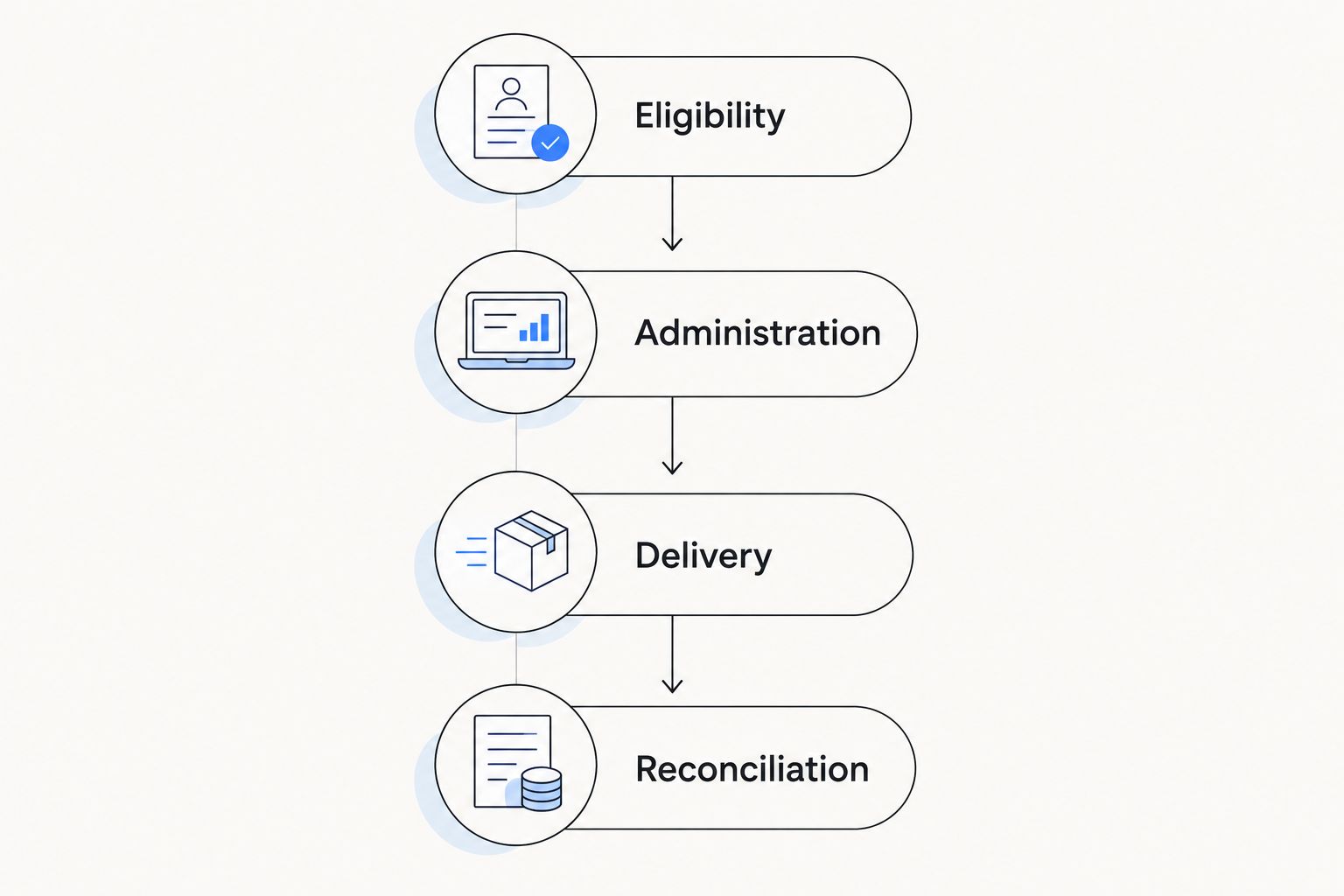
This is an honest tie on subject coverage, not a claim of equal functionality. Either category belongs in a benefits discussion. Your required layer determines which belongs in the purchasing brief.
Neither choice removes employer accountability
Employer accountability is a tie: software and service providers do not replace clear internal ownership. Compliance tools can support a process, but the employer still needs to establish responsibilities and confirm that the service matches its obligations.
For Turkey, KVKK concerns personal-data protection, while SGK is the social security institution. Employee and payroll workflows involve information and obligations that require deliberate handling. Do not interpret the word compliance as a guarantee that every responsibility has transferred to a vendor.
In a 2026 procurement review, ask both suppliers to explain:
- Which employee information the service requires.
- Who can access and change that information.
- Which records the employer receives.
- What the contract assigns to the supplier and to the employer.
- How errors and employee changes are handled.
The broader HR platform has more employment functions in its stated scope. The specialist benefit provider has a narrower purchasing purpose. Neither fact proves the quality of a specific control or establishes the terms of your contract.
Make acceptance criteria operational. Name the record you need, the person responsible and the action required when something is wrong. That produces a clearer decision than asking whether a vendor is simply compliant.
Pricing: compare contractual scope, not labels
Treat the commercial model as part of the workflow decision. For the HR platform, evaluate the agreement against the functions, implementation work and service responsibilities you intend to purchase. For Edenred, evaluate the agreement against the benefit service and employer arrangement.
Do not compare the contracts as though they buy identical outcomes. One purchase concerns broader HR operations; the other concerns a specialist benefit requirement. A narrower agreement and a broader agreement need different acceptance criteria.
Request a written breakdown of:
- The basis on which charges are calculated.
- The services included in the agreement.
- Implementation and ongoing responsibilities.
- Conditions that change the contractual cost.
- Renewal, termination and data-return terms.
The commercial tradeoff is predictability versus flexibility. A clearly defined scope makes budgeting easier; a contract that changes with usage or service choices requires closer forecasting. Establish which structure applies to each proposal instead of assuming a subscription or transaction model from the vendor category.
Compare proposals against the same documented requirement wherever their scope overlaps. Where it does not overlap, keep separate budgets and separate success criteria.
Final verdict: choose by the work you need done
Choose Ottohr if you need a broader HR platform
Best for: a growing employer, midsize organization or large enterprise evaluating hiring, onboarding, payroll, benefits and compliance together.
Choose this category when the purchasing brief spans employment functions rather than one benefit. Require demonstrations of your actual workflows and written confirmation of the responsibilities covered. Do not assume that breadth guarantees every specialized feature you need.
Choose Edenred if you need specialist meal-benefit delivery
Best for: an employer whose HR and payroll arrangements remain in place and whose immediate requirement is Ticket Restaurant meal benefits.
Choose this category when benefit delivery is the defined problem. Confirm the service arrangement against employee needs and employer administration. Do not expect a meal-benefits decision to replace the wider HR environment.
One-glance scorecard
| Dimension | Winner |
|---|---|
| Hiring-system evaluation | HR platform |
| Employment onboarding | HR platform |
| Payroll-system evaluation | HR platform |
| Ticket Restaurant meal-benefit requirement | Edenred |
| Benefits as a purchasing subject | Tie; separate administration from delivery |
| Employer accountability | Tie; assign responsibilities explicitly |
| Pricing fit | The proposal matching the documented scope |
FAQ
What's the main difference in otto hr vs edenred?
Ottohr is an HR platform covering hiring, onboarding, payroll, benefits and compliance, while Edenred is a specialist employee-benefits provider. Choose by whether you need broader employment operations or a specific benefit service.
Is Edenred better for employee meal benefits?
Edenred is the direct fit when your requirement is Ticket Restaurant meal benefits. Confirm the current employer arrangement against employee usage needs and your administration process.
Is an HR platform better for hiring and onboarding?
An HR platform is the relevant category when hiring and employment onboarding are the purchasing requirements. Benefit activation is only one part of joining an organization.
Can a meal-benefits provider replace payroll software?
A meal-benefit service is not a payroll-system replacement. Payroll requires its own input, calculation, review and approval workflow.
How should I compare the cost of these options?
Compare written proposals against the work each agreement covers. Establish the charging basis, included services, implementation responsibilities and conditions that change contractual cost.
Does choosing compliance software remove employer responsibility?
Choosing compliance software does not remove the need to define employer responsibilities. Confirm contractual ownership, data handling and the records required for your processes.
What should a Turkish employer check before choosing in 2026?
A Turkish employer should separate HR administration, payroll and benefit delivery before choosing a vendor in 2026. Define the relevant puantaj, personal-data and benefit-administration responsibilities, then request evidence against that scope.
One last thing
Write one sentence before booking a demonstration: The work we need to replace is… Complete it with an operational task, not a vendor name.
If the answer is meal-benefit delivery, evaluate that service. If the answer spans hiring, onboarding and payroll, evaluate an HR platform. This simple distinction prevents a category mismatch from becoming a 2026 purchasing decision.