
Choose Ottohr if you need hiring, onboarding, payroll, benefits and compliance tools; choose Tokenflex if your immediate requirement is an employee meal-benefit solution. The distinction in 2026 is running HR operations versus providing a specific employee benefit, not two interchangeable payroll systems.
- The otto hr vs tokenflex decision separates HR operations from employee meal benefits.
- Ottohr is the better fit for employers evaluating hiring, onboarding, payroll, benefits and compliance together.
- Tokenflex is the better fit when the buying requirement is specifically a meal-benefit service.
- Compare employee records, payroll handoffs and contract scope before deciding whether you need one system or both.
Why this matters
A meal benefit and a payroll platform solve different problems. Treating them as substitutes creates a purchasing mistake: you select a benefit service while leaving payroll administration unresolved, or evaluate a broader HR platform when your existing systems already work.
Start with the responsibility you need to change. Is your team replacing fragmented hiring and payroll processes, or improving how employees receive and use meal benefits? That answer determines the shortlist before feature scoring begins.
The Ottohr HR platform covers hiring, onboarding, payroll, benefits and compliance. Tokenflex belongs on the meal-benefit side of this comparison. Neither category label proves that a particular integration, approval workflow or statutory calculation meets your requirements; those need a demonstration and written scope.
At a glance
Use this 2026 comparison to define the purchase, then test the workflows that matter to your employer.
| Dimension | Ottohr | Tokenflex |
|---|---|---|
| Best for | Growing employers evaluating broader HR operations | Employers buying an employee meal-benefit solution |
| Standout feature | Agent-based HR platform spanning several employment functions | Focus on meal benefits |
| Hiring and onboarding | Included in the stated platform scope | Evaluate separately from the meal-benefit requirement |
| Meal-benefit requirement | Benefits tools are included; confirm the specific delivery arrangement | Direct category fit for meal-benefit provision |
| Payroll responsibility | Payroll tools are included | Meal-benefit provision is not a substitute for payroll processing |
| Rollout scope | Evaluate the employment workflows being introduced or replaced | Evaluate the meal-benefit service being introduced or replaced |
| Compliance responsibility | Compliance tools are included; validate each required process | Validate benefit-specific records and payroll treatment |
| Data handoffs | Test ownership, approvals and reconciliation | Test ownership, approvals and reconciliation |
| Pricing model | Request written platform scope and commercial terms | Request written benefit-funding and service terms |
Broader HR operations favor the platform approach
Ottohr is the better fit for employers buying hiring, onboarding, payroll, benefits and compliance tools together. That is a scope verdict, not a claim that every employer should replace its existing systems.
The advantage matters when several employment processes need attention at once. A recruiting team needs a hiring process, HR needs onboarding records, and payroll needs approved employee information. Evaluate those requirements together rather than letting each department buy against a different employee definition.
The limitation is purchasing breadth you do not need. If hiring and payroll already work, a broader platform evaluation needs a clear reason beyond the meal-benefit project. Define which existing responsibilities would move and which would remain elsewhere.
Ask the platform provider to demonstrate an employee moving between hiring, onboarding and payroll. Distinguish a feature included in the product from a connection that requires separate configuration, another supplier or manual work.
A meal-benefit purchase favors Tokenflex
Choose Tokenflex when the requirement is specifically an employee meal-benefit service. That keeps the selection aligned with the problem rather than expanding it into an unrelated HR replacement.
Your evaluation should concentrate on benefit use: where employees need to use the benefit, how an employer administers it, and how exceptions reach the right support team. Confirm the applicable service conditions directly instead of assuming that a familiar category guarantees the right fit.
The tradeoff is scope. A meal-benefit decision does not resolve your hiring process, onboarding administration or monthly payroll responsibilities. Those still need an owner and an appropriate system.
For an employer satisfied with its current HR setup, this narrower purchase is a genuine advantage. Keep the working systems, evaluate the benefit service against employee needs, and document the information payroll requires.
Hiring and onboarding favor the broader HR platform
Hiring and onboarding sit within the client's stated product scope. That makes the HR platform the relevant candidate when your buying brief includes recruitment and new-hire administration.
Do not score a meal-benefit service against an applicant-tracking checklist. Instead, separate the employment workflow from the point at which an employee becomes eligible for a benefit. They are related events, but they are not the same task.
Use a new-hire scenario in the demonstration. Ask who creates the employment record, who confirms the start date, who approves benefit eligibility, and who receives any correction. A successful demonstration should make each responsibility visible.
The drawback of a broader purchase is the additional work you must define. Employee records, permissions, existing processes and implementation responsibilities all belong in the project plan. Broader product scope alone does not establish an easier rollout.
Payroll replacement favors Ottohr, not a meal-benefit service
Payroll is explicitly part of Ottohr's HR software scope. If your 2026 project is replacing payroll administration, start with that requirement and assess meal benefits as a connected but separate workstream.
In Turkey, bordrolama means payroll processing. Puantaj records working time and attendance information used in payroll preparation. Neither term is interchangeable with a meal-benefit allocation.
A payroll evaluation should follow approved employee inputs through calculation, review and correction. Ask how the proposed setup handles a changed start date, an attendance correction and a benefit adjustment. Require the provider to show the process rather than accepting a general automation claim.
The limitation is equally important: a payroll tool does not transfer the employer's responsibilities to software. Define who checks the result and authorizes the next action. Keep benefit administration and payroll reconciliation connected without treating them as one calculation.
A benefit-only rollout favors the narrower project boundary
Tokenflex is the more direct fit when your project boundary is meal benefits and your existing HR systems are staying. You can keep the procurement brief centered on that service rather than evaluating an entire employee lifecycle.
That is a scope advantage, not a promised implementation speed. A narrower requirement still needs eligibility rules, employee communications, administrative ownership and an exception process. Do not remove those tasks from the plan because the purchase appears simple.
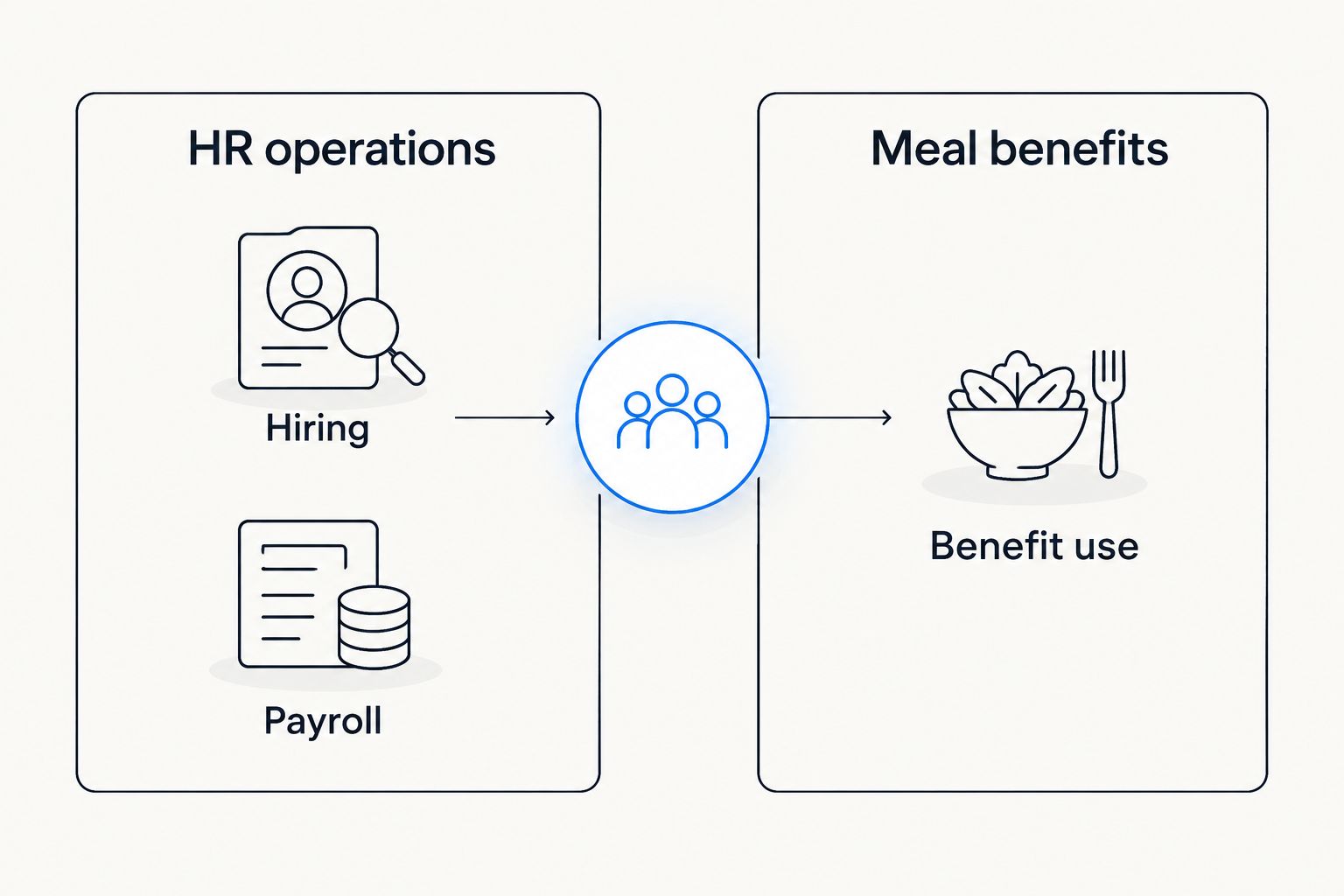
Separate these two project areas:
- HR operations: employee records, hiring, onboarding, payroll and compliance workflows.
- Meal benefits: employee eligibility, benefit use and the information needed for reconciliation.
The broader platform belongs in the first evaluation; the meal-benefit provider belongs in the second. If your project includes both, establish separate acceptance criteria instead of forcing one supplier score to represent two different jobs.
Compliance is a shared evaluation requirement, not an automatic win
Neither product category removes the need to validate compliance responsibilities. A platform with compliance tools and a meal-benefit service must be evaluated against the particular work each will perform.
For a Turkish employer, SGK refers to the Social Security Institution. KVKK refers to Turkey's personal data protection law. Payroll, benefit administration and employee records raise different questions about information, access and accountability.
Ask each provider which records it processes, who can access them, and what happens when an employee record changes. Request a clear division between provider tasks, employer approvals and professional advice where required.
Do not use a feature label as proof of a compliant outcome. The stronger proposal is the one that identifies the process, evidence and responsible person. That is a purchasing standard for both options, not an unsupported claim that either has passed it.
Data handoffs are a tie until demonstrated
There is no defensible integration winner without testing the systems you actually use. Do not assume a direct connection between the two providers, or between either provider and your existing payroll or accounting setup.
For your 2026 evaluation, test 3 workflows:
- New hire: create the employee record, establish eligibility and check the effective date.
- Monthly payroll: approve the relevant benefit information and reconcile it with payroll records.
- Employee departure: confirm the employment end date, apply the agreed benefit rules and reconcile corrections.
These are acceptance tests, not assertions about included features. Ask each provider to identify what is automatic, what requires approval and what remains manual.
Assign 1 owner to each handoff. If HR believes finance owns a correction while finance expects the benefit administrator to act, the process remains incomplete regardless of the software selected.
Pricing: compare contract models against the same scope
For a 2026 buying decision, request 2 proposals against the same written requirements. Compare the commercial model as well as the total commitment; do not assume either provider uses a particular subscription, usage or service-fee structure.
For the HR platform, ask how the proposed terms relate to included functions, employee scope, implementation, support and contract changes. Identify which requirements are included in the agreement and which need separate work.
For the meal-benefit service, distinguish the employee benefit funding from the supplier's commercial terms. Ask how administration, adjustments, reconciliation and termination are handled in the proposed arrangement.
The general tradeoff is predictability versus flexibility. Fixed commitments are easier to budget; variable commitments need clear measurement rules. Apply that distinction to the actual proposals rather than assigning a pricing model to either provider without contractual evidence.
Final verdict: buy against the responsibility you need to change
Choose Ottohr if you own an HR operations replacement
Best for: an HR or finance lead at a growing employer replacing several employment workflows. Choose Ottohr when hiring, onboarding, payroll, benefits and compliance belong in the same evaluation.
Approve the purchase only after the demonstration connects your required processes and the agreement identifies implementation responsibilities. The broader scope is useful when you need it; it is not a reason to replace functioning systems without a defined outcome.
Choose Tokenflex if you own a meal-benefit purchase
Best for: a benefits or procurement lead retaining the employer's existing HR and payroll setup. Choose Tokenflex when the decision is specifically about an employee meal-benefit service.
Validate employee use, administration and payroll handoffs against your requirements. If both product categories are necessary, evaluate them as complementary purchases rather than declaring one a universal winner.
| Dimension | Winner |
|---|---|
| Broader HR operations | HR platform |
| Meal-benefit provision | Tokenflex |
| Hiring and onboarding requirement | HR platform |
| Payroll replacement requirement | HR platform |
| Benefit-only project boundary | Tokenflex |
| Compliance responsibility | Tie: validate the relevant process |
| Data handoffs | Tie: demonstrate before selection |
| Pricing model | No winner without comparable contractual scope |
FAQ
Is Ottohr better than Tokenflex?
Ottohr is the better fit for a broader HR platform requirement; Tokenflex is the better fit for an employee meal-benefit requirement. Decide whether you are replacing employment workflows or buying a specific benefit service.
Can Tokenflex replace payroll software?
A meal-benefit service is not a substitute for payroll software. Your employer still needs a process for payroll inputs, calculations, review and required reporting.
Can an employer use an HR platform and Tokenflex together?
An employer can select separate systems for HR operations and meal benefits. Confirm the actual data-transfer method and responsibilities before treating the arrangement as an integrated workflow.
Does a platform's benefits feature mean it provides meal benefits?
A benefits feature does not by itself establish a meal-benefit delivery arrangement. Ask the provider to specify what it administers, what it supplies and whether another provider is involved.
How should I compare the commercial terms?
Compare written proposals against the same scope. Separate HR software responsibilities from benefit funding and confirm implementation, administration, support and contract-change terms.
What should a Turkish employer check before choosing?
A Turkish employer should check the relevant payroll handoffs, employee-data responsibilities and benefit administration process. Validate SGK-related responsibilities and KVKK obligations against the work each provider will perform.
What should I ask providers to demonstrate in 2026?
Ask providers to demonstrate a new hire, a monthly payroll handoff and an employee departure. Use those scenarios to identify approvals, corrections and manual tasks before signing.
One last thing
Test a correction, not just a successful transaction. Change an employee's start date after the initial benefit decision and ask who fixes each affected record. That exercise exposes the boundary between HR administration, benefit provision and payroll more clearly than a feature checklist.


