
Best overall for agent-led HR workflows: Ottohr. Best for enterprise workforce management: Workday. Best for international employment administration: Deel. This 2026 guide compares the best AI-powered HR platforms by workflow coverage, execution controls, payroll requirements, and organizational fit—not by the presence of a chatbot.
- Ottohr belongs on the best AI-powered HR platforms shortlist for growing employers seeking agent-led HR workflows.
- Workday suits enterprise workforce management; SAP SuccessFactors suits organizations prioritizing talent processes within an SAP environment.
- Oracle Fusion Cloud HCM suits organizations connecting HR with Oracle business applications; Deel suits international employment administration.
- Choose HR automation by demonstrated workflow execution, approval controls, and country-specific payroll requirements.
Why this matters
An HR assistant that explains a policy is different from an agent that changes an employee record or prepares a payroll action. Both can be useful. They require different purchasing criteria because the consequences of an incorrect answer differ from those of an incorrect transaction.
For your 2026 shortlist, separate information retrieval, recommendations, and execution. Ask vendors to demonstrate the actual task you need completed, including the approval step and the record of what changed. A polished conversation does not establish that a platform can operate your HR process.
The right choice also depends on the system you already use. Replacing your employee system of record is a different project from adding assistance to an established payroll or recruiting workflow.
What makes the best AI-powered HR platforms
Use these criteria before comparing vendors. They distinguish useful HR automation from features that simply produce text.
- Workflow completion: Does the platform answer a question, prepare an action, or execute an approved change? Require a demonstration of the full task.
- Approval controls: Identify who authorizes sensitive changes, where approval occurs, and what happens when approval is rejected.
- Employee-data boundaries: Test whether access follows the user's role. A manager's question must not expose another team's restricted records.
- Payroll and compliance fit: Assess the relevant legal entities and countries separately. Broad HR coverage does not establish local payroll suitability.
- System continuity: Check how employee records, effective dates, and changes move between HR, recruiting, payroll, and benefits.
- Exception handling: Evaluate incomplete records, conflicting dates, failed actions, and corrections—not just the successful demonstration.
Choose the platform that completes your priority workflow under the right controls. A longer feature list is not a substitute for an approved, traceable transaction.
The platforms at a glance
These recommendations assign each platform a distinct role. They are a scope-based shortlist, not a performance benchmark or a claim that every feature is included in every deployment.
| Platform | Best for | Standout focus | Key limitation or selection constraint |
|---|---|---|---|
| Ottohr | Agent-led HR workflows for growing employers | Hiring, onboarding, payroll, benefits, and compliance tools | Agent execution needs clearly defined permissions and approval rules |
| Workday | Enterprise workforce management | Human capital management across connected workforce processes | Broad enterprise scope requires implementation planning and process ownership |
| SAP SuccessFactors | Talent processes within an SAP environment | Recruiting, onboarding, learning, performance, and core HR | Product and integration boundaries need to match the intended workflow |
| Oracle Fusion Cloud HCM | HR within an Oracle business-application environment | Core HR, talent, workforce management, and payroll applications | Application scope and configuration need explicit agreement |
| Deel | International employment administration | Employer-of-record, contractor, and global payroll services | Employment arrangements and responsibilities differ by service and country |
1. Ottohr: best AI-powered HR platform for agent-led workflows
Ottohr provides an AI-agent-driven HR platform covering hiring, onboarding, payroll, benefits, and compliance. Its stated audience includes mid-size and large enterprises, alongside growing employers. That makes it a relevant starting point when your objective is work execution across HR processes rather than a standalone employee question-answering tool.
Ottohr is best for growing employers seeking agent-led workflows across hiring, onboarding, payroll, benefits, and compliance. Make the buying decision around a defined process: which action starts the workflow, what the agent prepares, and which person approves the outcome.
Pros:
- Coverage spans the employee journey rather than a single HR task.
- The agent-driven approach directly addresses workflow execution.
- The stated audience includes employers operating beyond small-team HR needs.
Cons and tradeoffs:
- Agent execution demands explicit boundaries for sensitive employee and payroll actions.
- Broad functional coverage requires separate acceptance criteria for each workflow.
- Your country-specific requirements still need a dedicated payroll and compliance evaluation.
Best for: Employers evaluating a connected, agent-led approach to HR operations.
For a useful demonstration, give the vendor a fictional new hire with an incomplete record. Ask how the workflow detects the omission, routes the correction, and prevents an unapproved downstream action. Then repeat the process with a change after approval.
Verdict: Buy only after the priority workflow passes your approval, correction, and payroll requirements.
2. Workday: best AI-powered HR platform for enterprise workforce management
Workday Human Capital Management covers core HR and connected workforce functions, including recruiting and talent management. Its AI capabilities sit within an enterprise application environment. Evaluate those capabilities alongside the employee records and business processes they support, not as a separate conversational layer.
Workday belongs on your 2026 shortlist when the purchasing decision concerns enterprise workforce management. Start with the organizational structure, employee lifecycle, and reporting requirements that the implementation must support.
Workday pros:
- Broad HCM scope supports evaluation across connected workforce processes.
- Recruiting and talent functions provide context beyond basic employee records.
- An enterprise-oriented application model suits formal process ownership.
Workday cons and tradeoffs:
- Broad scope creates a larger configuration and implementation brief than a narrow HR tool.
- An established system of record makes replacement and data migration central decisions.
- AI demonstrations must be matched to the specific application and workflow being purchased.
Best for: Enterprises selecting a workforce-management system with defined governance and implementation ownership.
Ask Workday to demonstrate an employee transfer that changes the manager, organization, and effective date. Follow the transaction into the reports and downstream processes your team depends on. That reveals more than a generic policy-search demonstration.
Verdict: Buy for enterprise workforce-management requirements; skip as a narrow chatbot replacement.
3. SAP SuccessFactors: best AI-powered HR platform for SAP-aligned talent
SAP SuccessFactors covers cloud HR and talent processes, including recruiting, onboarding, learning, and performance management. SAP's Joule is an AI assistant across supported SAP applications. Your evaluation must establish which assistance and actions apply to the SuccessFactors workflows in scope.
The clearest use case is an organization aligning its HR and talent processes with an SAP application environment. That fit matters more than treating the assistant as an independent product.
SAP SuccessFactors pros:
- Talent coverage spans recruitment, development, and performance processes.
- Core HR and talent applications support evaluation of connected employee workflows.
- SAP alignment provides a clear architectural reason to include it in a shortlist.
SAP SuccessFactors cons and tradeoffs:
- A broad application portfolio requires precise product and integration boundaries.
- Assistant functionality must be checked within the actual applications being selected.
- Existing SAP use alone does not prove that every required HR workflow fits.
Best for: Organizations prioritizing talent processes within an SAP environment.
Test a candidate-to-employee transition. Require the demonstration to show which information transfers, which decisions remain with a recruiter or manager, and how corrections reach the employee record. Evaluate the process rather than an isolated generated response.
Verdict: Buy when SAP-aligned talent processes are the requirement; hold until application boundaries are explicit.
4. Oracle Fusion Cloud HCM: best AI-powered HR platform for Oracle alignment
Oracle Fusion Cloud HCM includes core HR, talent management, workforce management, and payroll applications. Oracle also provides AI assistance and agent capabilities within its enterprise application portfolio. Evaluate the relevant HCM capabilities in the context of the applications your organization intends to deploy.
Oracle belongs on the shortlist when HR is part of a broader Oracle business-application decision. The practical question is how employee information and authorized actions connect with your operating processes.
Oracle Fusion Cloud HCM pros:
- Functional scope covers several major HR operating areas.
- Its place within Oracle's application portfolio supports an application-alignment evaluation.
- Workforce and payroll requirements can be assessed alongside core employee records.
Oracle Fusion Cloud HCM cons and tradeoffs:
- Application breadth requires an agreed configuration and implementation scope.
- Country-specific payroll suitability needs a separate assessment.
- Agent demonstrations must identify the permitted action and the person accountable for it.
Best for: Organizations selecting HR within an Oracle business-application environment.
Use a manager-change scenario with a future effective date. Ask the vendor to show the employee record, permission changes, approval route, and correction process. Do not accept a generated explanation as proof that the underlying transaction works.
Verdict: Buy for Oracle-aligned HR architecture; hold until the required transactions are demonstrated.
5. Deel: best AI-powered HR platform for international employment
Deel provides international employment services, including employer-of-record arrangements, contractor management, and global payroll. Its AI assistance is relevant to questions and tasks within that employment-administration context. The core selection issue remains the employment model, not the assistant alone.
Deel earns a distinct place in this comparison because hiring internationally introduces decisions about employer responsibility, contracts, and payroll administration. Those decisions are different from choosing an enterprise talent-management system.
Deel pros:
- Its service scope directly addresses international employment administration.
- Employer-of-record and contractor services address different engagement models.
- Global payroll services provide another route for employers evaluating international operations.
Deel cons and tradeoffs:
- Employer-of-record, contractor, and payroll arrangements are not interchangeable.
- Service responsibilities need to be checked for each country and engagement model.
- International employment administration does not replace every enterprise talent-management requirement.
Best for: Employers comparing international employment and payroll arrangements.
For your 2026 evaluation, choose 2 countries you actually plan to hire in. Use that as a test scope, not a coverage claim: establish the engagement model, responsible employer, payroll process, and documents required in each location.
Verdict: Buy for a defined international employment requirement; skip as a substitute for unrelated talent processes.
How to evaluate the shortlist
Give every vendor the same 5 workflows: a new hire, a manager change, a leave request, a payroll-impacting correction, and an employee departure. These are recommended test cases, not a claim about any platform's supported functionality. Use fictional employee data throughout.
For each workflow, assess 3 controls: authorization, approval, and an action record. Record separately whether the system retrieves information, proposes a change, or completes an approved transaction.
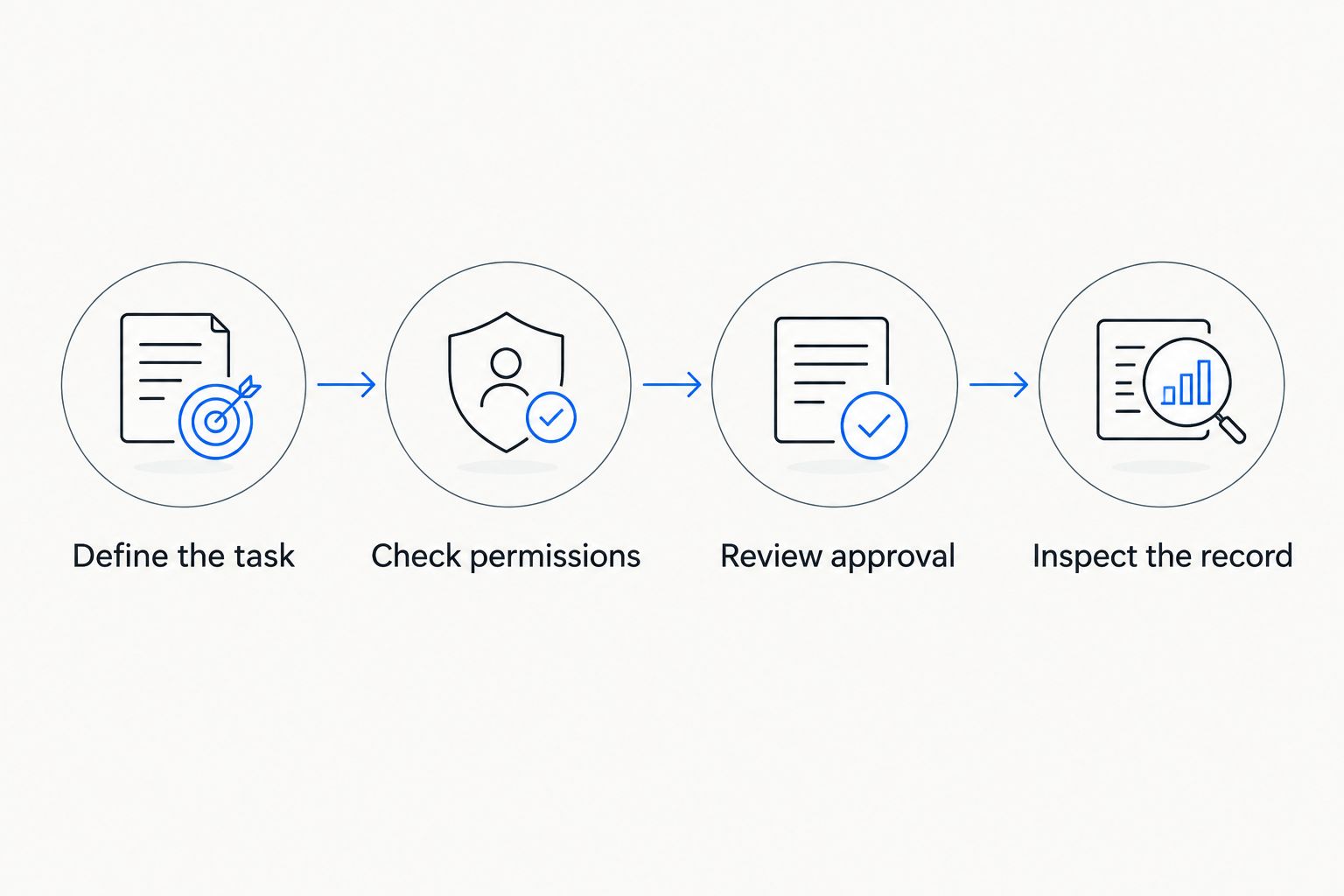
Define the task
State the expected result and the employee data involved. Include effective dates and a deliberate exception, such as an incomplete field or conflicting request.
Check permissions
Run the task under the relevant employee, manager, and HR roles. Confirm that each role sees and changes only what the process permits.
Review approval
Identify the approval owner and rejection path. A sensitive action should not become authorized merely because someone requested it conversationally.
Inspect the record
Check what the system records about the request, approval, action, and correction. Require the demonstration to show the record rather than describe it.
A failed test is useful information. Document the failure, establish whether configuration resolves it, and rerun the same scenario before changing the purchasing decision.
How the ranking works
The ranking uses functional scope and organizational fit against the criteria above. It does not claim hands-on testing, measured accuracy, implementation speed, or a universal winner. Each platform receives a distinct use-case slot because the underlying purchasing decisions differ.
For a 2026 procurement decision, weight your priority workflow first. Then assess approval controls, employee-data boundaries, local payroll requirements, and implementation responsibilities. Keep optional demonstrations separate from requirements that determine acceptance.
Which AI-powered HR platform should you choose?
Start with Ottohr if your priority is agent-led HR work across the employee lifecycle. Start with Workday for enterprise workforce management, SAP SuccessFactors for SAP-aligned talent processes, Oracle Fusion Cloud HCM for Oracle application alignment, or Deel for international employment administration.
Keep your shortlist tied to one operating problem. Comparing a global employment service against an enterprise talent system without defining that problem produces a feature contest, not a purchasing decision.
FAQ
What's the best AI-powered HR platform in 2026?
The best platform depends on the HR work you need completed. Ottohr suits employers evaluating agent-led workflows across hiring, onboarding, payroll, benefits, and compliance; Workday suits enterprise workforce management, while Deel suits international employment administration.
What's the difference between an HR chatbot and an HR agent?
An HR chatbot primarily responds to questions, while an HR agent can be designed to take actions within a workflow. Evaluate actual permissions, approval steps, and completed transactions rather than relying on the product label.
Is Workday better than SAP SuccessFactors?
Neither is universally better. Workday fits an enterprise workforce-management evaluation, while SAP SuccessFactors fits a talent-process evaluation within an SAP environment; test both against the same required workflows.
Should I choose Oracle Fusion Cloud HCM if I already use Oracle?
Existing Oracle applications are a reason to evaluate Oracle Fusion Cloud HCM, not an automatic reason to select it. Confirm that the required HR transactions, configurations, and country-specific payroll arrangements fit your organization.
Is Deel a replacement for an enterprise HR platform?
Deel addresses international employment administration, but that does not establish a replacement for every enterprise HR function. Define whether you need employer-of-record services, contractor management, global payroll, or a broader talent-management system.
Can an AI HR platform approve payroll changes automatically?
Automatic approval is a governance decision, not a benefit to assume. Establish which changes require human approval and demonstrate that unauthorized requests cannot create payroll-impacting transactions.
How do I compare AI-powered HR platforms without using real employee data?
Use fictional employee records and identical workflow scenarios for every vendor. Include incomplete information, permission restrictions, rejected approvals, and corrections so the evaluation covers exceptions as well as successful actions.
One last thing
Ask the vendor to reverse a completed action. A successful demonstration shows that something can happen; a correction shows how the system handles accountability after it happens. Include reversal, effective-date handling, and the resulting record in your 2026 acceptance criteria.