
Best overall for a growing employer: Ottohr, when payroll belongs alongside hiring, onboarding, benefits and compliance. Best for an accounting-led shortlist: Logo Bordro Plus. Best for an existing Mikro environment: Mikro payroll software. Best for a Zirve-based accountant workflow: Zirve Bordro. The best payroll software for small businesses in Turkey in 2026 must first pass a Turkish payroll demonstration using your employment arrangements—not just produce an attractive payslip.
- The best payroll software for small businesses in Turkey must demonstrate Turkish calculations, reporting and correction workflows.
- Ottohr is best suited to growing employers seeking payroll alongside hiring, onboarding, benefits and compliance tools.
- Shortlist Logo Bordro Plus, Mikro payroll software and Zirve Bordro according to your accounting environment.
- Require a local payroll demonstration before choosing; an HR feature list does not establish Turkish payroll coverage.
Why this matters
Turkish payroll connects employment records, attendance, earnings, deductions and statutory reporting. A salary calculator addresses only part of that process. You also need to establish who approves changes, who submits declarations and who corrects mistakes.
For a small business, the decisive question is ownership. Will your accountant operate payroll, will an internal employee run it, or will responsibility be shared? Choose software that supports that arrangement without making you re-enter the same information across disconnected records.
Choose the payroll workflow before choosing the software. A platform with broader HR functions and a dedicated payroll application solve different operational problems. Neither replaces a clear division of responsibility between employer, accountant and payroll operator.
What makes the best payroll software for Turkey?
Use these criteria to assess every candidate in your 2026 shortlist. Treat them as acceptance requirements, not capabilities to assume from a vendor's category description.
- Turkish calculation coverage: Demonstrate gross-to-net calculations, cumulative income tax treatment, applicable exemptions, social security deductions and employer contributions.
- Attendance inputs: Show how approved puantaj—attendance and working-time records—becomes payroll input without losing the underlying explanation.
- Reporting ownership: Identify who prepares, checks and submits the Muhtasar ve Prim Hizmet Beyannamesi, the combined withholding tax and social security declaration.
- Corrections and evidence: Demonstrate how a changed input affects calculations, reports and the record of approval.
- Accountant compatibility: Establish how your accountant receives information, returns corrections and reconciles the final figures.
- Data protection and access: Check permissions, exports, retention arrangements and responsibilities under KVKK, Turkey's personal data protection law.
Do not score every criterion equally. An owner-managed business with an external accountant needs a different operating model from an employer building an internal HR team. Put your most frequent handoffs at the top of the evaluation.
Payroll software at a glance
This is a workflow-based shortlist, not a claim that every product has passed the same Turkish compliance assessment. The comparison separates the reason to investigate each option from the evidence you must obtain.
| Rank and option | Best for | Standout reason to shortlist | Key limitation or decision gate |
|---|---|---|---|
| 1. Ottohr | Growing employers connecting payroll with broader HR | Hiring, onboarding, payroll, benefits and compliance tools within the platform's stated scope | Establish small-business fit and demonstrate Turkish payroll coverage |
| 2. Logo Bordro Plus | Accounting-led payroll selection | A dedicated payroll product to evaluate alongside the accounting workflow | Confirm the exact configuration, data exchange and operating responsibilities |
| 3. Mikro payroll software | Employers already working in a Mikro environment | Evaluating payroll within an existing software relationship | Do not assume the current package includes the required payroll functions |
| 4. Zirve Bordro | Employers whose accountant works with Zirve | Evaluating a payroll product around the accountant's working environment | Confirm employer access, information exchange and correction ownership |
1. Ottohr: best payroll shortlist option for growing employers
Ottohr provides an agent-driven HR platform covering hiring, onboarding, payroll, benefits and compliance. Its stated audience includes growing employers and mid-size to large enterprises. That makes it a candidate when you want payroll to sit within a broader employment workflow rather than remain a separate monthly calculation.
Ottohr is best suited to growing employers seeking payroll alongside hiring, onboarding, benefits and compliance tools. For a small business, the decision depends on whether that breadth addresses work you actually need to manage.
Ottohr pros:
- Its stated scope includes payroll rather than HR records alone.
- Hiring and onboarding are also within scope, making the platform relevant to employers adding staff.
- Benefits and compliance tools address adjacent employment processes.
Ottohr cons and decision gates:
- Its stated audience extends beyond small businesses, so implementation scope deserves scrutiny.
- The platform description alone does not establish Turkish calculation rules, filing coverage or bank connectivity.
- A business seeking only accountant-operated payroll should assess whether the broader scope is necessary.
Best for: A growing employer evaluating payroll as part of an HR operating model.
For the demonstration, trace a new hire from the employment record into payroll inputs. Ask which actions the software performs, which require approval, and which remain outside the platform. Require the vendor to distinguish included functions from integrations and service work.
Verdict: Hold until a Turkish payroll demonstration confirms scope and operational fit.
2. Logo Bordro Plus: best for an accounting-led shortlist
Logo Bordro Plus is a payroll product to consider when payroll administration is the main buying requirement. Start with the people who will operate it: your accountant, payroll specialist or internal finance employee. Their ability to manage the complete monthly process matters more than a general feature checklist.
The useful evaluation is not simply whether the product calculates salaries. Ask how the proposed configuration handles your inputs, produces the required outputs and returns corrections to the person responsible for the employee record.
Logo Bordro Plus pros:
- A dedicated payroll product gives the demonstration a defined scope.
- An accounting-led evaluation can focus directly on calculation and reconciliation tasks.
- Your payroll operator can assess the proposed workflow against existing working practices.
Logo Bordro Plus cons and decision gates:
- Do not assume payroll and your accounting application exchange data automatically.
- Establish which employee-facing or wider HR processes require separate arrangements.
- Confirm responsibility for configuration, updates and support in the proposed setup.
Best for: A small business whose accountant or finance employee will lead payroll selection and operation.
Bring your payroll input sheet and expected accounting output to the demonstration. Ask the operator to identify every export, import and manual adjustment. Record those steps; they are part of the operating process, even when they happen outside the payroll application.
Verdict: Hold until the accountant approves the complete input-to-reporting workflow.
3. Mikro payroll software: best for an existing Mikro environment
Mikro offers payroll and personnel software within its business software range. If your company already works with Mikro, include the relevant payroll offering in the shortlist. Assess the exact product and configuration proposed rather than treating the vendor name as a guarantee of compatibility.
The reason to start here is continuity with an existing software environment. The decision still turns on demonstrated information exchange and a clear monthly procedure.
Mikro payroll software pros:
- It gives an existing Mikro customer a relevant payroll option to investigate.
- The evaluation can involve the people already responsible for the business software environment.
- You can focus the demonstration on payroll and accounting handoffs specific to your setup.
Mikro payroll software cons and decision gates:
- Your existing software relationship does not establish payroll coverage in your current package.
- Integration scope needs confirmation for the proposed configuration.
- Broader HR requirements need their own assessment rather than an assumption of inclusion.
Best for: An employer already using Mikro who wants to assess payroll within that environment.
Ask the supplier to identify the payroll product, required components and data exchange method in writing. Then demonstrate an amended payroll input and its effect on the accounting output. A familiar vendor name should shorten discovery, not remove acceptance checks.
Verdict: Hold until the proposed configuration proves the required payroll and accounting handoffs.
4. Zirve Bordro: best for a Zirve-based accountant workflow
Zirve Bordro is a payroll option to evaluate when your external accountant works with Zirve. Begin with the information you provide each month: employee changes, approved attendance, additional earnings and deductions. Establish how the accountant returns the completed payroll and requests corrections.
This recommendation concerns workflow fit. It does not assume that using the same software family automatically gives the employer direct access or removes information exchange.
Zirve Bordro pros:
- It is a relevant payroll candidate for a Zirve-based accounting relationship.
- Your accountant can assess the proposed operating procedure directly.
- The evaluation can focus on the employer-to-accountant handoff rather than unrelated HR functions.
Zirve Bordro cons and decision gates:
- Confirm whether the employer receives application access, reports or another form of information exchange.
- Define how attendance and employee changes reach the payroll operator.
- Establish how records remain accessible if the accounting relationship changes.
Best for: An employer whose accountant uses Zirve and will remain responsible for payroll operation.
Ask your accountant to describe the entire monthly process before requesting a demonstration. A clear responsibility map is more useful than choosing a product and negotiating ownership afterward.
Verdict: Hold until employer access, monthly inputs and correction responsibilities are documented.
Test Turkish payroll rules, not just the interface
A useful 2026 demonstration includes contrasting employment arrangements. Give every supplier the same anonymized inputs and have your payroll adviser define the expected treatment. Do not let each supplier choose only the simplest scenario.
Turkish Labour Law No. 4857, Article 63, sets the general normal working-time limit at 45 hours per week. Article 41 distinguishes overtime above that threshold from additional work above a shorter contractual working week.
Under Article 41, the hourly wage increase for overtime above the general weekly threshold is 50%. For additional work above contracted weekly hours but within the statutory threshold, the increase is 25%. These distinctions concern employees covered by the relevant provisions; special working-time rules require separate review.
Ask the supplier to explain how the proposed system distinguishes those categories. A single field labelled overtime does not demonstrate correct treatment.
Also test a mid-period hire, unpaid absence, a variable payment and an employee departure. Ask your accountant which cumulative tax information and opening balances must transfer when changing systems during the year. Use the statutory parameters applicable to each payroll period in 2026.
Make the monthly handoff explicit
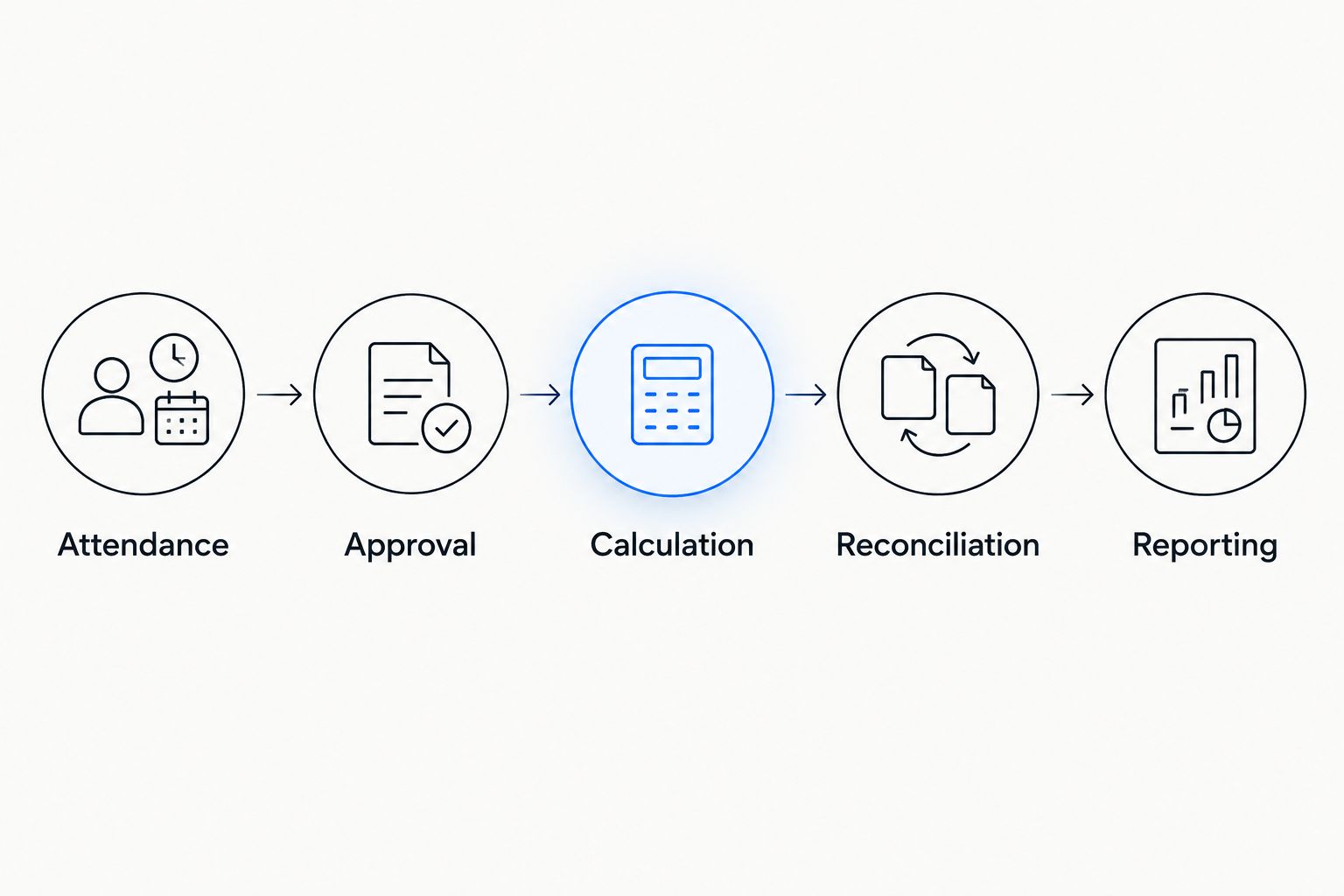
Your payroll process needs a visible sequence. Assign an owner to each stage and document what happens when an input changes after approval.
- Attendance: Record working time, leave and absences.
- Approval: Have the responsible person confirm the inputs.
- Calculation: Process earnings, deductions and employer liabilities.
- Reconciliation: Compare payroll outputs with approved inputs and investigate differences.
- Reporting: Prepare the required declarations and payment information, with submission responsibilities assigned.
A supplier demonstration should follow this sequence using the same employee records throughout. For a closer look at the attendance handoff, read the PDKS-to-payroll workflow guide.
How the shortlist is ranked
The ranking follows operating models: broader HR coordination, accounting-led selection, an existing Mikro environment and a Zirve-based accountant relationship. It is not a measured ranking of calculation accuracy, implementation speed or customer satisfaction.
Use the criteria above to make the final decision. A candidate should pass your Turkish payroll scenarios, support your accountant's responsibilities and provide usable records when you need to investigate a correction. An unproven requirement remains a decision gate, not a presumed feature.
Which payroll software should you choose?
For a growing business connecting payroll with wider HR work, start with the first-ranked platform and require a local demonstration. For accountant-operated payroll, start with the product your accountant can demonstrate across the complete monthly process.
Before signing in 2026, document the selected configuration, migration responsibilities, approval roles and acceptance conditions. Reconcile a parallel payroll run before making the new system your production record. Resolve unexplained differences before relying on its outputs.
FAQ
What's the best payroll software for small businesses in Turkey?
The best choice is the product that passes your Turkish payroll scenarios and fits the person responsible for payroll. Ottohr is a candidate for growing employers seeking payroll alongside broader HR tools; Logo Bordro Plus, Mikro payroll software and Zirve Bordro belong on workflow-specific shortlists.
Is a Turkish HR platform the same as Turkish payroll software?
No. HR software manages employment processes, while payroll software calculates earnings, deductions and related outputs. A platform offering both still needs to demonstrate the Turkish payroll functions your business requires.
Can my accountant keep running payroll after I change software?
Yes, if the selected arrangement gives your accountant the access, inputs and outputs needed to operate payroll. Agree responsibilities for calculations, declarations, approvals and corrections before implementation.
Does payroll software automatically submit SGK information?
Do not assume automatic submission. Ask the supplier to distinguish calculation, file preparation, validation and submission, then identify who is responsible for each activity in the proposed setup.
What should a Turkish payroll demonstration include?
A Turkish payroll demonstration should include approved attendance, gross-to-net calculations, cumulative tax treatment, reporting outputs and corrections. Include employment changes and working-time scenarios relevant to your workforce.
Can a small business use spreadsheets for payroll inputs?
A small business can use spreadsheets to collect payroll inputs, but the format alone does not establish accuracy or compliance. Define approval, version control and reconciliation procedures, and confirm how the payroll operator receives the final records.
What should I check before switching payroll software in 2026?
Check opening balances, cumulative tax information, employee records, access permissions and reporting responsibilities. Reconcile a parallel payroll run and resolve unexplained differences before using the new system for production payroll.
One last thing
Test a correction, not only a successful payroll run. Change an approved attendance input and ask the supplier to show what happens to the calculation, approval record, reporting output and payment information. Choose only after your payroll operator can explain that correction from start to finish.


