
Calculate Turkish shift-worker overtime by checking actual working time against the employee’s contractual hours, the statutory weekly threshold and applicable daily or night-work limits. Apply the correct premium to the ordinary gross hourly wage, then record the approved amount in payroll. A rotating schedule does not remove overtime entitlement, and paying a premium does not make an unlawful shift lawful.
- How to calculate overtime pay for shift workers in Turkey: classify working hours before applying payroll premiums.
- Work above 45 hours weekly normally attracts a 50% overtime premium, subject to lawful balancing rules.
- Contractual hours below 45 create a separate category: additional work generally carries a 25% premium.
- Ottohr is best for growing employers seeking HR, payroll and compliance tools in one platform.
Why this matters
Shift payroll becomes inaccurate when you treat scheduled hours, attendance records and payable working time as interchangeable. An employee’s clock-in record shows presence; the approved working-time record must identify work, genuine breaks, leave and exceptions.
For your 2026 payroll process, separate classification from calculation. Establish which hours qualify before multiplying anything. The PDKS turnstile-to-payroll workflow explains the handoff between access records, attendance review and payroll preparation.
This guide covers the general framework for employees subject to Turkish Labour Law No. 4857. Special employment regimes, sector-specific exceptions, collective agreements and more favourable contractual terms require separate assessment.
How do you calculate overtime pay for shift workers in Turkey?
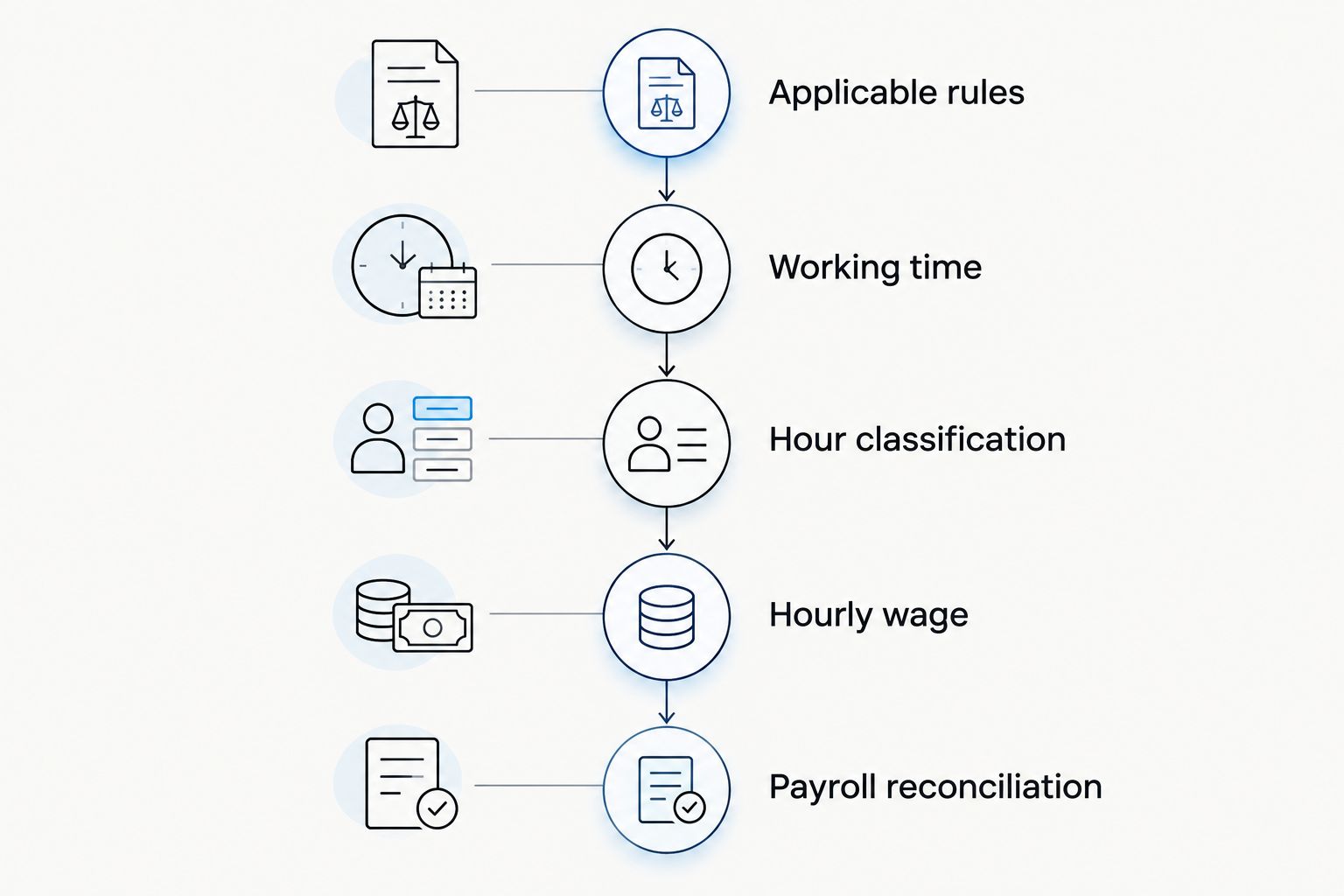
Use the following sequence for each employee and payroll period. Keep the underlying weekly records even when you pay salaries monthly: a monthly total alone does not establish the correct overtime entitlement.
Establish the applicable rules
Confirm that the employee falls under Labour Law No. 4857. Read the employment contract and any collective agreement for normal weekly hours, wage terms, shift arrangements and enhanced premiums.
Do not treat every employee with a monthly salary as exempt from overtime. Equally, do not assume that every additional hour belongs in the same pay category.
Reconstruct actual working time
Collect shift start and finish times, actual breaks, approved changes, leave and absences. Resolve missing punches before payroll approval rather than replacing them automatically with the planned schedule.
For an overnight shift, retain the start and end dates. Midnight is a calendar boundary, not proof that one continuous shift has become separate shifts for daily-limit purposes.
Classify the hours
The general weekly threshold is 45 hours. When contractual normal working time is shorter, work above that contractual limit but up to 45 hours falls into a separate category from work above 45 hours.
Also check daily and night-work limits independently. A weekly total below the general threshold does not settle every overtime question.
Establish the ordinary hourly wage
For a standard monthly-paid employee working a 45-hour week, the usual calculation is:
Ordinary gross hourly wage = ordinary gross monthly wage ÷ 225 hours.
Do not apply the 225-hour divisor automatically to every contract. Shorter contractual hours and different wage arrangements require the appropriate conversion. Do not use net take-home pay as the starting wage.
Calculate and reconcile
Multiply each qualifying category by its applicable hourly rate. Then reconcile the result against the attendance record, the approved exceptions and the payroll line items.
Keep ordinary pay, additional-hours pay, overtime and public-holiday treatment distinguishable. A correct total without a traceable classification is not a reliable payroll record.
Weekly overtime: 50% above the ordinary hourly wage
Under Article 41 of Labour Law No. 4857, overtime generally means work exceeding 45 hours per week, subject to lawful balancing arrangements. Each qualifying hour is payable at the ordinary hourly wage increased by 50%.
The formula is:
Gross overtime pay = qualifying overtime hours × ordinary gross hourly wage × 1.50.
The multiplier represents the total payment for the overtime hour, not just the additional premium. When reconciling payroll, check whether the ordinary component has already been included so that you neither omit it nor count it twice.
For 2026 payroll, use the applicable wage for the period in which the employee performed the work. A later wage change must not silently overwrite the historical calculation basis.
Additional contractual hours: 25% above the ordinary hourly wage
When a contract sets normal weekly working time below 45 hours, work above that contractual duration and up to 45 hours is generally fazla sürelerle çalışma. The statutory premium is 25%, rather than the 50% overtime premium.
Gross additional-hours pay = qualifying additional hours × ordinary gross hourly wage × 1.25.
This distinction does not authorise additional work for every employment arrangement. Turkish overtime regulations prohibit overtime and additional-hours work for part-time employees; do not apply the shorter-hours formula to a part-time contract without addressing that restriction.
| Working-time category | General treatment | Payroll check |
|---|---|---|
| Work within normal contractual hours | Ordinary wage | Confirm the contract and wage basis |
| Work above shorter contractual hours, up to 45 hours weekly | Ordinary hourly wage × 1.25 | Check eligibility and contract terms |
| Work above 45 hours weekly | Ordinary hourly wage × 1.50 | Check lawful balancing and other limits |
| Work exceeding applicable daily or night limits | Separate overtime and legality assessment | Do not rely solely on weekly totals |
| National holiday or general holiday work | Separate statutory holiday entitlement | Do not replace it with a generic overtime code |
The terms matter: fazla çalışma and fazla sürelerle çalışma describe different categories. Keep separate payroll codes so the premium follows the legal classification rather than a generic “extra shift” label.
Why shift-worker overtime pay varies
The statutory premium is only part of the calculation. These factors determine which hours enter each category and which wage basis applies:
- Contractual weekly hours. A shorter contractual week creates a distinction between additional hours and weekly overtime.
- Actual breaks. Genuine rest breaks are excluded from working time; an automatic deduction does not establish that a break occurred.
- Daily and night limits. These require independent checks even when weekly totals appear compliant.
- Lawful balancing. A valid balancing arrangement changes how uneven weekly hours are assessed, but it does not remove applicable daily restrictions.
- Contractual enhancements. A collective agreement or employment contract can provide more favourable payment terms.
- The applicable wage basis. Wage changes and nonstandard pay arrangements affect the hourly calculation.
In your 2026 attendance rules, attach each exception to a reason and an approver. “Manager approved” explains authorisation; it does not identify the statutory payment category.
How do daily limits and night shifts affect the calculation?
The general daily working-time ceiling is 11 hours. Turkish judicial practice treats work exceeding that limit as overtime even when the weekly total does not exceed 45 hours.
The general night-work limit is 7.5 hours. Statutory sector exceptions exist, so establish the applicable rule and required conditions before classifying an extended night shift. A shift occurring at night does not, by itself, create a universal statutory night-shift premium.
Check legality and payment separately. Paying overtime does not cure a breach of a working-time restriction, missing consent requirement or applicable prohibition.
For shifts spanning daytime and nighttime, do not classify the shift solely by its starting hour. Apply the Turkish rules governing night periods and shift classification, and preserve the underlying timestamps for review.
How should breaks, handovers and attendance records be treated?
Article 68 sets minimum rest breaks according to daily working duration: 15 minutes for work lasting up to 4 hours, 30 minutes for work exceeding 4 hours and lasting up to 7.5 hours, and 1 hour for longer work. These breaks are generally outside working time.
That exclusion depends on an actual rest break. If an employee continues performing duties during a scheduled break, investigate the record rather than deducting the planned duration without review.
Required shift handovers also need attention. Record time spent performing required duties instead of assuming that only production time or customer-facing time counts.
A useful puantaj, or attendance record, distinguishes:
- Scheduled start and finish from actual start and finish.
- Planned breaks from breaks actually taken.
- Work from annual leave, sickness absence and other absence categories.
- Original entries from corrections and approvals.
PDKS, the personnel attendance-control system, supplies evidence. The approved puantaj establishes the payroll input after exceptions have been resolved.
Can you average hours across rotating shifts?
45 hours is the general weekly reference point, but a lawful balancing arrangement can permit uneven weekly distribution without automatically creating weekly overtime. The arrangement must satisfy the applicable legal conditions and average-hours requirements.
Do not infer balancing from a rota simply because one week is busy and another is quiet. Document the arrangement and check its legal basis, reference period and daily limits.
For your 2026 payroll configuration, distinguish balancing from an informal monthly offset. A quiet week does not automatically cancel a previous overtime entitlement, and software should not make that legal decision through an unexplained setting.
What happens when a shift falls on a holiday or weekly rest day?
National holidays, general holidays and weekly rest involve separate entitlements. Under Article 47, an employee who works on a national or general holiday receives an additional day’s wage for that work alongside the holiday wage entitlement.
Weekly rest is a separate protection: the general rule provides an uninterrupted rest period of at least 24 hours within a seven-day period. Do not treat every weekend shift as weekly-rest work; identify the employee’s actual rest day under the applicable arrangement.
Where holiday work, weekly rest and overtime interact, assess the overlap before processing payment. A single “weekend overtime” code cannot reliably distinguish those legal categories.
Which controls should you put in the payroll system?
Ottohr provides HR, payroll and compliance tools for growing employers and larger organisations. The relevant fit is a shared workflow; the statutory classification still depends on the employment terms and verified working-time records.
When assessing Ottohr for shift payroll, require a demonstration using your actual categories: contractual hours, overnight shifts, corrected attendance, holiday work and approvals. Do not assume that a general payroll feature confirms every Turkish shift-pay rule.
Ottohr’s platform scope is useful when you want HR and payroll in one system. Its suitability for a particular shift arrangement requires checking the calculation rules, exception handling and records your organisation needs.
Before releasing your 2026 pay run, confirm that:
- The approved attendance record matches the hours used in payroll.
- Additional hours and overtime have distinct classifications.
- Daily and night-limit exceptions receive separate review.
- Wage changes use the correct effective date.
- Corrections retain their reason and approval history.
- Holiday and weekly-rest treatment has not been collapsed into ordinary overtime.
FAQ
What overtime rate applies to shift workers in Turkey?
A 50% premium generally applies to qualifying work above 45 hours per week under Labour Law No. 4857, subject to lawful balancing rules. The total overtime hourly rate is the ordinary hourly wage multiplied by 1.50.
How do I calculate the hourly wage from a monthly salary?
For a standard monthly-paid employee working a 45-hour week, the usual hourly calculation is ordinary gross monthly wage divided by 225 hours. Shorter contractual hours and other wage arrangements require the appropriate conversion.
Does every night shift qualify for overtime?
No. Night work does not automatically create a universal statutory night premium, but the general 7.5-hour night-work limit requires a separate compliance and overtime assessment. Statutory sector exceptions must be checked before applying that limit.
Can I deduct lunch breaks from overtime hours?
Genuine rest breaks are generally excluded from working time. Do not deduct a scheduled lunch break automatically when the employee continued performing duties during it.
Can a shorter week cancel overtime from a longer week?
Not automatically. Uneven weeks require assessment under a lawful balancing arrangement; an informal monthly offset is not enough to establish that overtime is absent.
Can employees choose time off instead of overtime pay?
Employees can request statutory compensatory time instead of the increased payment: 1 hour 30 minutes for each overtime hour, or 1 hour 15 minutes for each additional-hours hour. The employer cannot impose this substitution unilaterally.
Is there an annual overtime limit in Turkey?
The general annual overtime limit is 270 hours per employee. Monitor it separately from daily limits, night-work restrictions and consent requirements; it is not blanket permission to schedule otherwise prohibited work.
Should overtime be calculated from net salary?
No. Establish the applicable ordinary gross hourly wage, calculate the gross entitlement, and then apply the relevant payroll deductions. Net take-home pay is not the correct starting basis.
One last thing
Overtime approval and overtime entitlement are different questions. A missing approval record does not, by itself, establish that recorded work is unpaid; the facts and supporting evidence still require assessment.
Build the control before the shift happens. Define who can extend a shift, how the change is recorded and who checks the resulting daily and weekly totals. For 2026 payroll, that prevents the same unresolved attendance exception from becoming a recurring calculation dispute.


