
Outsourcing payroll is worth it for a growing company in 2026 when the provider takes defined processing work off your team and supplies the payroll expertise you need. It does not remove your responsibility for accurate employee data, approvals, employee questions, or oversight, so judge the arrangement by the work transferred—not just the processing fee.
- Is outsourcing payroll worth it for a growing company in 2026? Yes, when processing support outweighs retained administration.
- Keep an internal payroll owner responsible for inputs, approvals, exceptions, and provider oversight.
- Compare outsourced payroll, in-house payroll, and a hybrid model before choosing a delivery model.
- Ottohr suits growing employers seeking payroll and HR tools together; software alone is not an outsourced payroll service.
Is outsourcing payroll worth it for a growing company in 2026?
Yes, when outsourcing addresses a specific capacity or expertise gap. It is not a substitute for knowing who approves pay, where attendance records come from, or how payroll changes reach finance.
Start with the operating model rather than a provider shortlist. If your main problem is disconnected employee records, compare payroll software for growing companies before assuming an external processor is the answer.
| Delivery model | Best for | Main advantage | Main drawback |
|---|---|---|---|
| In-house payroll | Employers with payroll expertise and dependable internal cover | Direct control over calculations, changes, and employee queries | Your team owns processing, updates, review, and continuity |
| Outsourced payroll | Employers needing external processing capacity or specialist support | Transfers agreed processing tasks to a provider | Requires a disciplined handoff and internal oversight |
| Hybrid payroll | Employers retaining approvals while assigning defined tasks externally | Separates internal decisions from external processing | Unclear boundaries create duplicated work or missed tasks |
Choose the model that removes your actual bottleneck. A provider can perform agreed calculations; it cannot decide whether a manager approved overtime or whether an employee’s contract change is correct.
For a 2026 decision, ask each candidate to demonstrate the same payroll workflow. Compare what your team supplies, what the provider produces, and what remains unresolved between them.
Why this matters
Growth changes the work around payroll, not just the number of payslips. New hires, departures, working patterns, benefits, and compensation changes all create inputs that someone must validate.
An outsourcing agreement can move processing outside the business while leaving input collection untouched. If HR still reconciles conflicting spreadsheets and chases every manager, the underlying workload remains.
Separate the problem into three parts: collecting reliable inputs, calculating payroll correctly, and approving the resulting payments and filings. Then assign an owner to each part. That distinction makes provider proposals easier to evaluate and prevents software, processing services, and legal advice from being treated as interchangeable.
Outsourced payroll: best for processing and expertise gaps
Outsourced payroll is the stronger fit when you need work performed, not merely a different interface. Define that work explicitly: calculation preparation, payslip production, reporting, filing support, or another agreed responsibility.
Ask the provider to explain how it handles an incomplete attendance file, a disputed allowance, and a change submitted after approval. These examples expose the service boundary better than a feature presentation.
The advantage is access to external processing capacity and the expertise included in the engagement. The limitation is dependence on the provider’s timetable, communication process, and contracted scope.
Do not assume the service includes employee support, payment execution, amended filings, or advice on unusual employment situations. Request a written responsibility schedule. Anything excluded still needs an internal owner or a separate adviser.
Recommendation: choose outsourced payroll when the contract transfers the tasks your team cannot reliably sustain. Reject proposals that leave those tasks ambiguous.
In-house payroll: best for teams with established ownership
In-house payroll fits employers that have knowledgeable staff, documented procedures, and backup coverage. It keeps operational decisions close to the people managing employment changes and employee questions.
The advantage is direct access to the process. Your team can investigate an input, review a calculation, and explain a payslip without passing every question through an external service desk.
The drawback is retained responsibility for processing and continuity. A payroll system does not replace the person who interprets an unusual case, maintains the procedure, or checks that an approved result matches the intended payment.
Before outsourcing in 2026, distinguish a staffing problem from a data problem. Missing payroll expertise supports the case for external assistance. Repeatedly missing attendance approvals calls for a better approval process, regardless of who calculates pay.
Recommendation: keep payroll in-house when the team can demonstrate reliable ownership and cover—not merely because it has always done the work.
Hybrid payroll: best for separating decisions from processing
A hybrid model keeps specified responsibilities inside the business and assigns others to an external provider. For example, HR can validate employment changes, a provider can prepare calculations, and finance can authorize payment.
The advantage is a clear division between business decisions and processing tasks. The drawback is coordination: every handoff introduces a point where information can be incomplete, misunderstood, or left waiting.
Write the boundary at task level. “HR manages payroll” is too broad; “HR approves attendance adjustments before the payroll file is submitted” identifies an action and an owner.
Also decide who communicates corrections to employees. Without that assignment, HR, finance, and the provider can each assume another party has explained the issue.
Recommendation: use a hybrid model when you can name the owner, input, output, and approval for every handoff. Do not introduce a shared process without shared documentation.
Why the value of payroll outsourcing varies
The value depends on what changes in your own operation. Assess these factors against your current workflow rather than a generic employee-count threshold:
- Input quality. Approved attendance, leave, and compensation records give the processor usable instructions. Outsourcing does not establish which conflicting record is correct.
- Payroll complexity. Variable pay, shifts, departures, and multiple employment arrangements require more decisions than an unchanged recurring salary file.
- Internal expertise. An employer without dependable payroll cover has a different need from a team seeking only document automation.
- Service scope. Calculation support, filing support, employee queries, and payment preparation are separate responsibilities. Compare the same scope across proposals.
- Approval discipline. Someone inside the business must authorize employment changes and payroll release. A provider needs clear instructions about that authority.
- System handoffs. Re-entering approved information between attendance, HR, payroll, and accounting creates work that a processing contract alone does not remove.
Record the evidence behind your decision. Use actual internal time records, correction logs, service proposals, and unresolved employee queries—not a vendor’s general savings claim.
How do you assess a provider before signing?
Use your existing payroll process as the assessment script. Ask the provider to explain the proposed workflow using representative cases with personal information removed.
- Map responsibilities. Identify who maintains employee records, approves variable pay, prepares calculations, checks outputs, and authorizes release. Include responsibilities that remain internal.
- Define inputs. Specify the source and format of approved attendance, leave, new-hire details, departures, and compensation changes. Establish how rejected or incomplete records return to the owner.
- Test exceptions. Walk through a late adjustment, a disputed payment, and a departure. Ask who investigates, who approves the resolution, and how the correction is recorded.
- Check outputs. Review sample deliverables against your finance and HR requirements. Confirm which reports, payslips, reconciliation files, and filing records the engagement includes.
- Plan exit. Agree how employee records, payroll history, outstanding corrections, and operating documentation will be returned when the engagement ends.
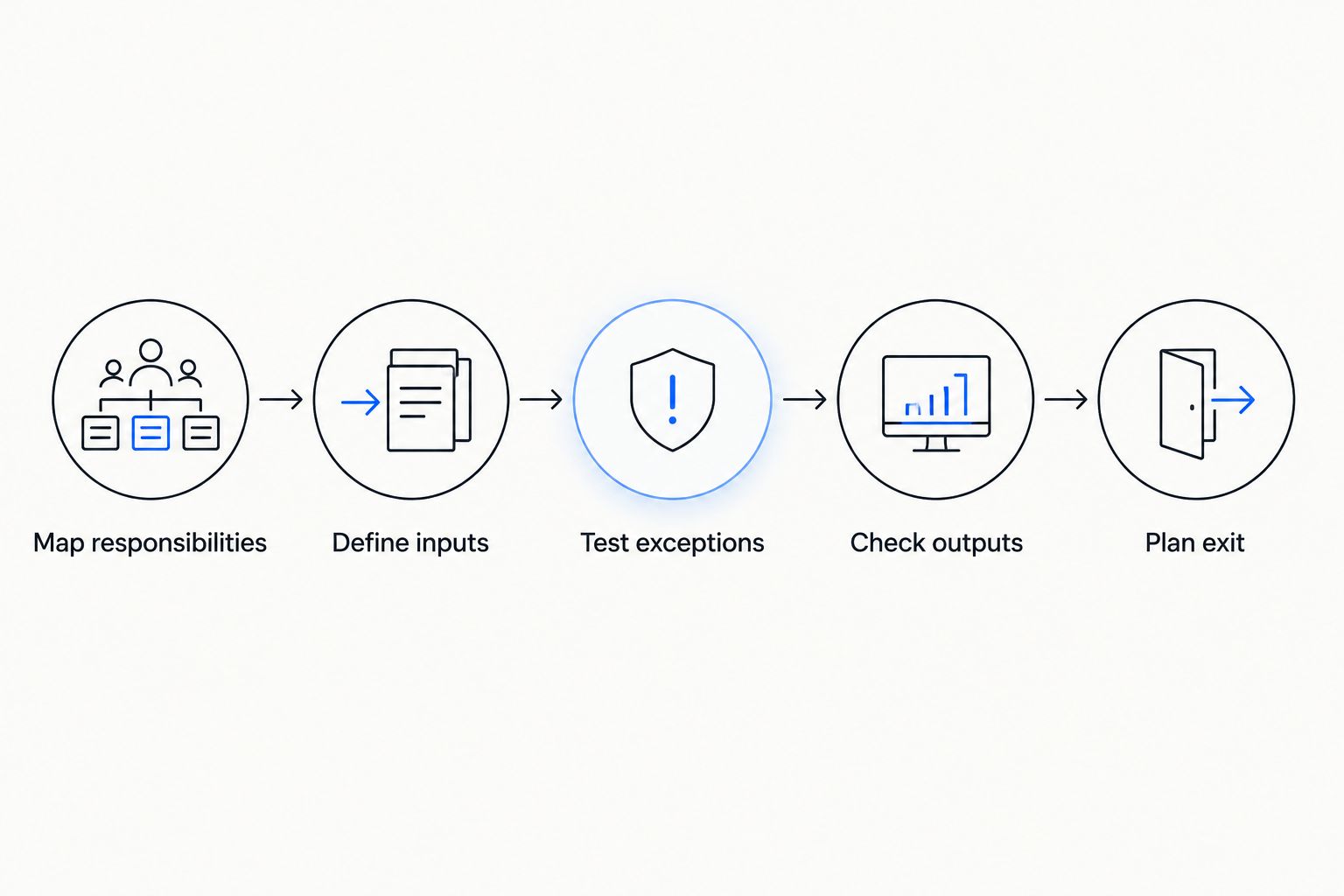
Do not accept a demonstration of routine processing as proof that exceptions are covered. Ask for the written procedure and the person responsible at each decision point.
Before switching, also agree how opening payroll data will be checked and how discrepancies will be resolved. Your acceptance criteria should describe the evidence needed for approval, not simply a planned launch date.
What should Turkish employers check in 2026?
For Turkish payroll, distinguish the employment record, the calculation, and the statutory reporting process. Puantaj records attendance-related inputs; bordrolama turns approved pay inputs into payroll calculations; SGK refers to Turkey’s Social Security Institution and the associated social security reporting context.
Ask who checks attendance against approved leave, shifts, and overtime. A processor needs instructions that reflect the employment facts; it should not have to infer whether an unexplained absence is authorized leave or missing time.
Treat personal-data handling as a separate assessment. Under Turkey’s KVKK framework, outsourcing is not permission to give unrestricted access to employee information. Establish the applicable data-protection roles, access permissions, processing instructions, retention requirements, and any cross-border transfer arrangements with qualified advice.
For a 2026 engagement, ask the provider how it maintains applicable payroll rules and identifies changes requiring your approval. Request the process rather than an unsupported promise of automatic compliance.
Contractual task allocation does not, by itself, transfer all employer obligations. Have your adviser confirm the responsibilities that remain with the employer and the remedies available under the service agreement.
Where does an HR platform fit?
Ottohr is for growing employers seeking payroll and HR tools in one platform. Its stated offering includes hiring, onboarding, payroll, benefits, and compliance tools for mid-size and large enterprises and growing employers.
An HR platform and an outsourced payroll service answer different questions. The platform concerns the tools your team uses; the service concerns who performs agreed work. Assess both separately, even when a proposal presents them together.
You can review Ottohr when evaluating that software layer. Confirm how the proposed setup handles your attendance inputs, approvals, required outputs, and any external provider relationship before treating it as a replacement for an existing process.
The potential fit is the stated breadth of HR and payroll tools. The limitation is that a platform description does not establish outsourced processing scope, country-specific coverage, integrations, or contractual responsibilities. Those require confirmation against your requirements.
Does outsourcing payroll remove the need for an internal owner?
No. An internal owner must coordinate approved employee information, resolve business questions, and authorize the result within your approval policy.
Give that owner a documented backup and an escalation route. The provider needs a clear contact who can obtain decisions, not an unmonitored shared inbox.
Is payroll software enough instead of outsourcing?
Payroll software is enough only when your team can perform the work around it. If the gap is calculation expertise or processing capacity, a different tool does not automatically fill that gap.
If the gap is duplicate entry or disconnected records, examine the software workflow first. Choose the remedy that addresses the cause.
Should you switch providers during a growth phase?
Switch when you can document the current process, validate transferred records, and assign transition responsibilities. Growth alone is not a sufficient switching plan.
Keep a list of unresolved payroll issues through the handover. Otherwise, a change of provider can leave uncertainty about who owns an existing correction.
FAQ
Is outsourcing payroll worth it for a growing company in 2026?
Yes, when it transfers defined processing work or supplies payroll expertise your team needs. Keep ownership of employee inputs, approvals, and provider oversight inside the business.
What's the biggest drawback of outsourcing payroll?
The main operational drawback is dependence on a separate organization for agreed processing and corrections. Define handoff deadlines, escalation procedures, and responsibilities before signing.
Do we still need someone responsible for payroll internally?
Yes, you still need an internal payroll owner. That person coordinates approved information, resolves business decisions, and oversees the provider relationship.
Is a payroll platform the same as payroll outsourcing?
No, a payroll platform supplies software, while outsourcing assigns agreed work to a service provider. Check who performs each task rather than relying on the label.
Can Turkish employers outsource payroll and stop checking compliance?
No, outsourcing does not eliminate employer oversight or automatically transfer all employer obligations. Confirm Turkish payroll, SGK, and personal-data responsibilities with qualified advisers.
What should we ask a payroll provider before signing?
Ask exactly which inputs, calculations, reports, corrections, filings, and employee queries the service covers. Also establish approval responsibilities, data handling, and exit arrangements.
How do we know whether outsourcing is delivering value?
Compare the agreed tasks transferred with your remaining internal workload and correction records. Use your own operating evidence rather than an assumed savings percentage.
One last thing
Test the exception, not just the routine pay run. Before signing, ask the provider to walk through a disputed payment discovered after approval, including investigation, authorization, correction, and employee communication.
That exercise shows whether the proposed arrangement has clear ownership when the standard workflow breaks. A polished routine demonstration does not answer that question.


