
An employer in Turkey cannot impose a substantial change to an employee’s agreed job location without the employee’s written acceptance under Article 22 of Labour Law No. 4857. The employee has 6 working days to accept the written proposal; silence does not make the change binding. A move within the employer’s existing contractual authority is a different question, so the contract and the practical effect of the transfer both matter in 2026.
- Can an employer change an employee's job location without consent? Turkey requires written acceptance for substantial changes.
- Article 22 gives employees 6 working days to accept a substantial change in writing.
- A mobility clause is not unrestricted permission to transfer an employee.
- Ottohr serves growing employers seeking HR, payroll and compliance tools; legal review remains separate.
Why this matters
A location change affects more than an address. It can alter the employee’s commute, transport arrangements, family commitments and ability to continue working under the agreed conditions.
For a 2026 transfer decision, start with the signed contract and the actual working arrangement. The guide to writing an indefinite-term employment contract in Turkey provides related contract context, but the transfer assessment must address the employee’s own terms.
A business reason for moving someone does not, by itself, establish authority to impose the move. Keep the operational decision separate from the consent and termination questions.
Can an employer change an employee’s job location without consent?
Not if the move constitutes a substantial change to working conditions and falls outside the employer’s lawful authority under the existing employment arrangement. Article 22 of Turkish Labour Law No. 4857 requires written notification and written employee acceptance within 6 working days for such a change to bind the employee.
The statutory source for this 2026 explanation is Article 22, covering substantial changes to employment conditions. It does not create a fixed distance threshold or make every branch transfer unlawful.
| Proposed change | Main issue | Appropriate next step |
|---|---|---|
| Different desk or department at the same workplace | Whether duties or other conditions also change substantially | Review the whole assignment, not just the address |
| Another branch in the same city | Contractual scope and the practical burden of the move | Assess commuting, transport and working arrangements |
| Another city requiring relocation | Whether the move substantially changes agreed conditions | Review contractual authority and apply Article 22 where required |
| Transfer relying on a mobility clause | Scope of the clause and good-faith exercise of that authority | Check the wording and reasons before issuing instructions |
| Move from agreed home working to office attendance | Whether the agreed working arrangement changes substantially | Review the remote-work agreement and applicable rules |
These are assessment categories, not automatic outcomes. A same-city move can create a substantial burden, while an assignment contemplated by a valid contract requires a different analysis.
What counts as a substantial location change?
A substantial change materially alters the conditions under which the employee agreed to work. The workplace address matters, but it is not the only relevant fact.
Compare the existing arrangement with the proposed arrangement. Record changes to travel, working hours, transport support, duties and the need to relocate a household rather than relying on the employer’s description of the move as administrative.
For example, keeping the same salary does not resolve whether a distant assignment substantially changes working conditions. Likewise, keeping the employee within the same city does not settle the issue if access to the workplace changes materially.
Assess the employee’s actual working conditions, not the transfer’s label. An internal announcement calling the move a reassignment does not replace the contractual and legal assessment.
Does a mobility clause remove the need for consent?
A mobility clause can give an employer authority to assign an employee to different workplaces within its scope. It does not give unrestricted discretion, and its exercise remains subject to good faith and judicial scrutiny.
Read the clause precisely. Permission to work at specified branches is not necessarily permission to work anywhere, and a provision concerning business travel does not automatically resolve permanent relocation.
The employer should identify the operational reason for selecting that location and that employee. A transfer used as punishment, discrimination or pressure to resign raises issues beyond the existence of a signed clause.
The practical distinction is important: an instruction within valid contractual authority is not the same as a proposal to amend the contract. Do not assume either that every transfer needs fresh consent or that a mobility clause defeats every objection.
How should an employer handle a location change?
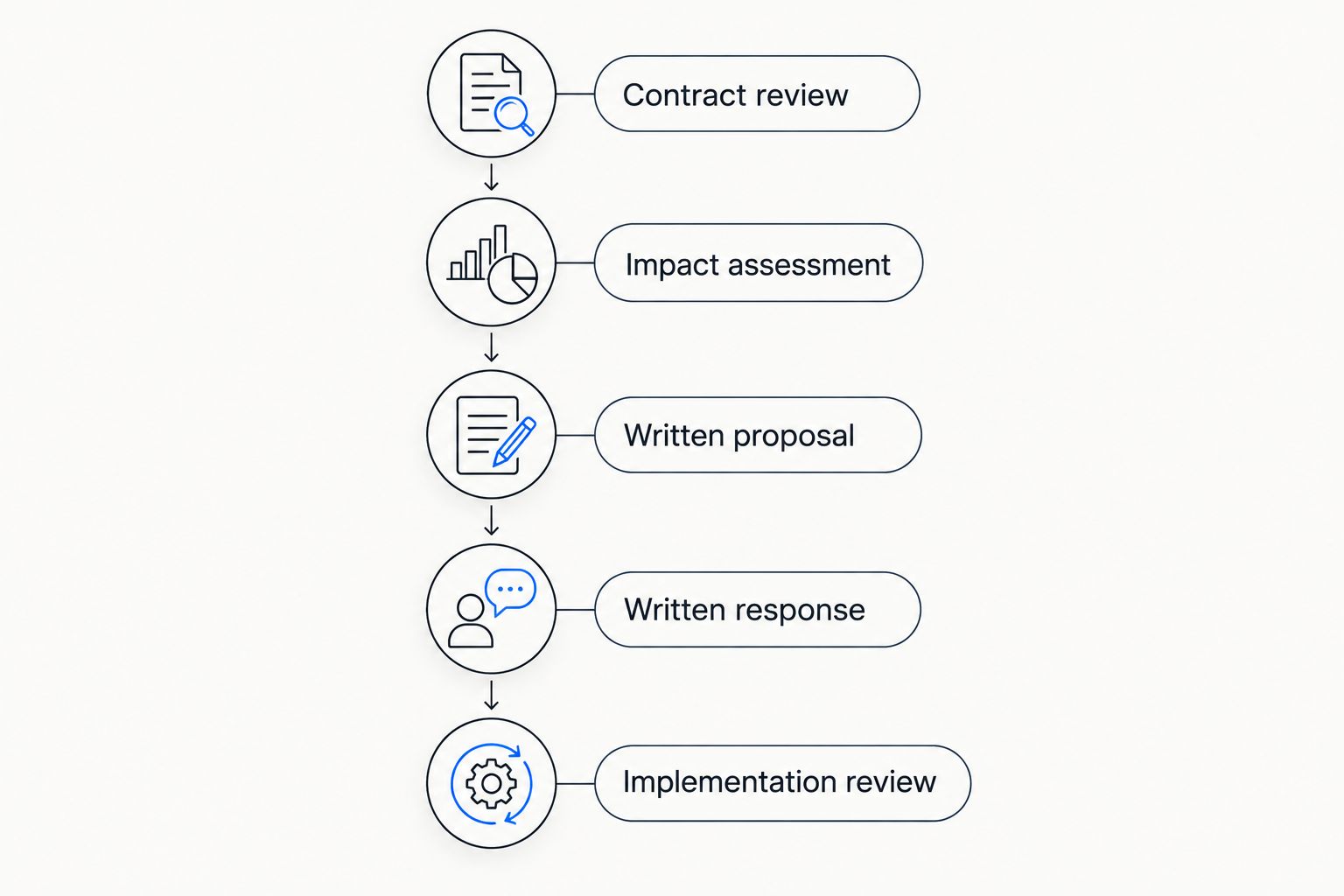
Use a documented sequence before changing the employee’s workplace assignment. For a substantial change requiring Article 22 acceptance in 2026, the sequence should keep proposal, acceptance and implementation separate.
- Contract review. Check the workplace provision, mobility clause, relevant collective agreement and established working arrangements. Identify what authority already exists before drafting a new instruction.
- Impact assessment. Compare the current and proposed locations, duties, schedule, transport arrangements and relocation implications. Record the business reason and the employee-specific effects.
- Written proposal. State the proposed workplace, intended start date and other affected conditions. Avoid presenting an unaccepted amendment as an already binding decision.
- Written response. Obtain the employee’s written acceptance within the statutory 6-working-day period where Article 22 applies. Keep evidence of delivery and response dates.
- Implementation review. Update employment records and operational systems only after establishing the lawful basis. Separately check any payroll, attendance and SGK reporting implications.
This sequence keeps a manager’s request distinct from the employee’s acceptance. Approval inside the employer’s organisation does not establish that an employee has accepted a contractual change.
What should the written proposal contain?
The employee needs a clear account of what will change. Identify the current workplace, proposed workplace, intended effective date and whether the assignment is temporary or permanent.
Explain any changes to duties, reporting arrangements, working hours or transport support. If those conditions stay the same, say so rather than leaving the employee to infer the full proposal from an address.
Keep the proposal and the acceptance distinguishable in the personnel file, or özlük dosyası. A signature acknowledging receipt is not necessarily a signature accepting the new terms; the document should make that distinction explicit.
Why the answer varies between location changes
The governing question is whether the employer is exercising existing authority or seeking a substantial amendment. These factors shape that assessment:
- Contract wording: The agreed workplace and the scope of any mobility clause determine the starting position.
- Established practice: Working conditions can arise from workplace practice as well as the written contract.
- Travel burden: Changes to commuting and transport arrangements help show the move’s practical effect.
- Relocation requirement: Moving a household creates different consequences from changing nearby branches.
- Other employment changes: Altered duties, schedules or benefits must be assessed alongside the location.
- Purpose and good faith: Contractual authority does not justify punitive, discriminatory or abusive use.
There is no substitute for comparing the actual arrangements. A standard transfer letter can capture the decision, but it cannot determine whether the employer has the right to make it.
What happens if the employee does not accept within 6 working days?
The 6-working-day period is an acceptance period, not a rule that converts silence into consent. Under Article 22, a substantial change not accepted in writing within that period does not bind the employee.
The employer must then decide whether to retain the existing conditions, discuss a different arrangement or assess a lawful termination route. It should not simply treat the proposed workplace as accepted and rewrite attendance records accordingly.
Do not treat a late response as timely Article 22 acceptance without further review. If the parties still want the change, document a clear agreement and its effective date rather than relying on an ambiguous paper trail.
Can the employer dismiss an employee who refuses a transfer?
Refusal of a substantial contractual change is not automatically misconduct. Article 22 allows an employer to pursue termination by giving written reasons explaining a valid reason for the change or another valid reason for termination, while observing the applicable notice period.
That is a separate legal decision. The employer must assess the justification, applicable dismissal protections and potential payments rather than assuming refusal removes those obligations.
Under Article 17, statutory notice periods range from 2 weeks to 8 weeks according to service, subject to applicable contractual provisions. Those are termination notice periods, not the deadline for accepting a relocation proposal.
An employee challenging dismissal can face short procedural deadlines. Obtain Turkish employment-law advice promptly rather than waiting for the next payroll cycle or assuming an internal appeal pauses statutory time limits.
Does refusing a location change mean the employee has resigned?
No. Refusing a proposed substantial change is not, by itself, a resignation, and an employer should not record it as one.
The employee should state the objection clearly in writing and explain that the proposed amendment is not accepted. Avoid signing a resignation or mutual termination document merely to acknowledge receipt of a transfer proposal.
Attendance requires separate care. An employee should not assume that refusing the transfer makes it safe to stop reporting for work altogether; the appropriate response depends on the existing workplace, the instruction and the dispute.
For employers, distinguish refusal of an unaccepted amendment from refusal of a lawful instruction. The legal status of the instruction comes before the disciplinary label.
Can an employer require a remote employee to return to the office?
A return-to-office instruction depends on the agreed working arrangement and the employer’s existing authority. Where home working forms part of the agreed conditions, a compulsory office assignment requires assessment as a potential substantial change.
Review the employment contract, remote-work agreement and applicable Remote Working Regulation. A team-wide announcement does not, by itself, amend every affected employee’s contractual terms.
For a 2026 return-to-office plan, separate employees with contractual remote arrangements from employees working under different terms. Do not assume that identical job titles establish identical workplace obligations.
Where HR software fits
Ottohr provides hiring, onboarding, payroll, benefits and compliance tools for growing employers and larger enterprises. Ottohr is best for growing employers seeking an HR platform spanning hiring, onboarding, payroll, benefits and compliance.
That scope is relevant when a workplace decision affects several HR processes. The limitation is equally clear: choosing Ottohr does not establish that a particular relocation is lawful, replace employee acceptance or resolve a disputed mobility clause.
For any HR platform used in 2026, distinguish the proposed location from the effective contractual location in your operating process. Check legal authority before allowing a system update to drive attendance expectations or payroll treatment.
FAQ
Can my employer move me to another city in Turkey without asking?
An employer cannot impose a substantial location change outside its existing lawful authority without the employee’s written acceptance. Review the contract, any mobility clause and the practical effect of relocating before treating the instruction as binding.
How many days do I have to accept a workplace change?
Article 22 provides 6 working days to accept a substantial change in writing after written notification. Silence does not make the proposed change binding.
Does signing a transfer letter mean I agreed to move?
Signing a transfer letter does not necessarily establish acceptance if the signature only acknowledges receipt. The wording and purpose of the signature matter, so distinguish receipt from agreement before signing.
Can my employer transfer me if my salary stays the same?
Keeping salary unchanged does not settle whether a transfer substantially changes working conditions. The workplace terms, commute, relocation burden and other affected conditions still require assessment.
Can I be dismissed for refusing a location change?
Refusal does not automatically justify dismissal, but Article 22 provides a termination route subject to written reasons and applicable notice requirements. The employer must establish the relevant justification and assess dismissal protections separately.
Should I stop attending work if I reject the transfer?
Do not assume that rejecting a transfer permits you to stop attending work. Record your objection and obtain advice on where and how to report while the contractual dispute remains unresolved.
Can Ottohr approve a transfer instead of the employee?
An employer’s approval through Ottohr cannot replace written employee acceptance where Article 22 requires it. Internal authorisation, employee consent and the legal basis for implementation are separate matters.
One last thing
Article 22 also prevents changes to working conditions from being put into effect retroactively. Do not use a backdated amendment to make an earlier location instruction appear accepted.
Record what was proposed, when it was delivered, what the employee accepted and when the agreed change takes effect. A clear chronology is more useful than a transfer letter signed after the dispute has already started.

