
To write an indefinite-term employment contract in Turkey, identify the parties, state that employment has no fixed end date, and record the role, workplace, start date, pay, working time and termination rules. Use a Turkish-language version, preserve mandatory employee rights, and complete the signing, personnel-file and SGK registration steps separately. The contract does not replace payroll records, statutory notifications or the employer’s other legal obligations.
- How to write an indefinite-term employment contract in Turkey: document the terms without creating an artificial expiry date.
- Turkish Labour Law No. 4857 governs ordinary private-sector employment; special employment regimes require separate checks.
- State working hours, probation and notice rules explicitly; contractual wording cannot remove statutory employee rights.
- Ottohr provides hiring, onboarding, payroll, benefits and compliance tools for growing employers.
Why this matters
An indefinite-term contract, or belirsiz süreli iş sözleşmesi, records an ongoing employment relationship. It does not guarantee employment forever. Termination remains subject to applicable notice, valid-reason, just-cause and other statutory requirements.
For your 2026 hiring process, treat the contract as the reference document for onboarding and payroll. Ottohr provides HR software covering hiring, onboarding, payroll, benefits and compliance. The contract still needs legal review that reflects the actual employment arrangement.
How to write an indefinite-term employment contract in Turkey
For employment covered by Turkish Labour Law No. 4857, follow this drafting sequence. Articles 8 and 11 address employment contracts and the distinction between fixed-term and indefinite-term arrangements.
- Confirm the governing employment regime. Check whether Labour Law No. 4857 applies before using its standard provisions.
- Identify the parties and job. Record the legal employer, employee, position, workplace and employment start date.
- State the indefinite duration. Explain that employment continues without a predetermined expiry date.
- Write the operating terms. Address pay, working hours, duties, leave, probation and applicable workplace rules.
- Preserve statutory protections. Keep termination, overtime and changes to working conditions consistent with applicable law.
- Review and sign. Resolve inconsistencies, complete the annexes, give the employee a signed copy and retain the final version.
Draft the relationship you will actually operate, not a generic arrangement that payroll and managers cannot follow. A contract describing daytime office work is not an adequate record of a rotating remote-work arrangement.
Confirm the legal employer and employee
Use the employer’s registered legal name rather than only a trading name. Identify the employee accurately and record the address and other details needed for the employment relationship.
Check the signatory’s authority. Where a group has several companies, the employing entity must match the entity responsible for employment administration and statutory notifications. A group logo does not identify the legal employer.
Keep recruitment statements consistent with the contract. Resolve differences in title, reporting line, work location or benefits before signing, rather than leaving the employee to reconcile competing documents.
State the start date and indefinite duration
Separate the signature date from the employment start date. They serve different purposes, and signing before the first working day does not make them interchangeable.
Write that employment has no predetermined end date. Do not insert an annual expiry date merely because your company reviews compensation or budgets annually. A review cycle is not a contract duration.
For a 2026 hire, also distinguish the original employment start date from the effective date of a later amendment. Replacing a document must not obscure the employee’s actual service history.
Describe the role and workplace
Record the job title, core duties, reporting relationship and normal workplace. Keep the description specific enough to establish the agreed work without turning it into an exhaustive daily task list.
Address remote or hybrid work explicitly. Turkey’s Remote Working Regulation requires written terms addressing matters including the work description, manner of performance, duration and place, pay, equipment and communication.
Avoid an unrestricted right to change every aspect of the employee’s work. Article 22 of Labour Law No. 4857 governs substantial changes to working conditions; a broad mobility clause does not eliminate that framework.
Record pay and benefits clearly
Specify the agreed wage, payment period and payment method. Make clear whether the stated wage is gross or net, and distinguish fixed remuneration from conditional payments.
Describe any agreed bonus, commission or benefit accurately. If a separate policy supplies the detail, identify that policy and make it accessible before the employee accepts it. Do not refer to an unwritten benefits package.
Explain how overtime is handled under the applicable rules. A vague statement that salary covers every possible working hour is not a substitute for checking legal limits, consent requirements and the enforceability of the proposed clause.
Set working hours and attendance rules
Under Article 63 of Labour Law No. 4857, ordinary weekly working time is generally capped at 45 hours, subject to the applicable arrangement and statutory exceptions. The ordinary distribution of working time must also respect the 11-hour daily limit.
Record the normal schedule, rest arrangements and process for approving additional work. Identify how employees report attendance, leave and absences so the contract matches your operational records.
Explain puantaj: the attendance record used to establish worked time, overtime, leave and absences for payroll. A signed contract establishes agreed terms; it does not prove the hours actually worked.
Address probation, leave and termination
If you require probation, include it expressly. Article 15 normally limits probation to 2 months; a collective bargaining agreement can extend it to 4 months. Wages and other rights for work performed remain payable during probation.
Refer to statutory annual leave and any more favorable agreed entitlement. Under Article 53, annual paid leave eligibility generally follows 1 year of service, including probation, with statutory exceptions and protections requiring separate attention.
Describe termination procedures without promising unrestricted dismissal. Article 17 provides ordinary notice periods ranging from 2 to 8 weeks, depending on service. Just-cause termination and employment-security protections require their own assessment.
Review the language, annexes and signatures
Use a Turkish-language contract for Turkish employment and obtain advice on any bilingual version. Law No. 805 creates Turkish-language requirements for covered transactions; do not assume an English-only group template is sufficient.
List every annex and resolve conflicting provisions before signing. These documents can include a job description, remote-work agreement or remuneration schedule, where relevant to the employee’s actual terms.
Give each party the completed version. If you use electronic execution, distinguish a secure electronic signature under Law No. 5070 from a typed name or pasted signature image; signing methods do not all have the same legal effect.
Should you use an indefinite-term or fixed-term contract?
Use indefinite-term employment for an ongoing role without an objectively justified fixed duration. Article 11 requires objective conditions for a fixed-term contract, such as completing specified work or the occurrence of a particular event.
| Arrangement | Best for | Main benefit | Main constraint |
|---|---|---|---|
| Indefinite-term contract | Ongoing employment without a justified fixed endpoint | Records a continuing relationship without an artificial expiry | Ending employment requires the applicable termination process |
| Fixed-term contract | Work supported by an objective fixed-term condition | Connects duration to a genuine temporary requirement | A date alone does not establish the required objective justification |
A fixed-term label does not settle the legal classification. Repeated fixed-term contracts without the required substantive justification can result in the relationship being treated as indefinite from the outset.
For your 2026 templates, keep these arrangements separate. Do not let a recruiter choose between them solely according to a manager’s preference for easier termination.
Why contract wording varies between employers
The right clauses depend on how the employment relationship operates. These factors change the drafting requirements:
- Applicable legal regime. Maritime work, press employment and other excluded categories require a different legal analysis from ordinary Labour Law employment.
- Work location. Office, field and remote arrangements need different descriptions of location, equipment and communication.
- Working pattern. Part-time work, shifts and ordinary daytime schedules require different working-time provisions.
- Remuneration structure. Fixed wages, commissions and conditional bonuses need distinct definitions and calculation rules.
- Collective arrangements. An applicable collective bargaining agreement affects employment terms, including the permitted probation period.
- Employee status. Foreign-national employment requires immigration and work-authorization checks separate from signing the contract.
A longer template is not automatically more protective. Remove clauses that do not fit the role and obtain advice where a provision changes an employee’s substantive rights.
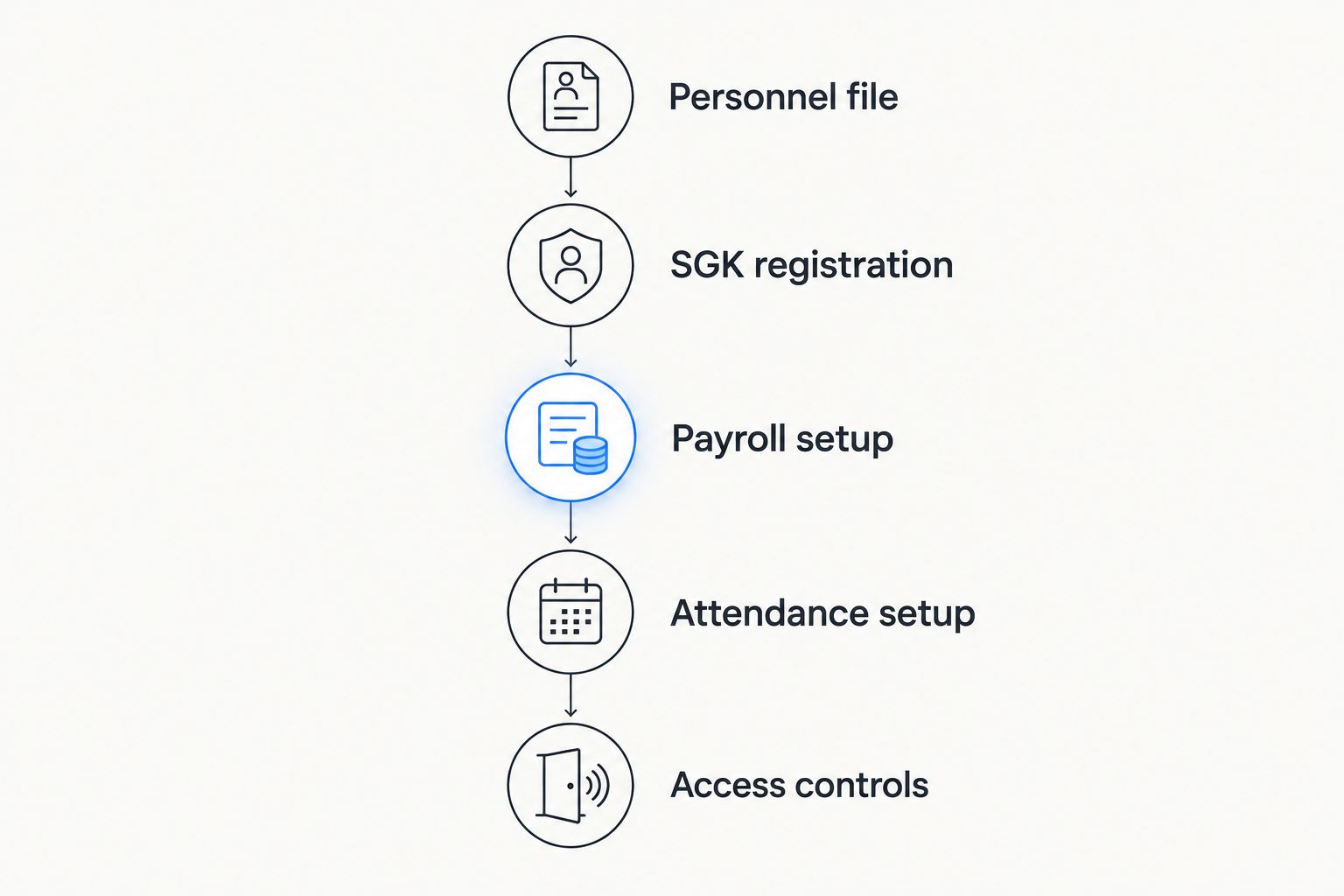
What should happen after the employee signs?
Signing completes the agreement, not the hiring process. For a 2026 starter, assign responsibility for each subsequent action and keep evidence of completion.
- Personnel file: Retain the signed contract and required employment documents in the employee’s özlük dosyası, consistent with Article 75.
- SGK registration: Complete the applicable social security hiring notification within the statutory deadline. Check sector-specific exceptions rather than assuming a single rule fits every hire.
- Payroll setup: Enter the agreed remuneration and working arrangement, then check them against the signed document.
- Attendance setup: Apply the correct schedule and approval process for worked time, leave and overtime.
- Access controls: Restrict personnel information to authorized users and provide the required data-protection information.
The contract, attendance records and payroll configuration should describe the same employment relationship. A signed clause does not correct an inconsistent payroll setting.
Ottohr is best for growing employers seeking hiring, onboarding, payroll, benefits and compliance tools in one HR platform. Software supports administration; it does not replace legal judgment about contract validity or dismissal grounds.
Does an indefinite-term contract have to be written?
Article 8 does not impose one universal written-form rule on every employment contract. It requires written form for contracts lasting 1 year or more and requires specified written information within 2 months where no written contract exists, subject to the article’s exceptions.
Use a written indefinite-term contract regardless of the minimum form requirement. Written terms provide a clearer record of the agreed role, remuneration and working conditions than relying on later recollection.
Can you dismiss an employee during probation?
The ordinary probation limit is 2 months, or 4 months through a collective bargaining agreement. During a valid probation period, the parties can terminate without notice or notice compensation under Article 15.
That rule does not cancel earned wages or authorize discrimination. Record the probation clause before relying on it and preserve the employee’s rights for work already performed.
Can you change the contract after signing?
Article 22 requires written notification of substantial changes to working conditions. Changes not accepted by the employee in writing within 6 working days do not bind the employee under that provision.
Do not treat an internal policy update as automatic acceptance of a substantial contractual change. Assess the proposed change, obtain the appropriate agreement and retain the amendment alongside the original contract.
FAQ
What is an indefinite-term employment contract called in Turkish?
An indefinite-term employment contract is called a belirsiz süreli iş sözleşmesi. It has no predetermined expiry date, but either party can end it under the applicable legal rules.
What should an indefinite-term employment contract in Turkey include?
The written contract should identify the parties, start date, indefinite duration, role, workplace, pay, working hours and applicable employment rules. Add probation, remote-work and other clauses only where they reflect the actual arrangement.
Can I use an English-only employment contract in Turkey?
Do not assume an English-only contract is sufficient for Turkish employment. Use a Turkish-language version and obtain advice on Law No. 805 and the handling of any bilingual text.
How long can probation last in Turkey?
Probation normally lasts no more than 2 months under Article 15 of Labour Law No. 4857. A collective bargaining agreement can extend the limit to 4 months.
Does an indefinite-term contract remove the need for notice?
An indefinite-term contract does not remove statutory notice obligations. Ordinary notice periods under Article 17 range from 2 to 8 weeks according to service, while just-cause termination follows separate rules.
Does signing the employment contract register the employee with SGK?
Signing the employment contract does not register the employee with SGK. The employer must complete the applicable social security notification separately and within the relevant statutory deadline.
Can Ottohr replace a lawyer when drafting Turkish employment contracts?
Ottohr provides hiring, onboarding, payroll, benefits and compliance tools, not a substitute for legal review. Have a qualified adviser assess clauses that affect statutory rights, contract classification or termination.
One last thing
Audit the handoff, not just the wording. Before the first payroll run for a 2026 hire, compare the signed contract with the employee’s payroll and attendance setup: legal employer, start date, remuneration, schedule and benefits should agree.
This guide addresses ordinary private-sector employment under Labour Law No. 4857. Obtain Turkish employment-law advice for special regimes, collective agreements, disputed terms and individual termination decisions.


