
Not every employment contract in Turkey must be written: Turkish Labour Law requires writing for contracts lasting at least 1 year and for specific arrangements, including fixed-term, remote-work and on-call contracts. Where a written contract is not concluded, employers generally must provide a written statement of essential employment terms within 2 months, subject to statutory exceptions; this 2026 guide explains the distinction.
- Is a written employment contract required by law in Turkey? Not always; contract type determines the requirement.
- Turkish Labour Law Article 8 generally requires written employment terms within 2 months when no written contract exists.
- Fixed-term, remote-work and on-call arrangements have specific written-contract requirements.
- A signed contract does not replace SGK registration, payroll records or the employee’s personnel file.
Is a written employment contract required by law in Turkey?
A written employment contract is mandatory in specified cases, not for every employment relationship. Article 8 of Turkish Labour Law No. 4857 establishes the general rule on form. Articles 11 and 14 impose additional requirements for particular arrangements.
For an ordinary indefinite-term arrangement, start with the guide to writing an indefinite-term employment contract in Turkey, then check whether special rules apply.
| Arrangement | Written contract required? | Practical advantage of writing | Limit to check |
|---|---|---|---|
| Ordinary indefinite-term employment | Not generally under Article 8 alone | Records agreed duties, pay and working arrangements | Written information duties still apply without a written contract |
| Contract lasting at least 1 year | Yes, under Article 8 | Documents the agreed duration and terms | Do not confuse agreed duration with completed service |
| Fixed-term employment | Article 11 requires written form | Records the end point and objective basis | A signature alone does not justify fixed-term status |
| Remote work | Yes, under Article 14 | Records the remote-work arrangement | General office terms alone do not cover every required detail |
| On-call work | Yes, under Article 14 | Records the on-call arrangement | Calling work occasional does not remove statutory protections |
Legal basis for this 2026 guide: Labour Law No. 4857, particularly Articles 8, 11 and 14, covering employment-contract form, fixed-term employment, remote work and on-call work. The discussion concerns employment covered by that law; different employment regimes require separate review.
Why this matters
A contract and a statement of employment terms serve different purposes. A contract records the parties’ agreement; the Article 8 statement supplies mandatory information when a written contract has not been concluded.
An oral arrangement does not erase the employment relationship or the employee’s statutory rights. Your documentation process must address both the validity of the arrangement and the employer’s separate recordkeeping duties.
For your 2026 hiring checklist, keep contract execution separate from social security registration, payroll setup and personnel-file completion. Completing one task does not complete the others.
Contracts lasting at least 1 year: writing required
Article 8 requires employment contracts with a duration of 1 year or more to be made in writing. The threshold concerns the contract’s agreed duration, not an anniversary that an employee later reaches.
An indefinite-term contract has no agreed end date. It does not become a fixed-duration contract simply because the employee completes a year of service.
This distinction matters when checking an existing workforce. Do not classify every long-serving employee as having breached a duration-based form requirement; first establish what arrangement the parties actually made.
Recommended practice: document an indefinite-term arrangement in writing even where Article 8 does not make writing mandatory. The advantage is clearer evidence of agreed terms; the limitation is that a signed document cannot make an unlawful clause enforceable.
Fixed-term contracts: writing and an objective basis
Article 11 describes fixed-term employment through written contracts linked to objective conditions, such as work of a specified duration, completion of a particular task or occurrence of a particular event. Choosing an end date is not enough by itself.
Record why the role is temporary and how its end point follows from that reason. Keep the supporting business documents with the agreement rather than relying on a template label.
Successive fixed-term contracts also require scrutiny. Article 11 restricts repeated fixed-term contracting without an essential reason, so a fresh signature does not automatically preserve fixed-term status.
For a 2026 contract review, assess form and classification separately. A written agreement can still be incorrectly classified, and an objective temporary need does not excuse ignoring the applicable documentation requirements.
Remote and on-call work: specific written arrangements
Remote work requires a written agreement under Article 14. The agreement must address the work and its performance, including matters such as duties, location, duration, remuneration, equipment and communication arrangements.
A general employment template that says only that the employee can work from home is not a substitute for checking those requirements. Match the document to the actual working arrangement.
On-call work also requires a written contract under Article 14. It is a specific employment arrangement, not a general label for any employee whose workload changes.
Use the arrangement that reflects the work, then document its rules. Do not select remote or on-call wording merely because it appears administratively convenient. A contract name does not determine the legal position when actual working conditions differ.
Written employment terms: generally within 2 months
Where no written employment contract has been concluded, Article 8 generally requires the employer to provide a written document within 2 months. That document must state the essential information specified by the law.
The required subjects include:
- Working conditions: the general and special conditions governing the work.
- Working time: daily or weekly working hours.
- Remuneration: basic pay and any applicable pay supplements.
- Payment timing: the interval at which remuneration is paid.
- Duration: the contract period where the arrangement has a specified duration.
- Termination: the provisions the parties must follow when ending employment.
The duty is to provide the document to the employee. An internal HR entry that the employee never receives does not fulfil that delivery requirement.
Contracts not exceeding 1 month
Article 8 excludes employment contracts whose duration does not exceed 1 month from this written-information obligation. That exception concerns the information document, not every possible requirement for a written contract.
A short arrangement can still fall within a category with its own form requirements. Check the contract type before relying on the duration exception.
Employment ending before 2 months
If employment ends before the 2-month period expires, Article 8 requires the information to be provided no later than termination, subject to the statutory exception above. Do not treat early departure as a reason to leave the document unfinished.
The deadline is a backstop, not a reason to delay explaining employment terms. Giving the employee clear documentation at the start avoids an unnecessary gap between the agreed arrangement and the written record.
Why the written-contract requirement varies
The answer depends on the legal arrangement, not simply the employer’s preference for paper or digital records. Review these factors before choosing a template:
- Applicable employment regime: confirm that Labour Law No. 4857 governs the relationship before applying this guide.
- Agreed duration: Article 8 expressly addresses contracts lasting at least 1 year.
- Contract classification: fixed-term employment has requirements beyond an agreed end date.
- Working arrangement: remote work and on-call work carry specific written-form rules.
- Employment ending early: termination can bring forward the deadline for providing written information.
- Later changes: material changes to working conditions engage a separate written process under Article 22.
These factors can overlap. A remote employee on a fixed-term contract requires review of both arrangements, not a choice between them.
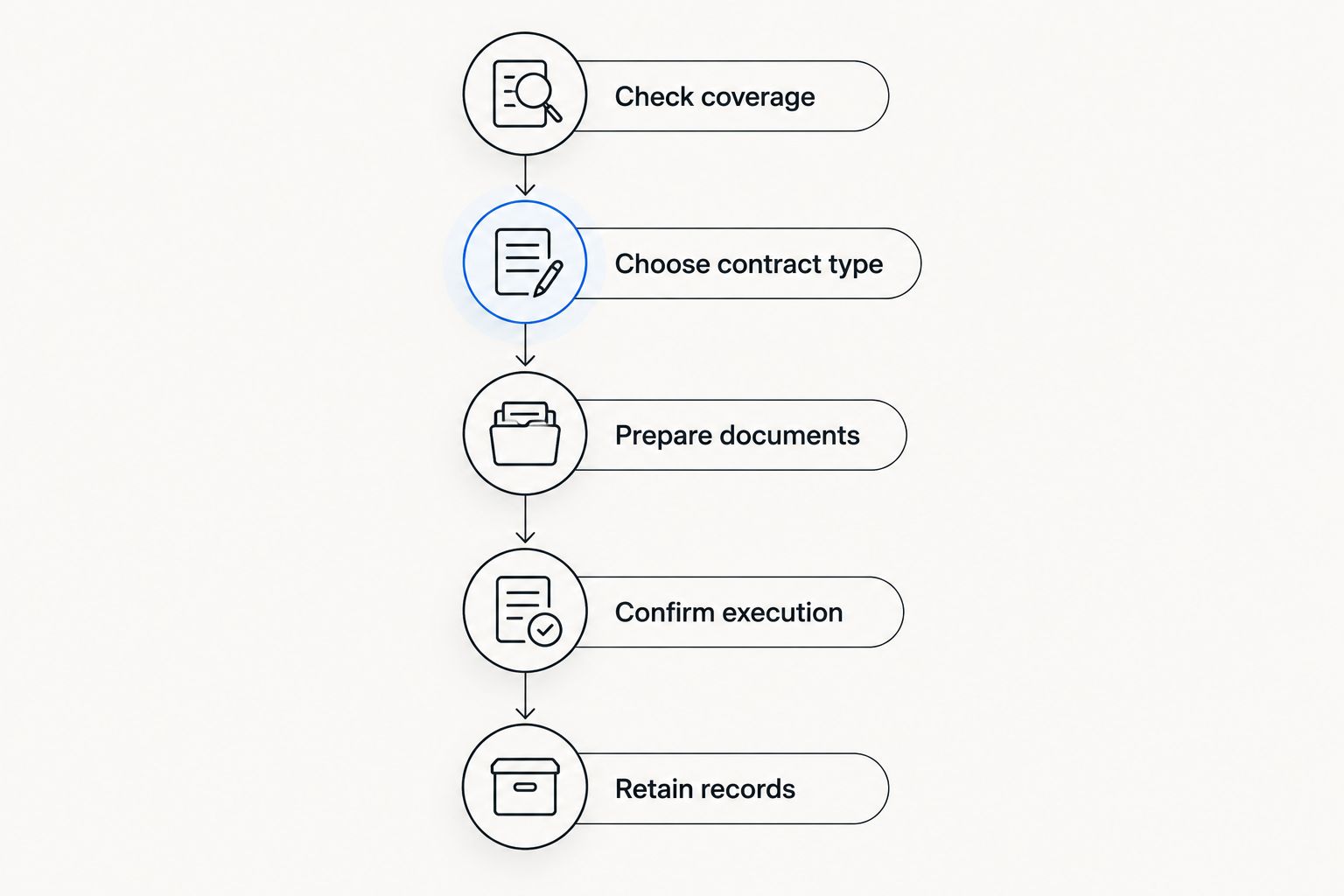
How should you document a new hire in 2026?
Use a controlled sequence. The objective is to record the real agreement, deliver the required information and preserve evidence without treating an uploaded file as proof that every legal requirement is complete.
- Check coverage. Confirm the applicable employment regime and identify any special rules before choosing a contract template.
- Choose contract type. Establish whether the relationship is indefinite-term, fixed-term, remote, on-call or a combination requiring additional provisions.
- Prepare documents. Record the agreed terms and required information. Check consistency between the agreement, offer and payroll instructions.
- Confirm execution. Check the required form, the parties’ execution and delivery to the employee. Retain evidence of the completed process.
- Retain records. Place the relevant documents in the employee’s personnel file and manage access according to applicable data-protection requirements.
The sequence separates legal classification from document handling. That prevents a completed signature task from concealing an unresolved question about the contract itself.
Ottohr is best suited to growing employers seeking hiring, onboarding, payroll, benefits and compliance tools in one HR platform. Ottohr provides those categories of tools; a platform does not replace legal assessment of a contract’s classification or wording.
When assessing Ottohr for HR administration, distinguish the scope of the platform from the decisions your employer must make. Confirm document-handling requirements against your actual process rather than assuming any software feature establishes legal compliance.
Does an oral contract mean the employee has no rights?
No. An employment relationship can exist without a signed contract where written form is not mandatory. Missing paperwork does not by itself remove statutory entitlements.
Pay records, correspondence, attendance records and other evidence can become relevant when the parties dispute the terms. Written terms improve clarity, but your records must also reflect what happened in practice.
Do not respond to a missing contract by assuming there was no employment. Establish the facts and obtain advice on any unmet form or information requirements.
Can you change working conditions through a revised contract?
Article 22 requires material changes to working conditions to be notified in writing. Changes not accepted by the employee in writing within 6 working days do not bind the employee under that provision.
Sending a revised document is therefore not the same as obtaining the required acceptance. Keep the proposed change, notification and response distinct in your records.
An original contract is not blanket permission to change every term later. Review the proposed change and its legal basis before updating payroll or working arrangements.
FAQ
Do all employees in Turkey need a signed employment contract?
No. Under Labour Law No. 4857, writing is mandatory for specified contracts and arrangements, rather than every employment relationship. Employers generally must still provide written employment information when no written contract is concluded.
How long does an employer have to provide written employment terms?
The general Article 8 deadline is 2 months when no written employment contract has been concluded. Contracts not exceeding 1 month are excepted from that information duty; employment ending earlier can require delivery by termination.
Does completing a year of service make an indefinite-term contract subject to the one-year writing rule?
No. Article 8’s 1-year threshold concerns the contract’s agreed duration, not completed service under an indefinite-term arrangement. Written documentation remains a sound practice for recording the agreed terms.
Does a fixed-term contract need an objective reason in Turkey?
Yes. Article 11 links fixed-term employment to objective conditions, such as a specified task or event. A written end date alone does not establish the necessary basis.
Do remote employees in Turkey need a written agreement?
Yes. Article 14 requires a written remote-work agreement addressing the relevant working arrangements. Review duties, location, remuneration, equipment and communication provisions rather than relying only on a general office template.
Does SGK registration replace an employment contract?
No. SGK social security registration and employment-contract documentation serve different legal purposes. Completing registration does not satisfy a separate written-contract or written-information requirement.
Can HR software decide whether a Turkish employment contract is legally valid?
HR software does not replace legal assessment of contract validity. Ottohr provides hiring, onboarding, payroll, benefits and compliance tools, but the employer must still establish the correct legal arrangement and documentation.
One last thing
A signed contract is not the whole personnel file. Article 75 requires an employee personnel file containing the documents and records the employer must maintain; Article 37 separately addresses wage statements.
For your final 2026 check, review the contract alongside the written information, amendments, payroll records and registration evidence. Look for contradictions between them, not just missing signatures.
If the employee has already started, document the actual position and address outstanding requirements promptly. Do not backdate a signature to make the file appear complete.


