
Yes. An HR platform can auto-generate payslips that support Turkish SGK compliance when its payroll calculations use the applicable rules, approved attendance records, and correct employee classifications. Generating a payslip does not itself submit a social security declaration, pay contributions, or remove the employer’s responsibility to check the result.
- Can an HR platform auto-generate SGK-compliant payslips? Yes, but payslip generation and statutory filing are separate processes.
- Turkish payroll needs approved puantaj, correct contribution treatment, and reconciliation before release.
- Ottohr offers payroll and compliance tools for growing employers; verify the required Turkish payroll workflow before selection.
- A generated PDF is not evidence that an SGK declaration was accepted or contributions were paid.
Why this matters
A payslip can look correct while the underlying payroll contains an error. An unpaid absence, an incorrectly classified allowance, or a missing earnings adjustment changes more than the document your employee receives.
For your 2026 payroll process, assess three separate outputs: the employee’s wage statement, the statutory declaration, and the payment records. Each serves a different purpose. They should reconcile, but none replaces the others.
Ottohr provides an HR platform with payroll and compliance tools for growing employers and mid-size and large enterprises. Evaluate any proposed Turkish payroll workflow against the controls below, rather than treating a broad compliance label as proof of a specific filing capability.
Can an HR platform auto-generate SGK-compliant payslips?
Yes, provided the platform calculates Turkish payroll correctly and produces the required wage statement. “SGK-compliant payslip” is not a substitute for checking wage-statement requirements and social security reporting separately.
For employees covered by Turkey’s Labour Law, Article 37 of Law No. 4857 governs the wage statement, or ücret hesap pusulası. Social security contribution treatment and reporting sit under separate provisions of Law No. 5510, including Articles 80 and 86.
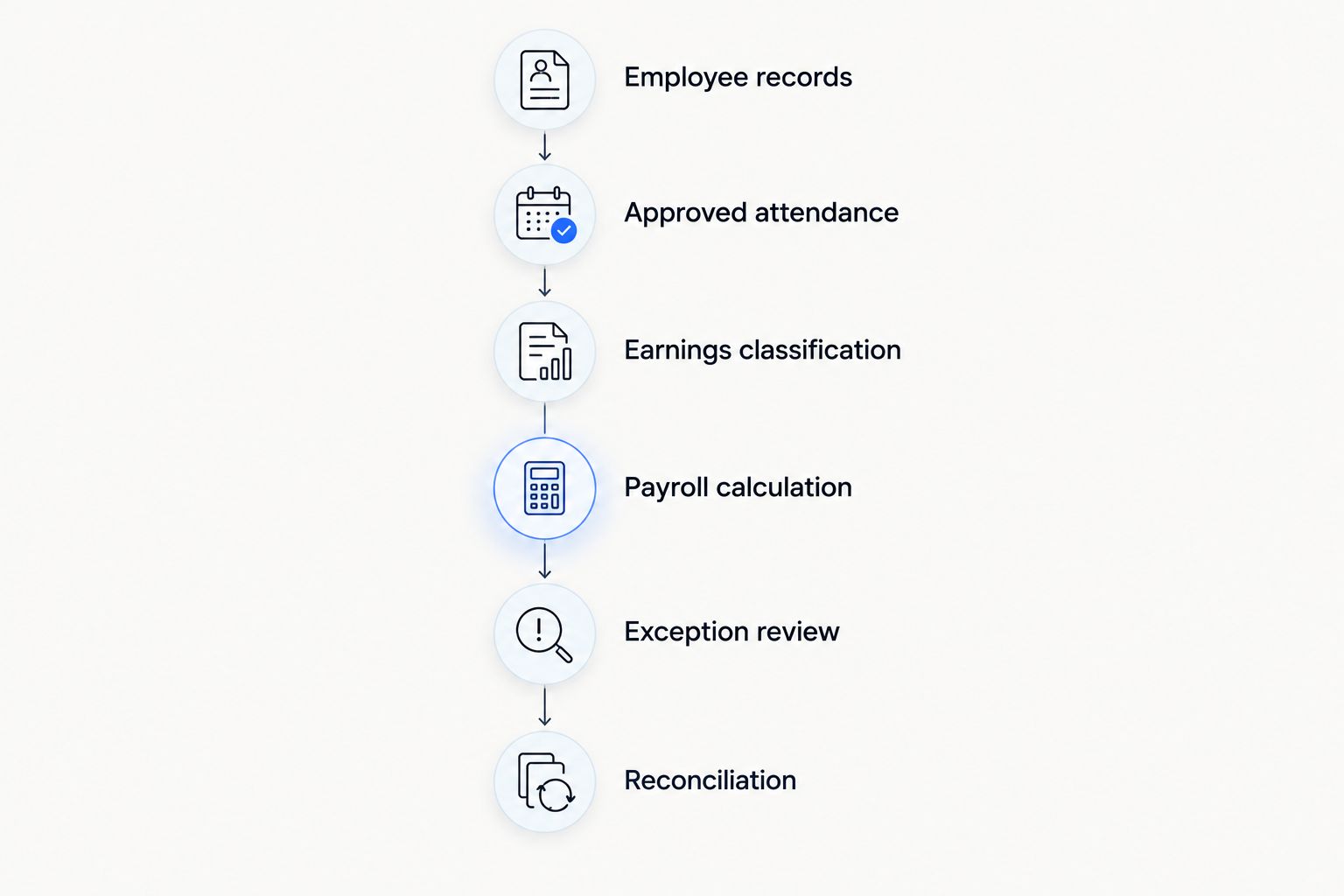
Use this sequence to evaluate a payroll system:
- Confirm employee records. Check employment dates, agreed pay, applicable insurance status, and the employer registration used for reporting. Resolve mismatches before calculating payroll.
- Approve attendance. Confirm worked days, leave, absences, overtime, and changes during the pay period. The approved puantaj is the attendance record feeding payroll, not simply a raw clock-in export.
- Classify earnings. Assign each earning and deduction its correct tax and social security treatment. Do not assume that every payment enters every calculation on the same basis.
- Calculate payroll. Apply the rules effective for the relevant period, including contribution boundaries, tax treatment, and applicable employee-specific conditions.
- Review exceptions. Investigate unexpected net-pay movements, incomplete records, unusual contribution days, and manual changes. Keep the reason for each correction.
- Generate and reconcile. Produce the wage statement, compare payroll totals with declaration data, and retain approval evidence. Track filing acceptance and payment separately.
A platform that generates documents but leaves classification and reconciliation entirely outside the workflow automates only part of payroll. Ask the supplier to demonstrate the complete sequence using representative employee cases.
What is the difference between a payslip and an SGK declaration?
A payslip explains an employee’s earnings and deductions. An SGK-related declaration reports statutory employment and contribution information through the applicable reporting process. A payment record demonstrates a transfer or settlement, not the correctness of the calculation.
The distinction matters when reviewing a 2026 software demonstration. A polished employee document establishes neither successful submission nor payment.
| Output | Best for | What it establishes | What it does not establish |
|---|---|---|---|
| Employee wage statement | Explaining individual pay | The earnings and deductions presented to the employee | Acceptance of a statutory declaration |
| Statutory declaration and acceptance record | Checking reported contribution information | What was submitted and its processing status | That wages or contributions were paid |
| Salary payment record | Reconciling employee transfers | The payment instruction or completed transfer, depending on status | Correct social security classification |
| Contribution payment record | Checking contribution settlement | The recorded settlement of the relevant liability | Correct employee-level payroll inputs |
Keep all four records connected by employer, employee where applicable, and payroll period. A declaration total should be traceable back to employee calculations without relying on a PDF filename.
Ask who handles rejected submissions. The workflow needs a named owner, a correction process, and retained evidence of the accepted replacement where required. An exported file alone does not prove that the authority received or accepted it.
What should an automatically generated Turkish payslip contain?
Article 37 of Labour Law No. 4857 requires a wage statement showing the payment date and the period covered. It also requires additions and deductions to be shown separately, including the categories specified in the provision.
For your review, check that the statement clearly distinguishes:
- Pay period and payment date: the period being paid and when payment occurs.
- Ordinary earnings: the wages forming the starting point for the calculation.
- Additional earnings: applicable overtime, weekly rest, public holiday, and other additions.
- Statutory deductions: tax and insurance deductions relevant to the employee.
- Other deductions: applicable items such as advances, enforcement deductions, or maintenance deductions.
- Net amount: the resulting amount payable to the employee.
The same provision addresses the employer’s signature or special mark. Do not assume that uploading an unsigned PDF to a portal settles every document-form or evidentiary requirement. Review the delivery and authentication method with the person responsible for Turkish employment compliance.
For a 2026 implementation, distinguish employee-facing fields from payroll working papers. Contribution bases, employer liabilities, and detailed calculation records can require separate review even when they are not all presented in the same employee document.
A readable payslip explains the result; retained calculation records explain how you reached it. You need both for an effective payroll review.
Why automated payroll results vary
Payroll differences often begin in employee records and earning classifications, not in document formatting. Check these drivers before blaming the payslip template:
- Employment dates: joining or leaving during the period changes the calculation inputs and reporting checks.
- Attendance and absence: worked time, unpaid leave, and missing-day information affect payroll treatment.
- Earning categories: salary, overtime, bonuses, and benefits need their applicable tax and contribution treatment.
- Insurance status: the employee’s applicable social security classification affects the calculation.
- Period-specific rules: effective dates, contribution boundaries, and tax parameters determine which rules apply.
- Adjustments: approved corrections can change earnings, deductions, or previously prepared reporting data.
For a fully worked month, Turkish social security reporting generally uses 30 premium days, including calendar months with a different length. Partial employment and missing days require their own treatment. Do not calculate every employee’s premium days by simply counting calendar days or dividing recorded hours.
The connection between attendance and payroll deserves its own review. The PDKS-to-automated-payroll workflow guide covers the handoff from access and attendance records to payroll preparation.
How should you test an automated payslip workflow?
Use representative payroll cases, not only a salaried employee with no changes. A routine case shows whether a document generates; exception cases show whether your process catches mistakes.
Test the inputs and classifications
Include a full-period employee, a mid-period starter, an employee with unpaid absence, and an employee with additional earnings. Add any insurance classifications and benefit types your workforce actually uses.
For each case, give the reviewer the underlying employment record, approved attendance, and earning instructions. Ask the supplier to explain which fields drive each calculation. A reviewer should be able to trace a deduction to its basis and rule, not just see a total.
Test approval and change control
Change an attendance entry after the initial calculation. Check whether the system identifies the affected payroll, requires review, and preserves the earlier result or an adequate change history.
Then test access boundaries. Establish who can amend compensation, approve attendance, release payroll, and view employee documents. Avoid a workflow in which an unexplained edit reaches a released payslip without review.
Test reconciliation and corrections
Compare employee-level earnings and deductions with payroll totals, declaration data, and payment instructions. Explain legitimate differences rather than forcing unrelated totals to match.
Finally, correct a released calculation in the demonstration. Confirm how the revised document is identified, how related reporting is handled, and how the employee receives the corrected information. Your 2026 acceptance checklist should cover recovery from errors as well as successful first-time processing.
Can payroll software calculate SGK contributions automatically?
Yes, payroll software can calculate SGK contributions when it has the correct contribution rules and employee data. Article 80 of Law No. 5510 governs earnings subject to social security contributions and relevant exclusions; a generic gross-to-net calculation is not enough.
Ask how the payroll engine distinguishes contribution-bearing earnings from excluded or limited items. Review the applicable lower and upper contribution boundaries and how effective-date changes are maintained.
The useful evidence is a traceable calculation showing the earning categories, contribution base, applied rules, and resulting deductions. A supplier’s statement that the platform “supports Turkey” does not replace that calculation.
Does automatic payslip generation mean automatic SGK filing?
No. Automatic payslip generation does not establish automatic SGK filing. Article 86 of Law No. 5510 addresses employer reporting and record obligations; document generation and statutory submission remain distinct capabilities.
Identify the exact handoff: does the platform prepare data, export a file, support an authorized submission process, or record acceptance? Each description represents a different operational scope.
Also confirm responsibility for the applicable Muhtasar ve Prim Hizmet Beyannamesi, the combined withholding and premium service declaration, where relevant. Assign responsibility for rejection handling and corrections before the first live payroll.
Where does Ottohr fit in this workflow?
Ottohr is an HR platform for growing employers seeking hiring, onboarding, payroll, benefits, and compliance tools together. That scope makes payroll workflow fit a relevant selection question, not a reason to skip technical validation.
Evaluate Ottohr against your actual Turkish employee classifications, attendance approvals, earning types, and reporting handoffs. Ask for the same calculation trace and correction demonstration you would require from any payroll supplier.
The benefit of a connected HR and payroll approach is fewer separate handoffs to manage. The constraint remains data quality: shared records do not make an incorrect absence code, earning classification, or employment date correct.
FAQ
Can an HR platform auto-generate SGK-compliant payslips in Turkey?
Yes. An HR platform can generate Turkish payslips supporting SGK compliance when calculations, employee classifications, and attendance inputs are correct. Payslip generation does not itself complete statutory filing or contribution payment.
Is a Turkish payslip the same as an SGK service record?
No. A payslip explains wages and deductions for a pay period, while an SGK service record reflects social security registration and reported service information. They serve different purposes.
Does generating a payslip mean SGK contributions have been paid?
No. A generated payslip shows a calculation, not contribution settlement. Check the declaration status and contribution payment records separately.
How many SGK premium days apply to a fully worked month?
30 premium days generally apply to a fully worked month under Turkish social security reporting rules. Partial employment periods and missing days require separate assessment.
Can payroll software use PDKS attendance data directly?
Payroll software can use attendance data as an input, but raw PDKS records need validation and classification. Approve leave, absences, overtime, and corrections before payroll calculation.
Can an employee portal replace every payslip formality?
No. Portal access alone does not establish that every applicable document-form, authentication, delivery, and evidence requirement has been met. Review the complete document process under the relevant employment rules.
What should I ask during a Turkish payroll software demonstration?
Ask for a traceable calculation, an exception review, and a correction workflow using representative employee cases. Also establish exactly who submits declarations and checks acceptance and payment.
One last thing
Test the correction workflow before approving the standard payslip. A clean example proves that software can produce a document; a corrected example shows whether your team can recover without losing the calculation history.
For your 2026 rollout, retain the original inputs, the approved correction, the revised payroll result, and the reporting decision. Keep them associated with the same payroll period. This gives your reviewer a clear explanation of what changed and why, rather than two conflicting PDFs with no reliable history.


