
Yes. Foreign companies can hire staff in Turkey without incorporating their own Turkish company through a legally valid local employment arrangement, but a provider’s “employer of record” label alone does not establish compliance. The arrangement must address employment, payroll, social security and any work-permit obligations; it does not automatically remove the foreign company’s Turkish tax exposure.
- Can foreign companies hire staff in Turkey without a local entity? Yes, through a legally valid employment arrangement.
- Turkey’s employer-of-record arrangements need legal review; a provider’s label does not establish authority to supply workers.
- Payroll outsourcing does not transfer the employer’s legal responsibilities or resolve permanent-establishment exposure.
- Ottohr provides HR and payroll software, not proof that an employment structure is legally valid.
Why this matters
You can avoid incorporating a subsidiary without avoiding Turkish employer obligations. Someone still needs to employ the worker under a valid structure, maintain the employment records and handle the applicable filings.
For your 2026 hiring plan, separate the employment structure from the software used to administer it. The HR compliance guide for foreign companies hiring in Turkey covers the operational side; legal and tax advisers must establish which structure fits your actual activities.
A foreign contract, overseas salary payment or remote-work policy does not, by itself, settle the Turkish position. Start with where the person works, what the person does and who directs the work.
Can foreign companies hire staff in Turkey without a local entity?
Yes, but “without a local entity” needs a precise meaning. Not incorporating your own Turkish subsidiary is different from having no Turkish registration, no local employer and no local compliance obligations.
The practical routes have different legal consequences:
| Arrangement | Best for | Main advantage | Main limitation |
|---|---|---|---|
| Legally valid local employment arrangement | Employers assessing hiring without their own subsidiary | A local employer handles the employment relationship within the agreed structure | Worker-supply rules and the actual working relationship need review |
| Direct employment by the foreign company | Employers with advice confirming the applicable registration, tax and social-security treatment | The foreign company remains the contractual employer | A foreign contract does not establish an exemption from Turkish obligations |
| Independent contractor engagement | Genuinely independent service providers | A commercial services relationship rather than employment | Unsuitable where the facts establish dependent employment |
| Own Turkish entity | Employers choosing a directly controlled local operation | Direct control over local employment and administration | Requires entity establishment and ongoing corporate administration |
Choose the legal relationship before choosing a payroll provider. A payroll bureau can calculate wages without becoming the employer. A contractor agreement can describe services without changing an employment relationship into independent work.
The key distinction is responsibility: identify who signs the employment contract, who registers the worker, who pays statutory contributions and who handles disputes or termination.
Local employment arrangements: check more than the EOR label
An employer of record generally describes a provider that employs a worker while the worker performs services for a client. In Turkey, that commercial description is not a standalone legal permission to supply personnel.
Turkish Labour Law No. 4857, Article 7, regulates temporary employment relationships, including arrangements through authorised private employment agencies. Those arrangements have statutory conditions and restrictions. Do not assume that a provider’s overseas model can be used unchanged in Turkey.
Before signing, ask the provider to identify:
- The legal entity that will employ the worker.
- The legal basis for the proposed working arrangement.
- Any required employment-agency authorisation and how it applies.
- The allocation of supervision, payroll, social-security and employment responsibilities.
- The process for handling leave, grievances, termination and employee claims.
Best for: employers whose proposed arrangement has passed Turkish employment-law review. The benefit is a defined local employment relationship; the limitation is that provider contracts cannot override mandatory law.
Request an explanation tied to your role and operating model, not a generic statement that the provider “covers Turkey.” Retain that explanation with the service agreement and employment documentation.
Direct foreign employment: assess the obligations separately
A foreign company signing an employment contract directly is not the same as hiring through a local employer. The foreign company remains the employer, and the Turkish treatment depends on the circumstances.
Employment law, income tax, social security and corporate tax ask different questions. A conclusion about one does not answer the others. For example, a particular wage-tax treatment does not establish that no social-security obligation exists.
Some foreign-paid wages fall within specific Turkish income-tax exemptions, but those exemptions have conditions. Do not treat payment from abroad or payment in foreign currency as automatic tax exemption. Have the statutory conditions assessed against the employer’s activities and the payment arrangements.
Best for: employers with a documented, case-specific assessment of direct employment. The advantage is a direct contractual relationship; the limitation is the need to establish and administer the applicable obligations rather than relying on a provider to become the employer.
Independent contractors: use only for independent work
A contractor supplies services as an independent business or professional. An employee works within a dependent employment relationship. The agreement’s title is not decisive when the working facts point elsewhere.
Assess who controls the work, whether the person operates an independent business, and how the relationship functions in practice. A permanent internal role with close managerial control requires employment-classification review, even when the individual issues invoices.
Best for: genuinely independent assignments. The benefit is a commercial services arrangement; the limitation is classification risk when the arrangement functions as employment.
Do not choose contractor status simply because you lack a Turkish subsidiary. First decide whether the work is independent. Then establish the appropriate tax, invoicing, confidentiality and data-protection terms.
Why the right hiring structure varies
Your 2026 decision depends on the work, not just the number of people you intend to hire. Use these factors to brief your advisers:
- Actual duties: internal support, sales activity and authority to negotiate or conclude contracts raise different questions.
- Direction and control: identify who sets working methods, approves leave and manages performance.
- Physical work location: distinguish work performed in Turkey from travel or work performed elsewhere.
- Worker status: Turkish citizenship, foreign nationality and existing immigration status affect the work-authorisation assessment.
- Provider structure: establish whether the provider employs staff, supplies temporary workers or only processes payroll.
- Business presence: review premises, local activities and the worker’s authority when assessing Turkish tax exposure.
A locally employed salesperson and an independent specialist delivering a defined project should not receive the same contract by default. Their activities and working relationships require separate analysis.
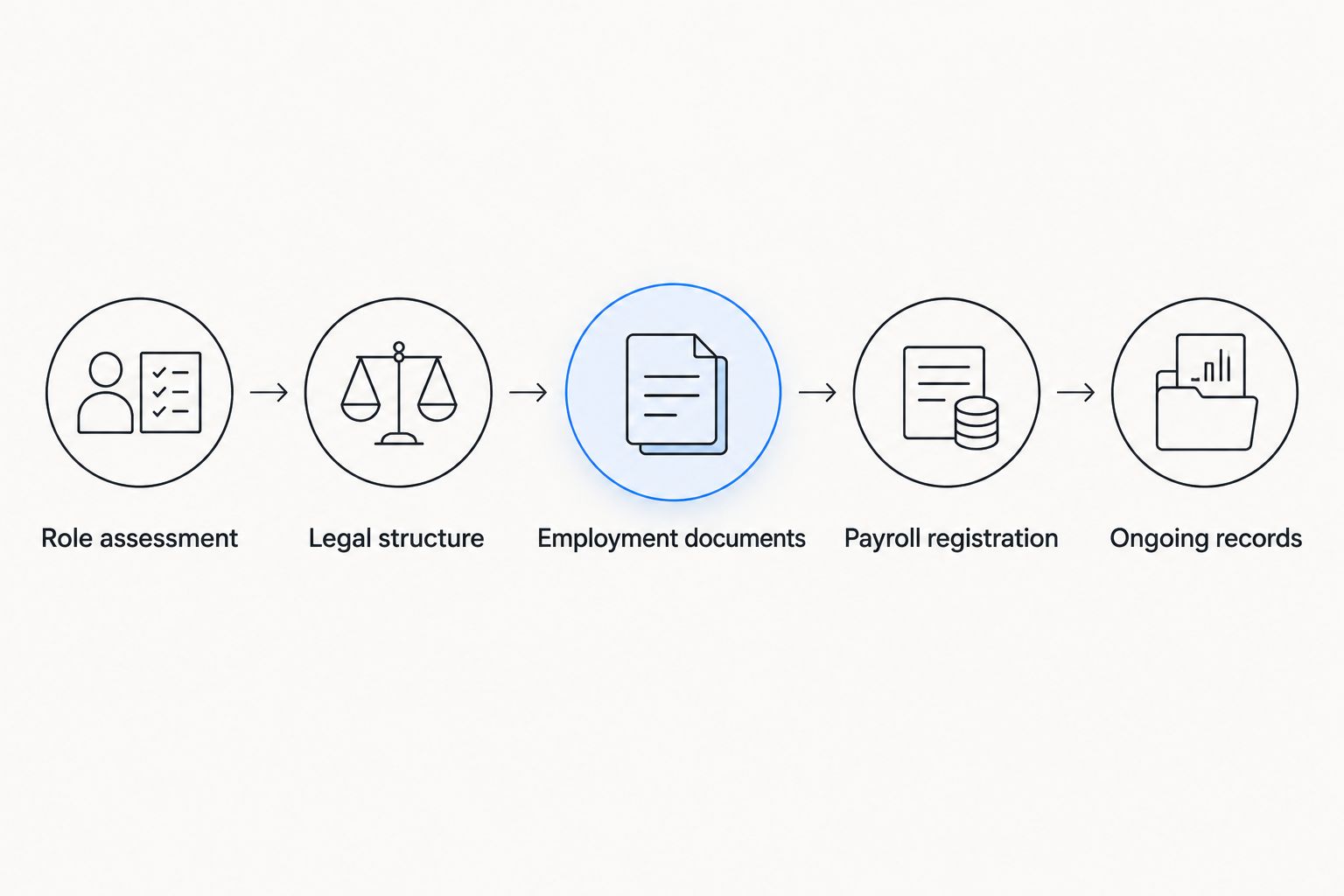
How do you set up a compliant hiring process?
Use this sequence before the employee begins work. Each step resolves a different responsibility; none substitutes for the others.
- Role assessment. Record the duties, reporting line, work location, working pattern and authority to represent the foreign company. Describe the actual job, not only its title.
- Legal structure. Obtain Turkish employment and tax advice on the proposed arrangement. Identify the employer and any relevant provider authorisation.
- Employment documents. Prepare the appropriate employment terms, job description, remote-working provisions and employee information notices. Make the documents consistent with the real management structure.
- Payroll registration. Assign responsibility for applicable social-security registrations, payroll treatment, filings and salary payments. Confirm the responsible entity and process before the start date.
- Ongoing records. Maintain attendance, leave, payroll approvals and personnel documentation. Define who corrects errors and who handles employee requests.
The order matters. A completed onboarding checklist cannot repair an employment structure that has not been assessed.
For your 2026 onboarding checklist, keep the legal decision and its supporting documents beside the operational checklist. The person administering payroll needs to know which entity employs the worker and which rules the calculation follows.
What employment records and working rules still apply?
Hiring without your own subsidiary does not mean working without employment records. The responsible employer needs a personnel file, appropriate employment documentation and records supporting payroll.
In Turkish HR, puantaj records working time, leave, absences and relevant overtime information. It supports payroll inputs; it is not a substitute for an employment contract or social-security registration.
For employees covered by the relevant provisions of Labour Law No. 4857:
- Article 63 sets the general normal working-time limit at 45 hours per week.
- Article 53 provides a minimum of 14 days of annual paid leave for the initial service band, after completing 1 year of service, including the probationary period.
- Article 75 requires the employer to maintain an employee personnel file, known as an özlük dosyası.
These are baseline references, not a complete payroll specification. Employee category, working arrangements and more favourable contractual terms require separate consideration.
In your 2026 policy review, check the current legal text and applicable exceptions rather than copying a foreign handbook. Preserve evidence of approvals and corrections, especially where a provider and the foreign company share operational tasks.
Does an employer of record remove permanent-establishment risk?
No. A local employment provider does not, by itself, eliminate the foreign company’s permanent-establishment exposure in Turkey.
Corporate-tax analysis considers the foreign company’s activities and the applicable domestic law and tax treaty. A fixed place of business or a person’s authority and activities can be relevant. The payroll arrangement is only part of the facts.
Ask your tax adviser to assess the worker’s duties before granting contracting authority or establishing a local operating location. Employment compliance and corporate-tax exposure need separate conclusions.
Do foreign nationals need work permission in Turkey?
Foreign nationals generally need an appropriate work permit or a valid exemption to work in Turkey. A residence permit alone does not automatically authorise employment.
International Labour Force Law No. 6735 governs the work-permit framework. The application route depends on the individual and proposed employment arrangement; do not assume that every provider can sponsor every role.
Confirm permission before work begins. A contract or an overseas payroll payment does not replace immigration authorisation.
Where HR software fits
Software belongs after the employment-structure decision. Ottohr provides hiring, onboarding, payroll, benefits and compliance tools for mid-size and large enterprises and growing employers.
Ottohr is best for growing employers that need HR and payroll software, not a substitute for a legally valid employment arrangement. Its stated scope addresses administration; it does not establish that a particular employer-of-record or direct-employment model is lawful.
Define the employer, filing responsibilities and approval process first. Then assess the platform against those requirements, including the records your payroll and compliance teams need to maintain.
FAQ
Can a foreign company hire a Turkish employee without opening a subsidiary?
Yes, a foreign company can hire without its own Turkish subsidiary through a legally valid employment arrangement. The employer, registrations, payroll obligations and tax position still need to be established.
Is an employer of record automatically legal in Turkey?
No, the employer-of-record label does not establish that a particular arrangement complies with Turkish law. Review the actual employment structure, applicable worker-supply rules and any required authorisation.
Can I just pay a Turkish employee from my overseas bank account?
An overseas bank transfer does not resolve employment, tax or social-security obligations. Establish the legal employer and applicable payroll treatment before arranging payment.
Can I hire everyone as an independent contractor instead?
No, contractor status must match a genuinely independent working relationship. A services agreement does not remove employment-classification risk when the actual relationship is dependent employment.
Does using a local employment provider prevent Turkish corporate-tax exposure?
No, a local employment provider does not automatically remove permanent-establishment exposure. Assess the foreign company’s activities, premises and the worker’s authority under the relevant law and tax treaty.
What should I check before hiring in Turkey in 2026?
For a 2026 hire, confirm the employment structure, worker classification, work permission, payroll responsibilities and tax exposure before the start date. Document who handles registrations, employee records and ongoing filings.
Can Ottohr replace the legal employer in Turkey?
Ottohr’s stated offering is HR, payroll, benefits and compliance software, not an employer-of-record service. Software supports administration; a legally valid employment relationship must be established separately.
One last thing
Ask who handles the employee’s exit before signing the hiring agreement. Notice, final payroll, unused leave and any applicable severance obligations need an assigned owner just as onboarding does.
A clear answer identifies the employer, the approval authority and the records required. Use that same responsibility map throughout the employment relationship. This article is general information, not individual legal or tax advice.


