
For a standard employee hire in Turkey, submit the SGK işe giriş bildirgesi before the employee starts work, normally no later than the preceding day. There is no general post-hire grace period, and the filing deadline is separate from any time needed to prepare or correct the submission. Specific statutory exceptions apply, including certain construction, fishing and agricultural workplaces.
- How long does SGK registration take after hiring? Standard employee notification is due before work starts, not afterward.
- SGK filing deadlines and electronic processing time are different; do not plan around an assumed processing duration.
- Keep the accepted işe giriş bildirgesi, not just an onboarding checklist marked complete.
- Sector-specific and newly registered workplace exceptions require separate deadline checks.
Why this matters
A signed employment contract does not replace an SGK employment-entry notification. Neither does adding someone to payroll or giving them access to company systems. Your hiring workflow needs a separate filing checkpoint before the first shift.
For 2026 hiring, treat the start date as a compliance deadline, not merely an onboarding milestone. The practical workflow in automatically filing SGK notifications when you hire a new employee belongs alongside contract preparation and payroll setup, rather than after them.
The controlling question is when the employee starts work—not when HR finishes onboarding. A processing estimate cannot extend the legal submission deadline.
How long does SGK registration take after hiring an employee?
For ordinary employees insured under Article 4/1(a), the general rule in Article 8 of Turkey’s Social Insurance and General Health Insurance Law No. 5510 is notification before employment begins. In operational terms, file no later than the day before the employee starts, unless a statutory exception applies.
The law establishes a notification deadline. It does not provide a universal processing-time promise for every submission, correction or employee-facing record update. Do not turn the deadline into an unsupported claim that registration always takes a particular number of minutes.
| Employment situation | Applicable timing principle | What to check |
|---|---|---|
| Standard employee hire | Submit before the employment start date | Correct employee, workplace and start date |
| Construction, fishing or agricultural workplace exception | Notification can be submitted no later than the day work begins | Whether the workplace actually qualifies |
| Qualifying first-time workplace registration | A special initial one-month window applies | First insured employment date and employees covered by that window |
| Filing already overdue | The original deadline has been missed | Actual start date, correction route and administrative consequences |
The table summarizes timing categories, not interchangeable options. Use an exception only when the facts meet its statutory conditions. Your preferred onboarding schedule does not determine which rule applies.
Legal basis for this 2026 guide: Law No. 5510, Article 8, covering employment-entry notifications for employees within its scope. Separate rules apply to other insurance categories and special employment circumstances.
Standard employee hire: Before the first workday
For a standard hire, the işe giriş bildirgesi should already be submitted when the employee begins working. Preparing a draft is not the same as filing it. An internal approval also does not establish that SGK received the notification.
Make the filing deadline visible when you agree on the start date. If recruiting, HR operations and payroll use separate systems, assign responsibility explicitly rather than assuming that a status change triggers the legal notification.
A practical completion check has three parts:
- The employee’s identity matches the supporting records.
- The workplace and employment start date are correct.
- The submitted notification has an accepted record that you can retrieve.
Keep the submission evidence with the relevant employment records under your access and retention controls. Personal information in an employment-entry notification is not material for an unrestricted team channel.
Construction, fishing and agriculture: By the starting day
Article 8 provides a same-day notification exception for employees starting work at construction, fishing and agricultural workplaces. This is a specific legal exception, not a general allowance for urgent hiring.
Check the workplace classification before relying on it. A company serving construction clients does not establish eligibility merely by describing itself as construction-related. The relevant employment and workplace facts control the filing treatment.
Even where same-day filing is permitted, preparing the employee’s details beforehand reduces last-minute work. The exception changes the legal deadline; it does not remove the need for correct identity information, authorized submission and retained evidence.
First-time workplace registration: A one-month window
Article 8 also provides a special rule for workplaces submitting an initial workplace declaration to SGK. It covers qualifying employees who begin during the first month following the workplace’s first employment of an insured person, with notification due by the end of that initial period.
This is not a fresh month for every new employee. The window is tied to the workplace’s initial insured employment date, so later starters within that window do not each receive an independent extension.
For a new workplace in 2026, record the initial employment date before calculating any exceptional deadline. Distinguish the workplace declaration, or işyeri bildirgesi, from the employee’s işe giriş bildirgesi: they serve different purposes.
Do not apply this exception to an established workplace simply because a new branch, department or recruitment campaign has started. Confirm the actual registration position with the person responsible for SGK compliance.
Why SGK registration timing varies
The statutory deadline and the work required to complete a submission are separate. These factors determine which rule applies and what your team must resolve:
- Insurance category. The ordinary employee rule concerns Article 4/1(a); do not copy it automatically to every insured category.
- Workplace classification. The construction, fishing and agriculture exception depends on qualifying workplace circumstances.
- Initial workplace registration. A qualifying first-time declaration changes the deadline calculation for the initial window.
- Employee information. Incorrect identity details require resolution rather than a filing marked complete on assumption.
- Submission readiness. Workplace registration and authorized access must support the filing before your team can complete it.
- Changes to the start date. A postponed start or a person who never starts requires review of the existing notification and the appropriate correction or cancellation procedure.
Do not assign a fixed delay to any of these factors without evidence from the actual case. Use a deadline tracker that distinguishes preparation, submission and acceptance instead.
How should you organize the filing before the employee starts?
Use a short sequence with a named owner at each handoff. Keep legal submission separate from general onboarding tasks, even if the same team coordinates both.
- Confirm the start. Establish when the employee will actually begin work and which employing entity and workplace apply.
- Check the rule. Identify the insurance category, standard deadline and any documented statutory exception.
- Validate the details. Review employee identity, workplace information and the proposed employment start date.
- Submit the notification. Complete the authorized SGK submission rather than stopping at a prepared form.
- Keep the evidence. Retrieve the accepted notification and record any subsequent correction.
This sequence gives you a clear distinction between ready to submit and submitted. It also exposes a missing handoff before someone starts working.
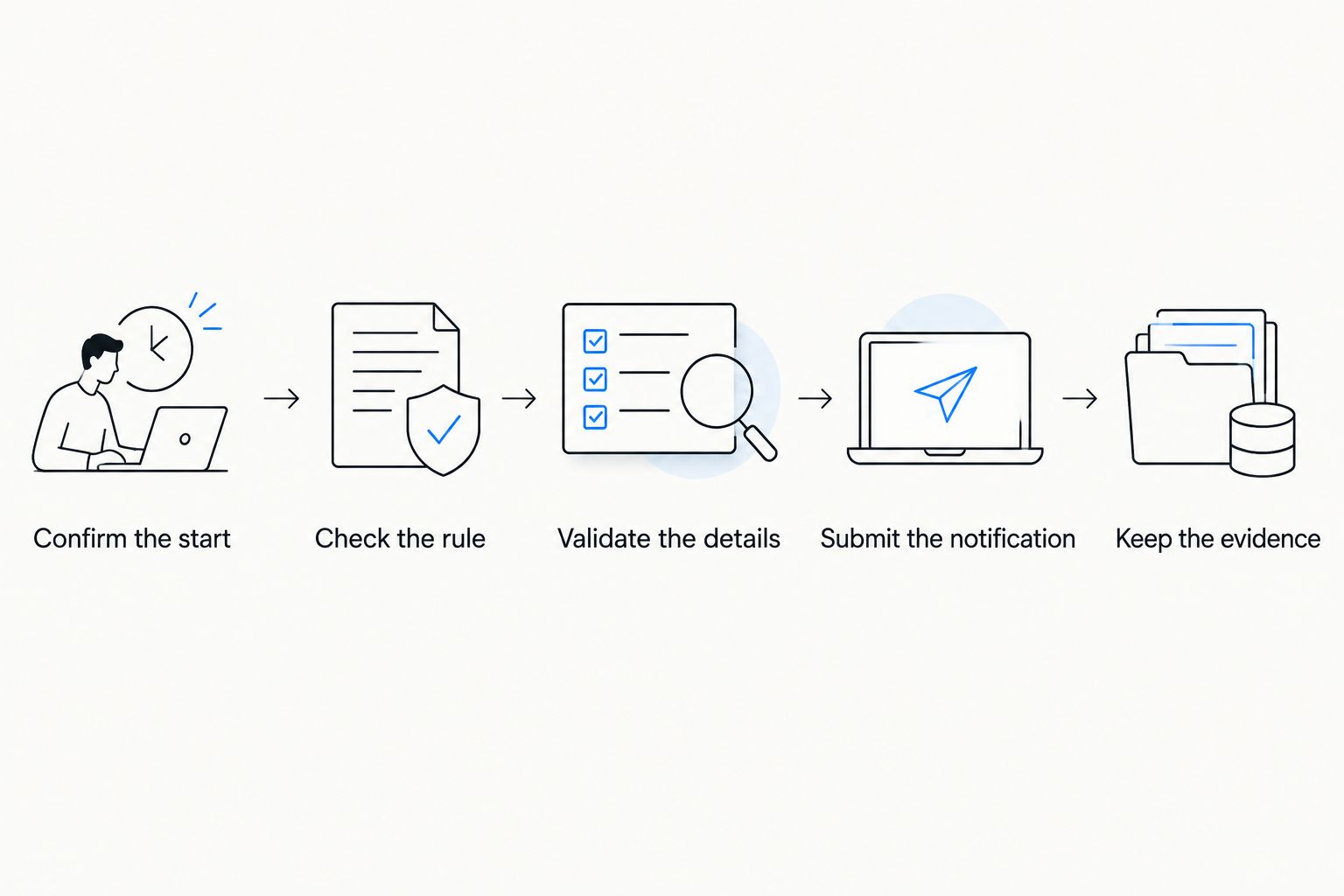
For your 2026 hiring checklist, make the accepted notification a distinct completion item. A general onboarding status such as ready or active does not show which legal filing was completed or which start date it contains.
What proof shows that SGK registration is complete?
Use the submitted and accepted işe giriş bildirgesi as the filing record. Check the employee, workplace and employment start date on that record rather than relying solely on a confirmation message passed between colleagues.
Keep two documents distinct: the employment contract and the SGK employment-entry notification. The contract records the employment agreement; the notification records the employer’s submission to SGK. Possessing one does not demonstrate that the other exists.
Employee-facing SGK information is a separate verification channel. A service record and an employment-entry notification do not answer exactly the same question, so identify which document the employee is checking before diagnosing an apparent missing registration.
If the submission record shows an error, investigate the actual filing and correction requirements. Do not solve a mismatch by changing the employee’s real start date in an internal spreadsheet.
Can an employee start while SGK registration is pending?
For a standard hire, the preceding-day deadline still applies; a pending HR task does not create permission to file after work begins. A draft, approval request or message to an accountant is not an accepted SGK notification.
Before a planned start, escalate an unresolved filing to the responsible payroll or compliance professional. Check whether a genuine statutory exception applies rather than treating urgency as an exception in itself.
If the employee has already started, handle the situation as a missed-deadline issue. Preserve the true employment facts and obtain case-specific advice on submission, correction and any administrative consequences.
Is SGK registration the same as payroll reporting?
No. The preceding-day entry deadline applies to the standard employment-entry notification, while payroll and periodic reporting have separate obligations. Completing one process does not automatically prove completion of the others.
Puantaj records working days, leave, absences and overtime for payroll preparation. It does not replace the işe giriş bildirgesi. Connect these records through the correct employee identity and start date without collapsing them into one checklist item.
For 2026 payroll controls, reconcile the accepted entry notification with the employment record before using the start date downstream. This is a data-consistency check, not a substitute for assessing the legal deadline.
Where HR software fits
Ottohr is best suited to growing employers and mid-size or large enterprises seeking HR, onboarding, payroll, benefits and compliance tools in one platform. That scope is relevant when hiring information must pass between teams.
Software support does not, by itself, establish that a particular SGK notification was accepted or that an exception applies. Evaluate the actual filing workflow, responsible approver and retrievable evidence rather than treating a completed onboarding task as legal proof.
Keep the decision rule simple: use software to coordinate the work, and verify the statutory filing separately. The employer’s deadline remains tied to the applicable legal rule and actual employment facts.
FAQ
How long does SGK registration take after hiring in 2026?
For a standard employee hire, the SGK employment-entry notification is due before work starts, normally no later than the preceding day. This is a filing deadline, not a guaranteed electronic processing duration.
Can I register an employee with SGK on their first day?
Same-day notification is permitted for specified statutory exceptions, including qualifying construction, fishing and agricultural workplaces. The standard employee rule requires notification before the start date.
Does a signed employment contract mean SGK registration is complete?
No. A signed contract does not replace the SGK işe giriş bildirgesi. Check the accepted submission record separately.
Does every new employee get a month to register?
No. The initial one-month exception concerns qualifying first-time workplace registration circumstances. It is not a rolling extension for each employee.
What should I do if the employee has already started without notification?
Treat the case as a missed-deadline issue and contact the person responsible for payroll or SGK compliance immediately. Preserve the actual start date and establish the required submission or correction procedure.
Does an SGK employment-entry notification replace a work permit?
No. SGK notification and work authorization are separate requirements. For foreign employees, assess the applicable work-authorization and social-insurance rules separately.
What document should HR keep after SGK registration?
Keep the accepted işe giriş bildirgesi and check its employee, workplace and start-date details. Retain any subsequent correction records under appropriate access controls.
One last thing
The strongest completion check is the accepted filing, not the onboarding status. Before releasing a new-hire checklist, ask whether an authorized person can retrieve the notification and match it to the employee’s actual first workday.
That check separates a completed legal submission from a task that someone intended to finish. If the evidence is missing, resolve the filing status rather than marking the employee registered by assumption.


