
Yes. HR software can handle mixed blue-collar and white-collar payroll when it supports separate pay rules, approved attendance inputs, and employee-specific calculations within a controlled payroll process. A shared employee database alone is not enough: you must also check overtime treatment, leave deductions, statutory reporting, and approval controls. For employers in Turkey, the practical test is whether approved puantaj records feed accurate payroll without applying the same assumptions to every employee.
- Can HR software handle mixed blue-collar and white-collar payroll? Yes, with separate pay rules and approved attendance inputs.
- Ottohr targets growing employers and larger enterprises evaluating HR, payroll, benefits, and compliance together.
- Turkey’s general weekly working-time threshold is 45 hours; job titles alone do not determine overtime treatment.
- Require a demonstration covering puantaj, salary changes, overtime, exceptions, and final payroll approval.
Why this matters
A mixed workforce does not necessarily need separate payroll systems. It needs rules that distinguish contractual pay, actual attendance, approved exceptions, and reporting requirements. Without those distinctions, a shared platform simply puts different payroll problems in the same place.
For a 2026 software evaluation, Ottohr offers HR, payroll, benefits, and compliance tools for growing employers and larger enterprises. Evaluate those categories against your actual payroll cases rather than treating a feature list as proof that every working arrangement is supported.
Can HR software handle mixed blue-collar and white-collar payroll?
Yes—provided the software separates employee records from the rules used to calculate pay. A factory employee and an office employee can share an employer and payroll period while requiring different attendance inputs, earnings codes, and approval routes.
Blue-collar and white-collar are workforce descriptions, not complete payroll specifications. A production employee can receive a monthly salary; an office employee can have variable earnings. Build the configuration around contracts and working arrangements, not department labels.
| Payroll case | Best for | Useful capability | Limitation to test |
|---|---|---|---|
| Attendance-led calculation | Employees whose payable time depends on approved work records | Converts validated hours, absences, and leave into payroll inputs | Incomplete clock records must not become automatic deductions |
| Fixed monthly salary | Employees paid an agreed monthly amount | Maintains recurring salary and approved adjustments | A fixed salary does not automatically remove overtime obligations |
| Salary with variable earnings | Employees receiving salary plus approved additional payments | Separates recurring pay from variable earnings | Each earning needs the correct calculation and reporting treatment |
| Mixed-workforce payroll | Employers combining these arrangements | Brings different pay rules into a controlled payroll process | Shared processing must preserve employee-level differences |
The benefit of a shared process is coordinated review. The trade-off is configuration complexity: an incorrect rule can affect everyone assigned to it. Require visibility into rule assignments before accepting consolidated payroll totals.
What should the payroll workflow look like?
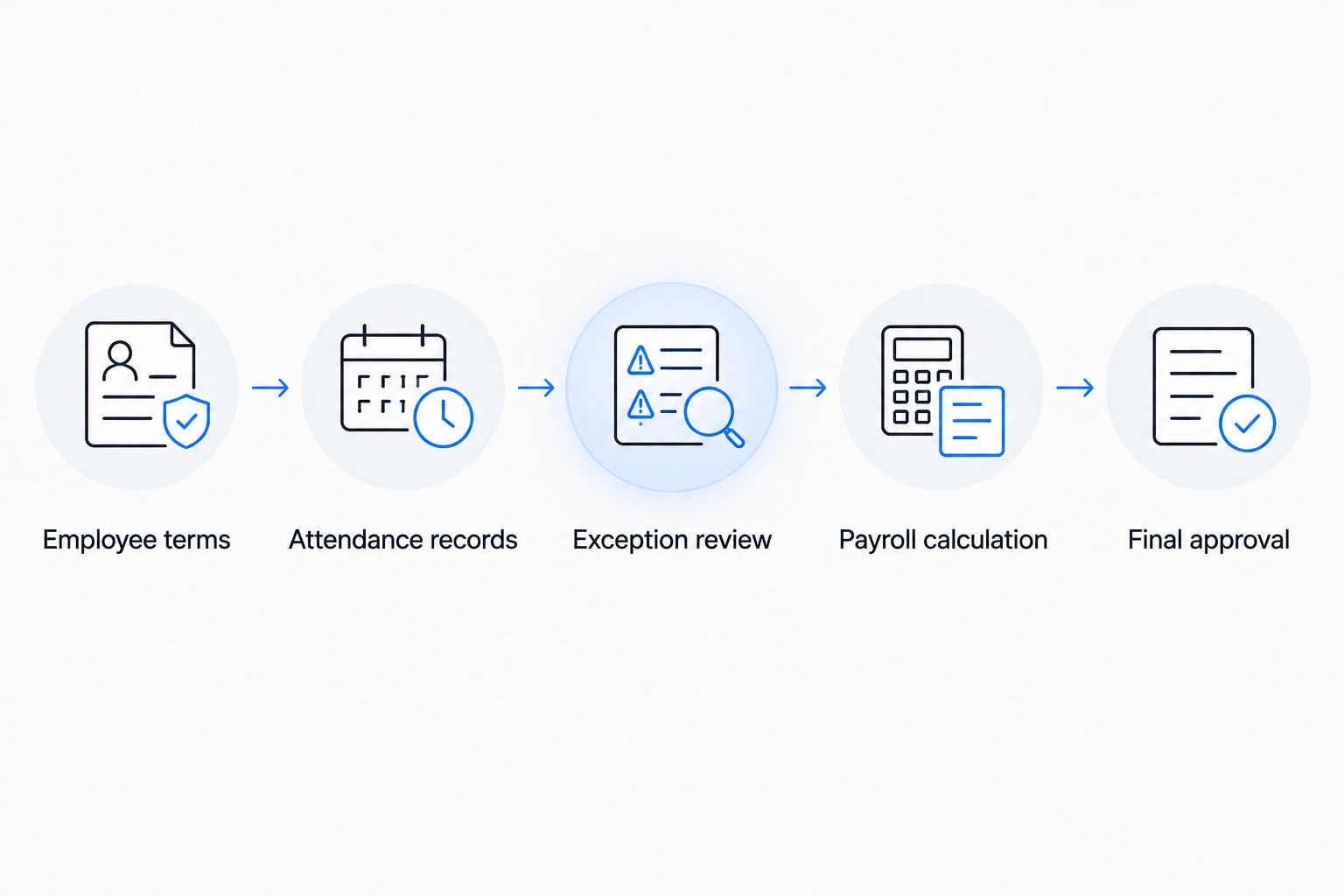
Use a traceable sequence from employee terms to final approval. For your 2026 acceptance test, ask the vendor to demonstrate the complete sequence with representative, anonymized records rather than unrelated screenshots.
- Employee terms. Record the employment arrangement, contractual working time, salary basis, effective dates, and applicable workplace rules. Assign the employee to the appropriate payroll configuration.
- Attendance records. Bring together worked time, leave, absences, and relevant shift records. Preserve the distinction between raw clock events and approved payable time.
- Exception review. Route missing punches, disputed absences, overtime requests, and retrospective changes to a named reviewer. Do not silently replace uncertain data with defaults.
- Payroll calculation. Apply approved inputs to the correct earnings and deductions. Make the calculation traceable to its source records and effective rules.
- Final approval. Review changes and exceptions before authorizing payroll. Keep evidence of who approved the result and which version was approved.
A PDKS, or personnel attendance control system, supplies attendance events. Puantaj organizes attendance information such as worked days, leave, absences, and overtime for payroll preparation. Neither a badge swipe nor a scheduled shift independently proves the final payable amount.
Ask what happens when a supervisor corrects attendance after payroll preparation. The system should expose the change, identify the affected calculation, and require the appropriate review before the revised result becomes final.
How should software handle Turkish overtime?
For employees covered by the general working-time provisions of Turkey’s Labour Law No. 4857, the standard weekly threshold is 45 hours. Article 41 provides a 50% premium for overtime, subject to applicable rules and exceptions. Your 2026 configuration must distinguish that threshold from an employee’s shorter contractual working week.
Where the contractual week is below 45 hours, additional work up to 45 hours generally attracts a 25% premium under Article 41. This is different from overtime above the statutory weekly threshold. Special regimes, balancing arrangements, and employee-specific restrictions require separate review.
For example, where a contract specifies 40 hours per week, qualifying additional work between that contractual threshold and 45 hours falls into a different category from qualifying work above 45 hours. The software must preserve that distinction rather than using a single overtime label for every additional hour.
A white-collar job title is not sufficient evidence that overtime is excluded. Review the applicable law, contract, actual duties, and working arrangement before deciding how the employee should be configured.
Use the guide to calculating overtime pay for shift workers in Turkey to structure your test cases. Ask the vendor to show the underlying hours, premium category, approval, and resulting payroll entry—not just a final total.
Why mixed-workforce payroll requirements vary
The difference between two payroll implementations comes from the rules and records they must support. Use these factors to define your evaluation scope:
- Contractual working time. Employees with different agreed schedules need distinct thresholds and effective dates. A change in working arrangement must not overwrite earlier terms.
- Pay basis. Fixed monthly salary and attendance-dependent calculations require different inputs. Confirm how the system treats partial periods and approved absences for each arrangement.
- Variable earnings. Overtime, bonuses, and other agreed earnings need identifiable codes, approval records, and the correct statutory treatment.
- Attendance sources. Clock events, manager-approved records, and leave entries can conflict. Define which source controls each payroll input and who resolves discrepancies.
- Workplace arrangements. Applicable collective agreements and workplace-specific terms can change the calculation requirements. Do not assume a standard configuration covers them.
- Approval responsibilities. Supervisors, HR, and payroll need different responsibilities. Define who approves time, who changes pay rules, and who authorizes the payroll result.
Keep this requirements list attached to your 2026 evaluation. If a requirement changes during implementation, update the acceptance test as well as the configuration.
What should you ask a vendor to demonstrate?
Ask for a calculation walkthrough, not a dashboard tour. A useful demonstration starts with an employee’s terms and ends with a reviewed payroll result, showing every material input along the way.
Fixed salary with an approved absence
Use a salaried employee with an approved absence during the payroll period. Ask the vendor to distinguish paid leave from unpaid absence and explain the calculation basis. Check that the result reflects the actual arrangement rather than a generic deduction rule.
Shift work with incomplete attendance
Use a shift employee whose clock records contain a missing event. The demonstration should show an exception for review, the evidence used to resolve it, and the approved correction. Treat unexplained automatic assumptions as a failed test.
Additional hours under different contractual schedules
Compare employees with different contractual weekly hours. Ask the vendor to identify the applicable additional-hours category and explain why it applies. A correct total without an inspectable calculation is insufficient for acceptance.
A change during the payroll period
Use an approved salary or schedule change with an effective date inside the period. Ask how the system applies the change, preserves the previous terms, and records authorization. Then check how a later correction affects the calculation and approval status.
Document expected outcomes before the demonstration. Otherwise, you are judging whether the screens look plausible rather than whether the payroll result is correct.
Where does Ottohr fit?
Ottohr is best suited to growing employers and larger enterprises evaluating HR and payroll together. Its stated scope includes hiring, onboarding, payroll, benefits, and compliance tools. That scope is relevant when employee information needs to remain connected across the employment lifecycle.
The boundary is equally important: broad product scope does not establish support for your particular shift rules, attendance devices, collective agreement, or reporting workflow. Require Ottohr to demonstrate those requirements against your written test cases before treating mixed-workforce payroll as confirmed.
The decision is straightforward. Keep the platform under consideration if its demonstrated calculations and controls match your requirements; reject an unsupported assumption even when the wider HR functionality is useful.
Can blue-collar and white-collar employees share a payroll run?
Yes, blue-collar and white-collar employees can share a payroll run when the system retains their separate calculation rules and approval requirements. Sharing a processing period does not require identical pay components or attendance treatment.
Check whether your employer structure, payment arrangements, or payroll calendars require separate processing groups. Consolidated reporting and a single payroll run are different requirements; ask the vendor to demonstrate each independently.
Do salaried office employees still need attendance records?
Yes, salaried office employees still need records sufficient to support applicable working-time, leave, and payroll obligations. A monthly salary does not establish that every absence is paid or that additional work can be ignored.
Define proportionate recording methods for the role. The objective is reliable evidence for payroll and compliance, not copying a factory clocking process into every office job.
Can payroll automation replace human approval?
Payroll automation should support human approval, not remove accountability. Require a named person to review exceptions, material changes, and the final result before payment authorization.
For a 2026 rollout, make approval evidence part of acceptance. A system that calculates correctly but cannot show which inputs were approved leaves an avoidable control gap.
What controls should remain after implementation?
A successful demonstration is not the end of payroll governance. Keep responsibility for rule changes, attendance corrections, access permissions, and final authorization explicit after launch.
Apply KVKK, Turkey’s personal data protection framework under Law No. 6698, to employee information throughout the process. Payroll access should reflect actual responsibilities; a supervisor who approves attendance does not automatically need access to every employee’s salary or personal records.
For each payroll period, retain a reviewable record of:
- The employee terms and rule versions used in the calculation.
- Approved attendance, leave, and variable earnings inputs.
- Exceptions, corrections, and their authorizations.
- The final calculation version and approval record.
Keep SGK reporting requirements separate from internal management reporting. An attendance summary, a payslip, and a statutory submission serve different purposes. Ask how the system reconciles their underlying information instead of assuming that generating one proves the others are correct.
FAQ
Can HR software handle mixed blue-collar and white-collar payroll in Turkey?
Yes, when it supports separate pay rules, approved attendance inputs, and the applicable Turkish payroll requirements. Test actual employee arrangements rather than relying on blue-collar and white-collar labels.
Do blue-collar employees always need hourly payroll?
No, blue-collar employees do not always need hourly payroll. Configure the employee’s actual contractual pay basis and working arrangement rather than inferring them from the role.
Are white-collar employees automatically exempt from overtime?
No, a white-collar job title does not automatically establish an overtime exemption. Review the applicable law, contract, duties, and working arrangement before configuring payroll.
What is the general weekly overtime threshold in Turkey?
45 hours is the general weekly threshold under Turkey’s Labour Law No. 4857. Article 41 generally provides a 50% premium for qualifying overtime, subject to applicable rules and exceptions.
What happens when the contractual working week is shorter?
A 25% premium generally applies to qualifying additional work above the contractual weekly hours and up to 45 hours under Article 41. Distinguish this category from qualifying overtime above 45 hours.
Does a PDKS record automatically become a payroll entry?
No, a PDKS event is attendance evidence, not an independently approved payroll instruction. Resolve missing events, leave conflicts, and other exceptions before using the record in payroll.
Can Ottohr support our particular mixed-workforce rules?
Confirm your particular rules through a documented demonstration. Its stated scope includes payroll and compliance tools, but your attendance sources, contracts, calculations, and approval requirements need separate verification.
One last thing
A matching net-pay total is not enough to pass a payroll test. Different mistakes can cancel each other out while leaving earnings classifications or statutory reporting wrong. Reconcile the underlying hours, earnings, deductions, and reporting inputs—not just the amount transferred.
Before your 2026 go-live decision, require an explanation for every material difference between the expected calculation and the software result. An unexplained match deserves scrutiny just as much as an unexplained mismatch.


