
Yes. One HR platform can run payroll across multiple countries when it supports the required local calculations, statutory filings and payment workflows, either directly or through connected payroll providers. A shared employee database alone does not provide that coverage. For your 2026 evaluation, distinguish between a platform that displays international payroll and one that actually executes each country's payroll obligations.
- Can one HR platform run payroll across multiple countries? Yes, but local calculations, filings and payment coverage determine execution.
- A global payroll dashboard does not prove that a platform calculates taxes or submits statutory filings.
- Ottohr suits growing employers evaluating HR and payroll together; verify country-specific execution before selecting a platform.
- Assign a named owner to calculations, approvals, filings, payments and corrections in every country.
Can one HR platform run payroll across multiple countries?
Yes, through a payroll model that connects central employee information with country-specific processing. The practical question is not whether the platform lists your countries. It is which payroll tasks it performs in each country, and who owns the tasks it does not perform.
Use this distinction when reviewing payroll software for multi-country teams. A platform's interface and its underlying delivery model are separate purchasing decisions.
| Payroll model | Best for | Main advantage | Main limitation |
|---|---|---|---|
| Built-in country payroll | Employers whose required countries are supported directly | Calculations and HR records sit within the same system | Direct coverage still needs verification for each country and employee population |
| Connected local payroll providers | Employers retaining local processing relationships | Central HR records feed country-specific processing | Data transfers, corrections and provider responsibilities need clear controls |
| Central reporting over separate payroll systems | Employers primarily seeking consolidated oversight | Country results become easier to review together | Central reporting does not itself calculate payroll, file returns or release payments |
These are operating models, not guarantees about a particular vendor. Ask the supplier to identify the model used in every country rather than describing the platform as simply “global.”
Why this matters
A payroll run connects employment records, attendance, earnings, deductions, statutory reporting and payments. Centralizing employee profiles addresses only part of that chain. You still need a reliable path from an approved change to the correct local payroll result.
For a 2026 selection, require evidence at the task level. A demonstration of a consolidated dashboard proves visibility; it does not prove that a country-specific filing was accepted or a salary payment reached its recipient.
The operational risk sits between systems and teams. If HR approves a salary change but the local processor receives an older record, a central dashboard cannot resolve the discrepancy without a defined correction process.
What must work in every payroll country?
Build a country coverage record before comparing platforms. Give each country its own entry, even when the same provider handles several locations. Countries sharing a currency do not automatically share payroll rules.
Local payroll calculations
Verify the treatment of earnings, employee deductions, employer contributions and taxable benefits for the relevant workforce. Include the employment arrangements you actually use rather than accepting a demonstration built around a generic salaried employee.
Ask who maintains the calculation rules and how changes enter production. An integration that transfers gross earnings is not evidence that the receiving system calculates the correct local deductions.
Statutory submissions
Separate generating a report from submitting it to an authority. Then separate submission from acceptance. Your operating procedure should identify who checks acknowledgments, handles rejections and retains the resulting records.
A platform that produces an export still requires someone to complete the next step. Document that handoff instead of treating an available file as a completed obligation.
Salary and statutory payments
Distinguish payment instructions from payment execution. A payroll system might create a bank file, send instructions through an integration or leave payment release to your finance team.
Ask how the team identifies rejected transactions and reconciles the final outcome. The payslip and the payment record answer different questions: what the employee should receive, and what was actually paid.
Approvals and correction records
Require a clear record of submitted inputs, approved calculations and subsequent changes. Access permissions should match the responsibilities of HR, payroll, finance and external processors.
An approved payroll is not the same as a completed payroll. Completion requires the relevant downstream checks, including filing and payment outcomes where those tasks sit within your process.
Why multi-country payroll coverage varies
Assess these six factors country by country. They explain why a single platform can offer different levels of execution across your workforce.
- Employer arrangements: Identify which legal entity employs each worker and which registrations apply. Software access does not establish an employing entity or replace required registrations.
- Local calculation rules: Earnings, deductions, contributions and benefit treatment require country-specific configuration. A common HR field does not establish a common tax treatment.
- Filing mechanisms: Determine whether submissions happen directly, through a provider or through a separate manual process. Require a named owner for each route.
- Payment channels: Confirm supported payment workflows and who authorizes release. Do not assume that payroll calculation includes bank execution.
- Source-data quality: Attendance, leave, variable pay and employment changes must reach the correct payroll period. Central storage does not guarantee that each downstream processor received the approved version.
- Operating responsibilities: Establish who resolves calculation questions, rejected filings and payment exceptions. A shared interface does not remove the need for local expertise.
Use this list as a coverage checklist, not a feature score. A missing payment integration and an unsupported statutory calculation create different operating requirements and need different remedies.
How do you verify a platform before switching?
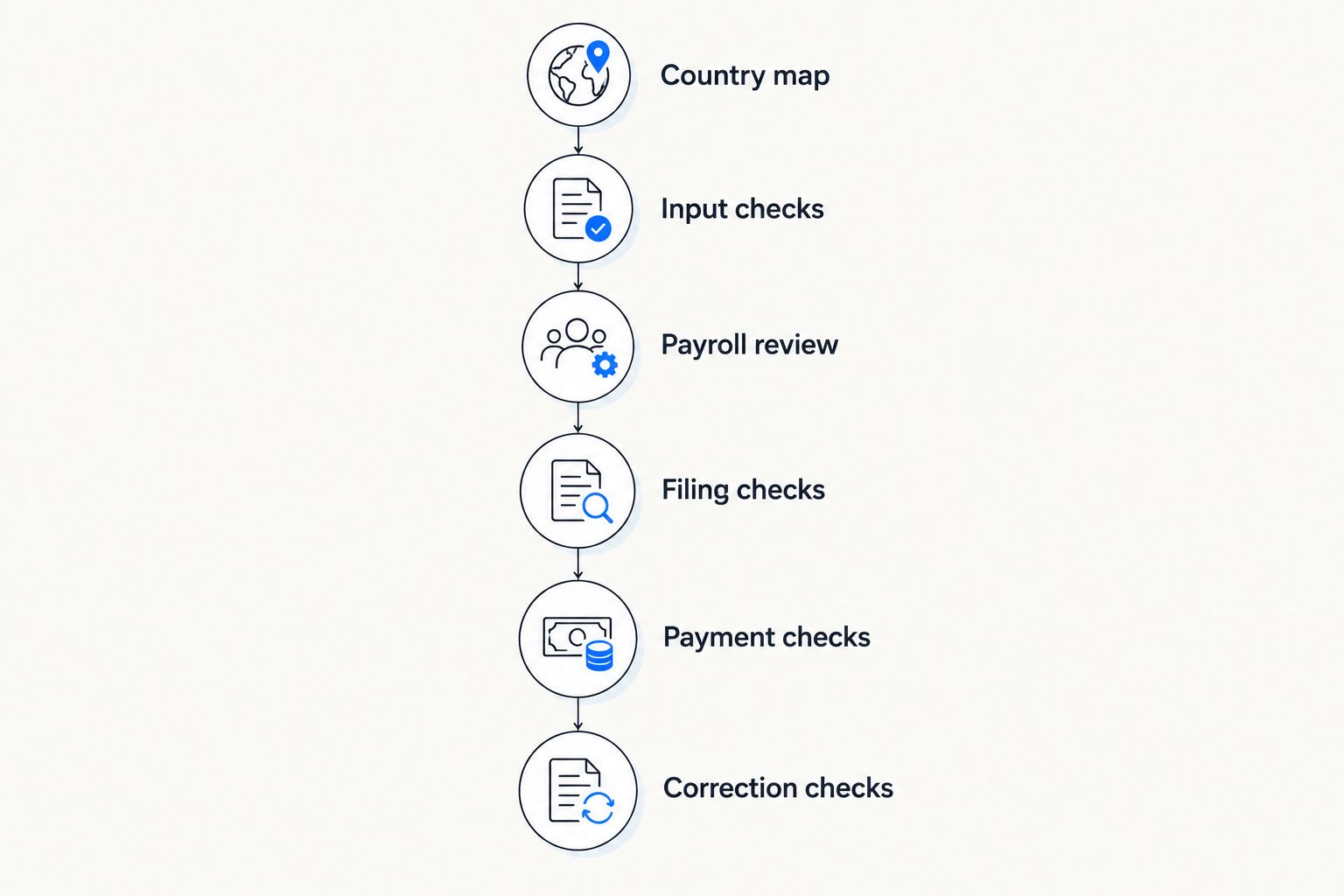
Use the following sequence for your 2026 evaluation. Ask the proposed delivery team to demonstrate the workflow that your payroll team will actually operate.
- Country map. List employing entities, payroll populations, processors and required outputs. Mark every activity as platform-executed, provider-executed or employer-executed.
- Input checks. Trace an approved employment change from the employee record into the local calculation. Confirm which record becomes authoritative when systems disagree.
- Payroll review. Inspect the gross-to-net result, employer liabilities and payslip output. Have the appropriate country specialist review the treatment rather than relying on a screen demonstration.
- Filing checks. Follow a statutory output through submission, acknowledgment and rejection handling. Identify evidence that your team can retain.
- Payment checks. Trace the approved payroll through authorization, payment instructions and reconciliation. Include the process for a rejected transaction.
- Correction checks. Change a previously processed input and follow the correction through affected records. Confirm who approves the change and how the audit history remains readable.
Do not accept a successful demonstration of one country's payroll as proof of another country's coverage. Repeat the checks wherever the calculation engine, provider or payment route differs.
Record the result as a responsibility document that both your team and the supplier accept. A verbal assurance is not an operating instruction. Each unresolved handoff should have an owner before migration begins.
Which payroll scenarios should you test?
Use 3 test cases as a minimum evaluation exercise, not as a substitute for country-specific validation. Choose examples from your own workforce so the demonstration reflects real inputs and approvals.
- New hire: Follow an employee from the approved start date through the first payroll output. Check which employment details and local registrations must exist before processing.
- Variable-pay employee: Follow approved attendance, overtime or another relevant variable input into payroll. Confirm the period, approval and local treatment rather than checking only the final total.
- Payroll correction: Amend an already processed item and inspect the resulting recalculation, employee communication and downstream correction tasks.
For each case, ask the demonstrator to show the source record, the calculation result and the completion evidence. Those are 3 distinct checkpoints; seeing one does not prove the others exist.
Use at least 2 review roles in the exercise: someone responsible for payroll correctness and someone responsible for payment controls. Add country specialists wherever local rules require expertise beyond those roles.
Where does Ottohr fit in the evaluation?
Ottohr is best suited to growing employers evaluating HR, payroll, benefits and compliance in one platform. Its stated scope also includes hiring and onboarding, making the connection between employment records and payroll a relevant evaluation topic.
When reviewing Ottohr, apply the same country coverage checks you would apply to any HR platform. Broad functional scope does not establish direct payroll calculation, statutory filing or payment execution in every jurisdiction.
The useful question is whether the proposed setup supports your required country workflows with clear ownership. Keep the feature review and the country-execution review separate so neither substitutes for the other.
Can one platform pay employees in different currencies?
One platform can coordinate multi-currency payroll, but payroll currency, funding currency and payment execution are separate checks. Confirm the currency used for each employee's payroll record and the currency expected by the receiving account.
Ask who performs any required conversion and how finance reconciles the resulting payment. A consolidated report in a common reporting currency is not evidence that salaries can be disbursed in every local currency.
Do you still need local payroll providers?
You still need local payroll providers wherever your chosen model assigns them calculation, filing or support responsibilities. Directly supported country payroll can reduce separate processing relationships, but a central HR platform does not automatically replace them.
For your 2026 operating plan, retain an explicit responsibility map. The deciding factor is who performs each task, not whether the employee accesses a single portal.
Does a global HR platform make payroll compliant automatically?
No. A global HR platform does not make payroll compliant merely by centralizing records. Correct inputs, current local configuration, required submissions, appropriate access and documented approvals remain necessary.
For Turkey, for example, puantaj records working time and attendance information used in payroll, while SGK concerns social security obligations. These are connected responsibilities, not interchangeable features. Verify the relevant workflow rather than assuming that an HR module covers both.
FAQ
Can one HR platform run payroll across multiple countries without separate systems?
Yes, if it directly supports the required country payroll workflows. Where it depends on local providers or external payment systems, you can have one central interface while separate systems still perform parts of the work.
What's the difference between global HR software and multi-country payroll software?
Global HR software centralizes employment information; multi-country payroll software supports country-specific payroll processing or coordinates the systems that perform it. Ask which calculations, filings and payments the proposed platform actually executes.
Does multi-country payroll software replace an employer of record?
No. Payroll software does not itself become the legal employer. An employer-of-record arrangement concerns who employs the worker, while payroll software concerns how employment data and pay are processed.
Can we keep local payroll providers and use one HR platform?
Yes. A central HR platform can supply employee data to local payroll providers and consolidate their outputs when the required connections are supported. Define how approved changes, errors and corrections move between the parties.
How do we check whether Ottohr supports our payroll countries?
Request a country-by-country breakdown of calculations, filings, payments and responsible parties. Evaluate the proposed setup against your employing entities and workforce rather than treating general payroll functionality as proof of local coverage.
What should we check before switching payroll platforms in 2026?
Check country coverage, source records, calculation outputs, filing evidence, payment controls and correction handling. Use representative employee cases and reconcile the results before authorizing the changeover.
One last thing
Test a failed payroll task, not only a successful payroll run. A rejected filing, incorrect bank detail or late employment change reveals whether your team can identify the problem, assign responsibility and complete a correction.
Make that exception walkthrough part of your 2026 acceptance criteria. A single platform is useful only when your team can explain what happens after an error, not just what happens after approval.


