
Part-time employees in Turkey must not be assigned statutory overtime or additional-hours work, but that prohibition does not make work already performed unpaid. For employers covered by Labour Law No. 4857, the distinction in 2026 is between permission to schedule extra work and the employee’s right to payment when that work has happened. Employee consent does not remove the prohibition, and disputed payment claims require an assessment of actual hours and the employment arrangement.
- Can part-time employees earn overtime pay in Turkey? Extra work is prohibited, but hours already worked cannot simply go unpaid.
- Article 8 prohibits both fazla çalışma and fazla sürelerle çalışma for employees on part-time contracts.
- The ordinary statutory overtime threshold is 45 hours per week; exceeding a part-time schedule is a different question.
- Ottohr’s practical recommendation: separate scheduling restrictions from payment obligations when reviewing part-time attendance.
Why this matters
A manager approves an extra shift. Payroll then sees a part-time contract and rejects the overtime entry. Neither approval nor rejection settles the legal issue: the manager cannot override the scheduling prohibition, and payroll cannot erase work that took place.
For growing employers using an HR and payroll platform such as Ottohr, the operational priority is to keep contractual hours, actual attendance and payment decisions distinct. Ottohr is best suited to growing employers and mid-size to large enterprises seeking HR, payroll and compliance tools. Software supports administration; it does not replace the legal assessment of a disputed wage claim.
Can part-time employees earn overtime pay in Turkey?
Part-time employees cannot lawfully be scheduled for either category of statutory extra work. Payment for work already performed is a separate issue. Article 8 of the Regulation on Overtime and Extra Hours under the Labour Law expressly prohibits both categories for workers employed under part-time contracts.
For a 2026 assessment under Labour Law No. 4857, read that prohibition alongside Article 41, which distinguishes overtime from additional-hours work. Do not transfer the ordinary full-time calculation rules directly to a part-time employee.
| Work category | Turkish term | General rule under Article 41 | Position for part-time contracts |
|---|---|---|---|
| Contracted ordinary work | Normal çalışma | Work within the agreed lawful schedule attracts ordinary wages | Permitted within the part-time arrangement |
| Additional-hours work | Fazla sürelerle çalışma | For an agreed week below 45 hours, qualifying additional hours up to 45 attract a 25% premium | Prohibited by Article 8 |
| Statutory overtime | Fazla çalışma | Qualifying work exceeding 45 hours per week attracts a 50% premium | Prohibited by Article 8 |
The table describes statutory categories, not a menu of scheduling choices. The 25% rule is not permission to extend a part-time employee’s working week.
The legal references used here are Labour Law No. 4857, Articles 13 and 41; the overtime regulation, Article 8; and the Working Time Regulation, Article 6. Their scope is employment governed by that Labour Law, not every employment relationship in Turkey.
Additional hours: the 25% rule is not a part-time entitlement
Fazla sürelerle çalışma means additional-hours work where the agreed ordinary working week is below the statutory 45-hour threshold. Article 41 provides a 25% premium for that category in arrangements where such work is legally permitted.
Part-time employment has an express exclusion. Do not configure every hour above a part-time employee’s contract as an automatic 25% premium. That approach ignores Article 8 and treats a prohibited scheduling practice as an ordinary payroll option.
Where a part-time employee has already worked beyond the agreed schedule but remains below 45 hours, payment analysis must distinguish ordinary wages for extra work from a statutory premium claim. Turkish case law distinguishes these hours from overtime above the weekly threshold; contractual terms and the facts of the employment relationship also matter.
The practical consequence is straightforward: preserve the additional hours, identify what remains unpaid, and obtain a legal assessment of any disputed premium. Do not delete the attendance entry because the work should not have been assigned.
Statutory overtime: the 50% rule does not authorise scheduling
Under the ordinary weekly rule in Article 41, qualifying work beyond 45 hours attracts a 50% overtime premium. Lawful averaging arrangements and special working-time restrictions require separate consideration.
A part-time contract does not give an employer permission to reach that threshold. Equally, an employer cannot rely on its own scheduling breach to treat proven work as unpaid.
If recorded hours exceed 45 in a week, review the entire arrangement rather than only the payslip. Check the actual working pattern, any applicable averaging arrangement, the reliability of attendance records and whether the employment is genuinely part-time.
Paying a premium does not cure an unlawful schedule. Payroll correction and prevention of repeat breaches are separate tasks, and both need an owner.
What counts as part-time employment in Turkey?
Article 13 of Labour Law No. 4857 compares the employee’s ordinary weekly working time with that of a comparable full-time employee. Article 6 of the Working Time Regulation defines part-time work as work up to two-thirds of the comparable full-time working time.
Where the comparable full-time week is 45 hours, that produces a part-time ceiling of 30 hours per week. The comparison matters: 30 hours is not a universal ceiling detached from the workplace’s full-time schedule. A shorter comparable full-time week produces a lower part-time threshold.
A contract label is therefore not enough. Review the agreed hours against the comparable employee, then compare the written arrangement with what actually happens.
For a 2026 contract review, use the guide to writing a part-time employment contract in Turkey alongside the attendance record. A well-drafted document cannot resolve a continuing mismatch between contracted hours and working practice.
Why payment treatment varies
The scheduling prohibition is clear. The payment assessment depends on what happened and which legal rules govern the claim.
- Contracted hours: Establish the agreed ordinary schedule before identifying work beyond it. A weekly total alone does not show the contractual position.
- Actual working time: Distinguish working time from presence on the premises, rest breaks and incomplete clock records.
- Weekly threshold: Hours above the part-time contract but below 45 hours raise a different payment question from qualifying work above 45 hours.
- Applicable terms: Review contractual or collective provisions that grant more favourable payment rights. Do not assume every contract contains the same terms.
- Employment classification: A recurring full-time pattern calls the part-time label into question. Assess the relationship as performed, not only as documented.
- Evidence and legal scope: Payslips, schedules, instructions and attendance records support the assessment. Confirm that Labour Law No. 4857 applies before using its framework.
None of these factors creates an exception allowing routine overtime for part-time employees. They explain why an existing wage dispute needs more than a payroll code.
How should you handle extra hours already worked?
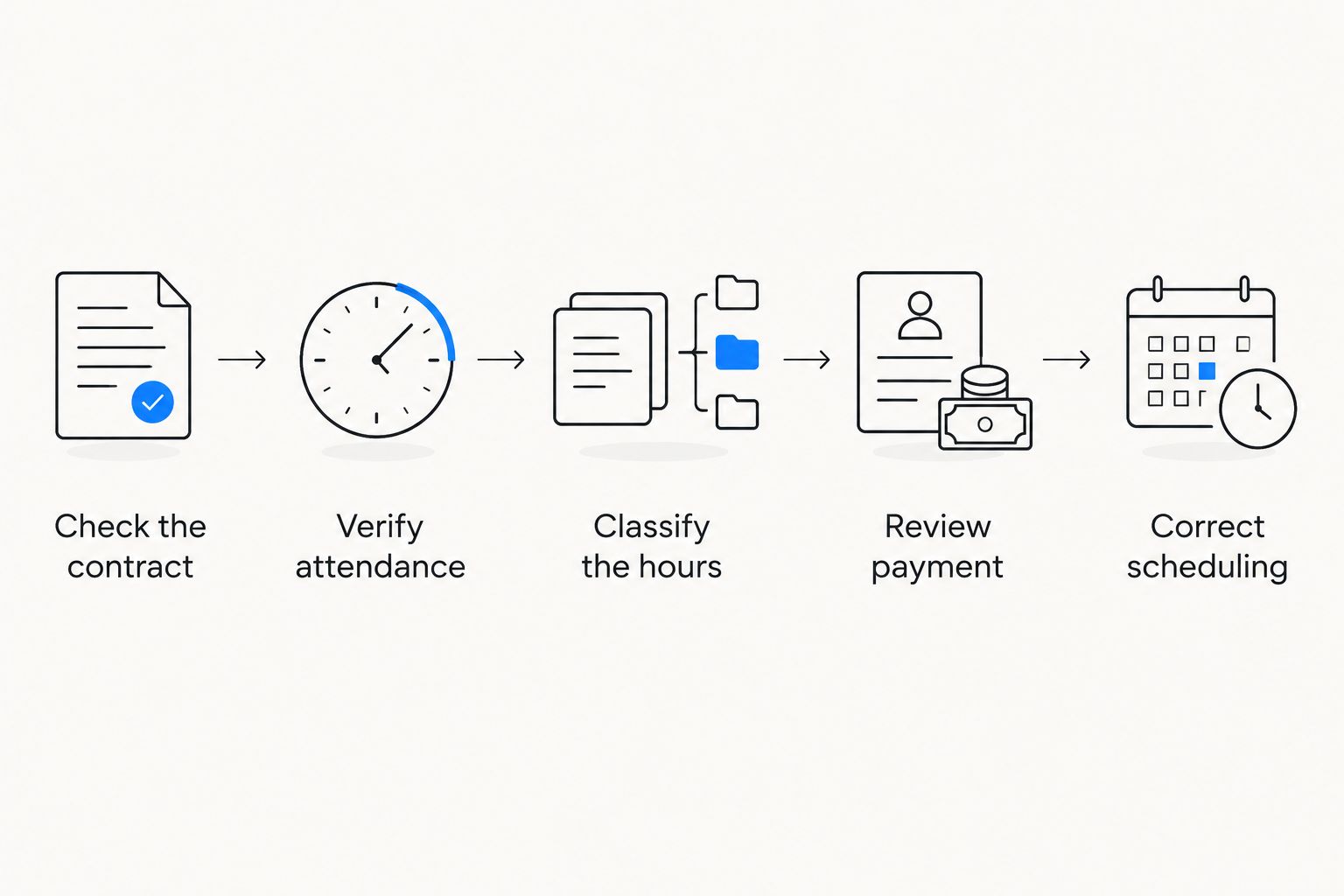
For a 2026 payroll review, use a sequence that preserves the evidence before deciding the payment treatment. The goal is to correct the record without normalising the prohibited schedule.
- Check the contract. Confirm the ordinary weekly hours, distribution of work and comparable full-time schedule. Check relevant collective terms where applicable.
- Verify attendance. Compare clock records with schedules, manager instructions and employee explanations. Resolve missing entries and distinguish actual work from rest breaks.
- Classify the hours. Separate contracted work, work beyond the contract and any hours crossing the statutory weekly threshold. Keep public-holiday and weekly-rest questions separate.
- Review payment. Establish what has already been paid and what remains due. Refer disputed premiums or classification issues for Turkish employment-law advice.
- Correct scheduling. Remove the recurring cause of the breach. Decide whether staffing or the contractual working arrangement needs a lawful change.
Puantaj is the attendance record used to document work, leave, absences and related payroll inputs. PDKS is the personnel attendance-control system that can supply clock data. Neither a clock event nor a manager’s approval independently determines the legal pay category.
Keep an audit trail of corrections rather than replacing the original attendance record without explanation. The record should show the work reported, the evidence checked and the reason for the final payroll treatment.
Can an employee agree to work extra hours?
Employee consent does not override Article 8’s prohibition for part-time contracts. A signed overtime consent form is not a general exemption from restrictions on who can perform overtime.
This distinction matters when a manager treats an employee’s willingness as sufficient approval. The employee’s agreement does not turn a prohibited assignment into a lawful one, and it does not remove payment obligations for work already performed.
Use a different staffing arrangement when you need predictable additional coverage. If the employee’s ordinary working pattern needs to change, assess the contractual change before implementing the schedule.
Does regularly working extra shifts make the contract full-time?
The two-thirds comparison is central to deciding whether work is genuinely part-time. Regular extra shifts require a review of actual working time against the comparable full-time schedule.
A single attendance exception does not establish every aspect of employment status. Conversely, continuing to describe a full-time working pattern as part-time does not settle the classification.
For 2026 workforce planning, recurring excess hours are a staffing issue, not merely a payroll exception. Review the contract, actual practice, wage treatment and related employment records together.
Are holiday work and overtime the same thing?
The 45-hour weekly threshold does not replace the separate rules for national holidays, general holidays or weekly rest. An employee’s holiday-work entitlement is not determined solely by whether the weekly total crosses the overtime threshold.
Keep each category visible in the attendance record. A part-time employee’s holiday work needs its own assessment under the applicable rules, rather than automatic inclusion in an ordinary overtime entry.
This also prevents the opposite mistake: rejecting a holiday-related payment solely because a part-time employee cannot lawfully be assigned statutory overtime. Different rights require different legal tests.
FAQ
Can part-time employees earn overtime pay in Turkey in 2026?
Part-time employees must not be assigned overtime or additional-hours work, but work already performed cannot simply go unpaid. Assess actual hours, contractual rights and any disputed premium separately from the scheduling breach.
Is every hour above a part-time contract paid at a 25% premium?
No. The general 25% additional-hours rule is not an automatic part-time entitlement, because Article 8 prohibits additional-hours work for part-time employees. Extra work below 45 hours needs a payment assessment that distinguishes ordinary wages from premium claims.
Can a part-time employee sign an overtime consent form?
A signed consent form does not override the prohibition on overtime and additional-hours work for part-time employees. Employee willingness does not make the assignment lawful.
Is the part-time limit always 30 hours a week in Turkey?
No. The limit is two-thirds of the comparable full-time employee’s ordinary weekly working time. It is 30 hours where the comparable full-time week is 45 hours.
Can an employer refuse payment because the extra shift was prohibited?
The scheduling prohibition does not make proven work unpaid. Establish the actual hours and assess the wages and any applicable premium rather than deleting or rejecting the attendance record.
Does working on a public holiday count as overtime?
Public-holiday work and statutory overtime are separate legal categories. Assess holiday-related rights separately instead of deciding entitlement only by reference to the 45-hour weekly threshold.
Can HR software decide whether disputed part-time hours attract a premium?
HR software does not replace legal assessment of a disputed wage claim. Ottohr provides HR, payroll and compliance tools for growing employers and mid-size to large enterprises; the employer still needs a legally supported payment decision.
One last thing
An accurate payroll result does not prove that the schedule was lawful. An employer can owe wages for work that should never have been assigned.
Make that distinction explicit in your 2026 process: record the hours, resolve payment, and correct the staffing decision. Reject the prohibited assignment before work starts, not the employee’s attendance record after the work is finished.

