
To write a part-time employment contract in Turkey, identify the comparable full-time role, set the employee’s shorter weekly hours, and document duties, pay, benefits, leave and termination terms in a signed agreement. The schedule must meet Turkey’s part-time threshold, and the contract must preserve statutory employment rights. For a 2026 hire, make the agreed hours usable by both attendance tracking and payroll; a signed contract does not replace SGK registration.
- How to write a part-time employment contract in Turkey: document the comparator, weekly hours, pay and statutory rights.
- A 45-hour comparable full-time week permits a part-time schedule of no more than 30 hours.
- Part-time employees retain annual leave rights; do not reduce leave duration simply because weekly hours are shorter.
- Ottohr provides HR, payroll and compliance tools for growing employers; legal review remains separate from software selection.
Why this matters
Part-time is an employment arrangement, not an exemption from employment law. A shorter schedule does not turn an employee into an independent contractor or remove the employer’s recordkeeping obligations.
The contract, actual attendance and payroll must describe the same arrangement. Your puantaj tracking obligations in Turkey matter because puantaj records working time, leave and absences that support payroll and social security reporting.
Use this 2026 guide for ordinary employment governed by Turkish Labour Law No. 4857. Special employment regimes and individual circumstances require separate assessment.
How to write a part-time employment contract in Turkey
Start with the employment relationship, then translate it into a workable schedule. Turkish Labour Law No. 4857, Article 13, governs part-time employment; Article 6 of the Working Time Regulation supplies the two-thirds threshold relative to comparable full-time work.
1. Confirm comparator
Identify a comparable full-time employee performing the same or similar work at the workplace. Where no comparable employee exists there, the legal comparison looks to an appropriate workplace in the same branch of activity.
Part-time working time must not exceed two-thirds of that comparator’s normal weekly hours. Where the comparable full-time week is 45 hours, the part-time ceiling is 30 hours per week. A workplace with a shorter full-time schedule needs a correspondingly lower threshold.
Record the basis for the comparison in your employment documentation. Do not assume every schedule below 45 hours qualifies as part-time.
2. Set hours
State the employee’s normal weekly hours, working days, daily start and finish times, and treatment of rest breaks. Distinguish working time from time spent on an unpaid break.
Explain how the employer communicates schedules and handles proposed changes. Avoid a clause that allows unrestricted extra work whenever business demand increases: the overtime rules restrict both overtime and additional-hours work for part-time employees.
For remote or hybrid work, describe the work location and assess the separate remote-working requirements. A part-time clause alone does not document the entire remote arrangement.
3. Document pay
Specify the gross wage basis, payment interval, payment method and treatment of applicable benefits. Make clear whether the agreed wage is hourly or monthly, without leaving payroll to infer the calculation.
Apply the statutory minimum-wage rules to the agreed working time. In a 2026 contract, check the applicable official minimum rather than carrying a figure forward from an old template.
Article 13 prohibits less favourable treatment solely because an employee works part-time, unless an objective reason justifies the difference. Divisible wage-related benefits are generally provided proportionately by reference to the comparable full-time employee’s working time; not every employment right is divisible.
4. Check rights
Address annual leave, public holidays, sickness, other statutory absences and termination without attempting to waive mandatory rights. State how employees request leave and how the employer records it.
Part-time employees qualify for statutory annual paid leave after completing the required service period, generally 1 year. The Annual Paid Leave Regulation, Article 13, preserves the same leave-duration rules as for full-time employees; do not multiply the leave entitlement by a part-time percentage.
If you include probation, Labour Law Article 15 ordinarily limits it to 2 months, extendable to 4 months through a collective labour agreement. Probation does not eliminate pay or other rights for work performed.
5. Sign and register
Include the parties’ legal identities, job title, duties, workplace, start date, contract duration and signatures. Use a written, signed agreement so that the schedule and employment terms are documented clearly.
Give the employee a copy and complete the employer’s registration obligations. For ordinary SGK-covered employment, the general rule requires the employment entry declaration before the employee starts, normally by the preceding day; statutory exceptions need separate checking.
Do not treat the employee’s signature as evidence that SGK filing occurred. Keep the filing confirmation with the employment records.
The drafting sequence connects the legal classification to the operational record. Complete it before the employee begins work, rather than trying to reconstruct agreed hours after payroll closes.
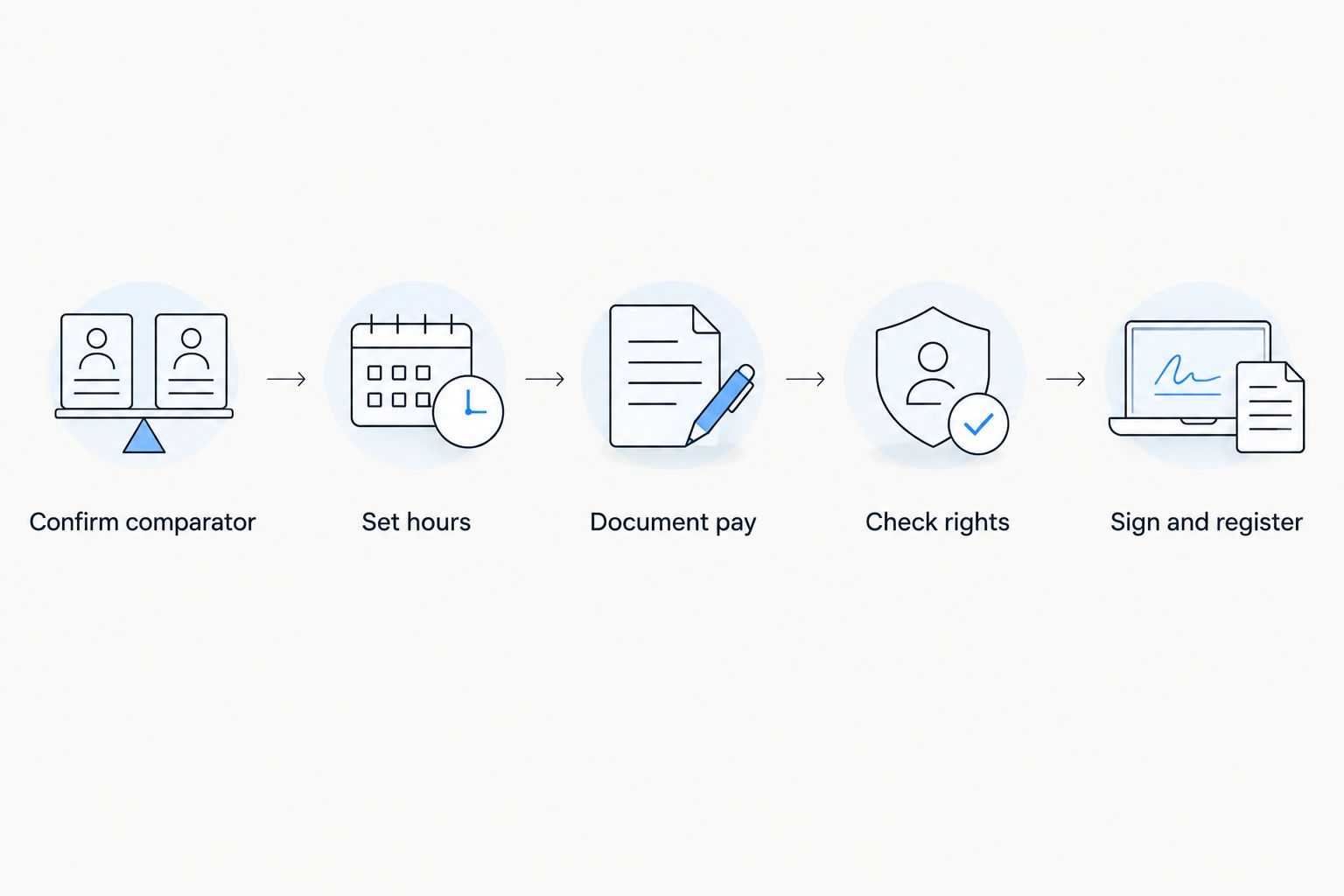
Choose the contract duration separately from working hours
Part-time describes working time. Fixed-term and indefinite-term describe duration. Treat these as separate decisions when drafting a 2026 agreement.
| Contract structure | Best for | Main advantage | Main limitation |
|---|---|---|---|
| Indefinite-term part-time employment | An ongoing role with reduced weekly hours | Reflects continuing employment without an artificial end date | Ending employment still requires the applicable termination process |
| Fixed-term part-time employment | Work supported by an objective fixed-term reason | Documents a genuine temporary requirement | A stated end date alone does not establish a lawful fixed-term basis |
Indefinite-term part-time employment
Use an indefinite-term agreement when the role continues without an objectively justified fixed endpoint. Describe the reduced schedule without implying that employment automatically ends when a particular roster finishes.
This structure fits recurring work. Its limitation is that termination remains subject to applicable notice, dismissal and payment rules; reduced hours do not remove those obligations.
Fixed-term part-time employment
Labour Law Article 11 requires an objective basis for fixed-term employment, such as completion of specified work or the occurrence of a particular event. Describe that basis in the agreement, not merely the intended end date.
This structure documents genuinely time-limited work, but it is not a substitute for probation. Repeated fixed-term contracts without the required substantive justification risk being treated as indefinite-term employment.
What should each contract clause contain?
Use the following drafting checklist to review the agreement. These are clause requirements, not a ready-to-sign legal template.
- Parties and role: Identify the employer and employee accurately, then describe duties and reporting arrangements. Avoid a job description so broad that the agreed role becomes unclear.
- Workplace: State where work occurs and address any agreed remote component. Assess workplace changes separately from routine scheduling.
- Working time: Record the comparator, weekly hours, workdays, daily distribution and breaks. Describe how schedule changes are proposed and documented.
- Remuneration: State the gross wage basis and payment arrangements. Explain eligibility for each relevant benefit rather than using a blanket exclusion for part-time staff.
- Leave and absence: Preserve statutory entitlements and identify the request and recording process. Separate annual leave from sickness and other absence categories.
- Duration and termination: State whether employment is indefinite or fixed-term. For fixed-term employment, document the objective reason; for termination, preserve mandatory rules.
- Confidentiality and data: Define legitimate confidentiality obligations and refer to the employer’s data-protection information. Do not treat a broad consent clause as a replacement for KVKK compliance.
For a 2026 agreement, review the contract alongside its referenced policies. An accurate main document does not cure a contradictory benefits schedule or working-time policy attached to it.
Why part-time contract wording varies
The employee’s actual arrangement determines the necessary detail. Adjust the agreement around these factors rather than copying a full-time contract and changing its title:
- Comparable full-time hours: The lawful part-time threshold depends on the relevant full-time schedule, not a universal reduced-hours label.
- Duration of the work: An ongoing role and objectively temporary work need different duration clauses.
- Predictability of the schedule: A stable weekly roster needs different scheduling detail from variable work. Call-on work also has specific rules under Labour Law Article 14.
- Work location: Remote work introduces documentation requirements beyond the part-time schedule itself.
- Benefit structure: Divisible payments and indivisible rights require different treatment. Do not apply one proportional reduction to everything.
- Applicable employment rules: Collective agreements, special statutory regimes and role-specific obligations affect the final wording.
How do you connect the contract to puantaj and SGK?
Use agreed hours to establish the arrangement and actual records to support payroll reporting. Puantaj is the attendance record; it is not the employment contract or the SGK declaration.
For qualifying hourly part-time arrangements, SGK premium days are calculated by dividing the relevant monthly working hours by 7.5 hours, with a fractional result counted as a full day. The legal basis and treatment of paid absences must be checked before applying that calculation to an individual employee.
Do not put a permanent SGK day count into a contract merely because the employee works a regular weekly pattern. Calendar distribution, paid periods and actual attendance affect the monthly record.
Before approving payroll, reconcile the signed schedule, recorded work, leave and reported missing days. Investigate differences instead of adjusting attendance retrospectively to match a preferred declaration.
Where does HR software fit?
The legal agreement and the operational records serve different purposes. Your Ottohr platform assessment should therefore cover HR, payroll and compliance needs without treating software as a substitute for contract review.
Ottohr is best suited to growing employers seeking HR, payroll and compliance tools in one platform. Its stated scope also includes hiring, onboarding and benefits; the limitation is that platform scope alone does not establish whether a particular employment clause is lawful.
When evaluating implementation, ask how agreed hours, attendance exceptions and payroll approvals will be handled. Confirm the required workflow rather than assuming a particular integration or automated filing function exists.
Can a part-time employee agree to work overtime?
A part-time employee cannot be assigned overtime or additional-hours work under Article 8 of the Overtime and Additional Hours Regulation. A general consent clause does not remove that restriction.
If actual working patterns repeatedly exceed the signed schedule, review the employment arrangement. Do not use an overtime-consent form to preserve a part-time classification that no longer matches the work.
Does a part-time employee receive less annual leave?
Part-time employees do not receive a shorter statutory annual leave duration simply because they work fewer weekly hours. The Annual Paid Leave Regulation applies the relevant service-based leave rules without that proportional reduction.
Leave duration and leave remuneration are distinct questions. Payroll must apply the correct pay treatment without converting reduced weekly hours into an automatic reduction of the statutory leave entitlement.
FAQ
What must I include in a Turkish part-time employment contract?
Include the parties, duties, workplace, start date, duration, weekly schedule, wage basis, benefits, leave and termination terms. Document the comparable full-time schedule and preserve mandatory employment rights.
Is 30 hours always the maximum for part-time work in Turkey?
No. A 30-hour ceiling applies where the comparable full-time week is 45 hours; the regulatory threshold is two-thirds of the comparable full-time working time.
Can I use a fixed-term contract just because the employee works part-time?
No. Part-time hours do not supply the objective reason required for fixed-term employment under Labour Law Article 11. Assess duration separately from working time.
Do part-time employees need SGK registration?
Part-time employee status does not remove the employer’s SGK registration obligations. Apply the relevant registration deadline and keep filing confirmation separately from the signed contract.
Can I cut annual leave in proportion to weekly hours?
No. Part-time status alone does not justify reducing statutory annual leave duration. Apply the relevant service-based rules and assess leave pay separately.
Can Ottohr replace legal review of a part-time contract?
No. Ottohr provides HR, payroll, benefits and compliance tools, but software selection does not establish that an individual contract complies with Turkish employment law.
One last thing
Audit the first payroll against the signed agreement. The revealing mismatch is often not a missing clause but a schedule that managers never actually followed.
For your 2026 hiring process, require the contract schedule, attendance record and payroll treatment to agree before approval. A polished template is not enough if daily operations contradict it.


