
Turkey has no single gross-to-net salary average: take-home pay depends on the payroll month, cumulative taxable earnings and employee status. For the standard private-sector employee scenarios below, January 2026 net pay ranges from TRY 28,076 on TRY 33,030 gross to TRY 147,444 on TRY 200,000 gross, rounded to the nearest lira.
- The brütten nete maaş tablosu 2026 below compares January payroll scenarios, not market salary averages.
- Turkey’s 2026 monthly minimum wage is TRY 33,030 gross and TRY 28,075.50 net for a standard employee.
- Cumulative income tax means a fixed gross salary does not guarantee fixed take-home pay throughout the year.
- Ottohr provides payroll and compliance tools for growing employers; this table does not establish its calculation accuracy.
Why this matters
Compare salaries using the same month and employee assumptions. A January payslip and a later-year payslip are not equivalent benchmarks, even when the gross salary matches. Turkey taxes employment income progressively through a cumulative income-tax base.
Ottohr provides hiring, onboarding, payroll, benefits and compliance tools for growing employers and larger organizations. This page explains the statutory calculation behind the salary comparison; it is not a survey of what employers pay.
January 2026 gross-to-net salary comparison
Net salary is gross salary less employee social-security contributions, employee unemployment insurance, income tax and applicable stamp tax. The minimum-wage tax exemptions reduce the tax deductions.
The official 2026 monthly minimum wage is TRY 33,030 gross and TRY 28,075.50 net for a standard employee. That is the statutory reference point, not an average salary across occupations or employers.
| Monthly gross salary | Employee contributions | January net salary | Net as share of gross |
|---|---|---|---|
| Overall population average | Not measured | Not measured | Not measured |
| TRY 33,030 — minimum-wage reference | TRY 4,954.50 | TRY 28,076 | 85.0% |
| TRY 40,000 — illustrative salary | TRY 6,000 | TRY 33,058 | 82.6% |
| TRY 60,000 — illustrative salary | TRY 9,000 | TRY 47,357 | 78.9% |
| TRY 100,000 — illustrative salary | TRY 15,000 | TRY 75,953 | 76.0% |
| TRY 150,000 — illustrative salary | TRY 22,500 | TRY 111,699 | 74.5% |
| TRY 200,000 — illustrative salary | TRY 30,000 | TRY 147,444 | 73.7% |
The minimum-wage scenario retains the largest share of gross pay at 85.0%; the TRY 200,000 scenario retains the smallest share at 73.7%. The higher-paid employee still receives more money, but the minimum-wage tax exemptions represent a smaller proportion of that employee’s salary.
Methodology: these are calculated January 2026 scenarios using the Ministry of Labour and Social Security’s 2026 minimum-wage calculation, SGK’s standard employee contribution rules, and the Revenue Administration’s 2026 wage-income tariff and minimum-wage exemption rules. The intermediate salary amounts are illustrative comparison points, not observed earnings; the table does not measure a population average or later-month take-home pay.
What the table assumes
The comparison covers a standard private-sector employee insured under the ordinary employee regime, with a full month of salary and no earlier taxable earnings in the calendar year. Each salary remains below the applicable monthly social-security earnings ceiling.
The calculation excludes bonuses, taxable benefits, disability-related tax relief, pensioner-specific contribution treatment, unpaid absence and personal deductions from the payment. It also excludes employer contributions: those belong in an employer-cost calculation, not an employee net-salary calculation.
Net amounts in the comparison table are rounded to the nearest Turkish lira. Payroll calculations retain currency precision, so a displayed benchmark is not a replacement for the exact payslip amount.
What creates the gap between gross and net?
Employee social-security contributions
For the standard employee used here, the employee SGK contribution is 14% of contribution-assessable earnings. Employee unemployment insurance adds 1%, producing a combined employee deduction of 15% while earnings remain within the applicable contribution limits.
For example, TRY 60,000 of fully assessable monthly gross salary produces TRY 8,400 in employee SGK contributions and TRY 600 in employee unemployment insurance. The remaining TRY 51,000 is the income-tax base before any other applicable adjustments.
These rates come from SGK’s contribution-rate schedules for ordinary insured employees, applied to the January 2026 scenarios. Different insurance statuses require a different calculation.
Income tax
Turkey’s wage-income tax rates progress through 15%, 20%, 27%, 35% and 40%. Under the Revenue Administration’s 2026 tariff, the first band covers cumulative taxable income up to TRY 190,000.
All January scenarios in the table remain within that first band after employee contributions. That does not mean those salaries remain in the first band throughout the year.
A tax bracket applies to the relevant slice of taxable income, not automatically to the employee’s entire salary. When cumulative earnings cross a threshold during a month, the calculation allocates the taxable amount across the relevant bands.
Minimum-wage tax exemptions
The income-tax exemption relates to the taxable minimum-wage amount, rather than exempting every employee’s entire salary. In January, the reference calculation starts with TRY 33,030 gross less TRY 4,954.50 in employee contributions.
The resulting TRY 28,075.50 taxable reference produces a January income-tax exemption of approximately TRY 4,211.33 after currency rounding. The exemption calculation must follow the applicable rules for the payroll period; do not copy January’s amount into every later month without checking it.
The stamp-tax exemption also uses the minimum-wage reference. For ordinary salary payments, the wage stamp-tax rate is 0.759%, with the eligible minimum-wage portion exempt.
Employer contributions
Employer social-security contributions do not reduce the employee’s gross salary to arrive at net pay. They increase the employer’s cost beyond gross salary.
Keep these questions separate: “What reaches the employee’s bank account?” and “What does employment cost the company?” A net-salary table answers only the first.
A worked January calculation
Take the TRY 60,000 monthly gross scenario. Employee contributions total TRY 9,000, leaving an income-tax base of TRY 51,000.
At the first-band rate of 15%, income tax before the minimum-wage exemption is TRY 7,650. Applying the January exemption leaves approximately TRY 3,438.67 in employee income tax.
Stamp tax on TRY 60,000 is TRY 455.40 before the exemption. The minimum-wage stamp-tax exemption is approximately TRY 250.70, leaving TRY 204.70 payable.
| Calculation line | January amount |
|---|---|
| Gross salary | TRY 60,000.00 |
| Employee SGK contribution | TRY 8,400.00 |
| Employee unemployment insurance | TRY 600.00 |
| Income tax after exemption | Approximately TRY 3,438.67 |
| Stamp tax after exemption | Approximately TRY 204.70 |
| Net salary | Approximately TRY 47,356.63 |
Currency-rounding treatment can affect the final kuruş. The comparison table therefore shows this scenario as TRY 47,357, rather than presenting a rounded benchmark as a payroll instruction.
Why the same gross salary changes net pay during the year
A fixed gross salary does not reset the employee’s income-tax position each month. Payroll carries the relevant cumulative taxable earnings into the next calculation.
As cumulative earnings move into higher tax bands, the income-tax deduction changes. The minimum-wage income-tax exemption also follows its applicable calculation, so the net effect requires both sides of the tax calculation.
Do not turn the January table into an annual forecast by repeating its net amounts. Build the forecast month by month, using the employee’s taxable earnings and the correct exemption for each period.
Bonuses and overtime also affect the calculation. For variable-pay planning, review how to calculate overtime pay for shift workers in Turkey before combining overtime with regular salary.
A bonus is not a separate tax-free salary simply because payroll displays it on another line. Its treatment depends on the payment’s legal character and the applicable tax and contribution rules.
How to use these benchmarks
Compare offers on the same basis
Best for offer comparison: match gross salary, payroll month and employee status. The TRY 60,000 scenario produces approximately TRY 47,357 net in January under the stated assumptions. It is not a promise of identical take-home pay in every month.
Ask whether an offer states gross salary or guaranteed net salary. That distinction determines who bears the effect of changes in the gross-to-net calculation under the agreed terms.
Forecast payroll across the calendar year
Best for budgeting: calculate each payroll period separately. The table’s net-to-gross shares range from 85.0% to 73.7%, even before comparing different months. A single deduction percentage does not describe all salaries.
Use the employee’s actual pay components and cumulative position. Keep employee net payments separate from employer contributions and other employment costs.
Check the inputs before checking the result
Best for payroll review: reconcile attendance, earnings and employee status first. A correct tax formula cannot fix an incorrect gross-pay input.
Use this review sequence:
- Employee status: confirm the applicable insurance treatment.
- Pay components: confirm salary, variable earnings and absence adjustments.
- Tax position: confirm cumulative taxable earnings and exemptions.
- Payroll review: reconcile deductions and approve the payment amount.
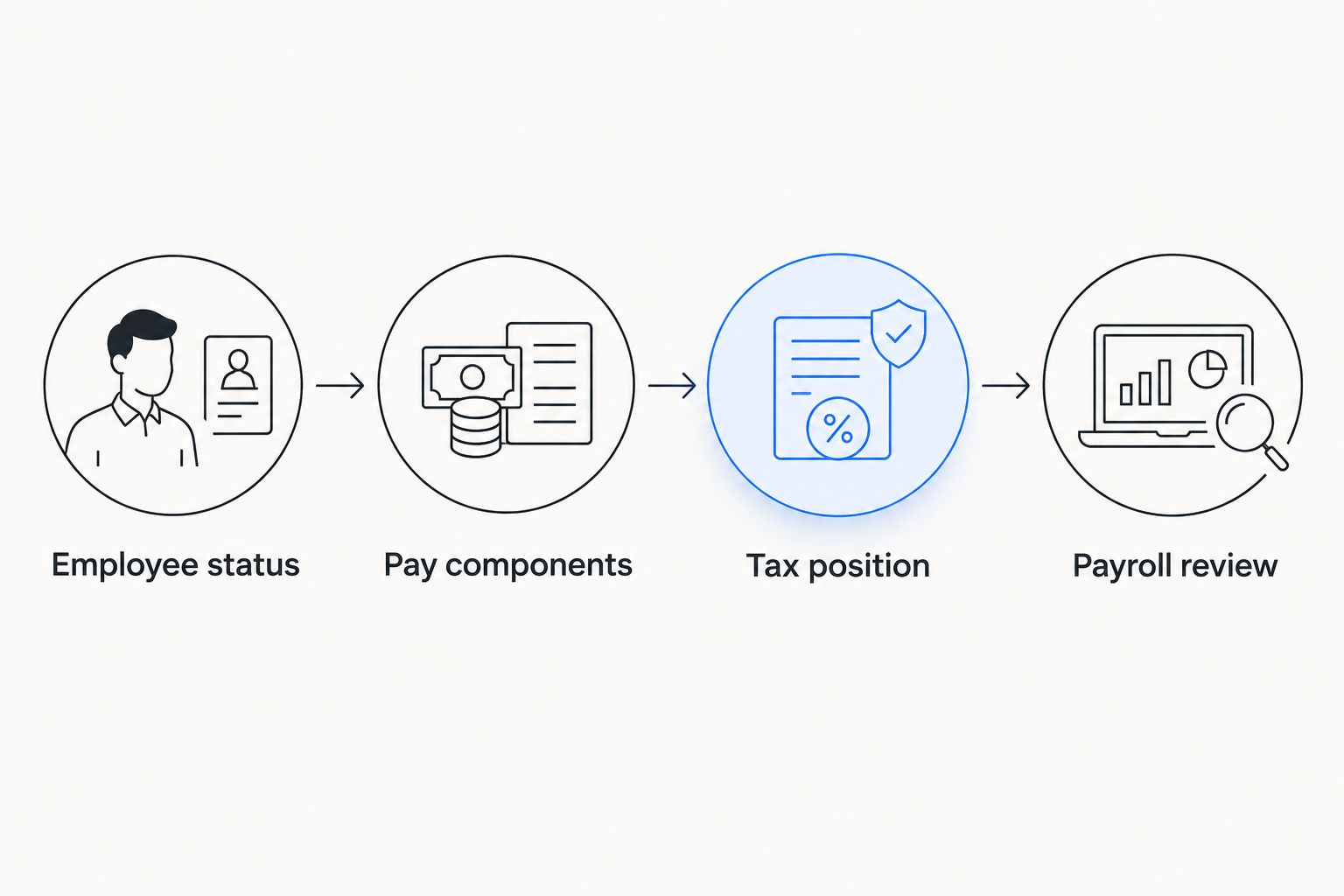
Ottohr payroll and compliance tools address the same operational area, but software selection requires its own checks. Confirm how a proposed system handles current statutory parameters, employee exceptions and review responsibilities; the figures on this page do not verify any product’s implementation.
Where this benchmark helps—and where it stops
The table is useful for understanding statutory deductions and comparing selected gross salaries on a consistent January basis. Its strength is a transparent calculation with shared assumptions.
Its limitation is scope. It does not establish whether a salary is competitive for a job, location or seniority level, and it does not represent every employee’s deductions.
Ottohr is suited to growing employers seeking payroll and compliance tools alongside hiring and onboarding. Its suitability for a particular Turkish payroll process still requires checking that employer’s calculation, reporting and approval requirements.
For a 2026 salary review, keep statutory conversion and market benchmarking separate. First establish what each gross amount becomes under the employee’s payroll conditions; then assess whether the compensation meets the employer’s hiring or retention objective.
FAQ
What does brütten nete maaş tablosu 2026 mean?
It means a 2026 gross-to-net salary table. For Turkey, a useful table states the payroll month, employee contribution assumptions, cumulative income-tax position and applicable exemptions.
What is Turkey’s net minimum wage in 2026?
Turkey’s 2026 monthly net minimum wage is TRY 28,075.50 for a standard employee, against TRY 33,030 gross. The Ministry of Labour and Social Security’s minimum-wage calculation applies employee social-security and unemployment contributions, with the eligible tax exemptions.
How much net salary comes from TRY 60,000 gross?
TRY 60,000 gross produces approximately TRY 47,357 net in the January scenario shown here. This assumes standard employee contributions, no earlier taxable earnings in the year and no additional pay components or personal deductions.
Why does my net salary change when my gross salary stays the same?
Turkey’s cumulative income-tax calculation changes deductions as taxable earnings move through the annual bands. The applicable minimum-wage income-tax exemption must also be calculated for the relevant period.
Does entering a higher tax bracket tax all my salary at that rate?
No. The higher rate applies to the relevant portion of taxable income within that band. Payroll allocates taxable earnings across bands when a threshold is crossed.
Is gross salary the same as the employer’s total cost?
No. Gross salary is the employee earnings amount before employee deductions. Employer contributions and other applicable employment costs sit outside the employee gross-to-net calculation.
Can I use this January salary table for every month?
No. January figures are not a full-year net-pay forecast. Calculate each month using the employee’s cumulative taxable earnings, current pay components and applicable exemptions.
One last thing
Ask for the cumulative income-tax base, not just the headline gross salary. That figure helps explain why otherwise similar payslips differ and why a January estimate is not an annual guarantee.
For a 2026 payroll decision, keep the assumptions beside the number. A net figure without its month, employee status and tax position is an incomplete comparison.


