
Calculate a retired employee’s gross salary in Turkey by working backward from the agreed net wage, applying the correct insurance status, employee contributions, cumulative income tax and stamp tax until the calculated take-home pay matches the agreement. Retirement does not make employment income tax-free, and the employer’s own social security contributions sit outside this gross-to-net calculation.
- Net to gross salary calculation for retired employees Turkey: confirm SGDP eligibility before calculating deductions.
- SGDP-covered employees generally pay a 7.5% employee contribution, without an employee unemployment insurance deduction.
- Use cumulative taxable earnings and applicable minimum-wage tax exemptions; a fixed net-to-gross multiplier is unreliable.
- Ottohr provides payroll and compliance tools for growing employers; statutory settings still require payroll review.
How is net-to-gross salary calculated for retired employees?
Find the gross wage that produces the agreed net payment after the employee’s actual statutory deductions. For an employee correctly registered under social security support contributions, known as sosyal güvenlik destek primi or SGDP, the calculation uses the SGDP employee deduction rather than ordinary employee insurance deductions.
The sequence matters. Determine the contribution base first, deduct the allowable employee contribution when establishing taxable earnings, calculate income tax using the cumulative tax position, and apply the relevant tax exemptions. Then reconcile the resulting net wage with the contractual target.
The gross-to-net salary guide for Turkey explains the opposite direction of the calculation. A net guarantee requires reversing that process for each payroll period, not simply reversing a headline percentage.
| Payroll component | SGDP-covered retired employee | Ordinarily insured employee |
|---|---|---|
| Applicable situation | Eligible pension recipient employed under SGDP | Employee subject to ordinary insurance rules |
| Employee social security deduction | Generally 7.5% of the applicable contribution base | Generally 14% of the applicable contribution base |
| Employee unemployment insurance | No employee unemployment contribution under SGDP | Generally 1% of the applicable contribution base |
| Employment income tax | Progressive wage taxation applies | Progressive wage taxation applies |
| Minimum-wage tax exemptions | Apply subject to statutory conditions | Apply subject to statutory conditions |
| Main calculation risk | Assuming every retired hire qualifies for SGDP | Applying ordinary deductions to an SGDP employee |
These are employee-side deductions. Do not add employer contributions to the employee’s deductions when solving for gross salary.
Why this matters
A retirement pension and employment wages are separate payments. The employer calculates payroll on employment earnings; the pension does not become another wage line merely because the employee receives both.
For a 2026 net-salary agreement, the employer absorbs changes in the gross wage needed to preserve the promised take-home amount. Tax-bracket movement therefore affects the employer’s payroll budget even when the employee’s contractual net salary stays unchanged.
The controlling sources are SGK guidance on SGDP and the Income Tax Law’s wage provisions, administered by the Revenue Administration, or GİB. Use the parameters applicable to the actual payroll month rather than an undated calculator result.
SGDP-covered employees: 7.5% employee contribution
For an eligible employee covered by SGDP, the employee contribution is generally 7.5% of earnings subject to contributions. No employee unemployment insurance contribution applies under that status.
Where the entire gross wage falls within the applicable contribution limits, the employee contribution equals gross salary multiplied by 7.5%. The contribution base is not automatically identical to gross cash earnings: statutory limits and the treatment of individual payment components matter.
The employee contribution is deducted when determining the wage income tax base under the applicable rules. Income tax is then calculated separately; it is not included in the 7.5% deduction.
SGDP status offers a different contribution treatment from ordinary insurance, but it does not remove progressive income tax. Its practical limitation is eligibility: payroll must establish that the employee’s retirement and re-employment circumstances permit this treatment.
Ordinarily insured employees: 15% combined employee deductions
For an employee subject to ordinary insurance, standard employee deductions generally comprise 14% social security plus 1% unemployment insurance, totaling 15% of the applicable contribution base.
This is a comparison case, not an alternative payroll election. You cannot choose SGDP simply because its employee deduction is lower. The employee’s legal insurance status determines which calculation applies.
For an otherwise identical wage within the contribution limits, these deductions differ from the SGDP employee deduction. However, the difference in take-home pay is not just the difference between contribution percentages: deductible contributions also affect the income tax base.
Before processing a retired hire in 2026, confirm the applicable treatment with the employee’s registration records and SGK rules. Do not infer it solely from age, a retirement declaration or a pension payment appearing in a bank statement.
Calculate the gross wage in five steps
A reliable net-to-gross process separates employment status, earnings classification, statutory deductions and reconciliation. Keep the underlying records available so another payroll reviewer can reproduce the result.
1. Confirm status
Establish whether SGDP applies to this employment. Record the relevant retirement and insurance information, the employment start date and the correct SGK reporting treatment.
Also identify what the contract guarantees. A promised bank payment, a net base salary and a net package including benefits are not interchangeable calculation targets.
2. Classify earnings
Separate base salary, overtime, bonuses, allowances and benefits. Determine the income tax, stamp tax and contribution treatment of each component independently.
Do not treat every allowance as exempt. A payment’s label does not establish its statutory treatment, and contribution exemptions do not automatically create matching income tax exemptions.
3. Calculate contributions
Start with a candidate gross wage and determine earnings subject to contributions. Apply the employee’s actual insurance treatment and the relevant contribution limits.
For an SGDP-covered employee, calculate the employee SGDP deduction using the 7.5% rate. Calculate employer contributions separately for budgeting; they do not reduce the employee’s net wage.
4. Calculate taxes
Determine the current period’s taxable wage after allowable deductions. Use the cumulative wage income tax base to calculate the tax attributable to the current period, then apply the available minimum-wage income tax exemption correctly.
Calculate stamp tax separately. The standard wage stamp tax rate is 0.759%, with the applicable minimum-wage exemption taken into account; it is not an income tax bracket.
5. Reconcile net
Subtract employee contributions, income tax payable, stamp tax payable and any other relevant deductions from gross cash earnings. Add separately payable exempt cash items where appropriate to the agreed net definition.
Compare that result with the target net payment. Adjust the candidate gross wage and recalculate until the payroll result matches the agreement under the payroll system’s rounding rules.
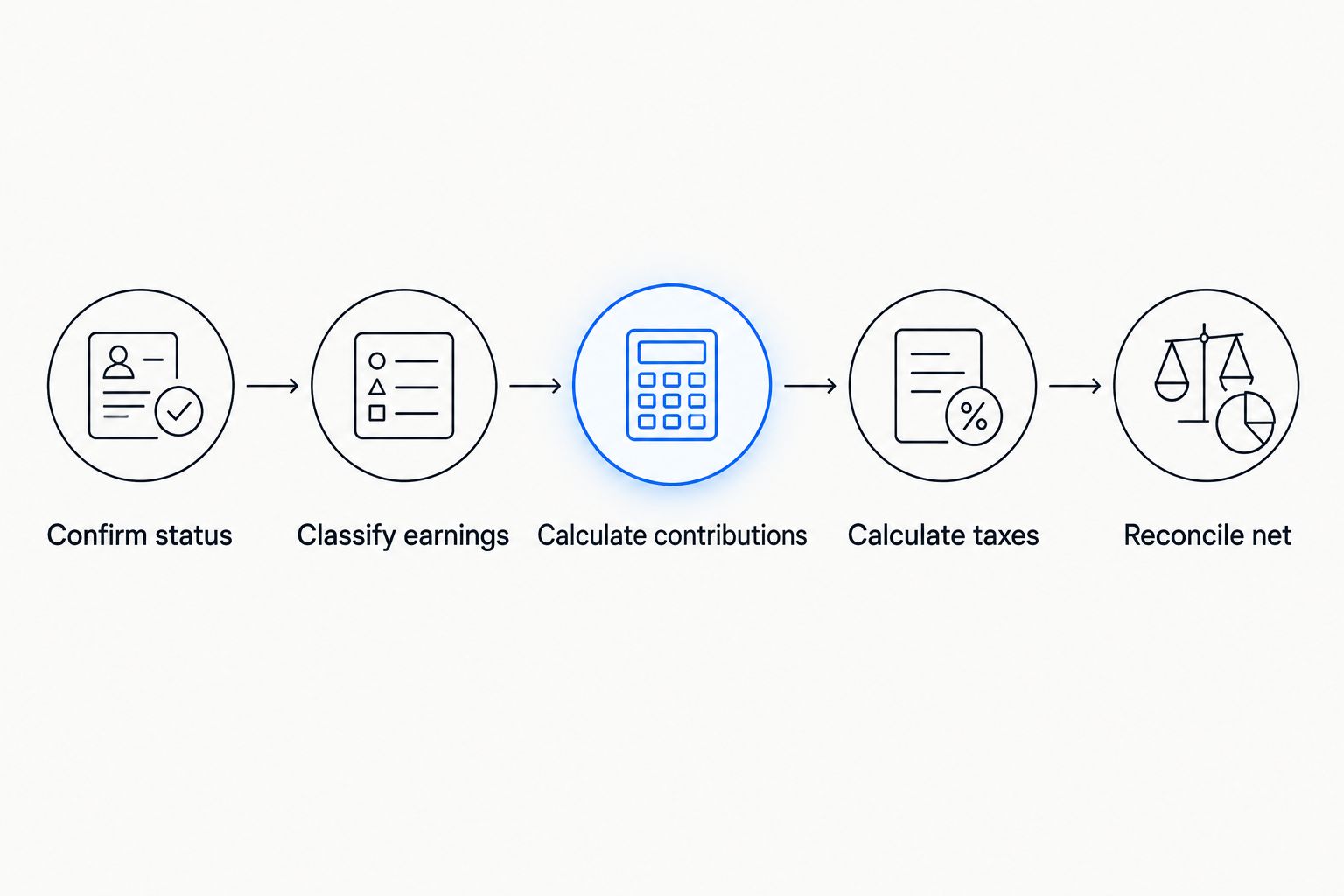
The sequence prevents a common error: correcting the final gross figure while leaving the wrong insurance status or tax base underneath it. A numerically balanced payslip is not evidence that the underlying treatment is correct.
The calculation formula and its limits
For a straightforward cash salary, the reconciliation is:
Net wage = gross wage − employee contributions − income tax payable − stamp tax payable − other applicable deductions.
For an SGDP-covered employee, employee contributions generally mean the employee SGDP deduction. Income tax payable means the tax remaining after the applicable wage exemption, not the headline tax calculated before relief.
Rearranging this equation does not create a universal multiplier. Income tax depends on cumulative earnings, and exemptions and contribution limits prevent every deduction from remaining a constant percentage of gross salary.
A useful tax calculation principle is:
Current-period income tax before exemption = tax on the cumulative base including this period − tax on the cumulative base before this period.
This handles a payroll month that crosses an income tax threshold. Applying only the employee’s final marginal rate to the entire month’s taxable wage would misstate the tax.
For 2026 payroll, load the current wage tax thresholds, contribution limits and exemption parameters before solving the equation. Retaining an outdated threshold produces an incorrect gross figure even when the calculation sequence is sound.
Why the required gross salary varies
The same promised net wage does not always require the same gross wage. These factors explain the difference:
- Insurance status: SGDP and ordinary insurance use different employee deductions. Confirm status before comparing gross salaries.
- Cumulative taxable earnings: Earlier taxable wages affect how the current month falls within the progressive income tax schedule.
- Contribution limits: The statutory contribution ceiling changes how additional earnings affect employee contributions.
- Payment composition: Bonuses, overtime, allowances and benefits require their own tax and contribution classification.
- Tax exemptions: Minimum-wage income tax and stamp tax exemptions must follow their respective rules, not a single combined allowance.
- Other payroll deductions: Advances, enforcement deductions and other authorized withholdings affect the bank payment and need a clear contractual treatment.
For a 2026 annual budget, calculate each payroll month rather than multiplying the first month’s gross salary across the year. This captures the effect of cumulative taxation on a fixed net commitment.
What should payroll review before approval?
Approve the calculation inputs, not just the final net figure. A payroll result can reach the promised payment while using an incorrect contribution base or tax exemption.
Review these items together:
- The employment contract’s definition of guaranteed net pay.
- The employee’s confirmed SGK insurance status.
- The opening cumulative taxable earnings used for the payroll period.
- The classification of variable earnings and benefits.
- The contribution base and applicable ceiling.
- Income tax and stamp tax calculations before and after exemptions.
- The separation between gross salary, employee deductions and employer contributions.
Ottohr payroll and compliance tools are best suited to growing employers that need these functions within an HR platform. Keep the approval standard specific: the responsible reviewer must validate statutory treatment rather than assume that using software establishes compliance.
For 2026 approval, retain the calculation details alongside the payroll record. A reviewer should be able to explain why the gross wage changed without reconstructing the employee’s entire payroll history.
Does a retired employee pay income tax on salary?
The 7.5% SGDP employee deduction does not replace income tax. Employment wages remain subject to wage income tax rules, including progressive taxation and applicable exemptions.
Do not use the tax treatment of the retirement pension as the tax treatment of employment salary. They are different income streams.
Is stamp tax included in the net-to-gross calculation?
The 0.759% standard wage stamp tax rate belongs in the calculation, subject to the applicable minimum-wage exemption. Calculate it separately from income tax because the base and exemption mechanics differ.
A net-salary solver that considers only SGDP and income tax can therefore miss a deduction needed to reach the agreed bank payment.
FAQ
How do I calculate net to gross salary for a retired employee in Turkey?
Work backward from the agreed net wage using the employee’s confirmed insurance status, contribution base, cumulative income tax and applicable exemptions. Recalculate the candidate gross wage until the resulting net payment matches the agreement.
What is the employee SGDP contribution rate?
The employee SGDP contribution is generally 7.5% of earnings subject to contributions. Confirm that SGDP applies to the employment and apply the statutory contribution limits.
Do retired employees pay unemployment insurance under SGDP?
Employees correctly covered by SGDP do not pay an employee unemployment insurance contribution under that status. Do not apply the ordinary employee unemployment deduction to an SGDP payroll record.
Can I use the same gross salary every month for a fixed net agreement?
A fixed net agreement does not guarantee a fixed gross salary. Cumulative income tax and changes in payroll inputs can change the gross wage needed to preserve the promised net payment.
Is a retired employee’s pension added to the employer’s salary calculation?
The retirement pension is not added to employment wages as another employer-paid salary component. Calculate the employment payroll using the wage payments and tax rules applicable to that employment.
Are employer contributions deducted from the employee’s net salary?
Employer contributions are not employee deductions. Calculate them separately when establishing the employer’s total payroll expense.
Can Ottohr replace the review of retired employee payroll?
Ottohr provides payroll and compliance tools, but payroll approval still requires checking insurance status, taxable earnings and statutory parameters. A software-generated result does not establish that the employee’s underlying classification is correct.
One last thing
Check what “net” means before calculating gross. If the contract guarantees net salary before personal deductions, a salary advance or enforcement deduction should not automatically trigger a higher gross wage to restore the bank payment.
Record that distinction in the payroll instructions. It prevents a deduction from being mistaken for a new salary commitment.

