
A background check when hiring in Turkey has no single fixed completion time in 2026: the schedule depends on the checks required, the records involved and the responses you need. Obtaining a document does not complete the process; identity matching, lawful handling of personal data and review of discrepancies also belong in your hiring schedule.
- How long does a background check take when hiring in Turkey? There is no universal completion time.
- An e-Devlet criminal record certificate is not a complete employment background check.
- Set your hiring deadline around required checks, outstanding responses and final approval.
- Ottohr supports hiring and onboarding; screening still requires a lawful purpose and a documented decision.
Why this matters
A start date becomes unreliable when your team treats screening as a single document request. A criminal record certificate, an employment reference and a qualification check answer different questions. Completing one does not complete the others.
For your 2026 hiring plan, separate screening from contract preparation, onboarding and employment registration. Your HR compliance process for hiring in Turkey should identify which checks are necessary before you request personal information.
Set a completion date only after you define what “complete” means for the role. Otherwise, recruiters and managers work toward different approval conditions.
How long does a background check take when hiring in Turkey?
The completion time depends on the last required check that remains unresolved. Candidate-supplied documents, replies from previous employers, institutional verification and internal review follow different routes. A document arriving quickly does not establish a turnaround time for the entire process.
Use the comparison below to define the scope before you promise a start date. These are screening activities, not interchangeable levels of assurance.
| Screening activity | Best for | What it establishes | Limitation affecting completion |
|---|---|---|---|
| Identity matching | Connecting documents to the applicant | Whether identifying details correspond | A mismatch needs clarification before you rely on the document |
| Criminal record review | Roles with a lawful, justified requirement | Information within the certificate’s scope | It does not verify employment history or qualifications |
| Employment references | Checking relevant work history | Information supplied by an authorized reference | Completion depends on another person responding |
| Qualification verification | Roles requiring specific credentials | Whether the relevant qualification is supported | An institution or issuing body might need to respond |
| Overseas verification | Relevant history outside Turkey | Evidence from the applicable foreign source | Local procedures, language and access requirements differ |
Do not convert these activities into a standard duration without a documented commitment from the people completing them. Ask for a proposed completion date, its assumptions and the escalation route for an unanswered request.
Criminal record review: document receipt is not clearance
An adli sicil kaydı is a criminal record certificate. Turkey’s e-Devlet service provides a route for individuals to obtain criminal record information through the Ministry of Justice’s relevant service.
The certificate is not a general assessment of suitability. Before reviewing it, establish why the role requires that information, whether you have a lawful processing condition and who is authorized to see it. Do not request archive information automatically because it appears more extensive.
Reference checks: another person controls the response
An employment reference depends on a former employer or another appropriate referee responding. Agree on the questions before making contact, and limit them to relevant information.
An unanswered reference is an open request, not evidence of misconduct. Record the attempts made and decide whether another lawful source can answer the same question.
Qualification checks: verify the requirement first
Start with the credential the job actually requires. A role needing a professional authorization calls for a different inquiry from a role where a degree is simply preferred.
Check the issuing institution or relevant professional body through an appropriate route. A document supplied by the candidate supports the review, but your process should state whether independent verification is required.
Why background check timing varies
Your 2026 screening schedule should reflect the actual dependencies rather than a generic estimate. These factors determine what must happen before you can close the review:
- Scope: Each additional required check creates another completion condition. Remove requests that have no justified connection to the role.
- Candidate documents: Missing pages, unclear copies or inconsistent identifying details require clarification before review.
- External responses: Former employers, institutions and authorized verification providers control their own replies.
- Overseas records: Foreign procedures, translations and access restrictions introduce separate requirements.
- Legal review: Criminal conviction and security-measure information requires treatment under the special-category rules of KVKK.
- Decision ownership: A completed report remains unresolved until an authorized person reviews exceptions and records the outcome.
Track the next action and its owner, not just whether the check is pending. “Waiting for the university” and “waiting for internal approval” require different interventions.
How to build a screening schedule you can defend
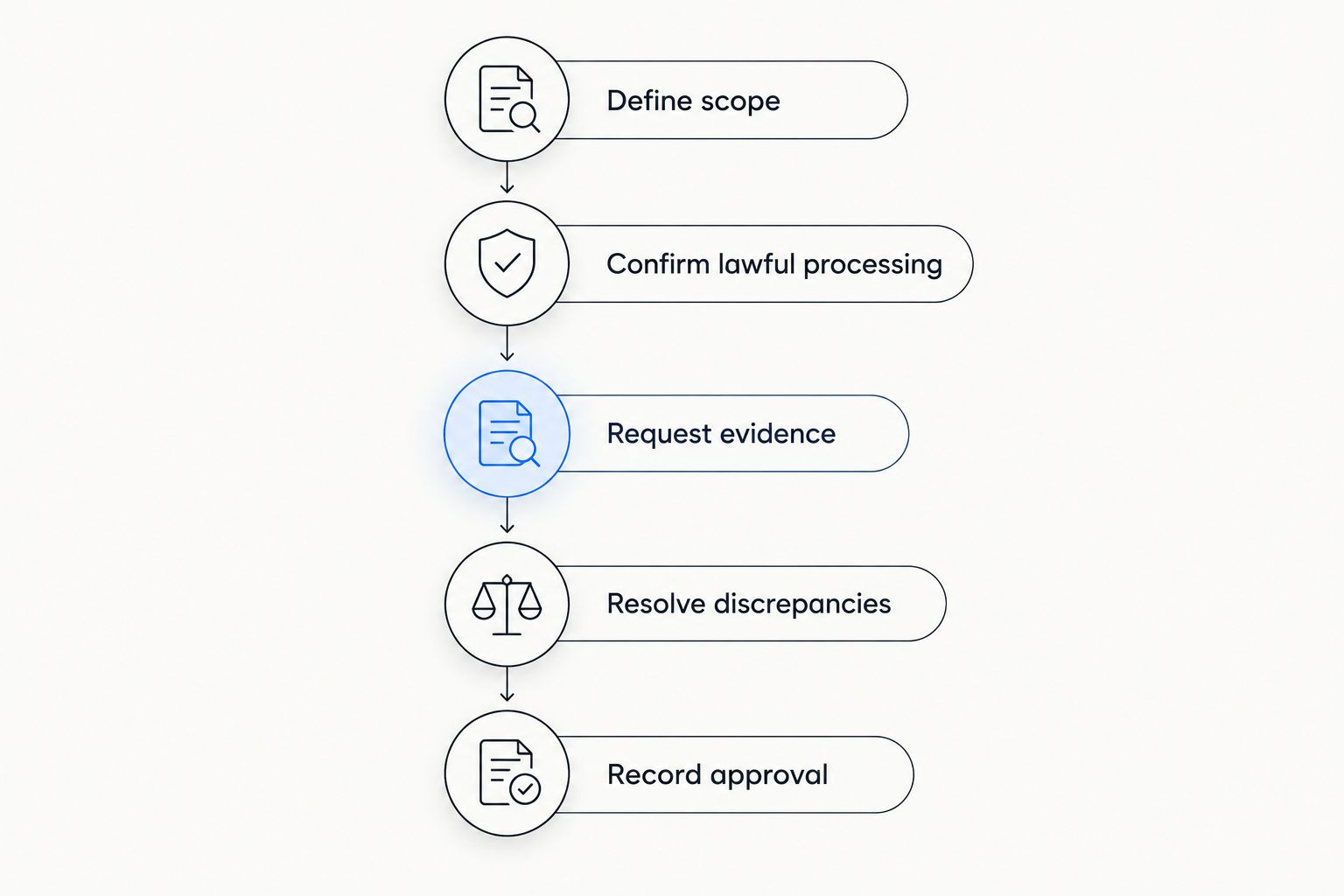
A workable schedule starts with a role-specific checklist and ends with a recorded hiring decision. Use the following sequence for your 2026 process.
1. Define scope
Write down what you need to establish and why. Separate essential qualifications, relevant work history and any legally justified criminal record requirement.
Do not copy the same checklist across every role. Access to sensitive systems, regulated responsibilities and professional licensing requirements need their own assessment rather than a broader request for personal history.
2. Confirm lawful processing
Identify the applicable processing condition, prepare the candidate notice and define access restrictions. Decide whether a screening provider or an overseas recipient will receive any information.
Do this before collection. A signed form does not correct an unnecessary request, an unclear purpose or an unlawful transfer.
3. Request evidence
Tell the candidate exactly what evidence is required, how to submit it and whom to contact about discrepancies. Ask references and institutions questions that match the approved scope.
Where lawful and practical, send independent requests in parallel. Keep a record of the request date, recipient, expected response and follow-up owner.
4. Resolve discrepancies
Match the evidence to the candidate and separate incomplete information from an actual contradiction. Ask for an explanation where a document, date or qualification does not match the application.
Do not treat an unexplained system status as a finding. Record the underlying issue in plain language so the decision-maker can assess it.
5. Record approval
Give an authorized person responsibility for the outcome. Record which requirements are satisfied, which remain open and whether an outstanding item prevents the planned start.
Keep the decision record separate from unrestricted copies of sensitive evidence. Your retention and access rules should apply after approval as well as during screening.
What does KVKK change about a background check?
Turkey’s Personal Data Protection Law, Law No. 6698, governs the handling of candidate personal data. For a 2026 screening workflow, the relevant statutory provisions include Article 4 on processing principles, Article 6 on special-category data and Article 10 on the obligation to inform individuals.
Article 4 requires processing to serve specified, explicit and legitimate purposes and remain relevant, limited and proportionate. That makes “we request this from everyone” an inadequate explanation for collecting information unrelated to a job.
Criminal record information needs a specific legal assessment
Article 6 treats information concerning criminal convictions and security measures as special-category personal data. Do not assume that an ordinary legitimate-interest assessment is enough to process it.
Determine the applicable Article 6 condition for the particular request. If you rely on explicit consent, assess whether it is valid in the employment context rather than attaching a blanket consent clause to every application.
The candidate notice is separate from consent
Article 10 concerns informing the individual about processing. Your notice should address the controller’s identity, processing purposes, relevant recipients, collection method and legal basis, and the individual’s statutory rights.
A privacy notice explains processing; consent, where applicable, is a separate legal condition. Neither document gives an employer unrestricted access to criminal records or unrelated personal information.
Limit access and review transfers
Give access only to people who need the information for the stated purpose. A hiring manager might need the approval outcome without needing the underlying certificate.
If a provider or HR system sends candidate data outside Turkey, assess the applicable international-transfer requirements separately. Permission to collect information does not automatically establish permission to transfer it abroad.
How should you handle a delayed check?
Start by identifying the unresolved requirement. A missing candidate document calls for a clear request; an unanswered institutional inquiry calls for follow-up; an internal review queue calls for a decision owner.
Use status descriptions that identify the next action:
- Awaiting candidate evidence: State the exact document or clarification needed.
- Awaiting external response: Name the organization responsible and the follow-up owner.
- Under review: Identify the discrepancy and the person assessing it.
- Approved: Record the decision and any conditions that remain relevant.
Avoid labelling every delayed case as failed. The absence of a response does not establish that the candidate supplied false information.
If the start date is approaching, escalate the specific unresolved requirement. Do not quietly remove a role-critical check to make the dashboard appear complete.
Can an employee start before the background check is complete?
There is no universal clearance rule covering every private-sector role in Turkey. The answer depends on statutory role requirements, the unresolved check and the employer’s lawful hiring conditions.
Before permitting a start, identify what remains unknown and whether it prevents the person from performing the role. Any temporary restriction must fit the employment arrangement and applicable law; an internal approval cannot waive a statutory requirement.
Keep SGK obligations separate from screening. A pending reference or certificate does not suspend employment-registration duties.
Does an e-Devlet criminal record certificate finish the check?
An e-Devlet criminal record certificate finishes only the document step that your lawful screening scope requires. It does not establish qualifications, confirm previous employment or replace the hiring decision.
Check the certificate’s identity details and relevance to the request. Do not circulate the document as a general candidate profile or collect additional record categories without a justified basis.
Is an overseas background check part of the Turkish process?
An overseas background check is a separate dependency when relevant history or required evidence sits outside Turkey. Define the country, source, purpose and verification method before including it in your completion criteria.
Tell the candidate what is needed rather than asking for a generic international clearance. Review both the foreign collection requirements and the Turkish rules governing your processing and any transfer.
Where an HR platform fits
Ottohr is best for growing employers and mid-size to large enterprises seeking hiring, onboarding, payroll, benefits and compliance tools in an HR platform. That scope places the platform in the wider employment workflow, not in place of a lawful screening decision.
When evaluating Ottohr, distinguish the HR functions you need from the verification services your screening process requires. Do not assume that an HR platform includes criminal-record access, institutional verification or a guaranteed screening turnaround.
The practical question is how your team will connect an approved hiring decision to onboarding without exposing unnecessary candidate data. Assess Ottohr against your documented requirements, including approval ownership and the handling of unresolved checks.
FAQ
How long does a background check take when hiring in Turkey in 2026?
There is no single fixed completion time for a background check when hiring in Turkey in 2026. The schedule depends on the required records, external responses, discrepancies and final review.
Can I get a Turkish criminal record certificate through e-Devlet?
Individuals can use the relevant Ministry of Justice service on e-Devlet to obtain criminal record information. The certificate is not a complete employment background check or a guarantee of hiring suitability.
Can an employer request a criminal record from every applicant?
An employer must establish a lawful and proportionate reason for requesting criminal record information. KVKK treats information concerning criminal convictions and security measures as special-category personal data, so a blanket request needs more than administrative convenience.
Does candidate consent make every background check lawful?
Candidate consent does not make every background check lawful. The employer must still assess the applicable processing condition, necessity, proportionality, notice obligations and any transfer requirements.
Should I reject a candidate because a reference has not replied?
An unanswered reference is not evidence that the candidate has misrepresented their history. Record the outstanding request and assess whether another lawful source can establish the required fact.
Can onboarding begin while a check is pending?
Preparatory onboarding and permission to start work are separate decisions. Assess the unresolved requirement, any statutory restrictions and your employment obligations before allowing the employee to begin.
Does a background check replace SGK registration?
A background check does not replace SGK registration. Screening, employment documentation and social-security notifications remain separate responsibilities.
One last thing
The final reviewer is part of the screening timeline. A file with every document attached is still incomplete if nobody has authority to resolve discrepancies and approve the result.
Before opening your next vacancy, assign that person. Then write the approval criteria beside the checklist so your recruiter knows when evidence collection ends and the hiring decision begins.


