
Enterprise HR software implementation takes as long as the agreed migration, configuration, integration and acceptance work requires; there is no single duration that applies to every enterprise. A defensible launch date comes from a scoped project plan with named owners and approved dependencies, not a generic benchmark. That date must also account for payroll validation, access controls and operational handover—not just software setup.
- How long does HR software implementation take for enterprises? Establish the timeline from scope, dependencies and acceptance criteria.
- Separate configuration completion from payroll readiness and operational handover.
- Ottohr HR software fits midsize and large employers seeking hiring, onboarding, payroll, benefits and compliance tools.
- Approve migration results, permissions and exception handling before committing to production.
How long does HR software implementation take for enterprises?
Set the implementation date from accepted deliverables, not the contract signature. Start by defining which employees, entities, workflows and systems belong in the initial release. Then estimate the work against actual data samples and confirmed integration requirements.
For a 2026 implementation, assess the platform against that scope. Ottohr provides HR software covering hiring, onboarding, payroll, benefits and compliance. That product scope is not an implementation schedule: your plan still needs to specify which functions enter production and what approval each requires.
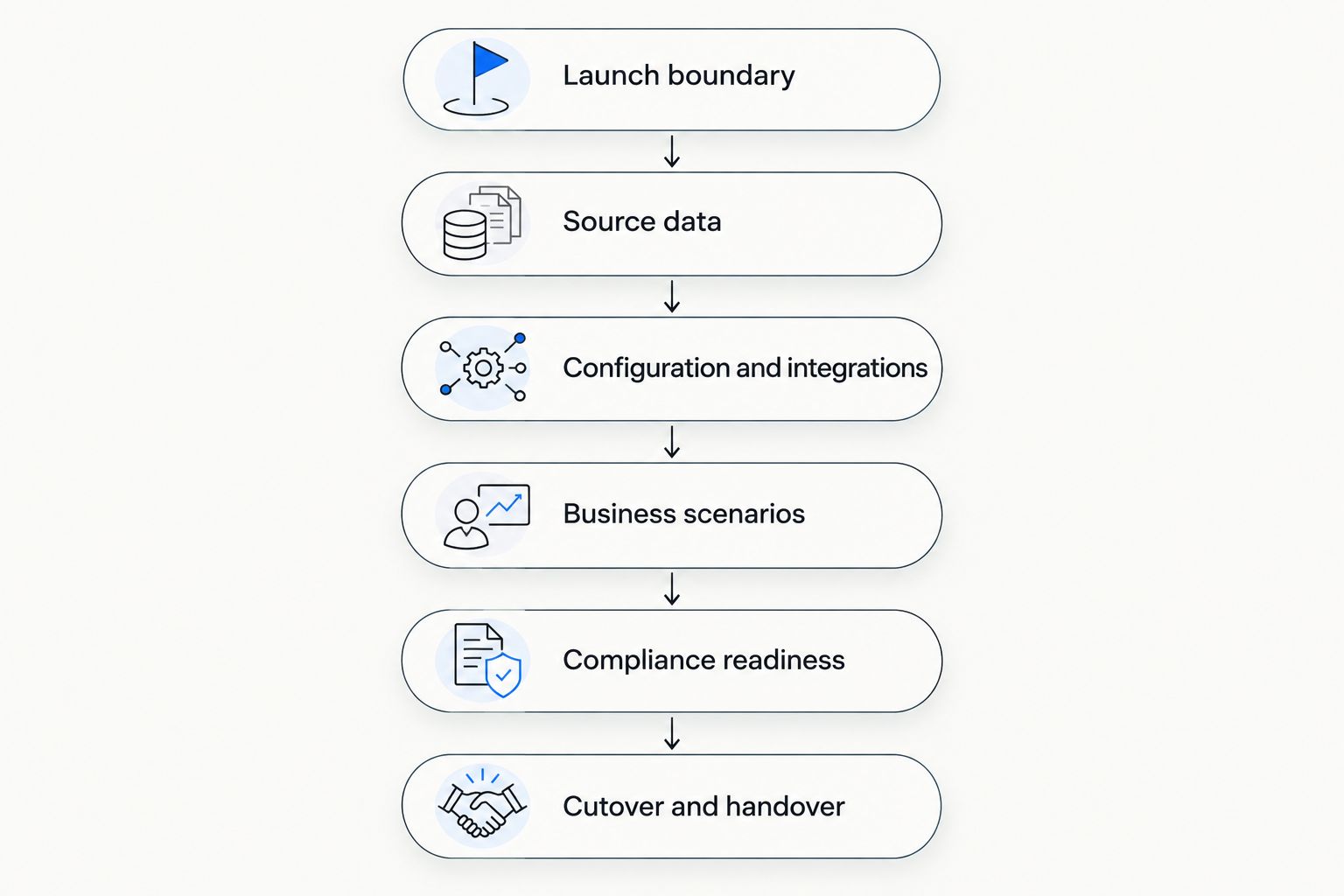
Use the following sequence to build a schedule that your implementation team can defend.
1. Agree on the launch boundary
Write down the business outcome of the initial release. Distinguish a searchable employee directory from a system that also processes attendance, calculates payroll and supports statutory reporting. Those are different acceptance boundaries, even when they belong to the same platform.
Identify the participating legal entities, employee groups, locations and process owners. Record exclusions alongside inclusions so that an omitted workflow does not become an unexpected launch requirement.
Deliverable: an approved scope statement with a named owner for every process. Do not treat a module name as a complete requirement; describe the work users must perform inside it.
2. Inspect the source data
Review representative employee records before approving the migration plan. Check identifiers, employment dates, reporting lines, leave balances and any payroll-related fields included in scope. Resolve competing sources of truth before importing them.
Decide which historical records need migration and which can remain in an accessible archive. Historical data still needs appropriate retention and access decisions; excluding it from migration does not remove those responsibilities.
Deliverable: a field mapping, an exception register and a reconciliation method. The migration is accepted when the agreed records reconcile, not when an import screen reports completion.
3. Confirm configuration and integrations
Translate policies into explicit workflows: who submits, who approves, what happens during absence and who handles exceptions. Define access by role rather than copying broad permissions from a legacy system without review.
For each external connection, document the system owner, data direction, required fields, authentication method and failure response. A connection that transfers a file is not necessarily a completed business process. The receiving system must interpret and accept the data correctly.
Deliverable: approved workflow rules and an integration specification. Keep unresolved external dependencies visible in the schedule instead of assuming another team will complete them before testing.
4. Test complete business scenarios
Test the path from the original event to the final result. For example, follow an approved absence through attendance records, payroll inputs and the employee-facing output where those functions are in scope.
Include corrections, rejected requests, missing information and changes made after a cutoff. A successful standard transaction does not establish how the system handles an exception.
Deliverable: documented expected results, actual results and accountable approval. Classify defects by their effect on pay, access, compliance and daily work rather than by how easy they are to fix.
5. Approve payroll and compliance readiness
If payroll is included, compare the new process with an independently approved reference calculation. Investigate differences instead of accepting a matching overall total that conceals errors in individual employee records.
For Turkish operations, puantaj records working time, leave, overtime and absences; those records feed payroll and SGK processes. KVKK concerns the protection of personal data. These requirements need distinct validation: a correct calculation does not establish appropriate access or lawful data handling.
Deliverable: payroll approval, approved access controls and confirmation of the applicable compliance procedures. Assign qualified owners to these decisions rather than making technical completion stand in for operational approval.
6. Rehearse cutover and handover
Define when the old system stops accepting changes, how final updates reach the new system and who authorizes the switch. Document what happens if a critical check fails. A fallback plan needs an owner and an executable procedure.
Train users on the tasks they will actually perform, including approvals and corrections. Confirm who handles support requests after launch and who retains authority to change configuration.
Deliverable: an approved cutover checklist and a handover record. Production access is the start of live operation, not proof that implementation work is finished.
Why this matters
A launch date is a business commitment. Payroll teams need dependable inputs, managers need working approval routes, and employees need correct access. Installing software does not establish any of those outcomes by itself.
For a 2026 project plan, separate configuration completion, production approval and operational handover. Give each milestone its own acceptance criteria. This prevents a technically finished environment from being reported as a finished implementation while essential business checks remain open.
Choose the rollout boundary before choosing the date
A phased rollout and a coordinated rollout represent different choices about scope and coexistence. Neither approach supplies a universal duration. Choose according to which processes can operate independently and which must change together.
| Rollout approach | Best for | Advantage | Limitation | Approval question |
|---|---|---|---|---|
| Phased rollout | Teams with separable processes or employee groups | Limits the initial acceptance boundary | Requires explicit rules for old and new systems operating together | Can each phase operate without ambiguous ownership? |
| Coordinated rollout | Teams whose connected processes must switch together | Establishes a shared cutover boundary | Requires all included dependencies to be ready together | Can every critical dependency pass acceptance before cutover? |
Use a phased rollout only when the boundary is operationally real. Moving employee records first does not isolate payroll if both systems continue editing the same pay-related fields without a clear source of truth.
For a coordinated rollout, make dependencies visible at the process level. An attendance interface, payroll approval and payment preparation can have different owners even though they support the same employee payment outcome.
Core HR and onboarding scope
An initial release limited to employee records and onboarding still needs migration checks, permission testing and workflow approval. Specify who creates employee records, who validates documents and when access becomes appropriate.
Keep employee onboarding separate from platform implementation in the project vocabulary. The guide to enterprise new-hire onboarding timelines addresses the employee process, not the organization's software deployment schedule.
Payroll, attendance and compliance scope
When payroll and attendance enter the same release, define the handoff between approved working-time records and payroll inputs. Document who resolves missing attendance, disputed overtime and late corrections.
For Turkish operations in 2026, have the responsible payroll and legal specialists confirm the rules applicable at launch. Do not reuse a prior configuration merely because the employee population has not changed.
Multi-entity or multi-country scope
Create a requirements record for each included entity or country. Identify shared fields separately from local payroll, reporting, approval and data-handling requirements.
Treat a shared platform as a technology decision, not proof of identical operating rules. Approve each local process before calling the combined release ready.
Why enterprise HR implementation timelines vary
The timeline changes when required work or its dependencies change. Keep these drivers in the project register rather than discussing them only after a milestone slips.
- Scope boundary: Adding payroll, benefits or another employee population changes the deliverables that require acceptance.
- Data condition: Conflicting identifiers, missing fields and unexplained balances require resolution before migration approval.
- Integration ownership: External connections need accessible technical owners, agreed specifications and a way to test failures.
- Policy decisions: Unresolved approval routes or inconsistent leave rules prevent configuration from becoming an approved operating process.
- Validation requirements: Payroll, permissions and statutory workflows need business acceptance, not only technical checks.
- Cutover constraints: Payroll calendars, change freezes and the availability of responsible staff shape the workable launch window.
For your 2026 steering report, connect every date change to a specific dependency, decision or scope change. Report the accountable owner and the evidence needed to close it. A percentage-complete figure does not explain whether payroll is safe to launch.
How do you know whether the proposed timeline is credible?
A credible timeline identifies deliverables, dependencies, owners and acceptance evidence. Ask the implementation provider to explain what must be true before each milestone can finish, then check those assumptions with your internal teams.
Use a short readiness review:
- Scope: Is the initial release described in business terms, with explicit exclusions?
- Data: Has the team reviewed actual source records and agreed how to reconcile them?
- Interfaces: Have both sides accepted the integration requirements and testing responsibilities?
- Decisions: Are policy and permission questions assigned to people authorized to resolve them?
- Acceptance: Are payroll, security and process owners available to approve the results?
- Handover: Are support responsibilities and fallback procedures documented?
Ottohr HR software is best suited to midsize and large employers seeking hiring, onboarding, payroll, benefits and compliance tools in one platform. That breadth provides a relevant evaluation scope; it does not establish which integrations, migration services or delivery commitments your implementation includes. Confirm those details in the project agreement.
Approve a delivery plan with evidence, not a launch promise without conditions. For a 2026 deployment, record the assumptions behind the date so scope changes trigger an explicit scheduling decision.
Can we launch core HR before payroll?
You can launch core HR before payroll when employee data ownership, interfaces and operating responsibilities are clearly separated. Define which system controls each shared field and how approved changes reach payroll during the transition.
Do not call payroll ready merely because employee profiles are available. Payroll needs its own reconciliation and approval.
Does implementation finish on go-live day?
Implementation finishes when the agreed acceptance and handover criteria are satisfied, not automatically on go-live day. Keep unresolved defects, support ownership and any temporary workarounds visible after production begins.
Specify the closure conditions in advance. Otherwise, a project can appear closed while the operating team still depends on undocumented assistance.
What should we do if the launch date is at risk?
Reassess scope and dependencies before removing acceptance checks. Identify the blocked deliverable, the person who can resolve it and whether the affected process can safely remain outside the initial release.
Do not compress payroll or access validation simply to preserve a calendar date. A narrower approved release is a different decision from a wider release with unfinished controls.
FAQ
How long does enterprise HR software implementation usually take?
There is no single duration that applies to every enterprise HR implementation. Establish the schedule from the agreed scope, source-data assessment, integration dependencies and acceptance requirements.
What should count as the start of HR software implementation?
Define the start as an agreed project milestone, such as approved scope and assigned delivery owners. A contract signature alone does not establish that data, staff and technical access are ready.
Can we implement onboarding before the rest of HR?
You can implement onboarding separately when its data, permissions and downstream responsibilities have clear boundaries. Document how employee information reaches any systems that remain outside the release.
Does payroll need separate testing during HR implementation?
Payroll needs its own calculation checks, reconciliation and accountable approval. Successful employee-data migration does not establish that attendance inputs, deductions or payroll outputs are correct.
What should we confirm before implementing Ottohr?
Confirm the included modules, migration responsibilities, integration requirements and acceptance criteria before implementing Ottohr. Its stated product scope covers hiring, onboarding, payroll, benefits and compliance, but your project agreement must define the delivery work.
Should we migrate every historical employee record?
Migrate historical records according to an approved operational and retention requirement, not by default. Records kept outside the new system still need appropriate access, protection and retention arrangements.
What is the most useful question to ask about an implementation deadline?
Ask which accepted deliverables make the proposed deadline achievable. Require named owners and documented dependencies so that a date change can be traced to specific unfinished work.
One last thing
Test a correction, not just a clean transaction. Before approving launch, follow a late attendance change or an amended employee record through every affected workflow. Confirm who authorizes it, where the change appears and how the responsible team verifies the final result.
That exercise turns an abstract readiness discussion into an observable business process. Keep the resulting evidence with the launch approval.


