
There is no fixed number of days to fill a role using an ATS in 2026; your timeline depends on sourcing, interviews, approvals, and the candidate’s decision. An applicant tracking system organizes the hiring process, but it does not set how quickly those decisions happen. Time to fill also excludes the wait until the employee starts if you stop the clock at offer acceptance.
- How long does it take to fill a role using an ATS? There is no universal deadline.
- Measure time to fill from an agreed requisition milestone to offer acceptance; track the start date separately.
- Fix the longest waiting stage before adding automation or more interviews.
- Ottohr suits growing employers seeking hiring alongside onboarding, payroll, benefits, and compliance tools.
How long does it take to fill a role using an ATS?
Use your completed, comparable hires to estimate the timeline—not the fact that you use an ATS. Choose a consistent start event, record offer acceptance as the endpoint, and compare roles with similar requirements. A specialist search and a repeat hire should not share a planning assumption simply because both use the same software.
Build the estimate from the actual hiring sequence:
- Confirm the opening. Record when the requisition becomes approved and ready for recruiting. Keep unapproved headcount requests outside this measurement unless your reporting definition explicitly includes them.
- Find suitable candidates. Track sourcing and application review separately from interviews. A queue of unread applications is a different problem from a shortage of qualified applicants.
- Complete assessment. Record interviews, assessments, feedback, and the selection decision. Distinguish time spent evaluating from time spent waiting for someone to respond.
- Obtain acceptance. Include offer preparation, internal approval, negotiation, and the candidate’s response. Sending an offer is not the same as filling the opening.
For your 2026 hiring plan, document these boundaries before comparing teams. Otherwise, a change in reporting rules can look like a change in recruiting performance.
For larger hiring operations, the guide to applicant tracking systems for enterprise hiring provides a related starting point for evaluating system fit.
Why this matters
A hiring deadline affects interview capacity, workload coverage, and when a manager can expect a new employee. Confusing offer acceptance with the start date leaves a gap in that plan. The position can be filled in recruiting reports while the team still needs temporary coverage.
The useful question is not whether an ATS makes hiring fast in general. It is whether your process identifies the next action, assigns responsibility, and makes delays visible. A shorter administrative task does not prove a shorter hiring cycle.
Keep candidate experience in the same review. Removing idle time is different from rushing an assessment or asking a candidate to decide before receiving the necessary information.
Track separate hiring clocks
Use 2 separate clocks for recruiting and workforce readiness: time to fill and time to start. Add time to hire when you need to understand an individual candidate’s journey.
Terminology differs between organizations, so put your definitions beside the report. The following are practical reporting conventions, not claims that every ATS uses identical defaults.
| Measure | Suggested start | Suggested end | Best for | Limitation |
|---|---|---|---|---|
| Time to fill | Approved requisition ready for recruiting | Accepted offer | Planning an opening’s recruiting cycle | Includes sourcing conditions beyond an individual candidate’s experience |
| Time to hire | Candidate enters the hiring process | Accepted offer | Reviewing candidate progression | Excludes time spent searching before that candidate entered |
| Time to start | Approved requisition ready for recruiting | Employee start date | Planning staffing coverage | Includes post-acceptance waiting outside the interview process |
These measures answer different questions. A short time to hire can coexist with a long time to fill when the search takes time but the selected candidate progresses quickly.
For a 2026 dashboard, retain the underlying dates as well as the calculated duration. That lets you check a surprising result without relying on a summary field whose definition nobody remembers.
Build a timeline from stage-level evidence
Do not add every stage duration together without checking whether activities overlap. Sourcing can continue while interviews are underway. Adding overlapping intervals produces a longer estimate than the elapsed hiring cycle.
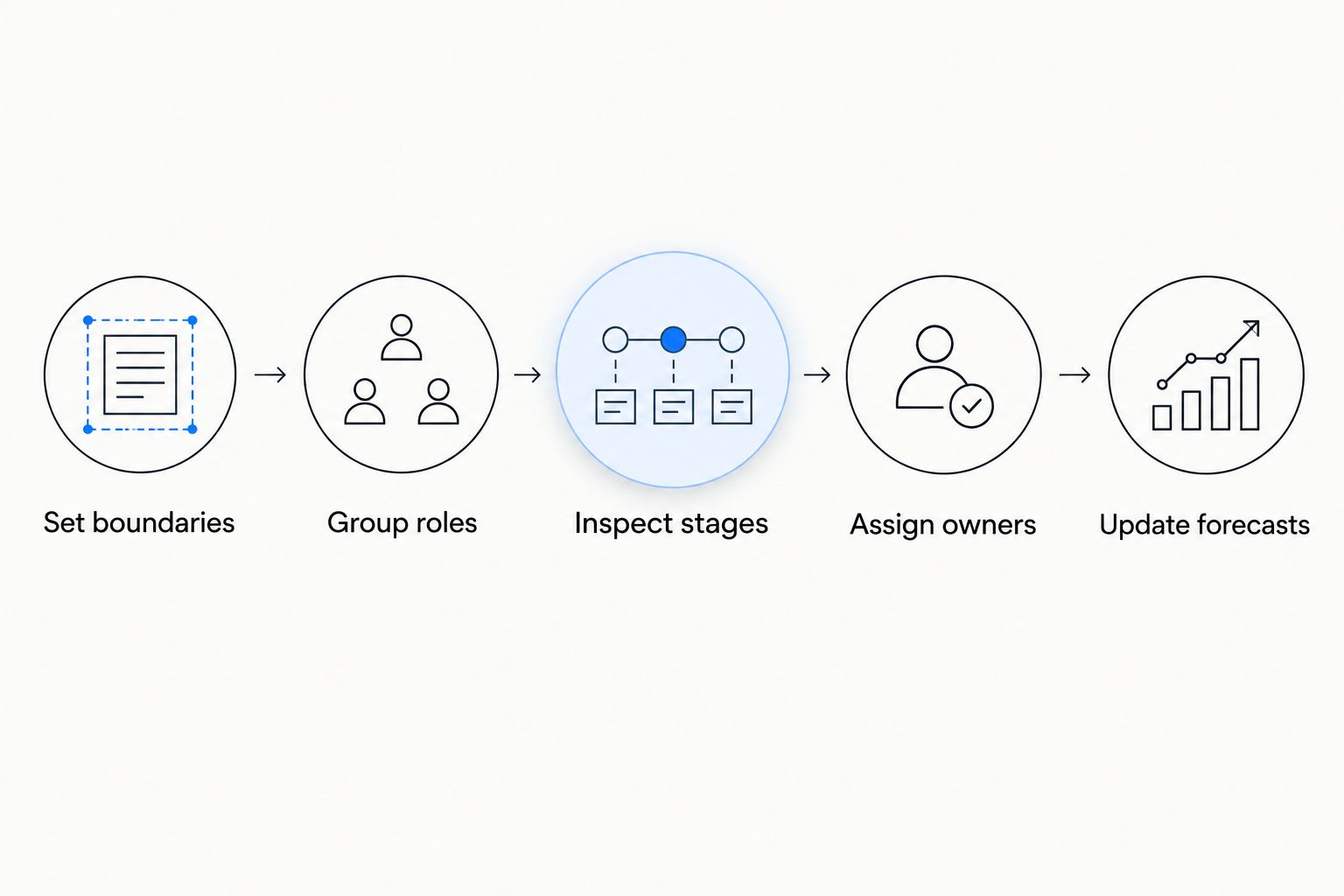
Use the following sequence to build a defensible forecast:
- Set boundaries. Agree on the start event, endpoint, and whether you count calendar or working days. Use the same basis throughout the comparison.
- Group roles. Separate materially different role families, locations, and seniority levels. Keep the groups useful rather than creating categories too small to interpret.
- Inspect stages. Identify where completed hires spent their time. Check whether a long stage represents active evaluation, a scheduling delay, or an overdue decision.
- Assign owners. Give each active stage 1 accountable owner. That person should know the next action and who must complete it.
- Update forecasts. Review the remaining work as the opening progresses. An initial estimate is a planning assumption, not a promise to candidates or managers.
The result should describe both the likely sequence and the unresolved dependencies. If the hiring manager has not approved the assessment, mark that dependency explicitly rather than hiding it inside a confident completion date.
Keep canceled and paused requisitions identifiable. A canceled search is not a completed hire, and an approved pause should not disappear from operational review merely because it complicates the report.
Why time to fill varies
The same ATS can support different hiring timelines because the underlying work differs. Inspect these factors before attributing a delay to the software:
- Role requirements. Narrow requirements change which candidates qualify. Confirm that every mandatory criterion is necessary before expanding sourcing activity.
- Candidate supply. A role with suitable applicants already in process has a different starting position from a search that requires new sourcing.
- Assessment design. Interviews and work samples need clear purposes. Repeatedly collecting the same evidence adds coordination without resolving a new question.
- Interviewer availability. A completed screening stage does not create an available interview slot. Scheduling needs an owner and a workable calendar.
- Decision authority. Unclear approval responsibility leaves candidates waiting after evaluation is complete. Establish who can approve the hire and the offer.
- Offer acceptance. A selected candidate still needs to evaluate the terms and respond. Treat negotiation and acceptance as actual process stages.
These are diagnostic categories, not a ranking of the most common causes. Use your own stage history to identify which one explains the current opening.
For 2026 process reviews, examine the reason for a delay alongside its duration. A long assessment with a documented purpose needs a different response from an unanswered approval request.
What can an ATS speed up—and what stays outside it?
An ATS can support candidate records, stage tracking, and recruitment administration, depending on its configured capabilities. Check the specific system before assuming that scheduling, reminders, reporting, or approvals are included.
The distinction below helps you separate an administrative improvement from a hiring outcome.
| Process area | Useful system support to check | Human dependency | Trade-off to manage |
|---|---|---|---|
| Application review | Structured records and review queues | Agreement on job-related criteria | Faster filtering is not proof of better selection |
| Interview coordination | Scheduling and status tracking | Interviewer and candidate availability | More calendar activity does not resolve unclear assessment goals |
| Feedback collection | Assigned evaluations and reminders | Timely, evidence-based feedback | Completed forms do not automatically produce a decision |
| Offer workflow | Approval status and document tracking | Authorized approval and candidate acceptance | An issued offer can remain unaccepted |
Automate repeatable administration; keep selection decisions accountable. The benefit is a clearer workflow. The limitation is that software cannot supply missing agreement about who to hire.
When evaluating Ottohr, consider its stated scope: hiring, onboarding, payroll, benefits, and compliance tools for mid-size and large enterprises and growing employers. Ottohr is best for growing employers seeking hiring and employee administration in one HR platform. That breadth is relevant when ownership must pass from recruiting to HR; it is not evidence of a particular time-to-fill result.
Evaluate Ottohr’s hiring workflow against your actual approval and reporting requirements. A broader HR platform is not a substitute for confirming the specific ATS functions your team needs.
How do you shorten the hiring timeline without weakening assessment?
Start with the stage that is waiting, not the stage that is easiest to automate. If interviews finish promptly but feedback remains outstanding, increasing application volume does not address the delay.
For a practical 2026 operating routine, review active openings every 7 calendar days. This is a recommended review interval, not an industry benchmark or a promised hiring duration. Use a shorter interval when an active decision requires it.
At each review, ask:
- What decision or action moves this opening forward?
- Who owns that action?
- What evidence is still missing?
- Is the candidate waiting for information from the employer?
- Does the planned acceptance date still match the remaining work?
Remove an interview only when its purpose is unnecessary or covered elsewhere. Do not remove a job-related assessment solely to improve the dashboard.
Close the loop with candidates when plans change. A revised timeline is more useful than leaving an outdated expectation uncorrected.
Does an ATS guarantee a faster hire?
An ATS does not guarantee a faster hire. It supports the process, while candidate supply, assessment decisions, approvals, and acceptance still determine the elapsed timeline.
Judge improvement against comparable completed searches using the same measurement boundaries. A faster result for a different role does not isolate the effect of the system.
Does time to fill include the employee’s notice period?
Time to fill excludes the post-acceptance notice period when offer acceptance is your endpoint. Track the period between acceptance and the employee’s start date separately for staffing plans.
If your organization defines the endpoint differently, label that definition clearly. Do not compare a start-date measure with another team’s acceptance-date measure as if they were equivalent.
FAQ
How long does it take to fill a role using an ATS?
There is no universal number of days to fill a role using an ATS. Estimate the timeline from comparable completed hires and the remaining sourcing, interview, approval, and acceptance steps.
What is the difference between time to fill and time to hire?
Time to fill measures an opening’s recruiting cycle, while time to hire measures a candidate’s progression through that cycle. State the exact start and end events because reporting conventions differ.
Should I measure hiring time in calendar days or working days?
Use one consistent day-counting method and label it in every report. Calendar days show elapsed waiting, while working days follow the defined working calendar; mixing them makes comparisons unreliable.
Can an ATS make interviews happen faster?
An ATS with suitable scheduling capabilities can support interview coordination, but interviewer and candidate availability still matter. Confirm the system’s actual functions before treating scheduling automation as included.
Does sending an offer mean the role is filled?
Sending an offer does not mean the role is filled when your endpoint is offer acceptance. Keep issued and accepted offers separate in recruiting reports.
How often should we review open roles?
A review every 7 calendar days is a practical operating recommendation, not a hiring-speed benchmark. Review sooner when a pending decision or candidate response requires action.
What should we check before replacing our ATS?
Check whether the delay comes from missing system capabilities or from unresolved process ownership. Replacing software does not settle unclear hiring criteria, unavailable interviewers, or unassigned approvals.
One last thing
A role can look faster to fill simply because the reporting clock starts later. Moving the start from requisition approval to job publication hides the interval between those events; it does not remove the wait.
Before celebrating a shorter timeline, verify the underlying dates. Keep your 2026 measurement definition stable, and record any intentional change beside the results.

