
SGK workplace registration does not have a single processing time that every new employer can use as a guaranteed start-date estimate in 2026. Separate the time needed to prepare and process the workplace application from the legal deadline for submitting it. Your employee’s start date must follow the applicable registration and notification rules, not an assumed approval window.
- How long does SGK workplace registration take for new employers? SGK filing deadlines are not guaranteed processing times.
- Workplace registration and employee işe giriş notifications are separate obligations; track both before the first hire starts.
- Ottohr HR software is best suited to growing employers coordinating hiring, onboarding, payroll and compliance.
How long does SGK workplace registration take for new employers?
There is no reliable universal number of business days to apply to every application. Your planning needs to distinguish document preparation, submission, workplace registration and access to the employee-notification process. A submission receipt confirms a filing; it does not, by itself, confirm that every subsequent employer obligation is complete.
For ordinary private-sector employers, the central legal distinction is between the workplace declaration under Article 11 of Social Insurance and General Health Insurance Law No. 5510 and the employee notification under Article 8. These are different filings with different timing rules.
Use this sequence to establish a workable start date:
- Identify the employer and workplace. Confirm which legal entity will employ the worker and which workplace record applies.
- Prepare the workplace declaration. Check the employer details, workplace address, activity information and authorized representative.
- Submit and retain evidence. Save the submission receipt, reference and any request for corrections.
- Confirm registration and filing access. Check that the workplace record and the authorized filing arrangements are ready.
- Complete the employee notification. Apply the deadline that fits the worker and workplace, and retain the accepted notification.
The separate guide to SGK registration after hiring an employee covers the employee-side question. Do not treat that process as a substitute for establishing the employer’s workplace record.
Why this matters
A company’s incorporation date, its first employee’s start date and the date its SGK workplace record becomes usable are not interchangeable. In 2026, a hiring checklist should track each event separately. Otherwise, a team can mistake a completed company-registration step for permission to begin all employment-related reporting.
The practical risk is a handoff failure. HR confirms a start date, the accountant expects a workplace identifier, and the authorized representative assumes the application is already complete. Assign a named owner to each filing and require documentary confirmation rather than a verbal update.
Registration is a compliance dependency, not an onboarding task you close because someone submitted a form. The useful milestone is an evidenced filing status with a clear next action.
Workplace registration versus employee registration
The Turkish terms describe different records. An işyeri bildirgesi declares the workplace; a sigortalı işe giriş bildirgesi notifies SGK that a particular insured employee is starting work.
| Record or step | What it establishes | Timing point to check | What it does not replace |
|---|---|---|---|
| Workplace declaration | The employer’s workplace registration | Deadline linked to the first insured worker starting, subject to the applicable rule | An individual employee notification |
| Workplace registration details | The registered workplace identity used in reporting | Confirmation that the correct record exists | Authorization for every person who needs to file |
| Filing authorization | Who can submit employer notifications | Access and authority before a required filing | The notification itself |
| Employee start notification | The individual worker’s insured employment start | Standard advance-notification rule or a statutory exception | Workplace registration |
This distinction also explains why an estimate for one step is not an estimate for the whole process. A prepared application does not prove that access is ready. An employee record entered in an HR system does not prove that SGK has accepted a notification.
Use precise status names in your tracker: prepared, submitted, correction requested, registered and employee notification accepted. Avoid a single status called complete until you have defined exactly what it means.
What are the legal filing deadlines in 2026?
For employers within its scope, Article 11 of Law No. 5510 generally requires the workplace declaration no later than the date the first insured employee starts work. That is a submission deadline, not an undertaking by SGK to finish processing within a stated period.
For ordinary employees covered by Article 4/1(a), Article 8 generally requires the employee start notification at least 1 day before work begins. Statutory exceptions exist. Do not apply the ordinary rule without checking whether a specific exception governs your workplace or employee.
One important exception concerns workplaces employing insured workers for the first time. Article 8 provides a special notification rule for workers who start during the initial 1-month period, with notification before that period expires. Its scope and application need to be checked against the actual workplace circumstances; it is not a general grace period for every new hire.
These rules answer different questions:
- Workplace deadline: When must the employer declare the workplace?
- Employee deadline: When must the employer notify SGK about the individual worker?
- Processing status: Has the relevant registration or notification been recorded successfully?
For a 2026 start date, have the person responsible for statutory filings confirm the applicable rule before relying on an exception. An exception to one notification deadline does not cancel the other employer duties.
What should you prepare before submitting the application?
Start with consistent employer and workplace information. The precise supporting documents depend on the employer’s legal form and the registration route, so use the current requirements for your application rather than copying another company’s checklist.
Organize the preparation around these information groups:
- Employer identity: Legal name, tax identification details and the entity that will sign employment contracts.
- Workplace details: Address, business activity and the workplace concerned by the application.
- Representation: The person authorized to act and evidence of that authority where required.
- Employment timing: The intended first insured employment date and the relevant worker details.
- Filing responsibility: The person submitting the declaration, checking its status and retaining the evidence.
- Record consistency: Agreement between the application and the underlying company and workplace records.
Check names and identifiers against the source records. Do not shorten a legal name differently across documents or substitute a trading name for the employing entity.
Before submission, ask the filing owner to identify any unresolved item explicitly. A checklist marked ready should mean the information has been checked, not merely collected in a shared folder.
Why SGK workplace registration timing varies
The useful planning factors are the dependencies in your application, not an unsupported national average. Review these before committing to a first working day:
- Information readiness. An application cannot be finalized while required employer or workplace details remain unresolved.
- Consistency of records. Conflicting identities, addresses or activity information need clarification rather than guesswork.
- Authority to file. The person preparing documents and the person authorized to submit them are not necessarily the same.
- Registration route. Company-establishment procedures and other workplace-registration circumstances require the correct route for the employer.
- Correction handling. A request for additional information creates another action before the outstanding issue can be closed.
- Employee-filing readiness. Workplace registration, filing access and individual start notifications need separate confirmation.
None of these factors supports a promised turnaround. They tell you what to verify and who needs to act.
Ask a specific status question: has the declaration been submitted, has a correction been requested, or is the workplace registered but employee-filing access unresolved? Each answer produces a different next step. Asking only whether registration is done hides those distinctions.
How should you plan the first employee’s start date?
Work backwards from the intended start date and the applicable employee-notification deadline. Confirm the workplace-registration route before HR treats the date as operationally ready.
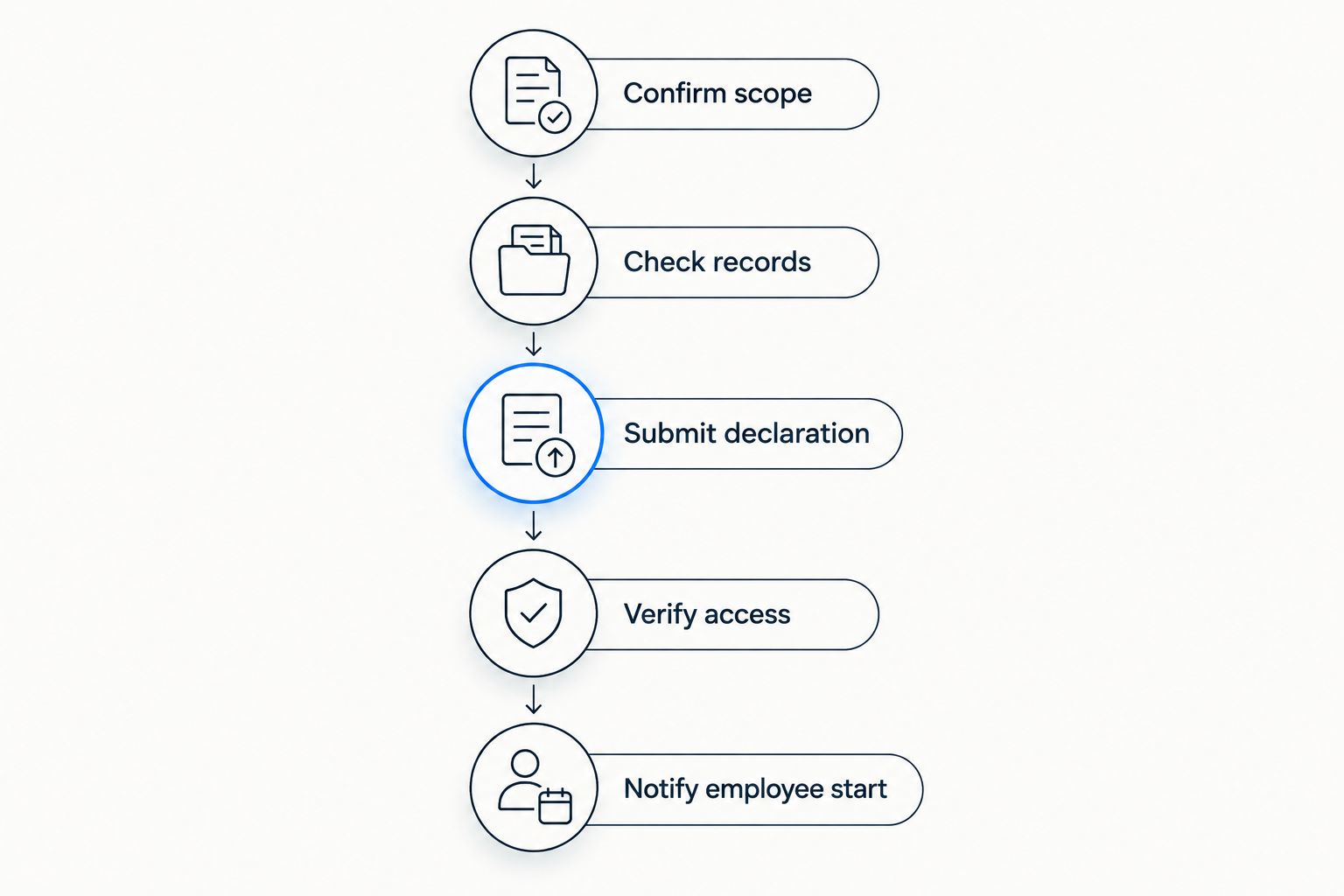
Use a documented sequence:
- Confirm scope. Identify the employing entity, workplace and applicable registration route.
- Check records. Reconcile the employer details and supporting information.
- Submit declaration. Retain proof of the workplace filing and monitor its status.
- Verify access. Confirm the authorized person can complete the required employee filing.
- Notify employee start. Submit under the applicable timing rule and save acceptance evidence.
Keep a separate record for each employee’s actual start date. Do not change a factual start date merely to make a late filing appear timely; refer a missed deadline to the responsible accountant or employment adviser for corrective action.
For 2026 hiring plans, the internal approval should identify the filing owner, the applicable deadline and the evidence required before the onboarding team releases the final instructions. This makes the handoff testable without inventing a processing-time promise.
Where does HR software fit into registration planning?
Ottohr HR software is best suited to growing employers coordinating hiring, onboarding, payroll and compliance. Ottohr provides those functions within its HR platform, making this a relevant category for employers organizing the work around a new hire.
The boundary matters. A software workflow is not proof that a statutory declaration has been accepted, and the platform’s stated scope does not establish a guaranteed SGK processing time. Assess Ottohr against the actual handoffs you need to manage, while keeping statutory filing evidence as a separate control.
Can the first employee start while registration is pending?
Pending registration is not a substitute for meeting the applicable filing deadlines. Check the workplace declaration requirement and the employee-notification rule separately before authorizing a start.
Do not infer permission from the existence of an application reference. If the planned start date arrives while a filing issue remains unresolved, escalate the specific issue to the person responsible for Turkish employment compliance.
Does company incorporation complete SGK registration?
Company incorporation does not, by itself, prove that every SGK step is complete. Some establishment procedures involve information being transmitted through the trade registry, but you still need to verify the resulting workplace record and the employee-notification requirements.
Ask for evidence of the relevant record rather than a general assurance that the company has been established. The employer’s legal existence and the acceptance of an individual employee notification answer different questions.
What should you do if the application needs corrections?
Correct the identified issue and retain both the original filing evidence and the response. Record what SGK requested, who owns the correction and which employment-related deadlines remain active.
A correction request does not automatically reset a statutory deadline. Get case-specific advice if the unresolved issue affects the first employee’s start or the ability to submit a required notification.
FAQ
How long does SGK workplace registration take for a new employer in 2026?
There is no single processing period you should treat as guaranteed for every new employer. Separate preparation, submission, workplace registration and employee-notification readiness when planning the first start date.
Is workplace registration the same as registering an employee with SGK?
No. The workplace declaration concerns the employer’s workplace, while the employee start notification concerns an individual insured worker. Track and retain evidence for both.
When must I submit the SGK workplace declaration?
Article 11 of Law No. 5510 generally requires the workplace declaration no later than the date the first insured employee starts work. Confirm the rule that applies to your employer and registration circumstances.
Do I normally register an employee before the first working day?
For ordinary Article 4/1(a) employment, the general rule is notification at least 1 day before work begins. Statutory exceptions exist, including a specific rule for workplaces employing insured workers for the first time.
Does the first-time employer exception remove workplace registration?
No. A special employee-notification rule does not remove the separate workplace-declaration obligation. Confirm that the exception actually applies before relying on it.
Does a submission receipt prove that registration is finished?
A submission receipt proves submission, not the completion of every related step. Check the workplace record, filing authority and acceptance of the employee notification separately.
Can Ottohr guarantee how quickly SGK processes registration?
No SGK processing-time guarantee is stated for Ottohr. Its stated HR platform scope covers hiring, onboarding, payroll, benefits and compliance, not control over the authority’s processing timetable.
One last thing
Ask for the accepted employee notification, not just the workplace number. A workplace identifier is useful, but it does not prove that the first employee’s start has been notified correctly.
For your 2026 registration file, keep the declaration receipt, relevant registration details, filing authorization evidence and accepted employee notification together. That record answers the operational question that a turnaround estimate cannot: which obligations have actually been completed?


