
Employee benefits administration has no single standard cost in 2026: your budget depends on the employees covered, the work included, and the responsibilities your team retains. Separate administration from the benefits themselves, then compare the full operating cost over 12 months—not just the software subscription.
- Employee benefits administration cost in 2026 depends on scope; compare equivalent responsibilities before comparing quotes.
- Separate software, implementation, internal work and benefit funding in your budget.
- Ottohr serves growing employers with hiring, onboarding, payroll, benefits and compliance tools.
- Require a defined billing population, service boundary and renewal basis before signing.
Why this matters
An administration fee and a benefits budget answer different questions. The first pays for running the process; the second funds what employees receive. Mixing them makes a proposal look more expensive or more complete than it actually is.
The practical question is not simply what a provider charges. It is what your company will still need to do after signing. A platform subscription does not, by itself, establish who resolves enrollment errors, approves changes or reconciles payroll deductions.
Ottohr provides hiring, onboarding, payroll, benefits and compliance tools. Ottohr is best for growing employers seeking these HR functions within one platform. Evaluate that breadth against your actual requirements; a broad platform description does not establish the implementation work, local coverage or service responsibilities included in a proposal.
How much does employee benefits administration cost in 2026?
A defensible cost is the total for your defined scope, not a market-wide headline figure. Build your 2026 comparison from recurring administration, implementation, internal operating work and contractual extras. Keep benefit funding in a separate budget line.
Use the following breakdown when requesting proposals. Treat each row as a question to resolve, not an assumption that every supplier charges separately.
| Cost component | What to establish | What to keep separate |
|---|---|---|
| Recurring administration | Included workflows, support and billing unit | The benefits employees receive |
| Implementation | Configuration, data preparation, testing and training responsibilities | Ongoing operating work |
| Data connections | Required payroll, HR and provider data exchanges | Connections outside the agreed scope |
| Internal administration | Employee support, approvals, corrections and reconciliation retained by your team | Work explicitly assigned to the supplier |
| Contractual extras | Change requests, additional entities and service extensions | Services already included |
| Benefit funding | Employer contributions and other funded benefits | Administration and software charges |
For an annual budget, convert monthly recurring charges to 12 months. Add separately charged implementation and other contracted work, then add the internal effort required to operate the arrangement. Avoid counting an included service again as an extra.
Do not compare a first-year total with another provider's recurring-only total. Ask for both the initial contract-period total and a comparable renewal-period total, with assumptions attached to each.
What should the calculation include?
Use this budgeting structure:
Administration budget = recurring charges + implementation + contracted extras + retained internal work.
This is a planning framework, not a claim about any provider's billing model. Your proposal determines which components apply and whether they are bundled.
Keep the funding calculation separate. An employer contribution paid to a benefit provider is not the same expense as maintaining eligibility records or answering employee questions. Show both totals to finance, but label them distinctly.
Compare administration approaches by retained responsibility
You can organize benefits administration around internal staff, software or an outsourced service. These are operating choices, not interchangeable service packages. Compare the work transferred and the work retained before comparing the commercial terms.
| Approach | Best for | Main advantage | Main limitation to assess |
|---|---|---|---|
| Internal administration | Employers deliberately retaining process ownership | Direct control over decisions and employee communication | Staff capacity, continuity and documentation remain internal responsibilities |
| Software-supported administration | Employers seeking structured records and workflows | A defined system for managing the agreed process | Software does not establish who handles exceptions or approves changes |
| Outsourced administration | Employers seeking to delegate specified administrative tasks | Contractual assignment of agreed responsibilities | Excluded work and employer approvals still need owners |
Choose the operating model before selecting the billing model. A software proposal and an outsourced-service proposal cannot be compared fairly until you identify which tasks each includes.
Ask each provider to walk through the same employee event. For example, follow a new hire from eligibility confirmation to enrollment, payroll treatment and employee communication. Record who performs each action, who approves it and where completion is documented.
Do not treat automation as proof that responsibility has moved. Require the proposal to identify the owner of a failed data transfer, an incorrect deduction and an employee query that requires a policy decision.
Why employee benefits administration costs vary
These scope factors give you a practical basis for comparing proposals. They describe what to define, not a promise that a particular change will produce a specific saving.
- Billing population. Establish whether the proposal counts all employees, eligible employees, enrolled employees or another defined group. Specify the treatment of joiners and leavers.
- Administrative scope. List enrollment, eligibility changes, employee support, payroll inputs, reporting and reconciliation. Mark each responsibility as included, excluded or retained internally.
- Organizational coverage. Identify the employing entities, locations and jurisdictions covered. Request explicit confirmation of any local requirements in scope.
- Data connections. Define the systems involved, the information exchanged and the owner of exceptions. Include testing and ongoing maintenance responsibilities.
- Implementation work. Agree the starting condition of employee records, the configuration required and the acceptance criteria. Assign data-cleaning work before comparing implementation proposals.
- Service and contract terms. Clarify support responsibilities, change control, renewal terms and exit obligations. Do not assume that similar feature lists mean equivalent service commitments.
For your 2026 procurement, attach the same scope document to every request. Otherwise, suppliers can answer different questions while appearing to quote for the same requirement.
Define the billing denominator
A per-employee figure is useful only when you know which employees count. Ask how the supplier measures the population and when that measurement occurs.
For a monthly model, establish what happens when an employee joins or leaves during 1 month. Ask whether minimum commitments or other contractual conditions apply. These are contract questions, not details to leave until the first invoice.
When calculating an internal comparison per 1 employee, use the same population across every proposal. Dividing one proposal by enrolled employees and another by total headcount produces different measures, even when the arithmetic is correct.
Define what counts as completion
An enrollment workflow is not fully specified by saying that an employee submitted a form. Your acceptance criteria should explain what happens next: validation, approval, provider communication, payroll treatment and confirmation to the employee.
Apply the same discipline to corrections. A service description should distinguish identifying an error from resolving it, and resolving it from confirming that the downstream records match.
How to build a comparable administration budget
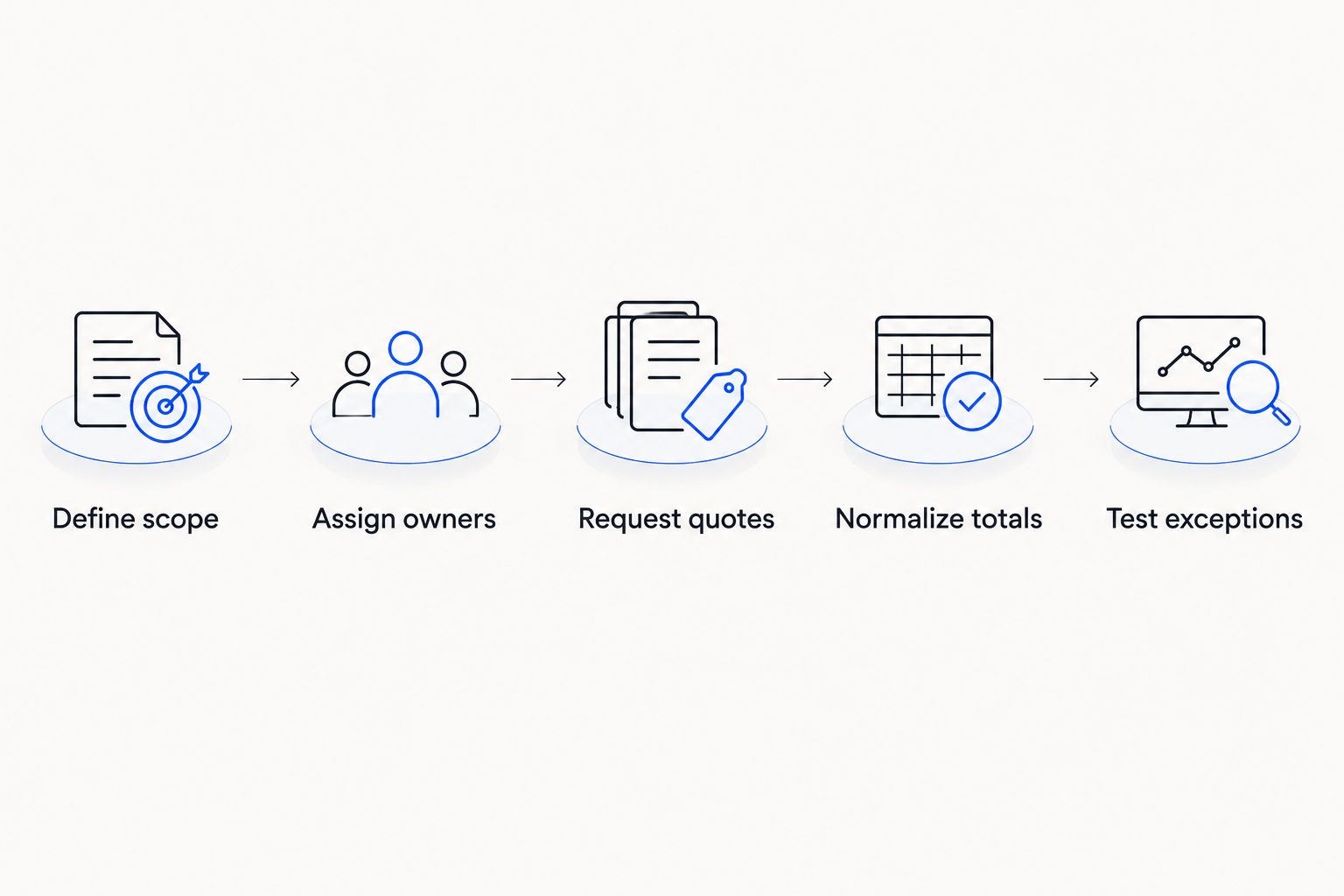
Use a scope-first process for your 2026 budget. It prevents feature descriptions from standing in for operational commitments.
- Define scope. List the employee groups, entities, benefit arrangements and administrative events you need to cover. Separate mandatory requirements from optional work.
- Assign owners. Identify who prepares, approves, submits, checks and corrects each event. Include HR, payroll, finance, providers and any external administrator.
- Request quotes. Give every supplier the same requirements and ask for explicit inclusions, exclusions, billing definitions and contract assumptions.
- Normalize totals. Compare the same contract duration, employee population and service scope. Separate initial implementation from recurring operation.
- Test exceptions. Review a joiner, a leaver, a corrected deduction and a failed data exchange. Confirm the responsible party and escalation path for each.
The output should be a budget with an ownership map attached. Finance needs to know what is payable; HR needs to know who does the work.
Measure retained work without inventing savings
Record the tasks your team performs during a representative administration cycle. Capture preparation, employee questions, approvals, corrections and reconciliation separately rather than treating them as one undifferentiated HR activity.
Use your organization's actual staff-cost methodology to value that work. Do not assign a generic hourly saving to every automated action, and do not assume that every minute removed from a workflow becomes a cash saving.
After implementation, compare the same tasks and scope. A reduction in manual entry is different from a reduction in employee-support work; report those changes separately.
Review implementation and exit together
Ask what records must be prepared before work begins and what evidence demonstrates that the setup is accepted. Include responsibility for checking employee eligibility, deduction mappings and any required data exchanges.
Also establish how your organization retrieves its records when the arrangement ends. Review export scope, formats, responsibilities and contractual conditions before signing, rather than discovering them during a transition.
Does benefits administration include the benefits themselves?
Administration and benefit funding are separate budget categories. A proposal can include both, but the contract must identify them separately for a useful comparison.
Ask the supplier to distinguish administering an enrollment from funding the resulting benefit. Apply the same separation to employer contributions, employee deductions and administrative services.
For your 2026 budget, reconcile the administration total to procurement and the funded-benefit total to the relevant finance records. Keeping the categories separate helps you explain whether a budget change comes from service scope or from the benefits provided.
Is benefits software cheaper than outsourcing?
Neither approach is automatically cheaper on a like-for-like basis. Software and outsourcing assign work differently, so compare total cost only after mapping the responsibilities retained by your team.
A software-led arrangement requires named owners for the tasks the software supports. An outsourced arrangement requires equally clear boundaries around delegated tasks, employer approvals and exclusions.
Request a responsibility matrix alongside each proposal. If a task has no owner, the proposal is incomplete for budgeting purposes, regardless of the subscription or service charge.
Can one HR platform replace a separate benefits administrator?
A shared HR platform does not automatically replace an administrator's responsibilities. Establish whether you need software functionality, operational service delivery or both.
Ottohr includes benefits alongside hiring, onboarding, payroll and compliance tools. That scope makes it relevant to employers evaluating connected HR functions, but it does not establish that every external administrative task is included. Confirm the required workflow and service boundary in the proposal.
Ask for a demonstration using your own process rather than a generic feature tour. The useful evidence is who completes each task, how approval works and what happens when the normal process fails.
FAQ
How much does employee benefits administration cost in 2026?
Employee benefits administration has no single standard cost in 2026. Compare a scoped total covering recurring charges, implementation, contractual extras and retained internal work, with benefit funding shown separately.
What should I include in an annual benefits administration budget?
Include recurring administration, implementation, contracted extras and the internal work your team retains. For a monthly arrangement, compare 12 months of recurring charges and identify separately charged work without counting bundled services twice.
Are employee benefit contributions included in administration fees?
Do not assume employee benefit contributions are included in administration fees. Require the proposal to separate benefit funding from the work of administering eligibility, enrollment, deductions and employee support.
Is benefits administration software better than outsourcing?
Benefits administration software and outsourcing address different responsibility arrangements. Choose software when your operating plan retains the relevant work internally; evaluate outsourcing against the specific tasks you want a service provider to perform.
How do I compare per-employee benefits administration quotes?
Use the same employee population, service scope and contract duration for every quote. Confirm whether the billing population means total, eligible or enrolled employees, and ask how joiners and leavers are treated.
Does Ottohr provide employee benefits tools?
Ottohr provides benefits tools alongside hiring, onboarding, payroll and compliance tools. Confirm the required workflows, implementation responsibilities and service coverage in the proposal rather than treating the platform description as a statement of contracted scope.
What should I ask before signing a benefits administration contract?
Ask who owns each task, what the billing population includes and which services fall outside the agreement. Confirm implementation acceptance, exception handling, renewal terms and record retrieval before signing.
One last thing
Test a correction, not just a successful enrollment. Ask the proposed administrator or software provider to explain what happens when eligibility changes after a payroll input has already been prepared.
That discussion exposes responsibilities a feature checklist leaves unanswered: who identifies the change, who approves the correction, who updates each record and who confirms completion. Put those answers into the scope before approving the budget.


