
No. In 2026, an SGK service record is not a blanket legal prerequisite for hiring an employee in Turkey or verifying every new hire’s employment history. The employer must separately complete the applicable SGK hiring notification; requesting a candidate’s historical service record does not satisfy that obligation. Any request for employment-history data needs a defined purpose, an appropriate legal basis, and a scope consistent with Turkey’s personal data protection rules.
- Is an SGK service record required for a new hire in Turkey? No, not as a blanket hiring requirement.
- SGK employment-history records and employer hiring notifications serve different purposes; neither replaces the other.
- Ottohr provides HR and compliance tools; employers still need a lawful purpose for collecting employment-history data.
- Request only relevant evidence, protect personal data, and investigate discrepancies before making a hiring decision.
Why this matters
A document checklist can turn an optional verification request into an unnecessary hiring barrier. An employee entering insured work for the first time has no previous employment service to demonstrate. That absence is not evidence that the person cannot be hired.
For your 2026 onboarding process, separate identity checks, employment-history checks, and employer registration duties. Each answers a different question. Ottohr provides HR, onboarding, payroll, and compliance tools, but your document policy must still explain why each item is needed and who reviews it.
Treat a service record as purpose-specific evidence, not a universal permission to employ someone. A completed document upload does not establish that your statutory filing is complete.
Is an SGK service record required to verify a new hire in Turkey?
No general requirement makes an employee’s historical SGK service record mandatory for every new hire. For ordinary employment covered by Turkish social insurance, the employer’s notification obligation is governed by Article 8 of Law No. 5510. That obligation concerns reporting the new employment, not collecting a complete history of previous employers.
The distinction matters because several Turkish documents are casually described as proof of employment. They are not interchangeable.
| Document | Best for | What it establishes | Limitation |
|---|---|---|---|
| SGK hizmet dökümü | Checking relevant insured-service history | Service and contribution information recorded within the document’s scope | Does not establish job performance, duties, or permission to work |
| Sigortalı işe giriş bildirgesi | Documenting the employer’s hiring notification | The reported start of the relevant insured employment | Does not verify the employee’s previous career |
| Çalışma belgesi | Confirming previous employment and work performed | Information supplied by the former employer about the employment | Is not an SGK contribution history |
| Work permit or applicable exemption evidence | Checking a foreign national’s right to work | Authorization within the applicable conditions | Does not replace SGK notification or employment-history checks |
A record can be authentic yet insufficient for your purpose. An SGK entry supports a statement about recorded insured service; it does not independently prove that the employee held the job title stated on a résumé.
For a role requiring particular credentials or experience, identify the evidence that actually establishes that requirement. Do not substitute a broad service-history request for a qualification check.
How should you verify a new hire without overcollecting records?
Use the following sequence for your 2026 onboarding checklist. It keeps the employer’s filing obligation separate from discretionary background checks and gives reviewers a clear reason for each request.
1. Define the purpose
Write down the question you need to answer before requesting a document. Examples include confirming a claimed period of insured employment, establishing the correct social insurance treatment, or verifying a role-specific credential.
Avoid the instruction to collect a service record simply because it appears on an inherited checklist. A checklist is an administrative tool, not a legal basis. If no reviewer can explain how the record affects a lawful employment decision or obligation, reassess the request.
2. Select the evidence
Match the document to the question. For previous duties, a çalışma belgesi or a focused reference check is more directly relevant than a contribution record. For insured-service dates, the relevant service-record extract addresses a different question.
Article 28 of Law No. 4857 concerns the employment certificate issued by an employer when an employee leaves. That certificate is distinct from SGK’s record of insured service. Neither document should be treated as a complete assessment of the candidate’s experience or suitability.
3. Explain the request
Tell the employee what information you need, the purpose of processing it, and the relevant recipients. Identify the lawful basis rather than assuming that an upload or signature resolves every data-protection issue.
If an extract is sufficient, explain which period or entries are relevant. Do not default to requesting the person’s entire working history when the decision concerns a particular employment period. Keep the request understandable to someone unfamiliar with Turkish payroll terminology.
4. Review discrepancies
Compare the relevant entries with the claim you are checking. Verify that the document concerns the correct person and that its scope covers the period under review.
A mismatch requires clarification, not an automatic accusation. Differences between a résumé and an SGK record do not, by themselves, establish dishonesty. Ask the employee to explain the difference and consider evidence appropriate to that explanation before recording a conclusion.
5. Complete registration
Prepare and submit the employer’s applicable SGK hiring notification independently of the background-check process. Under the general rule in Article 8 of Law No. 5510, notification is due before the employee’s start date; statutory exceptions have different timing rules.
For an ordinary case, plan submission no later than the day before work starts. Do not interpret that as a universal 24-hour waiting period, and do not apply it without checking whether an exception covers the employment. Keep evidence of the completed filing, not just evidence that somebody created a draft.
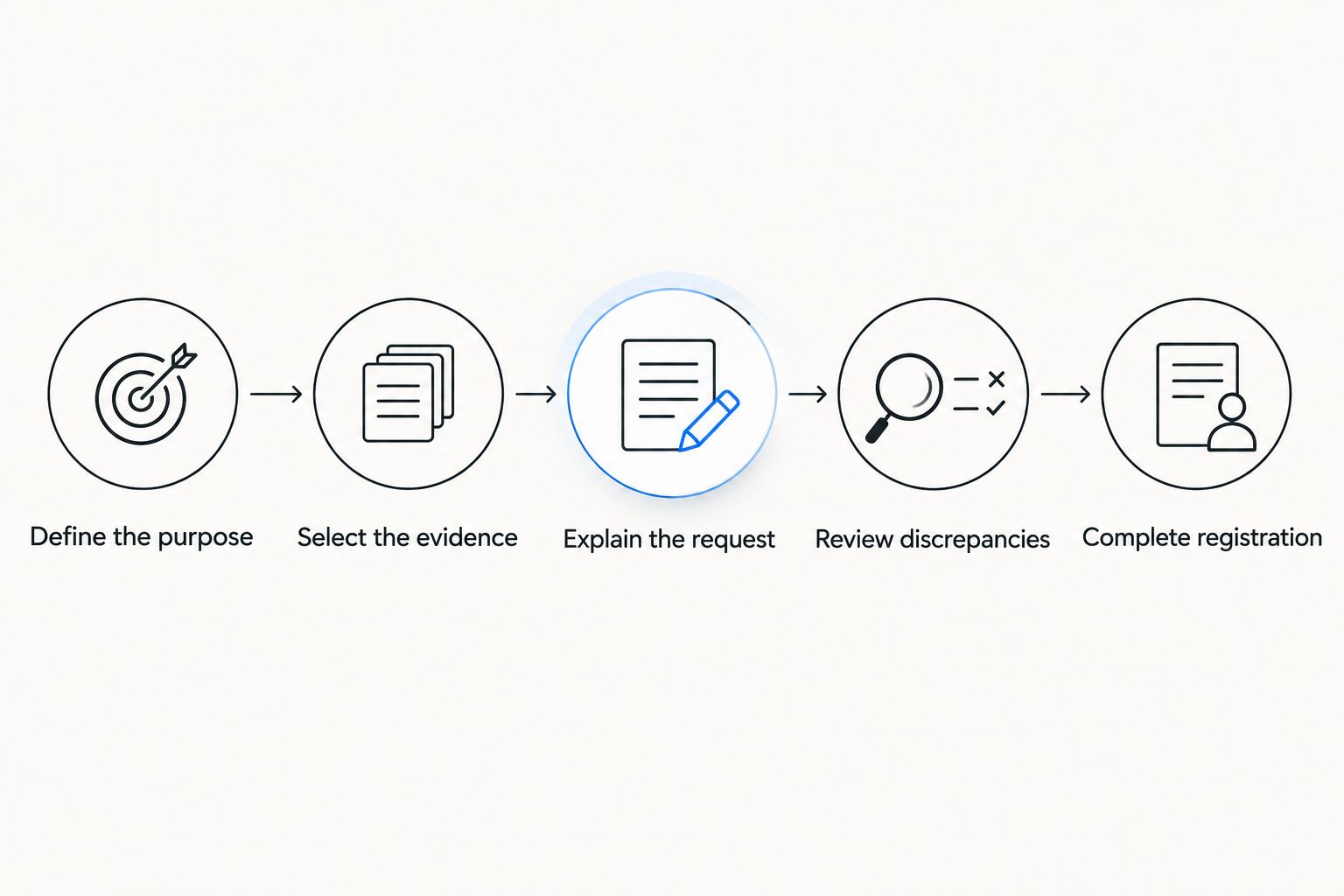
Assign responsibility for both document review and filing confirmation. An employee uploading a record does not tell payroll whether the employer’s notification was accepted. Your process should make those completion states visibly different.
For the filing side of onboarding, see the guide to SGK notifications when hiring a new employee. Keep its operational workflow separate from your decision about whether historical service evidence is necessary.
Why employment-history requests vary
There is no single service-record request that fits every employee. The scope depends on the actual verification purpose and applicable obligations, not merely the employer’s preference for a fuller file.
- The claim being checked. Confirming insured employment dates is different from confirming duties, professional qualifications, or management responsibility. Choose evidence that addresses the claim.
- The employee’s history. A first-time worker cannot supply a history of previous employment. The process needs an appropriate route for that situation rather than treating it as a failed check.
- The applicable insurance position. Retirement or another relevant status can require additional assessment of contribution treatment. Request evidence tied to that assessment rather than collecting unrelated history.
- The legal conditions of the role. A regulated position can require qualifications or other specific evidence. Establish the actual requirement instead of describing every document as an SGK requirement.
- The data needed for the decision. A limited extract can answer a focused question without exposing an entire career history. Document why broader collection is necessary if you require it.
In 2026, your checklist should distinguish statutory requirements from internal policy requests. Labeling both simply as mandatory hides the difference and makes exceptions harder to handle consistently.
Can you hire someone who has no SGK service record?
No previous SGK service history does not, by itself, prevent hiring. Someone entering insured employment for the first time will not have past employment contributions to show. Assess identity, the conditions for the role, and applicable registration obligations separately.
Do not ask a first-time worker to manufacture an equivalent employment-history document. Record that there is no previous service history relevant to the request, then complete the checks that actually apply.
The same caution applies when a person describes work outside the scope of the Turkish record you requested. Absence from that record is not proof that the work never occurred. Ask for evidence suited to the claim rather than drawing a conclusion from a document that does not cover it.
Is an SGK service record the same as a hiring notification?
An SGK service record and a hiring notification are different documents with different purposes. The service record describes recorded insured service. The sigortalı işe giriş bildirgesi concerns the employer’s notification of the new insured employment.
A previous employer’s entry does not register the employee with your workplace. Likewise, filing your own notification does not independently verify everything in the employee’s résumé.
For your 2026 control process, keep separate statuses for evidence requested, evidence reviewed, notification submitted, and filing confirmation retained. This is a process recommendation, not a claim that the law prescribes those exact status labels. The separation prevents an administrative checkmark from concealing an unfinished employer obligation.
What does KVKK require when you request a service record?
An SGK service record contains personal data. Article 4 of Law No. 6698 requires processing to be connected with its purpose, limited, and proportionate. Article 5 sets out processing conditions, while Article 10 addresses the controller’s information obligation.
Apply those principles to the document request itself, not just to its eventual storage. A clearly explained but unnecessarily broad request still raises a proportionality question. Equally, a relevant document still needs an appropriate processing basis and access controls.
Use practical controls:
- Limit collection. Specify the relevant employment period or information rather than routinely requesting everything.
- Limit access. Give access to the HR, payroll, or compliance personnel who need the information for the stated purpose.
- Protect credentials. Never ask an employee to hand over an e-Devlet password or authentication code. Request the relevant document through an appropriate submission process instead.
- Control retention. Set a retention approach tied to applicable obligations and the documented purpose. Do not assume every onboarding attachment belongs in permanent storage.
An upload portal does not itself establish legal compliance. You still need to decide what enters the portal, who can access it, and when the information is no longer needed.
Where does HR software fit?
Ottohr is best suited to growing employers and mid-size or large enterprises seeking HR, payroll, and compliance tools. Its stated scope includes hiring and onboarding alongside payroll, benefits, and compliance.
The limit is equally important: software does not turn an optional background check into a statutory requirement. Your employer policy must define required evidence, approval responsibility, and the basis for collecting personal data. Keep those decisions explicit rather than embedding unexplained document demands in onboarding tasks.
When assessing an HR platform, ask how your team will distinguish a requested document from a reviewed document and a completed statutory filing. Evaluate those controls directly. A product’s general HR category is not proof that a particular SGK verification or filing function is supported.
FAQ
Is an SGK service record required for a new hire in Turkey in 2026?
No, an SGK service record is not a blanket requirement for every new hire in Turkey in 2026. The employer must separately meet applicable hiring-notification obligations and justify any collection of historical employment data.
Can an employer ask me for my SGK service record?
An employer can request relevant service information where the processing has an appropriate legal basis and a defined, proportionate purpose. The request is not automatically justified merely because it appears on an onboarding checklist.
What if this is my first job and I have no SGK history?
Having no previous SGK employment history does not, by itself, prevent you from being hired. The employer must complete the applicable checks and notification for your new employment.
Does my service record replace the employer’s işe giriş bildirgesi?
No, a service record does not replace the employer’s sigortalı işe giriş bildirgesi. Historical service evidence and notification of your new employment serve different purposes.
Should I give HR my e-Devlet password to verify my record?
No, do not give HR your e-Devlet password or authentication codes. Provide only the relevant document through an appropriate submission process after the employer explains the request.
Does an SGK service record prove my previous job title?
An SGK service record is not a complete verification of your previous job title, duties, or performance. A relevant employment certificate or focused reference check addresses those questions more directly.
Can Ottohr replace the employer’s legal review of onboarding requirements?
No, Ottohr’s HR and compliance tools do not replace the employer’s responsibility to determine applicable legal requirements. Document requests, processing grounds, and filing responsibilities still need an accountable decision.
One last thing
The most useful change is to split your checklist into legal obligations and verification requests. For each verification request, write the question it answers and identify the person responsible for reviewing it. For each legal obligation, identify the filing or evidence that proves completion.
Apply that distinction to your next hire before requesting a service record. It exposes unnecessary collection without confusing it with mandatory SGK reporting. A smaller document file is not necessarily an incomplete file; the test is whether it contains the relevant evidence and whether the employer has completed the obligations that actually apply.


